Retiring Arizona Prison Watch...


This site was originally started in July 2009 as an independent endeavor to monitor conditions in Arizona's criminal justice system, as well as offer some critical analysis of the prison industrial complex from a prison abolitionist/anarchist's perspective. It was begun in the aftermath of the death of Marcia Powell, a 48 year old AZ state prisoner who was left in an outdoor cage in the desert sun for over four hours while on a 10-minute suicide watch. That was at ASPC-Perryville, in Goodyear, AZ, in May 2009.

Marcia, a seriously mentally ill woman with a meth habit sentenced to the minimum mandatory 27 months in prison for prostitution was already deemed by society as disposable. She was therefore easily ignored by numerous prison officers as she pleaded for water and relief from the sun for four hours. She was ultimately found collapsed in her own feces, with second degree burns on her body, her organs failing, and her body exceeding the 108 degrees the thermometer would record. 16 officers and staff were disciplined for her death, but no one was ever prosecuted for her homicide. Her story is here.

Marcia's death and this blog compelled me to work for the next 5 1/2 years to document and challenge the prison industrial complex in AZ, most specifically as manifested in the Arizona Department of Corrections. I corresponded with over 1,000 prisoners in that time, as well as many of their loved ones, offering all what resources I could find for fighting the AZ DOC themselves - most regarding their health or matters of personal safety.

I also began to work with the survivors of prison violence, as I often heard from the loved ones of the dead, and learned their stories. During that time I memorialized the Ghosts of Jan Brewer - state prisoners under her regime who were lost to neglect, suicide or violence - across the city's sidewalks in large chalk murals. Some of that art is here.

In November 2014 I left Phoenix abruptly to care for my family. By early 2015 I was no longer keeping up this blog site, save occasional posts about a young prisoner in solitary confinement in Arpaio's jail. I'm deeply grateful to the prisoners who educated, confided in, and encouraged me throughout the years I did this work. My life has been made all the more rich and meaningful by their engagement.

I've linked to some posts about advocating for state prisoner health and safety to the right, as well as other resources for families and friends.

until all are free -

MARGARET J PLEWS (June 1, 2015)
arizonaprisonwatch@gmail.com


INDIGENOUS ACTION MEDIA

INDIGENOUS ACTION MEDIA
ANTICOLONIAL zines, stickers, actions, power

Taala Hooghan Infoshop

Kinlani/Flagstaff Mutual AID

MASS LIBERATION AZ

MASS LIBERATION AZ
The group for direct action against the prison state!

Black Lives Matter PHOENIX METRO

Black Lives Matter PHOENIX METRO
(accept no substitutions)

BLACK PHX ORGANIZING COLLECTIVE

BLACK PEOPLE's JUSTICE FUND

PHOENIX: Trans Queer Pueblo

COVID Mutual AID PHOENIX

AZ Prison Watch BLOG POSTS:


Showing posts with label jan brewer. Show all posts

Tuesday, June 10, 2014

AZ state prisoners and activists call for DOJ Investigation into rape and gang violence in AZ DOC.


QUEER PRISON WALLS
chalk art by Margie Diddams
Photography by Margaret Jean Plews
Phoenix City Hall (02/26/2103)


(EDITED to remove sensitive information on June 26, 2014) 


NOTE: This is my response to reading  Jan Brewer's May 1, 2014 letter to US Attorney General Eric Holder about Arizona's decision to refuse to comply with the Prison Rape Elimination Act. I actually finished and sent this on June 9, also posting it to the Daily Kos

I encourage all prisoners, former prisoners, and families of those presently in the custody of the AZ Department of Corrections to contact Attorney General Holder, as well, with your personal stories related to your safety or that of a loved one  in prison. Now is the time to strike - the feds need to be dragged into this by more than just me. They need to hear all of you calling them out to take some responsibility for neglecting this mess. It's not like this is the first time they have heard from me, anyway...

Please send me a copy of what you write so I can post it here, too.

----------------

chalk art on sidewalk: margaret jean plews
photograph: PJ Starr (phoenix 2011)
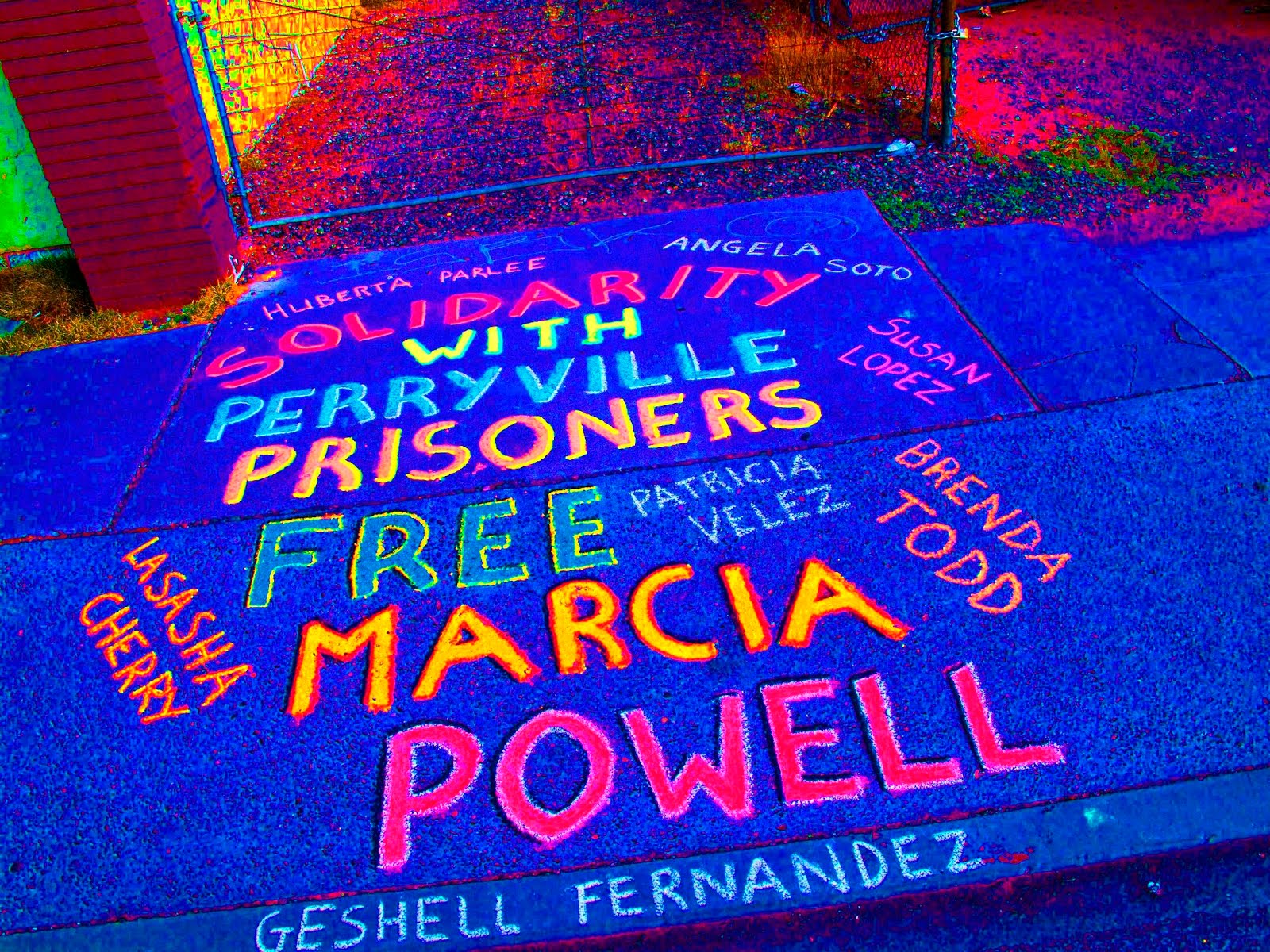

FreeMarciaPowellchalk3small.jpgMargaret Jean Plews
PO Box 20494
Phoenix, AZ 85036
480-580-6807


"Our strategy should be not only to confront empire, but to lay siege to it. To deprive it of oxygen. To shame it. To mock it. With our art, our music, our literature, our stubbornness, our joy, our brilliance, our sheer relentlessness, and our ability to tell our own stories..."


- Arundhati Roy

June 7, 2014

The Honorable Eric H. Holder, Jr.
Attorney General, US Department of Justice
950 Pennsylvania Avenue, NW
Washington, DC 20530-0001

Dear Attorney General Holder;

I am writing to provide a citizen’s rebuttal of Governor Jan Brewer’s statements of May 1, 2014 in her letter to you regarding the Prison Rape Elimination Act, which grossly misrepresented conditions in the state prison system during her reign. I am also intending this letter to serve as a formal request for a CRIPA Investigation into the pervasive patterns and practices at the Arizona Department of Corrections that place prisoners at exceptionally high risk for sexual victimization and complications from unresolved trauma, especially women, the mentally and otherwise-impaired, and LGBT prisoners.

I am emailing this letter with relevant links embedded, but will also be snail- mailing a copy to you with supporting documents (as well as some of my artwork, memorializing the ghosts of Jan Brewer and Chuck Ryan).

By way of introduction, I am the author/editor of the blog ARIZONAPRISONWATCH.ORG, which I began writing five years ago after the death of prisoner Marcia Powell revealed disturbing practices and attitudes at the Arizona Department of Corrections. My particular concern was the mentally ill women at ASPC-Perryville, at first. I recognized in Marcia’s life story the same elements of the numerous women I had come to know and love in my many years working with people who were trying to survive while homeless, addicted and severely mentally ill in Ann Arbor. I also identified with her - I myself am a recovering alcoholic and addict, and could have landed in prison under draconian drug war and repeat-offender sentencing  had I been caught at any number of things earlier in my life, especially if it was in Arizona (what but a “repeat offender” is an addict, anyway?). I also have bi-polar disorder and a bad attitude when it comes to authority, and could have easily been in Marcia’s cage that day myself.

If you are unfamiliar with the case, Marcia was doing 27 months for a $20 blow job she agreed to give an undercover Phoenix cop one fateful day, and died  in a cage in the Arizona sun in May of 2009, at ASPC-Perryville. That was after an extended “suicide watch” in the 107 degree heat, during which time a prisoner is supposed to be checked on every 10 minutes.  After ignoring Marcia’s pleas for relief for four hours (one guard walked away offering no aid knowing she had even defecated on herself) -  officers eventually noticed she had collapsed from the elements with second degree burns on her body and her organs failing; her core temperature at the hospital still exceeded the ability of thermometers to read it, which only went as high as 108 degrees. Not realizing she had a legal guardian and an adoptive mother, Ryan pulled the plug on her life support before the stroke of midnight - she died shortly thereafter.


 chalk art by margaret j plews                                          photo by PJ Starr

AZ DOC Central Office, Phoenix
(Thanksgiving 2011)

DOC officers never expected that Marcia Powell would die out there because they had just left another woman in that cage for 20 hours 3 days earlier, and she didn’t die. See, Marcia’s death was horrific, but it’s not really shocking that it happened - the only wonder was that the DOC got away with punishing prisoners in the heat that way for so long.

That was less than five months into Charles Ryan’s tenure as Interim Director at the Arizona Department of Corrections, but he had begun disassembling the more rehabilitative and empowering programs his predecessor had implemented and imposing new policies immediately upon taking office. A former DW of Ryan’s alleged to the AZ Attorney General that the change the new director made about how to house cellies resulted in at least two homicides within the first 18 months of his rise to power there.  But Ryan had moved up through the ranks under the more brutal directors whose bullying style of management he appears to have emulated, and thus played a large role for decades in cultivating the policies and ethos at the AZ DOC that are so deeply hostile towards prisoners who exercise their right to not be subjected to cruel and unusual punishment. That tendency to resolve issues with violence or the threat of it trickles down from admin to officers to prisoner, and eventually ignites the flames that can bring a prison to its knees.

The good governor talked about Arizona’s “long traditions” of protecting citizens in custody - wow, is she out of touch. She hasn’t read Prof. Mona Lynch’s “SUNBELT JUSTICE” yet, about the trailblazing role the state has played in implementing draconian sentencing and correctional practices over the past 3 decades - the increase in criminalization for politics and profit that the rest of the country has seen the folly of and begun to abandon.

Its actually because of this state’s long tradition of depriving prisoners both of their rights as well as the most basic tools they need in order to fight for them that the AZ DOC is in such shameful condition now. Arizona’s 1990 constitutional amendment excluding prisoners from the definition of crime victim (and related rights and resources), the Lewis v Casey decision in 1996 eliminating the right of prisoners to access a law library among other things, and the Clinton-era Prison Litigation Reform Act (heavily lobbied for by then DOC Director Terry Stewart) were collectively devastating.

I have volumes of letters that will lead you to both victims and perpetrators of countless civil rights abuses precisely because the grievance procedure on most yards is a sham and the DOC obstructs efforts by prisoners to file suit by creating obstacles - especially for illiterate, Spanish-speaking, and mentally ill or developmentally disabled prisoners. In fact, the DOC has NO POLICIES translated into Spanish, despite nearly 20% of their population being foreign nationals, mostly from Spanish-speaking countries. I’ve been recruiting people to do the translations myself, as this is not a concern of the DOC’s so long as no Spanish-speaking prisoners grieve the lack of Spanish-language policies.

This means that Spanish-speaking prisoners (and other non-English-speakers) apparently need to rely on the skills of untrained staff and fellow prisoners who happen to speak some dialect of Spanish when they need to speak to medical, for example, or appeal a disciplinary action, or grieve their housing assignment. Most just suffer their time in silence.

If prisoners could fight abuse and neglect more effectively themselves, the DOJ and ACLU wouldn’t have to do it for them, and you know it as well as I do, Mr Holder. So does the AZ DOC - they put an extraordinary amount of energy into preventing prisoners from learning to articulate their grievances and use persuasion, negotiation and civil law to effectively change their world. There’s a prisoner petition, of sorts, going around that expresses well the barriers they encounter on their way to the courts while trying to exhaust administrative remedies, and offers some proposed solutions, as I recall. It is worth a look by your people.

As a result of a disempowered prisoner population (and, some argue, extremely weak correctional officers unions in AZ), the state prisons are fire traps, and prisoners often complain they are in decaying facilities with mold growing freely in corners, rats and roaches competing for space with the people, feces and blood smeared on the wall in suicide watch cells, inoperable hot water heaters in the winter and non-existent air conditioning in the summer, and scarcely enough food in the sack-lunch “sedentary diets” given to those in detention, administrative segregation and maximum security to keep them from starving to death. More prisoners are fleeing the violence on the yards than are being punished for perpetrating it.

AZ DOC’s medical and psychiatric care is not just deplorable in its negligence, it’s outright abusive, and the DOC has as much to do with that as any of the other parties involved: Parsons v Ryan was filed before the system was even privatized, after all. When I started blogging on the prisons the only thing one could find about AZ DOC on the internet was pretty much what the state wanted you to see. Now you can easily Google “arizona prison health care” to see how much things got worse when Wexford and Corizon came in to feed off of the sick and dying; Director Ryan has lost control over the department’s squeaky clean public image, among other things. His own well-funded propaganda machine is failing him, as are all levels of management and administration, apparently.


 THE FIREHOUSE, Phoenix AZ
40-foot sidewalk mural memorializing the ghosts of jan brewer...


I met with director Ryan and his classification staff in December of 2013, along with Dianne Post from the NAACP here, the primary author of a lengthy letter to him about gay and trans prisoner safety based on my correspondents.  I don’t think he realized how much of what he and his people had to say was disturbing to the outside observer; some of the documents from that meeting - detailing how serious the need for safety is in the AZ DOC - are in the packet.

According to the DOC, 75% of detention cells are full of guys who are unacceptable to or just plain uncooperative with the racialized gangs running the yards - those are the prisoners I hear the most from. The guys pass my name and addy around the detention cells as they do the 805 dance from prison to prison, because I send them the info they need to fight the DOC - stuff like the Jailhouse Lawyers Handbook. It costs me a few hundred bucks a month in printing and postage to keep up with the need for assistance...but, some people spend their time and money on their gardens or pets or kids - I just happen to be a little eccentric about helping the underdog.  I think its a worthy investment, helping people help themselves.

Those prisoners filling the detention cells while fleeing the violence are either seeking Protective Custody (PC) or being punished for refusing their General Population (GP) housing assignments (with “refusal to house” tickets ) after being denied PC. The guys complaining about the assaults extortion and murders, in fact, are overwhelmingly being denied PC and maxed out (ie their good time and privileges are lost and their classification scores zoom up) on major disciplinary tickets for not doing anything to hurt anyone, while the ones behind the extortion, assaults and murders, drug trade and other evils are still free to dominate the prison yards and dictate the culture - often empowered by corrupt officers who want the gangs to help keep the grievances down on the yard, or to keep the assaults just between prisoners, or who just want to line their pockets to buy a new gun or truck.

I have read the Does v Stewart proposed settlement, by the way, and am well-familiarized with DOC policy - I can assure you that both the Does v Stewart agreement and the DO805 policy are routinely being blatantly violated by administrative staff at Central Office. I can say that with certainty after receiving hundreds of letters from prisoners and half as many more calls from family members over getting folks into safe housing since last winter. I have ample evidence the DOC is denying PC to almost ALL prisoners who seek it without the aid of an attorney or the very expensive assistance of Donna Hamm from Middle Ground Prison Reform.

(She’s done a lot of good work, don’t get me wrong - she just costs a pretty penny.)

Interestingly, Ms. Hamm, who charges a flat fee of $2500 to advocate for PC housing for a prisoner, claims a 85- 90% success rate for her clients, while about that same percentage of all PC requests each month are denied, according to the DOC, leaving hundreds of guys in detention each month awaiting the PC verdict. That alone should raise red flags that the DOC isn’t really using any real criteria when they decide who goes to PC and who goes back to the hole in the next GP yard to try again(or get killed), other than that prisoner’s or their family’s ability to litigate them.

And they don’t do the mental health checks they’re required to do on each guy who is turned down for PC to make sure he doesn’t kill himself out of terror. They can’t possibly meet that demand - Corizon isnt even meeting its minimum mental health care mandates.  Thus, I believe guys are still probably killing themselves in the wake of PC denials, like Rosario Rodriguez-Boroquez did in the fall of 2010. A rape victim in the hole on the same MAX unit in Florence followed in his footsteps a week later. That second prisoner might have been saved had the DOC debriefed affected prisoners, they way they do with staff after suicides, homicides and traumatic deaths of prisoners or staff; correctional “best practices” would suggest they should.

Over the course of the past 12 months I’ve corresponded with approximately 35 gay and transgender prisoners alone, some of whom the Navajo Nation’s Human Rights Commission and the NAACP of Maricopa County  have already contacted the DOJ about (and have heard nothing back). In the fall of 2013 a collective of concerned community members convened to study the data from my queer correspondents and draft a letter to Charles Ryan with concerns about the LGBT population being routinely denied PC by his staff when they seek it, even after reporting to the DOC that they had been sexually assaulted or exploited, extorted or beaten because of their sexual orientation or gender identity (the AZ DOC houses transgender women on GP yards in all-male prisons, FYI). In fact, right now there are several gay and transgender prisoners still in GP who have been trying to get into PC for up to and over a year now, unsuccessfully.

Most recently, one gay prisoner who I had intervened personally for to advocate that he receive PC was denied PC and subsequently raped by his cellie, only to be denied PC again and placed in another GP yard. He had initially sought PC because his crime was widely publicized and the media indicated that his male lover was an accomplice - he was  marked man on the yards, no matter what prison they put him in, and they knew it. That was not only deliberate indifference to his safety, I believe endangering that vulnerable prisoner -repeatedly -  was an act of malice and spite in retaliation for my criticisms of the DOC’s staff who make those decisions. And that, sir, is a federal crime, I believe, for a state agent to do. Mr Ryan cannot be trusted to hold those staff responsible for harming that victim, the only party to his rape - to my knowledge - who sits in a detention cell tonight. My correspondence with Director Ryan and his staff about that case is enclosed in the packet.

Even though the victim in the above case had to be taken to a hospital and rape kit was done, there’s no reason to think the perpetrator will actually be held responsible or that further rapes will be discouraged by how this one will be handled. According to the AZ DOC’s current PREA report as posted on their website, out of 54 alleged “inmate-on-inmate unwanted sexual acts” and 30 alleged “inmate-on-inmate abusive sexual contacts” (I think they mean RAPE!) reported to them in 2012, absolutely none could be substantiated by the DOC’s CIU. Either the entire DOC prisoner population lies about rape and it never really happens in our state, or the DOC has no sincere commitment to either preventing it or responding effectively to it when it occurs.

Why should anyone even report their sexual victimization to the DOC, I’m asked? They end up being labeled as a snitch and sitting in the hole for months on end seeking PC, while the perpetrator gets off scott free to rape again. It’s especially disturbing to prisoners when the perp is a gang leader or enforcer, too - which is too often the case, particularly in re: the exploitation and abuse of transgender prisoners. “PREA reporting” has become a sick joke at the AZ DOC - it only stigmatizes the victim, who too often gets no counseling, nor are they very often placed in protective custody or mental health programs beyond the term of the rape investigation, even though research shows that most prisoners are at exquisite risk for even further victimization and deterioration of their mental status once they are raped the first time.

In addition to the recent example of the prisoner who was deliberately placed at risk by DOC staff with a bone to pick with me, I know of one gay prisoner who was verbally abused expressly for being gay after he reported rape (along the lines of you deserved it you fucking fag), in an incident in which he ended up biting staff while being taken down when he refused to sit on the floor to take more of the abuse. The rape victim got an extra year and half added onto his sentence as a result, and had to beg his judge to tell the DOC to place him in PC before they finally relented and did so. I believe he was more traumatized and harmed (by way of being charged with assaulting the staff) by the DOC’s response to his rape report and request for PC than he was by the actual sexual assault on him in the first place.. He is more than willing to make a statement if you will interview him.

I’m also wondering if the DOC ever reported the suicide of Forrest Day as a potential PREA issue. She had reported to her sister before she died that she was being sexually pressured/propositioned by an officer which she found disturbing, but his identity wasn’t revealed to anyone before she was found hanging in her cell, so he couldn’t be investigated. It no doubt never would have been substantiated anyway - you know how it is, when it comes down to the word of a prisoner against a crooked cop: the bad guys in power always win. So, again, why bother reporting rape in Arizona’s DOC even if PREA was implemented, the prisoners want to know. What would be any different than it is now, in practice, even if the DOC did say they were on board with the feds? The culture is so misogynistic and transphobic that it will take not only re-training, but years of just cleaning house - all those good old boys of Chuck Ryan’s and Terry Stewart’s need to go in order to turn this Titanic around.

That isn’t about to happen if Jan Brewer  is left to her own devices here, though, because she has been unmoved by the needless tragic deaths, the abysmal medical care,  or the DOC’s brutal response to those trying to simply flee the violence - and its not like I haven’t been emailing her staff my blog posts all this time - they know, at least, even if she doesnt. No matter what new atrocity is perpetrated on prisoners at the AZ DOC, Jan stands by her man, and so is either completely fooled by him and sheltered from public opinion, or she is fully aware of all that I’ve told you about, and is flat out lying to you in that May letter. If that’s the case, I’d like to know why they’re so damned determined to keep the DOJ out of their prisons.

Either way, be it due to ignorance or complicity with evil, Jan Brewer has consistently failed to provide any leadership around protecting prisoners - not even the children. She says that Arizona is a “leader” in protecting our most vulnerable people, especially kids and the mentally ill. After all, everything she’s done to improve mental health care and child protection is going to be her legacy - which is truly sad, because she hasnt done much on those fronts short of the medicaid expansion, which was to save the hospitals from going under as much as it was for the good of the poor here.

I dont know if she recalls - or ever even knew - that the last kid to suicide at the Adobe Mountain Detention Center run by the AZ Department of Juvenile Corrections did so after some of the other kids relentlessly bullied him for being gay and mentally ill. It seems the staff didn’t know how to deal with either queer kids or serious mental illness. I hope they do now. Charles Flanagan who took over the AZDJC several years ago, has not invited nearly the scrutiny of his department by me that Ryan has, so he might be doing something right there - or at least not so horribly wrong as his former boss. I’ll be terribly disappointed if he advised the Governor not to comply with PREA as well, though.

What I’m saying here is that Jan Brewer is either deliberately whitewashing the prison picture here, or she just doesn’t know what she’s talking about when it comes to prison rape, plain and simple. I can verify myself that Chuck Ryan knows everything I’ve told you of and more because most of what was reported to me along those lines I passed on to him, personally. I have lots of emails documenting it all.

The problem is that Ryan doesn’t tell the truth about any of this, either - he even insists to the legislature that there’s NO SOLITARY CONFINEMENT practiced at the AZ DOC (that’s just semantics, but the legs accept his answer as evidence that the ACLU is hysterical and over-reacting) -  so you can’t count on him to give you an accurate assessment of whether or not the AZ DOC is doing its job when it comes to protecting prisoners from violence, exploitation,  and rape.

No, Mr. Holder, you really need to come talk to me and the families I work with- not just have the FBI spy on me and my buddies in black. Look at my files and analyze my data yourselves. Visit my correspondents. Chat with former employees like former Eyman DW Carl Toersbijns or former Perryville officer Gary Bullock, former ASPC-Lewis Lieutenant Chuck Bauer, former Corizon employee, Teresa Short, AZ State Representative Chad Campbell, who has called for Ryan’s resignation, or any number of other parties to this disaster who I could introduce you to so you can verify mine and the the prisoners’ accounts of prison conditions and the many assaults on their safety - including sexual assaults and exploitation -  in the AZ DOC.

While you’re at it, subpoena the records from the AZ Corrections and Peace Officers Association - they had thousands of DOC employees sign onto a letter of no confidence in Chuck Ryan to Jan Brewer not two years into his tenure. That letter alleged that, among other things:

“...There exists, within ADOC administration, a well-known pattern of obstructing the disclosure of hazards in time to prevent accidents, injury, illness, and deaths. Tragically, in these instances, danger is not "imminent" - it is past, and too late to respond. Employees are routinely ordered to falsify documents and when they proactively seek to report identified hazards, they face punishment and retaliation. Obtaining an accurate account of the range and extent of violations will be difficult from records alone. It is unlikely that ADOC will disclose information without well-planned intervention by authorities.”


These are strikingly similar to the allegations that prisoners make, which are often dismissed as  “unsubstantiated”. The Governor completely ignored the union’s letter, by the way, so its not the credibility of the source that's really the issue - it’s simply a critique she doesn’t want to hear.

In addition to the letters I get from current AZ DOC prisoners, I’ve reviewed hundreds of  death reports since the the start of the current administration. I call tell you that prisoners routinely die of both indifference and  outright abuse here, and Charles Ryan’s DOC sometimes uses their Criminal Investigations Unit to cover up homicides they didn’t feel like pursuing or listing for the feds as such.  Like PC and SP. The AZ DOC’s inspector general’s office didn’t even have the decency to tell PC's mother that his death was more likely than not a homicide, instead of a suicide. They just left her believing her child had taken his life. Fortunately, PC’s mom never bought it and had her own autopsy done - which revealed that there was plenty of evidence he was murdered the DOC never even bothered to look at...

(section edited out)

I dont know if the CIU is corrupt or just has an irresponsible ethos that has no regard for the survivors of victims of violence in their custody. Maybe they are all just lazy - though I suspect the Ryan administration calculated that they would be more liable to a mother whose child was murdered instead of one whose child committed suicide in custody, and decided that if she wasn’t going to sue over  a suicide, they better not tell her it was murder, or someone will start to dig...

(section edited out) 

In any case, the DOC can’t be trusted to investigate themselves and be forthright with their discoveries, and the ACLU is already busy with the health care and psychiatric concerns, including the abuse of solitary confinement for mentally ill prisoners. That’s why we need the feds in on this matter of prisoner safety and prison rape now. Charles Ryan’s Criminal Investigations Unit has no credibility with the prisoners, the staff, or the advocates who know what’s going on in there. Nor do his media and legislative liaisons - they outright lie to the public and elected officials about the heinous behavior of their employees and the corporate jackals who feed off the imprisoned population. Just ask the journalists who have been covering the DOC under Ryan’s tenure - like KPNX’s Wendy Halloran, who won an Emmy for pursuing the truth about the suicide of Tony Lester, or the AZ Republic’s Bob Ortega, who did a fantastic series on “Arizona’s Other Death Row” - that is, the mainstream prison population, which he noticed was dying by suicide, drug overdose, and homicide at unusually high rates after Ryan had been in charge for awhile.

I once had a contact at the DOJ’s Special Litigation Section - Aaron Zisser. I even sent him all the death records my mother bought from the AZ DOC for me to analyze. But I think Special Litigation abandoned AZ awhile ago, perhaps thinking the ACLU et al have it covered. Not hardly.  And Ryan knows no one will hold him accountable for prison rape if the feds don’t - just look at his annual reports. For the past two years in the Five-Year Plans, Director Ryan has managed to invisibilize rape victims in his custody - its not even an institutional goal to reduce the incidence of sexual assaults in the prisons anymore, much less a priority.

Do you understand where I’m coming from here, Mr Holder?

(section edited out)

By the way, Arizona’s sole Protection & Advocacy authority, the AZ Center for Disability Law, won’t help or visit or investigate abuse reports from SMI prisoners under any circumstances. It appears that they only joined Parsons v Ryan in name because they were coerced into doing so. Now, they are the only ones in this state with the authority to get into those prisons on demand to see disabled individuals reporting abuse, and yet they adamantly refuse to exercise it. Is that legal, for a P&A agency to flat out discriminate against an entire population of disabled people solely because the institution housing and abusing them is a prison or jail, instead of a school or a nursing home? If they refuse to exercise that authority, another agency should be identified that will do so, and should be funded to do so. That’s got to be unconstitutional.

Along those lines, I want to quote from a letter I received from the women’s prison just yesterday - this is from (a prisoner) on Death Row, in a building where other maximum security prisoners - like the mentally ill - are held as well. She (wrote) despite risking retaliation from the state because she is so troubled by what she’s hearing and is afraid the women who cry and plead all day and night are too mentally impaired, traumatized, and intimidated to know how to get help themselves via the grievance process and courts…

“They have watch cells below us and I’m very concerned about our mentally ill being pepper-sprayed and drug around naked by male guards and videoed by male guards over the simplest issue. They yell at the mentally ill, scare them. then when they don’t comply (usually strip out) they spray them. They are forced to strip out 3-4 times a day with male guards walking all over. I hear some of them crying “I don’t want to get naked”. I understand security, but not these measures on the mentally ill…”


That sounds like a violation of the agreement the DOC made with the AZDOC some 15 or so years ago to keep a sexual harassment/abuse CRIPA complaint from proceeding to trial, is it not? Let me remind you that I myself have a major mood disorder and PTSD - is this the kind of treatment I can expect as an American citizen in our women’s prisons, should I ever find myself there?

(She) also reports the male officers don’t announce themselves on Lumley. That comes as no surprise - as indicated by the good governor’s letter to you, the DOC doesn’t think it’s necessary for them to do so, even though they are citing women for sexual offenses if they accidentally expose themselves while changing, or toileting, or showering. You know as well as I that most women in prison - especially the severely mentally ill - are already traumatized. Best practices would not say that security demands the male guards come through without announcing themselves. Best practices in corrections now would look at trauma-informed care more closely than the security aspect of that  and say those women are being routinely retraumatized and violated by the AZ DOC’s policies and practices for no good penological reason. They are just not wanting to make sure female staff are available at all times for the women prisoners, though they are quite plentiful in the men’s prisons.

Well, I’ve covered a lot of ground, and there still so much more. I wish we could meet to discuss PREA and CRIPA matters further in person, but I know you have a lot on your hands already, so please have the appropriate staff contact me as soon as possible about this matter - I and the prisoners are requesting a DOJ CRIPA Investigation into these patterns and practices of violating prisoners civil rights, as well as the Governor’s decision to not bother with PREA mandates anymore. At the very least, you should call her out on that.

Thank you so much for reading this through, Mr Holder, if you’ve made it this far. I will be eagerly anticipating your reply. So will the prisoners and their loved ones.

Sincerely,

Margaret Jean Plews

Monday, June 9, 2014

Jan Brewer to AG Holder on PREA: Whitewash of prison rape.

Below is Governor Jan Brewer's letter to the US Attorney General, Eric Holder, explaining why she doesn't think Arizona should comply with the Federal Prison Rape Elimination Act (PREA). I posted my own letter to Holder to the DAILY KOS today...


Monday, June 2, 2014

AL JAZEERA's America Tonight: Another whistle blown on Corizon.


Blessings to former Corizon employee and whistleblower Teresa Short. What she did here took both courage and compassion. How sad that it has become an extraordinary thing these days to simply do the right thing and tell the truth.


Thanks to Abby Leonard and Adam May at Al Jazeera America Tonight for this coverage last week, too. They've been super.


Families, if you're advocating for an imprisoned loved one needing medical or mental health care, check out these posts below, and feel free to contact me: peggy plews 480-580-6807 / arizonaprisonwatch@gmail.com.


Corizon and the AZ DOC: Prisoners & Families, Know Your Rights. http://www.arizonaprisonwatch.org/2013/03/corizon-and-az-doc-prisoners-families.html

 Corizon's deliberate indifference: fighting back.

A word of advice - if you need help and cant hire an attorney, you'll need to drag your AZ state legislators into it to get anywhere - start filling them in  now, and make sure the DOC knows that you're cc'ing them on everything you have to write to Director Ryan in order to get your loved one taken care of. They can be found here: http://www.azleg.gov/alisStaticPages/HowToContactMember.asp

Please make sure your loved one in prison is doing the grievance process properly so they can sue these bastards if they still don't treat them right. Keep an eye on the DOC policy page, too, so you can see when things change and send copies inside.

 ---------------------------------


An “America Tonight” investigation found dozens of cases of neglect in Arizona'€™s privatized prison health care system

 Watch parts one and two of Adam May's report.


SAFFORD, Ariz. — Regan Clarine found out she was pregnant just two days before she was sentenced to two and a half years behind bars for possessing a narcotic for sale. Giving birth to her baby daughter while she was incarcerated at the state prison complex near (Phoenix) was an experience she says nearly killed them both.

Clarine says her first indication things were not right with her health care was when she asked prison officials for an ultrasound. She was worried she wasn't gaining enough weight, but they never gave her one. Instead, Clarine said that after about nine months, prison doctors sent her to the hospital to induce labor, but when the baby still didn’t come, they performed a cesarean section against her wishes.

When Clarine went back to her cell, her C-section wound re-opened.

“It was big enough for me to put my fist in there,” she said. “It was the worst pain I’d ever been through in my life.”

Clarine said she alerted guards, but they refused to let her see a doctor, leaving her on the prison yard with a gaping wound for two weeks. When she finally saw medical staff, she said they told her that she was lucky to be alive. They treated her with a wound vacuum. Then, she said, they employed an antiquated medical treatment.

“They decided to use sugar … like McDonald’s sugar,” she said. “They would open it and pour it inside [the wound] and put gauze over and tape it up. And I had to do that for like three weeks.”

Clarine’s story is one of dozens. Like many other states, Arizona privatized its prison health care system two years ago. In a six-month investigation, “America Tonight” found disturbing cases of inadequate treatment, and evidence that Wexford Health Sources, the first private company Arizona contracted to provide prison health care, was aware that it was violating prisoners’ constitutional rights.

Arizona’s system is currently run by Corizon Health, the largest private prison health care provider in the country. Now, for the first time ever, one of its former employees is blowing the whistle about its failures.

Going unfed
Teresa Short was a patient care technician for Corizon, but lost her job in late March for refusing to go to work while suffering from a case of scabies she caught from a prisoner. Short said she thought it would be unethical to treat patients while she was still contagious. She had already infected a family member, she said, and feared her son could contract it and bring it to his high school. According to Short, Corizon and Arizona prison officials have been trying to cover up the outbreak, which now includes the original prisoner and seven staff members. (Read Corizon's response.)

But the most persistent problem at Corizon, Short said, was staffing.

“We have a lot of dementia patients that take time in feeding,” she said, “and because of the short staff we'd have to stand there for hours to try to feed them and it was just not permitted.”

Sometimes, those patients would go unfed, she said. Others who were incontinent would sit for hours in their own feces, she said. And still others died.

Short described one dementia patient who had a vascular catheter in his arm for dialysis treatments. He didn’t understand what it was and kept playing with it, she said, so she repeatedly told senior staff he needed additional supervision. Instead, they sent him back to his cell, alone. At 5 a.m., she went in to check on him.


Former Corizon patient care technician Teresa Short said some Arizona prisoners have died because there weren't enough medical staff on duty.


Former Corizon patient care technician Teresa Short said some Arizona prisoners have died because there weren't enough medical staff on duty.


“[I] could smell blood before I even went into the room,” she said. “And when I turned on his light, it looked like somebody had been murdered. There was blood all over the room. I screamed for help.”

Short said the man had unplugged the catheter and quickly bled out. If Corizon had employed more staff to monitor patients, she said, he might still be alive.

There are some numbers to back up Short’s claims. Since the state privatized its prison health care, medical spending in prisons dropped by $30 million and staffing levels plummeted, according to an October report from the American Friends Services Committee, a Quaker social justice organization. It also found a sharp spike in the number of inmate deaths. In the first eight months of 2013, 50 people died in Arizona Department of Corrections custody, compared with 37 deaths in the previous two years combined.

According to a 2012 lawsuit filed by the American Civil Liberties Union, the health care in Arizona’s prisons now amounts to cruel and unusual punishment, with prisoners at serious risk of "pain, amputation, disfigurement and death.” The suit cites examples of Arizona health officials telling prisoners to pray to be cured and drink energy shakes to alleviate cancer symptoms.

“People are often sent to prison for two-year, three-year sentences that have turned into death sentences because of the absence of the basic minimal care,” said Dan Pochoda, legal director for the ACLU in Arizona. He said in his 40-year career, he’s never seen a worse prison health care system.

In an emailed statement, Corizon spokeswoman Susan Morgenstern said that the company could not discuss individual cases because of privacy laws, but that “the vast majority of our current staff levels exceed contract requirements,” and that their care follows the guidelines of the National Commission on Correctional Health Care and the American Correctional Association.

“Our goal is always to provide quality care while being good stewards and making the best use of public funds,” she wrote.

“As for lawsuits, we treat hundreds of thousands of patients in millions of healthcare encounters each year,” she added. “… The majority of lawsuits are brought by inmates without an attorney representing them and are dismissed or resolved prior to trial.” (Read the company’s full statement.)

'He had plans'


After his cancer, inmate Tony Brown's pain medication was switched from morphine to less-powerful Lortab.


After his cancer, inmate Tony Brown's pain medication was switched from morphine to less-powerful Lortab.
America Tonight


Tony Brown is another inmate who died since Arizona privatized its prison health care. He was serving a 10-year sentence for aggravated assault and was due to be released last September.

“They were supposed to come down for Thanksgiving this year,” his daughter Jenna Jumper said. “He never got to meet my husband and he wasn't there when I got married, so they were going to come visit.”

Brown was in remission from esophageal cancer, according to his medical records, and had been prescribed morphine for the pain. But in October 2012, the prison ran out of the drug. Medical staff switched him to Lortab, a weaker painkiller.

In a video taken by prison guards and obtained by “America Tonight,” Brown is seen just after he was put on the new medication, writhing in pain while handcuffed to a gurney. His medical records show that guards told nurses his condition was worsening and that he "needed to be checked out." But there is no record of medical staff visiting his cell.

In another video taken two days later, a prison chaplain checks on Brown at his wife’s request.

“Inmate Brown, I spoke with your wife earlier today,” the chaplain is heard saying. “Can you communicate with me please? I’d like to speak with your wife later on. Is there something I can tell her?”

Brown, face down on a bunk, barely moves and doesn’t respond. A guard can be heard saying, “Is it me or does this just not feel right to anybody else?”

The guards started CPR and nurses came to assist, but 40 minutes passed before they realized no one had called an ambulance.

He died in a hospital the next day. Two days later, his widow Jami Brown said she finally received a call back from Wexford, the private prison health care company in charge at the time.

“My biggest thing is that if people would stop to realize that he did have family,” his daughter said, “and that he did have a child and he did have a wife and he had plans.”

The official cause of death was listed as complications from cancer. But Brown's family is suing Wexford, claiming he died from lack of adequate medical care.

In a statement, Wexford attorney Ed Hochuli said he couldn’t discuss details of the case because of the lawsuit and health care privacy laws, but wrote: "Based on the limited information we have at this time, though, I am very confident Wexford Health and its employees acted appropriately, and further investigation of this claim will demonstrate and prove the lack of any wrongdoing or negligence by Wexford Health.”

But there are signs that Wexford was aware of problems.

“America Tonight” obtained a copy of a PowerPoint presentation written by top Wexford executives for a meeting with the Arizona governor's office in November 2012 – four months after the company started providing care in the state. It warned that the care it and the Department of Corrections were providing was "not compliant with … requirements" and that "the current class action lawsuits are accurate." It recommended an overall operational cleanup, staffing reassessment and the appointment of a governor’s office liaison.

The PowerPoint presentation also says that the department's "transparency" policy with the media could "encourage negative press."

'A grain of sugar'


State Rep. John Kavanagh said Clarine’s story about being treated with sugar didn’t seem like a “true allegation,” adding that it “sounds ridiculous.”


State Rep. John Kavanagh said Clarine’s story about being treated with sugar didn’t seem like a “true allegation,” adding that it “sounds ridiculous.”


Prison officials deny any problems with privatized care. Richard Pratt, the interim director of the health services division of Arizona’s Department of Corrections, told “America Tonight” that staffing levels since privatization were “basically the same.”

“Corizon staffing levels have been coming up on a monthly basis to the point even last month the hours that they were working with their existing staff exceeded the contract requirements,” he said.

He also denied there was a scabies outbreak, as Teresa Short had charged.

But Pratt emphasized that privatizing health care wasn’t a decision made by the Department of Corrections.
“It was legislated and mandated and it was the law,” he said. “So we were forced to do this.”

Legislators who supported the privatization promised that it would save taxpayers money, while maintaining adequate levels of care for inmates. The majority of states have privatized prison health care, rewarding private companies for keeping costs down.

“I mean, people die in prisons,” said state Rep. John Kavanagh, who wrote the legislation that privatized the state’s prison health care. “I receive a lot of handwritten notes from prisoners. I receive emails from prison families with all sorts of allegations of crazy behavior. And then, you call the prison people up and they usually have a reasonable explanation for it.”

Kavanagh said Clarine’s story about being treated with sugar didn’t seem like a “true allegation,” adding that it “sounds ridiculous.”

“You know prisoners have 24/7 to think up allegations and write letters,” he said. “I'm not saying that some of them can't have a basis in fact. But you got to take them with a grain of salt or in the case of the hospital, with maybe a grain of sugar.”

Kavanagh was also dismissive of the ACLU lawsuit. “I think most people who get into [class-action lawsuits] wind up with nothing and the lawyers walk away in limousines with their trunks full of cash,” he said.

No bid, nothing


Richard Pratt, interim health services director for Arizona’s Department of Corrections, denies that there’s a scabies outbreak in prison and says that Corizon’s staffing levels have exceeded the requirements of the contract.


Richard Pratt, interim health services director for Arizona’s Department of Corrections, denies that there’s a scabies outbreak in prison and says that Corizon’s staffing levels have exceeded the requirements of the contract.


Before Tony Brown’s death, Wexford was already coming under fire after a contract nurse exposed more than 100 inmates to hepatitis C by using dirty needles to deliver medication, according to the Department of Corrections. Four months later, Arizona severed ties with Wexford and awarded the three-year, $369 million contract to Corizon, which has similar contracts in 28 states, according to its website. But it has faced problems in many of them; in the last five years, Corizon has been sued for malpractice 660 times.

Arizona Democratic House Minority Leader Chad Campbell said the Legislature didn't properly vet Corizon before signing the contract.

“No bid. Nothing,” he said. “It was deemed an emergency situation by Department of Corrections so they didn't have to go through the normal process.”

Campbell also noted that Corizon had just hired the former head of the Department of Corrections, who was the mentor of the current head of the department.

That’s not the only tie that members of the state government have to private prisons. Charles Coughlin, the former campaign strategist for Gov. Jan Brewer, runs a lobbying firm called HighGround Public Affairs Consultants, which represented one of the country’s largest private prison companies. HighGround donated $5,000 to Jan PAC, Brewer's super PAC.

Then in late March, Kavanagh allocated $900,000 in state funding to the private prison company GEO Group Inc., even though the Department of Corrections said it wasn’t needed, according to the Arizona Republic.

“They're profiting on taxpayer dollars and to me, if I'm going to hand out money to a private entity, I want to make sure it's being spent wisely,” said Campbell, who is now calling for an investigation.

The governor's office declined a request from “America Tonight” for an interview and referred us back to Kavanagh, who said the allegations that Brewer accepted bids because of personal relationships were “baseless.”

“I think they're propaganda,” he said. “I mean, people say to me I've gotten campaign contributions from private-prison people. Well, yeah. I got from a lobbyist who represents them but that lobbyist also represents 40 other clients in different industries. It's smoke and mirrors. It's a façade.”

In the meantime, allegations of wrongdoing continue to mount. According to the American Friends Service Committee report, an inmate at the Whetstone Unit of the Arizona State Prison Complex tested positive for tuberculosis in August. But Corizon did not test other prisoners, even those who were doing community service outside the complex.

A healthy baby


Clarine walks out of prison, escorted by her father


Clarine walks out of prison, escorted by her father


Earlier this month, Regan Clarine completed her sentence. “America Tonight” met her as she was released into the waiting arms of her father, Paul.

“It’s one of the happiest days of our life,” he said. “Hopefully we’ll never have to do this again.”

They drove to a nearby hotel to reunite with the rest of the family, including her 11-month-old daughter, Rylan.

They’d met a handful of times on brief prison visits, but Rylan didn’t recognize her mother. Still, Clarine was happy to see her so healthy.

She responded to Kavanagh’s allegation that she was probably making up her story with a laugh, saying, “That’s crazy. I don’t think I could even come up with something like that … Sugar?”

To add insult to injury, her mother, Lori, said the prison has billed her $2,000 for Rylan’s birth. She is disputing the charges but fears it could hurt her credit if she doesn’t pay them. She says privatized prison health care simply isn’t working.

“You know, she got her just punishment,” Lori said. “But, oh my goodness, they're still human beings. Take care of them.”

Monday, December 30, 2013

Red Rock Ready: AZ prisoners soon to fill CCA prison in Eloy.

Interesting how deftly AZ DOC director Chuck Ryan managed to duck responsibility for these private prison contracts by saying he's just implementing policy - the AZ Legs wouldn't have ordered him to privatize anything if he told them it would be a bad idea, and I sure never heard him put up a fight. 

I also find it interesting that there's no mention of filling Red Rock with sex offenders, which is what he told me he was planning when I met with him just a couple of weeks ago. That isn't still some kind of secret from the Eloy community, I hope - though its an easy and relatively inexpensive population for private companies to manage. 

Given the absurd minimum mandatory sentences in Arizona, unless we do something drastically different then regardless of who we send to Red Rock, I'm sure this place will keep that prison full another 20 years, sad to say.

Dianne Post of the Maricopa County NAACP met with Director Ryan and his staff and I earlier this month to discuss why the violence is so out of control in his prisons and what he intends to do about it, by the way. I'll have more on that in another week or so; right now I'm just enjoying my family. 

So, blessings to all out there for a better year. Tell your legislators now that we want an end to minimum mandatories and privatization, some kind of meaningful oversight of the AZ DOC, and accountability for these private prisons so they have that in their heads when the next session opens in January. They are all at 1700 W Washington St. Phoenix 85007 or find them here

Arizona House of Representatives 2013

Arizona faces growing cost of private prisons
State begins to place inmates in new facility
The Republic | azcentral.com  
Sun Dec 29, 2013 12:39 AM
 
The Red Rock Correctional Center, Arizona’s newest private prison, will begin housing inmates next month, with taxpayers guaranteeing its owner a profit to help alleviate overcrowding in the state penitentiary system.
State Corrections Director Charles Ryan hopes to house up to 1,000 inmates there by the end of next year — twice the number originally planned in the first year. The facility along East Arica Road and Arizona 87 just outside Eloy has the capacity for 1,596 inmates.

The complex about 65 miles south of Phoenix was built in 2006 by Corrections Corporation of America to house inmates for the state of California. After CCA won an open-bid contract last year to house Arizona inmates, it moved its California prisoners to other CCA sites around the country.

According to Ryan, state-owned facilities have roughly 5,000 inmates sleeping in temporary beds because of overcrowding. Arizona, as of Friday, housed 41,157 inmates, about one-sixth of them in private facilities.

“The department was in need of beds,” Ryan said. “The solution was a private-prison operator.”

Corrections officials forecast the state prison population will surpass 43,000 in fiscal 2016, despite four recent years of relatively little growth or declines in the population.

The Corrections Department is wary of building its own new prisons to accommodate the growth, citing costs that could exceed $100 million. Instead, it is expanding its use of private prisons.

If the contract lasts 20 years as expected, the long-term cost of the CCA contract is likely to exceed $400 million.

CCA wins contract

The Corrections Corporation of America beat four other private-prison companies in August 2012 to win the contract.

CCA is guaranteed a 90 percent occupancy rate at Red Rock, meaning the state will transfer inmates out of state-operated facilities and into the private prison until the minimum occupancy is met.

The guarantee requires a minimum of 450 inmates by the end of the first year, and 900 by the end of the second, but Ryan wants to accelerate the transfer of up to 1,000 inmates in 2014. There also is room to expand to the facility’s capacity.

Arizona will pay CCA $65.43 a day per inmate. Once the contract is fully implemented, the 90 percent occupancy guarantee will result in the company being paid at least $58,887 a day for 900 inmates — nearly $21.5 million a year. The contract is for an initial term of 10 years, with two five-year renewal options upon mutual agreement. Should the contract run 20 years, CCA could make at least $430 million. Ownership of the facility would transfer to the state after 20 years.

The Arizona Republic reviewed Corrections documents and CCA financial records and calculated the company’s operating margin on the Red Rock contract. The operating margin measures how much of each dollar of revenue from the state Red Rock will keep after ordinary expenses.

The Nashville-based company, which is publicly held, said in a U.S. Securities and Exchange Commission filing that its average total daily expenses per inmate at facilities it owns and manages was $45.89 during the first nine months of 2013. Based on that figure, Arizona’s daily payment will provide $19.54 in daily operating income per inmate, as compared with $22.23 in daily income per inmate the company typically makes in other facilities it owns and operates.

That equates to an operating margin of about 30 percent on the Red Rock contract. The company, which operates 69 facilities in 20 states and the District of Columbia, averages just more than a 29 percent operating margin at all facilities it manages or owns, according to a recent company filing.

The state is requiring CCA to make numerous improvements, such as building a new softball field, enhancing dining facilities and adding parking at Red Rock. The company, in an SEC filing, said it expects to incur approximately $20.5 million in capital-improvement expenses — less than what it will make in an entire year with Arizona’s occupancy guarantee.

“We are being compensated for a service we provide,” said Steven Owen, a CCA spokesman. “It’s a very specialized service.... We are providing cost savings at the end of the day to taxpayers and relieving unsafe overcrowding.”

Corrections Corporation of America trades on the New York Stock Exchange. For the first nine months of this year, it recorded $1.26 billion in revenue and posted $253.3 million in profit — more than double the earnings recorded for the same time in 2012.

High occupancy

Critics say promising such a high inmate-occupancy rate at Red Rock guarantees CCA a healthy bottom line at taxpayer expense. The occupancy guarantee at Red Rock, however, is the lowest among the state’s three private-prison operators, with other sites having occupancy guarantees of 95 to 100 percent, according to Corrections Department records. The other private operators are the GEO Group Inc. and Management & Training Corp.

Ryan said occupancy-rate guarantees are a way for the state to secure a fixed cost to house inmates, and it keeps contractors from raising rates because of demand. The guarantees also are needed, he said, to attract private-prison operators who must recover their costs to build facilities. The state saves money upfront by not having to build new prisons despite a growing inmate population, he said. The state also assumes ownership of the facilities at the end of the contract.

“We are not closing state prison beds to ensure a private-bed operator a guaranteed occupancy rate,” Ryan said.

But Shar Habibi, research and policy director for a Washington, D.C.-based watchdog group called In the Public Interest, said Arizona taxpayers are on the hook if the CCA beds and other private facilities go unused.

“If you don’t fill those beds, you are still paying for them,” said Habibi, whose group monitors private-prison contracts around the country.

CCA spokesman Owen called In the Public Interest’s claims against private-prison companies “sensationalized.” He said occupancy guarantees are commonly used by state governments to control costs.

“We look at what we can do to provide the most cost-effective solutions,” Owen said.

But Justin Jones, former Oklahoma Department of Corrections director who has worked with Habibi and is an opponent of private prisons, said correctional facilities should be used to reduce recidivism — not become a “profit machine” for private businesses.

Lower costs

Arizona began looking at private prisons in the late 1980s, Ryan said, when a group of lawmakers and Corrections officials visited Louisiana and compared the operational cost between state-run and private facilities.

Ryan, at the time an upper manager at DOC, was asked to go on the trip and assess staffing levels and operations. He said he concluded that the private prison had lower operating costs because it did not have a correctional officer at all of the security posts.

He said his opinion was not solicited at the time about whether Arizona should have private prisons. He sidesteps the question today.

“Private prisons are part of the public policy of the state of Arizona as determined by the Legislature and the executive branch,” Ryan said. “I am here to support the public policy, and that public policy has served the Department of Corrections and the state of Arizona particularly well during difficult budgetary times.... To me, it’s not a philosophical issue. It’s a business decision.”

Arizona’s first contract prison opened in Marana in October 1994, 10 months after a “truth in sentencing” law went into effect that dramatically increased prison sentences and the state’s inmate population, which at the time was just less than 19,000 inmates. Arizona’s prison population is now more than double that.

And since fiscal 1995, the number of in-state private-prison inmates has grown from 273 to 6,489. Arizona also contracted to house inmates with out-of-state private prisons from fiscal 2004 to 2010.

Whether CCA or other private-prison operators save the state money is debatable.

A Corrections Department study found it was less expensive in 2008, 2009 and 2010 to house inmates in state-run medium-security facilities compared with similar in-state private facilities.

That still may be the case, but it is difficult to determine because the state no longer factors inmate costs the same way.

In fiscal 2013, which ended June 30, the non-adjusted average daily cost per inmate at a medium-security prison was $64.52, compared with the private-prison cost of $58.82.

However the state’s number includes inmates who have significant medical or mental-health issues. The private prisons house only healthy inmates.

When an adjustment is made for the medical costs, the balance tips significantly in the state’s favor.
The adjusted 2010 daily cost of housing a medium-security inmate in a state-run facility was $48.42, compared with the private-prison cost of $53.02.

Ryan acknowledged that private-prison inmates are “a healthier, less-expensive population” to house.
The Legislature in 2012 repealed the law that required the Corrections Department to conduct a state and private cost comparison, which had occurred since fiscal 1995.

Monday, October 21, 2013

Witness: Yuma prison May "Melee" was another race riot.

UPDATE (OCTOBER 21, 2013)

From a witness to May's "Yuma Melee" (statement dated October 9, 2013)

"I was an inmate during the time at the Dakota Unit when the riot occurred and I was fortunate to not be invovled, but I happened to see the ordeal at its entirety. The initial issue stemmed from a black inmate who sold a Chief (member of the Native American gang) inmate some black tar heroin cut with coffee - the other races had requested for the blacks to "clean up their back yard" and smash that black guy for his actions, but they continued t refuse so during recreation on May 29th, 2013, I had a birds' eye view out of my cell window when all the Mexicans (New Mexican Mafia) Whites (Aryan Brotherhood) and Chiefs went after all of the blacks.


Now be assured this consisted of over 400 inmates for almost 8 minutes. There are two rec fields that consist of 200 inmates, two housing pods were staging/lining up for the chow hall which consissted of another 100 inmates, two chow halls had 50 inmates in each one, the kitchen workers and education building all sturck full force at the same time. The CO's were in complete panic firing off tear gas from the gun tower. Several inmates were even stabbed. I seen it with my own two eyes. It was ugly and nerve-wracking...

The state/DOC seems to be working with the AB and the EME (New Mexican Mafia) gangs which somehow stems to money. The drug trade in here thrives before ANYTHING else - no other thing matters or comes first - drugs of all kinds flood the GP yards statewide and lots of money is made..."

 ---------------------
 
see also:

ASPC-Tucson/Santa Rita: September Prison Riot.

ASPC-Tucson/Whetstone Race Riot Update: Ryan has lost control.

AZ DOC's Protective Custody fight: tend to both body and soul.


ORIGINAL POST OF MAY 30, 2013

FYI: I'm compiling a report for the US Department of Justice right now about the violence in AZ DOC prisons and the problems with the protective custody process (805), whereby it's impossible for male prisoners to refuse to "join" the gangs (which often involves assaulting another prisoner)  - much less just refuse to follow their stupid racist, homphobic, patriarchal rules - without being victimized themselves, yet many guys still refuse. All reports of violence that folks are aware could be useful as I put this thing together, so please send them to me at arizonaprisonwatch@gmail.com.


---------------from the Yuma Sun-----------------


BY CHRIS McDANIEL


May 29, 2013 22:48:01
Six inmates at Arizona State Prison Complex–Yuma were transported to the hospital Tuesday after being injured during a melee. None of their injuries were life threatening.

According to Andrew Wilder, Arizona Department of Corrections director of communications, at about 2:30 p.m., two inmates began fighting inside the close-custody Dakota Unit yard.

“This fight escalated to involve additional inmates,” Wilder said. “There were a total of about 100 inmates in the outdoor yard area at the time – however it's not the case that all of these inmates participated in the incident.”

AZDOC officers responded quickly to stop the fight and were able to secure the unit within three minutes, Wilder noted, adding there were no injuries to prison staff reported.

The Dakota Unit will remain locked down while this incident continues to be investigated. No other details were available as of press time Wednesday.

ASPC–Yuma is located at 7125 E. Juan Sanchez Blvd. near San Luis, Ariz., and houses over 4,000 inmates in five separate units.