Retiring Arizona Prison Watch...


This site was originally started in July 2009 as an independent endeavor to monitor conditions in Arizona's criminal justice system, as well as offer some critical analysis of the prison industrial complex from a prison abolitionist/anarchist's perspective. It was begun in the aftermath of the death of Marcia Powell, a 48 year old AZ state prisoner who was left in an outdoor cage in the desert sun for over four hours while on a 10-minute suicide watch. That was at ASPC-Perryville, in Goodyear, AZ, in May 2009.

Marcia, a seriously mentally ill woman with a meth habit sentenced to the minimum mandatory 27 months in prison for prostitution was already deemed by society as disposable. She was therefore easily ignored by numerous prison officers as she pleaded for water and relief from the sun for four hours. She was ultimately found collapsed in her own feces, with second degree burns on her body, her organs failing, and her body exceeding the 108 degrees the thermometer would record. 16 officers and staff were disciplined for her death, but no one was ever prosecuted for her homicide. Her story is here.

Marcia's death and this blog compelled me to work for the next 5 1/2 years to document and challenge the prison industrial complex in AZ, most specifically as manifested in the Arizona Department of Corrections. I corresponded with over 1,000 prisoners in that time, as well as many of their loved ones, offering all what resources I could find for fighting the AZ DOC themselves - most regarding their health or matters of personal safety.

I also began to work with the survivors of prison violence, as I often heard from the loved ones of the dead, and learned their stories. During that time I memorialized the Ghosts of Jan Brewer - state prisoners under her regime who were lost to neglect, suicide or violence - across the city's sidewalks in large chalk murals. Some of that art is here.

In November 2014 I left Phoenix abruptly to care for my family. By early 2015 I was no longer keeping up this blog site, save occasional posts about a young prisoner in solitary confinement in Arpaio's jail. I'm deeply grateful to the prisoners who educated, confided in, and encouraged me throughout the years I did this work. My life has been made all the more rich and meaningful by their engagement.

I've linked to some posts about advocating for state prisoner health and safety to the right, as well as other resources for families and friends.

until all are free -

MARGARET J PLEWS (June 1, 2015)
arizonaprisonwatch@gmail.com


INDIGENOUS ACTION MEDIA

INDIGENOUS ACTION MEDIA
ANTICOLONIAL zines, stickers, actions, power

Taala Hooghan Infoshop

Kinlani/Flagstaff Mutual AID

MASS LIBERATION AZ

MASS LIBERATION AZ
The group for direct action against the prison state!

Black Lives Matter PHOENIX METRO

Black Lives Matter PHOENIX METRO
(accept no substitutions)

BLACK PHX ORGANIZING COLLECTIVE

BLACK PEOPLE's JUSTICE FUND

PHOENIX: Trans Queer Pueblo

COVID Mutual AID PHOENIX

AZ Prison Watch BLOG POSTS:


Showing posts with label eric holder. Show all posts

Tuesday, June 10, 2014

AZ state prisoners and activists call for DOJ Investigation into rape and gang violence in AZ DOC.


QUEER PRISON WALLS
chalk art by Margie Diddams
Photography by Margaret Jean Plews
Phoenix City Hall (02/26/2103)


(EDITED to remove sensitive information on June 26, 2014) 


NOTE: This is my response to reading  Jan Brewer's May 1, 2014 letter to US Attorney General Eric Holder about Arizona's decision to refuse to comply with the Prison Rape Elimination Act. I actually finished and sent this on June 9, also posting it to the Daily Kos

I encourage all prisoners, former prisoners, and families of those presently in the custody of the AZ Department of Corrections to contact Attorney General Holder, as well, with your personal stories related to your safety or that of a loved one  in prison. Now is the time to strike - the feds need to be dragged into this by more than just me. They need to hear all of you calling them out to take some responsibility for neglecting this mess. It's not like this is the first time they have heard from me, anyway...

Please send me a copy of what you write so I can post it here, too.

----------------

chalk art on sidewalk: margaret jean plews
photograph: PJ Starr (phoenix 2011)
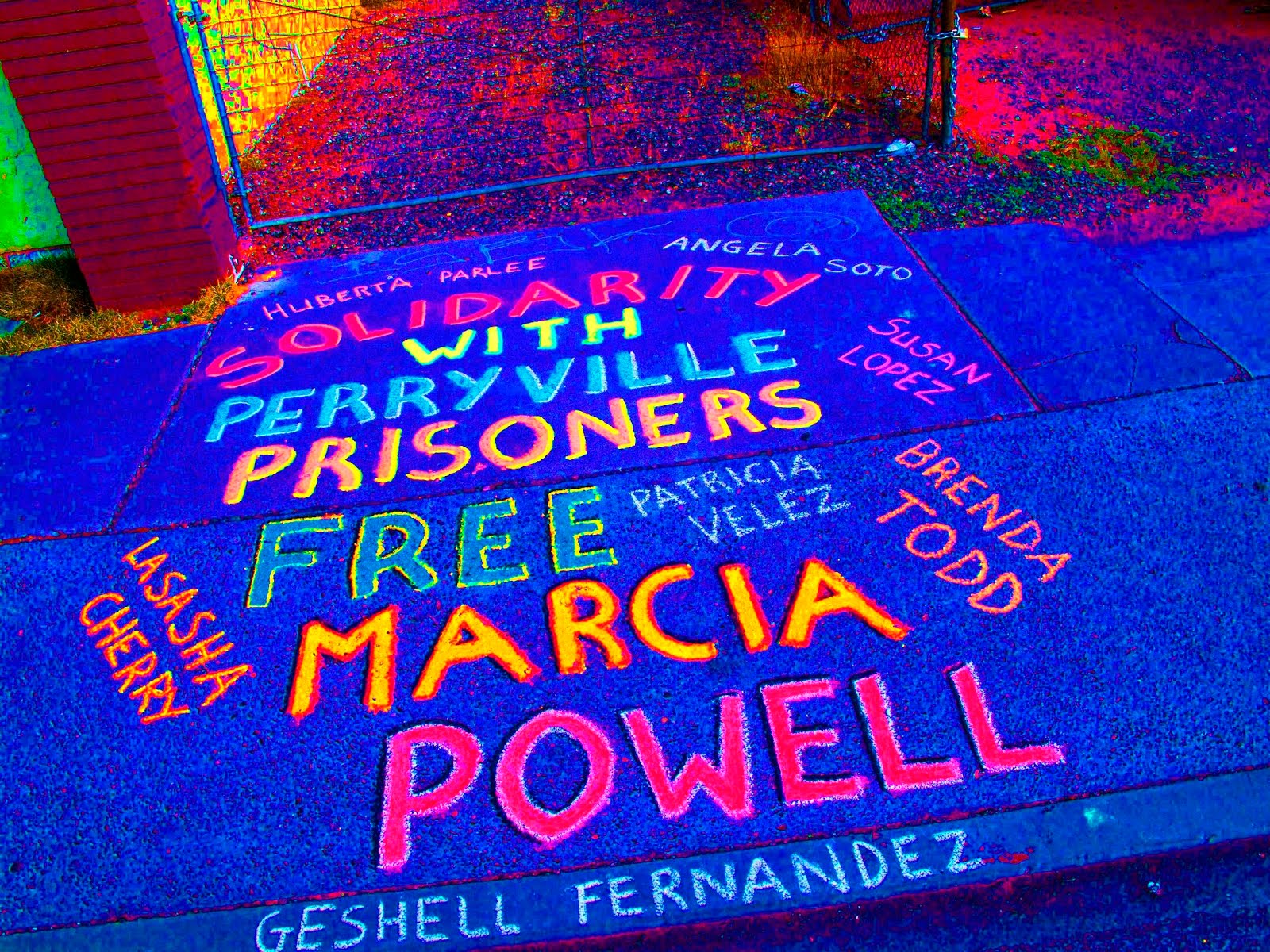

FreeMarciaPowellchalk3small.jpgMargaret Jean Plews
PO Box 20494
Phoenix, AZ 85036
480-580-6807


"Our strategy should be not only to confront empire, but to lay siege to it. To deprive it of oxygen. To shame it. To mock it. With our art, our music, our literature, our stubbornness, our joy, our brilliance, our sheer relentlessness, and our ability to tell our own stories..."


- Arundhati Roy

June 7, 2014

The Honorable Eric H. Holder, Jr.
Attorney General, US Department of Justice
950 Pennsylvania Avenue, NW
Washington, DC 20530-0001

Dear Attorney General Holder;

I am writing to provide a citizen’s rebuttal of Governor Jan Brewer’s statements of May 1, 2014 in her letter to you regarding the Prison Rape Elimination Act, which grossly misrepresented conditions in the state prison system during her reign. I am also intending this letter to serve as a formal request for a CRIPA Investigation into the pervasive patterns and practices at the Arizona Department of Corrections that place prisoners at exceptionally high risk for sexual victimization and complications from unresolved trauma, especially women, the mentally and otherwise-impaired, and LGBT prisoners.

I am emailing this letter with relevant links embedded, but will also be snail- mailing a copy to you with supporting documents (as well as some of my artwork, memorializing the ghosts of Jan Brewer and Chuck Ryan).

By way of introduction, I am the author/editor of the blog ARIZONAPRISONWATCH.ORG, which I began writing five years ago after the death of prisoner Marcia Powell revealed disturbing practices and attitudes at the Arizona Department of Corrections. My particular concern was the mentally ill women at ASPC-Perryville, at first. I recognized in Marcia’s life story the same elements of the numerous women I had come to know and love in my many years working with people who were trying to survive while homeless, addicted and severely mentally ill in Ann Arbor. I also identified with her - I myself am a recovering alcoholic and addict, and could have landed in prison under draconian drug war and repeat-offender sentencing  had I been caught at any number of things earlier in my life, especially if it was in Arizona (what but a “repeat offender” is an addict, anyway?). I also have bi-polar disorder and a bad attitude when it comes to authority, and could have easily been in Marcia’s cage that day myself.

If you are unfamiliar with the case, Marcia was doing 27 months for a $20 blow job she agreed to give an undercover Phoenix cop one fateful day, and died  in a cage in the Arizona sun in May of 2009, at ASPC-Perryville. That was after an extended “suicide watch” in the 107 degree heat, during which time a prisoner is supposed to be checked on every 10 minutes.  After ignoring Marcia’s pleas for relief for four hours (one guard walked away offering no aid knowing she had even defecated on herself) -  officers eventually noticed she had collapsed from the elements with second degree burns on her body and her organs failing; her core temperature at the hospital still exceeded the ability of thermometers to read it, which only went as high as 108 degrees. Not realizing she had a legal guardian and an adoptive mother, Ryan pulled the plug on her life support before the stroke of midnight - she died shortly thereafter.


 chalk art by margaret j plews                                          photo by PJ Starr

AZ DOC Central Office, Phoenix
(Thanksgiving 2011)

DOC officers never expected that Marcia Powell would die out there because they had just left another woman in that cage for 20 hours 3 days earlier, and she didn’t die. See, Marcia’s death was horrific, but it’s not really shocking that it happened - the only wonder was that the DOC got away with punishing prisoners in the heat that way for so long.

That was less than five months into Charles Ryan’s tenure as Interim Director at the Arizona Department of Corrections, but he had begun disassembling the more rehabilitative and empowering programs his predecessor had implemented and imposing new policies immediately upon taking office. A former DW of Ryan’s alleged to the AZ Attorney General that the change the new director made about how to house cellies resulted in at least two homicides within the first 18 months of his rise to power there.  But Ryan had moved up through the ranks under the more brutal directors whose bullying style of management he appears to have emulated, and thus played a large role for decades in cultivating the policies and ethos at the AZ DOC that are so deeply hostile towards prisoners who exercise their right to not be subjected to cruel and unusual punishment. That tendency to resolve issues with violence or the threat of it trickles down from admin to officers to prisoner, and eventually ignites the flames that can bring a prison to its knees.

The good governor talked about Arizona’s “long traditions” of protecting citizens in custody - wow, is she out of touch. She hasn’t read Prof. Mona Lynch’s “SUNBELT JUSTICE” yet, about the trailblazing role the state has played in implementing draconian sentencing and correctional practices over the past 3 decades - the increase in criminalization for politics and profit that the rest of the country has seen the folly of and begun to abandon.

Its actually because of this state’s long tradition of depriving prisoners both of their rights as well as the most basic tools they need in order to fight for them that the AZ DOC is in such shameful condition now. Arizona’s 1990 constitutional amendment excluding prisoners from the definition of crime victim (and related rights and resources), the Lewis v Casey decision in 1996 eliminating the right of prisoners to access a law library among other things, and the Clinton-era Prison Litigation Reform Act (heavily lobbied for by then DOC Director Terry Stewart) were collectively devastating.

I have volumes of letters that will lead you to both victims and perpetrators of countless civil rights abuses precisely because the grievance procedure on most yards is a sham and the DOC obstructs efforts by prisoners to file suit by creating obstacles - especially for illiterate, Spanish-speaking, and mentally ill or developmentally disabled prisoners. In fact, the DOC has NO POLICIES translated into Spanish, despite nearly 20% of their population being foreign nationals, mostly from Spanish-speaking countries. I’ve been recruiting people to do the translations myself, as this is not a concern of the DOC’s so long as no Spanish-speaking prisoners grieve the lack of Spanish-language policies.

This means that Spanish-speaking prisoners (and other non-English-speakers) apparently need to rely on the skills of untrained staff and fellow prisoners who happen to speak some dialect of Spanish when they need to speak to medical, for example, or appeal a disciplinary action, or grieve their housing assignment. Most just suffer their time in silence.

If prisoners could fight abuse and neglect more effectively themselves, the DOJ and ACLU wouldn’t have to do it for them, and you know it as well as I do, Mr Holder. So does the AZ DOC - they put an extraordinary amount of energy into preventing prisoners from learning to articulate their grievances and use persuasion, negotiation and civil law to effectively change their world. There’s a prisoner petition, of sorts, going around that expresses well the barriers they encounter on their way to the courts while trying to exhaust administrative remedies, and offers some proposed solutions, as I recall. It is worth a look by your people.

As a result of a disempowered prisoner population (and, some argue, extremely weak correctional officers unions in AZ), the state prisons are fire traps, and prisoners often complain they are in decaying facilities with mold growing freely in corners, rats and roaches competing for space with the people, feces and blood smeared on the wall in suicide watch cells, inoperable hot water heaters in the winter and non-existent air conditioning in the summer, and scarcely enough food in the sack-lunch “sedentary diets” given to those in detention, administrative segregation and maximum security to keep them from starving to death. More prisoners are fleeing the violence on the yards than are being punished for perpetrating it.

AZ DOC’s medical and psychiatric care is not just deplorable in its negligence, it’s outright abusive, and the DOC has as much to do with that as any of the other parties involved: Parsons v Ryan was filed before the system was even privatized, after all. When I started blogging on the prisons the only thing one could find about AZ DOC on the internet was pretty much what the state wanted you to see. Now you can easily Google “arizona prison health care” to see how much things got worse when Wexford and Corizon came in to feed off of the sick and dying; Director Ryan has lost control over the department’s squeaky clean public image, among other things. His own well-funded propaganda machine is failing him, as are all levels of management and administration, apparently.


 THE FIREHOUSE, Phoenix AZ
40-foot sidewalk mural memorializing the ghosts of jan brewer...


I met with director Ryan and his classification staff in December of 2013, along with Dianne Post from the NAACP here, the primary author of a lengthy letter to him about gay and trans prisoner safety based on my correspondents.  I don’t think he realized how much of what he and his people had to say was disturbing to the outside observer; some of the documents from that meeting - detailing how serious the need for safety is in the AZ DOC - are in the packet.

According to the DOC, 75% of detention cells are full of guys who are unacceptable to or just plain uncooperative with the racialized gangs running the yards - those are the prisoners I hear the most from. The guys pass my name and addy around the detention cells as they do the 805 dance from prison to prison, because I send them the info they need to fight the DOC - stuff like the Jailhouse Lawyers Handbook. It costs me a few hundred bucks a month in printing and postage to keep up with the need for assistance...but, some people spend their time and money on their gardens or pets or kids - I just happen to be a little eccentric about helping the underdog.  I think its a worthy investment, helping people help themselves.

Those prisoners filling the detention cells while fleeing the violence are either seeking Protective Custody (PC) or being punished for refusing their General Population (GP) housing assignments (with “refusal to house” tickets ) after being denied PC. The guys complaining about the assaults extortion and murders, in fact, are overwhelmingly being denied PC and maxed out (ie their good time and privileges are lost and their classification scores zoom up) on major disciplinary tickets for not doing anything to hurt anyone, while the ones behind the extortion, assaults and murders, drug trade and other evils are still free to dominate the prison yards and dictate the culture - often empowered by corrupt officers who want the gangs to help keep the grievances down on the yard, or to keep the assaults just between prisoners, or who just want to line their pockets to buy a new gun or truck.

I have read the Does v Stewart proposed settlement, by the way, and am well-familiarized with DOC policy - I can assure you that both the Does v Stewart agreement and the DO805 policy are routinely being blatantly violated by administrative staff at Central Office. I can say that with certainty after receiving hundreds of letters from prisoners and half as many more calls from family members over getting folks into safe housing since last winter. I have ample evidence the DOC is denying PC to almost ALL prisoners who seek it without the aid of an attorney or the very expensive assistance of Donna Hamm from Middle Ground Prison Reform.

(She’s done a lot of good work, don’t get me wrong - she just costs a pretty penny.)

Interestingly, Ms. Hamm, who charges a flat fee of $2500 to advocate for PC housing for a prisoner, claims a 85- 90% success rate for her clients, while about that same percentage of all PC requests each month are denied, according to the DOC, leaving hundreds of guys in detention each month awaiting the PC verdict. That alone should raise red flags that the DOC isn’t really using any real criteria when they decide who goes to PC and who goes back to the hole in the next GP yard to try again(or get killed), other than that prisoner’s or their family’s ability to litigate them.

And they don’t do the mental health checks they’re required to do on each guy who is turned down for PC to make sure he doesn’t kill himself out of terror. They can’t possibly meet that demand - Corizon isnt even meeting its minimum mental health care mandates.  Thus, I believe guys are still probably killing themselves in the wake of PC denials, like Rosario Rodriguez-Boroquez did in the fall of 2010. A rape victim in the hole on the same MAX unit in Florence followed in his footsteps a week later. That second prisoner might have been saved had the DOC debriefed affected prisoners, they way they do with staff after suicides, homicides and traumatic deaths of prisoners or staff; correctional “best practices” would suggest they should.

Over the course of the past 12 months I’ve corresponded with approximately 35 gay and transgender prisoners alone, some of whom the Navajo Nation’s Human Rights Commission and the NAACP of Maricopa County  have already contacted the DOJ about (and have heard nothing back). In the fall of 2013 a collective of concerned community members convened to study the data from my queer correspondents and draft a letter to Charles Ryan with concerns about the LGBT population being routinely denied PC by his staff when they seek it, even after reporting to the DOC that they had been sexually assaulted or exploited, extorted or beaten because of their sexual orientation or gender identity (the AZ DOC houses transgender women on GP yards in all-male prisons, FYI). In fact, right now there are several gay and transgender prisoners still in GP who have been trying to get into PC for up to and over a year now, unsuccessfully.

Most recently, one gay prisoner who I had intervened personally for to advocate that he receive PC was denied PC and subsequently raped by his cellie, only to be denied PC again and placed in another GP yard. He had initially sought PC because his crime was widely publicized and the media indicated that his male lover was an accomplice - he was  marked man on the yards, no matter what prison they put him in, and they knew it. That was not only deliberate indifference to his safety, I believe endangering that vulnerable prisoner -repeatedly -  was an act of malice and spite in retaliation for my criticisms of the DOC’s staff who make those decisions. And that, sir, is a federal crime, I believe, for a state agent to do. Mr Ryan cannot be trusted to hold those staff responsible for harming that victim, the only party to his rape - to my knowledge - who sits in a detention cell tonight. My correspondence with Director Ryan and his staff about that case is enclosed in the packet.

Even though the victim in the above case had to be taken to a hospital and rape kit was done, there’s no reason to think the perpetrator will actually be held responsible or that further rapes will be discouraged by how this one will be handled. According to the AZ DOC’s current PREA report as posted on their website, out of 54 alleged “inmate-on-inmate unwanted sexual acts” and 30 alleged “inmate-on-inmate abusive sexual contacts” (I think they mean RAPE!) reported to them in 2012, absolutely none could be substantiated by the DOC’s CIU. Either the entire DOC prisoner population lies about rape and it never really happens in our state, or the DOC has no sincere commitment to either preventing it or responding effectively to it when it occurs.

Why should anyone even report their sexual victimization to the DOC, I’m asked? They end up being labeled as a snitch and sitting in the hole for months on end seeking PC, while the perpetrator gets off scott free to rape again. It’s especially disturbing to prisoners when the perp is a gang leader or enforcer, too - which is too often the case, particularly in re: the exploitation and abuse of transgender prisoners. “PREA reporting” has become a sick joke at the AZ DOC - it only stigmatizes the victim, who too often gets no counseling, nor are they very often placed in protective custody or mental health programs beyond the term of the rape investigation, even though research shows that most prisoners are at exquisite risk for even further victimization and deterioration of their mental status once they are raped the first time.

In addition to the recent example of the prisoner who was deliberately placed at risk by DOC staff with a bone to pick with me, I know of one gay prisoner who was verbally abused expressly for being gay after he reported rape (along the lines of you deserved it you fucking fag), in an incident in which he ended up biting staff while being taken down when he refused to sit on the floor to take more of the abuse. The rape victim got an extra year and half added onto his sentence as a result, and had to beg his judge to tell the DOC to place him in PC before they finally relented and did so. I believe he was more traumatized and harmed (by way of being charged with assaulting the staff) by the DOC’s response to his rape report and request for PC than he was by the actual sexual assault on him in the first place.. He is more than willing to make a statement if you will interview him.

I’m also wondering if the DOC ever reported the suicide of Forrest Day as a potential PREA issue. She had reported to her sister before she died that she was being sexually pressured/propositioned by an officer which she found disturbing, but his identity wasn’t revealed to anyone before she was found hanging in her cell, so he couldn’t be investigated. It no doubt never would have been substantiated anyway - you know how it is, when it comes down to the word of a prisoner against a crooked cop: the bad guys in power always win. So, again, why bother reporting rape in Arizona’s DOC even if PREA was implemented, the prisoners want to know. What would be any different than it is now, in practice, even if the DOC did say they were on board with the feds? The culture is so misogynistic and transphobic that it will take not only re-training, but years of just cleaning house - all those good old boys of Chuck Ryan’s and Terry Stewart’s need to go in order to turn this Titanic around.

That isn’t about to happen if Jan Brewer  is left to her own devices here, though, because she has been unmoved by the needless tragic deaths, the abysmal medical care,  or the DOC’s brutal response to those trying to simply flee the violence - and its not like I haven’t been emailing her staff my blog posts all this time - they know, at least, even if she doesnt. No matter what new atrocity is perpetrated on prisoners at the AZ DOC, Jan stands by her man, and so is either completely fooled by him and sheltered from public opinion, or she is fully aware of all that I’ve told you about, and is flat out lying to you in that May letter. If that’s the case, I’d like to know why they’re so damned determined to keep the DOJ out of their prisons.

Either way, be it due to ignorance or complicity with evil, Jan Brewer has consistently failed to provide any leadership around protecting prisoners - not even the children. She says that Arizona is a “leader” in protecting our most vulnerable people, especially kids and the mentally ill. After all, everything she’s done to improve mental health care and child protection is going to be her legacy - which is truly sad, because she hasnt done much on those fronts short of the medicaid expansion, which was to save the hospitals from going under as much as it was for the good of the poor here.

I dont know if she recalls - or ever even knew - that the last kid to suicide at the Adobe Mountain Detention Center run by the AZ Department of Juvenile Corrections did so after some of the other kids relentlessly bullied him for being gay and mentally ill. It seems the staff didn’t know how to deal with either queer kids or serious mental illness. I hope they do now. Charles Flanagan who took over the AZDJC several years ago, has not invited nearly the scrutiny of his department by me that Ryan has, so he might be doing something right there - or at least not so horribly wrong as his former boss. I’ll be terribly disappointed if he advised the Governor not to comply with PREA as well, though.

What I’m saying here is that Jan Brewer is either deliberately whitewashing the prison picture here, or she just doesn’t know what she’s talking about when it comes to prison rape, plain and simple. I can verify myself that Chuck Ryan knows everything I’ve told you of and more because most of what was reported to me along those lines I passed on to him, personally. I have lots of emails documenting it all.

The problem is that Ryan doesn’t tell the truth about any of this, either - he even insists to the legislature that there’s NO SOLITARY CONFINEMENT practiced at the AZ DOC (that’s just semantics, but the legs accept his answer as evidence that the ACLU is hysterical and over-reacting) -  so you can’t count on him to give you an accurate assessment of whether or not the AZ DOC is doing its job when it comes to protecting prisoners from violence, exploitation,  and rape.

No, Mr. Holder, you really need to come talk to me and the families I work with- not just have the FBI spy on me and my buddies in black. Look at my files and analyze my data yourselves. Visit my correspondents. Chat with former employees like former Eyman DW Carl Toersbijns or former Perryville officer Gary Bullock, former ASPC-Lewis Lieutenant Chuck Bauer, former Corizon employee, Teresa Short, AZ State Representative Chad Campbell, who has called for Ryan’s resignation, or any number of other parties to this disaster who I could introduce you to so you can verify mine and the the prisoners’ accounts of prison conditions and the many assaults on their safety - including sexual assaults and exploitation -  in the AZ DOC.

While you’re at it, subpoena the records from the AZ Corrections and Peace Officers Association - they had thousands of DOC employees sign onto a letter of no confidence in Chuck Ryan to Jan Brewer not two years into his tenure. That letter alleged that, among other things:

“...There exists, within ADOC administration, a well-known pattern of obstructing the disclosure of hazards in time to prevent accidents, injury, illness, and deaths. Tragically, in these instances, danger is not "imminent" - it is past, and too late to respond. Employees are routinely ordered to falsify documents and when they proactively seek to report identified hazards, they face punishment and retaliation. Obtaining an accurate account of the range and extent of violations will be difficult from records alone. It is unlikely that ADOC will disclose information without well-planned intervention by authorities.”


These are strikingly similar to the allegations that prisoners make, which are often dismissed as  “unsubstantiated”. The Governor completely ignored the union’s letter, by the way, so its not the credibility of the source that's really the issue - it’s simply a critique she doesn’t want to hear.

In addition to the letters I get from current AZ DOC prisoners, I’ve reviewed hundreds of  death reports since the the start of the current administration. I call tell you that prisoners routinely die of both indifference and  outright abuse here, and Charles Ryan’s DOC sometimes uses their Criminal Investigations Unit to cover up homicides they didn’t feel like pursuing or listing for the feds as such.  Like PC and SP. The AZ DOC’s inspector general’s office didn’t even have the decency to tell PC's mother that his death was more likely than not a homicide, instead of a suicide. They just left her believing her child had taken his life. Fortunately, PC’s mom never bought it and had her own autopsy done - which revealed that there was plenty of evidence he was murdered the DOC never even bothered to look at...

(section edited out)

I dont know if the CIU is corrupt or just has an irresponsible ethos that has no regard for the survivors of victims of violence in their custody. Maybe they are all just lazy - though I suspect the Ryan administration calculated that they would be more liable to a mother whose child was murdered instead of one whose child committed suicide in custody, and decided that if she wasn’t going to sue over  a suicide, they better not tell her it was murder, or someone will start to dig...

(section edited out) 

In any case, the DOC can’t be trusted to investigate themselves and be forthright with their discoveries, and the ACLU is already busy with the health care and psychiatric concerns, including the abuse of solitary confinement for mentally ill prisoners. That’s why we need the feds in on this matter of prisoner safety and prison rape now. Charles Ryan’s Criminal Investigations Unit has no credibility with the prisoners, the staff, or the advocates who know what’s going on in there. Nor do his media and legislative liaisons - they outright lie to the public and elected officials about the heinous behavior of their employees and the corporate jackals who feed off the imprisoned population. Just ask the journalists who have been covering the DOC under Ryan’s tenure - like KPNX’s Wendy Halloran, who won an Emmy for pursuing the truth about the suicide of Tony Lester, or the AZ Republic’s Bob Ortega, who did a fantastic series on “Arizona’s Other Death Row” - that is, the mainstream prison population, which he noticed was dying by suicide, drug overdose, and homicide at unusually high rates after Ryan had been in charge for awhile.

I once had a contact at the DOJ’s Special Litigation Section - Aaron Zisser. I even sent him all the death records my mother bought from the AZ DOC for me to analyze. But I think Special Litigation abandoned AZ awhile ago, perhaps thinking the ACLU et al have it covered. Not hardly.  And Ryan knows no one will hold him accountable for prison rape if the feds don’t - just look at his annual reports. For the past two years in the Five-Year Plans, Director Ryan has managed to invisibilize rape victims in his custody - its not even an institutional goal to reduce the incidence of sexual assaults in the prisons anymore, much less a priority.

Do you understand where I’m coming from here, Mr Holder?

(section edited out)

By the way, Arizona’s sole Protection & Advocacy authority, the AZ Center for Disability Law, won’t help or visit or investigate abuse reports from SMI prisoners under any circumstances. It appears that they only joined Parsons v Ryan in name because they were coerced into doing so. Now, they are the only ones in this state with the authority to get into those prisons on demand to see disabled individuals reporting abuse, and yet they adamantly refuse to exercise it. Is that legal, for a P&A agency to flat out discriminate against an entire population of disabled people solely because the institution housing and abusing them is a prison or jail, instead of a school or a nursing home? If they refuse to exercise that authority, another agency should be identified that will do so, and should be funded to do so. That’s got to be unconstitutional.

Along those lines, I want to quote from a letter I received from the women’s prison just yesterday - this is from (a prisoner) on Death Row, in a building where other maximum security prisoners - like the mentally ill - are held as well. She (wrote) despite risking retaliation from the state because she is so troubled by what she’s hearing and is afraid the women who cry and plead all day and night are too mentally impaired, traumatized, and intimidated to know how to get help themselves via the grievance process and courts…

“They have watch cells below us and I’m very concerned about our mentally ill being pepper-sprayed and drug around naked by male guards and videoed by male guards over the simplest issue. They yell at the mentally ill, scare them. then when they don’t comply (usually strip out) they spray them. They are forced to strip out 3-4 times a day with male guards walking all over. I hear some of them crying “I don’t want to get naked”. I understand security, but not these measures on the mentally ill…”


That sounds like a violation of the agreement the DOC made with the AZDOC some 15 or so years ago to keep a sexual harassment/abuse CRIPA complaint from proceeding to trial, is it not? Let me remind you that I myself have a major mood disorder and PTSD - is this the kind of treatment I can expect as an American citizen in our women’s prisons, should I ever find myself there?

(She) also reports the male officers don’t announce themselves on Lumley. That comes as no surprise - as indicated by the good governor’s letter to you, the DOC doesn’t think it’s necessary for them to do so, even though they are citing women for sexual offenses if they accidentally expose themselves while changing, or toileting, or showering. You know as well as I that most women in prison - especially the severely mentally ill - are already traumatized. Best practices would not say that security demands the male guards come through without announcing themselves. Best practices in corrections now would look at trauma-informed care more closely than the security aspect of that  and say those women are being routinely retraumatized and violated by the AZ DOC’s policies and practices for no good penological reason. They are just not wanting to make sure female staff are available at all times for the women prisoners, though they are quite plentiful in the men’s prisons.

Well, I’ve covered a lot of ground, and there still so much more. I wish we could meet to discuss PREA and CRIPA matters further in person, but I know you have a lot on your hands already, so please have the appropriate staff contact me as soon as possible about this matter - I and the prisoners are requesting a DOJ CRIPA Investigation into these patterns and practices of violating prisoners civil rights, as well as the Governor’s decision to not bother with PREA mandates anymore. At the very least, you should call her out on that.

Thank you so much for reading this through, Mr Holder, if you’ve made it this far. I will be eagerly anticipating your reply. So will the prisoners and their loved ones.

Sincerely,

Margaret Jean Plews

Monday, June 9, 2014

Jan Brewer to AG Holder on PREA: Whitewash of prison rape.

Below is Governor Jan Brewer's letter to the US Attorney General, Eric Holder, explaining why she doesn't think Arizona should comply with the Federal Prison Rape Elimination Act (PREA). I posted my own letter to Holder to the DAILY KOS today...


Wednesday, February 12, 2014

AG Holder: restoring civil life for ex-felons part of ending racial disparities.

It's going to take a lot more than this to really respond to the consequences of felonization for people once they leave prison and try to start a new life. But it's impressive how aggressive Holder has been about fighting racial disparities, now in the last year of his likely stay in office. Every week he's talking about ending harsh drug sentencing, telling prisoners in for drug crimes to apply for clemency this year, and so on. He really seems to be trying to address racism, classism, and injustice in the system he administers, where for the longest time there has only been silence or denials when confronted. That's way overdue.

-----------------------------

AG urges restoring voting rights to ex-inmates

KTAR.COM (2/11/14)


WASHINGTON (AP) - Attorney General Eric Holder called on a group of states Tuesday to restore voting rights to ex-felons, part of a push to fix what he sees as flaws in the criminal justice system that have a disparate impact on racial minorities.

"It is time to fundamentally rethink laws that permanently disenfranchise people who are no longer under federal or state supervision," Holder said, targeting 11 states that he said continue to restrict voting rights for former inmates, even after they've finished their prison terms.

"Across this country today, an estimated 5.8 million Americans- 5.8 million of our fellow citizens- are prohibited from voting because of current or previous felony convictions," Holder told a symposium on criminal justice at Georgetown University.

Now into his fifth year as attorney general and hinting that this year might be his last, Holder survived political controversies that, early on, placed him on the defensive. Now, he is doubling down on the kinds of issues that have long held his interest during a career in law enforcement- prison overcrowding, overly harsh mandatory drug sentences and school disciplinary policies that he says push kids into street crime.

Congress used to be the place that highlighted Holder's problems, including a plan to try terrorists in New York City and the failed Justice Department investigation of gun smuggling in Arizona that ended in the death of a border patrol agent.

Now, Holder is talking about partnering up with conservative lawmakers like Sen. Rand Paul, R-Ky., who shares concerns such as mandatory minimum prison sentences that can put away low-level drug offenders for decades. On Tuesday, Holder took note of the fact that Paul was to be a participant in the criminal justice symposium later in the morning.

On a topic with racial overtones, Holder said 2.2 million black citizens, or nearly one in 13 African-American adults, are banned from voting because of these laws, and he said the ratio climbs to one in five in Florida, Kentucky and Virginia.

"Although well over a century has passed since post-Reconstruction states used these measures to strip African-Americans of their most fundamental rights, the impact of felony disenfranchisement on modern communities of color remains both disproportionate and unacceptable."

The 11 states identified by the Justice Department as restricting voting rights of former inmates are Arizona, Florida, Alabama, Iowa, Kentucky, Mississippi, Nebraska, Nevada, Wyoming, Tennessee and Virginia.

In Iowa, action by the governor caused the state to move from automatic restoration of rights following completion of a criminal sentence to an arduous process requiring direct intervention by the governor in every individual case, Holder said.

"It's no surprise that, two years after this change- of the 8,000 people who had completed their sentences during that governor's tenure- voting rights had been restored to fewer than 12," the attorney general added.
Reaction was swift. In Iowa, the governor's office disputed Holder's figures, saying that in 2013, the voting rights of 21 individuals were restored. No applications were denied, and seven applications are pending, the governor's office said.

Iowa Republican Gov. Terry Branstad "believes that when an individual commits a felony, it is fair they earn their rights back by paying restitution to their victim, court costs, and fines," said Jimmy Centers, the governor's spokesman. Centers said Branstad has no plans to change the current process and that too often, victims are forgotten.

Alabama Gov. Robert Bentley said if a prisoner has served a sentence and is a productive citizen, "I believe the people should have their rights." Those convicted of most felonies in the state can apply to the parole board to get their voting rights restored once they have finished their sentences and probation and paid all fines and restitution.

If Holder has been on an aggressive streak, it's by design.

A year ago, he ordered up a review to find areas in the Justice Department's mission that needed change.
The first results became public last August, when Holder instructed federal prosecutors to stop charging many nonviolent drug defendants with offenses that carry mandatory minimum sentences. He said long mandatory terms have flooded the nation's prisons with low-level drug offenders and diverted money away from crime fighting.

A month ago, Holder joined Education Secretary Arne Duncan in pressing the nation's schools to abandon disciplinary policies that send students to court instead of the principal's office. The two Cabinet officials said "we have found cases where African-American students were disciplined more harshly and more frequently because of their race than similarly situated white students."

Then over the weekend, Holder applied a landmark Supreme Court opinion to the Justice Department, declaring same-sex spouses cannot be compelled to testify against each other, should be eligible to file for bankruptcy jointly and are entitled to the same rights and privileges as federal prison inmates in opposite-sex marriages.

His call for restoring voting rights for ex-prisoners are part of what the attorney general calls his "Smart On Crime" program.

On Tuesday, Holder said that because of state laws that restrict former inmates' right to vote, about 10 percent of Floridians and 8 percent of people in Mississippi are disenfranchised. Mississippi Attorney General Jim Hood said it would require voters to change the state's constitution.

On the positive side, Holder said 23 states, including Nebraska, Nevada, Texas and Washington state, have enacted recent improvements and Virginia has adopted a policy that automatically restores the voting rights of former prisoners with nonviolent convictions. The Virginia policy was carried out by order of the governor, but Holder said legislation is needed to make permanent change.

Kentucky is studying a proposed constitutional amendment that would put on the state ballot the question of whether to automatically restore voting rights for certain felons who've completed their sentences and probation. Championed by a Democratic lawmaker, the proposal also has drawn support from Republicans, including Paul.

A measure introduced in the Wyoming Legislature would allow restoration of voting rights for non-violent felons at the end of their parole and probation or sentence. State law lets people who have been convicted of a single nonviolent felony seek restoration of voting rights once they've waited five years after they served their sentence.

Nebraska restores voting rights to felons automatically, two years after they've finished their prison sentences and any parole or probation.
___
AP reporters Catherine Lucey in Des Moines, Iowa, Brett Barrouquere in Louisville, Ky., Ben Neary in Cheyenne, Wyo., Phillip Rawls in Montgomery, Ala., Jack M. Elliott in Jackson, Miss., and Grant Schulte in Lincoln, Neb., contributed to this report.

Saturday, September 28, 2013

Eric Holder to American Bar Association on sentencing reform, mass imprisonment.

There have been many articles and opinion pages already written about this change in the headwinds at the DOJ, which is quite signifigant. After looking around for the best analysis to post here, I decided the best thing to do is just put Holder's whole speech out there for you to see yourself. This is really pretty remarkable, considering the DOJ that raised it's ugly head under John Ashcroft. 

Already the feds have told Colorado and Washington State that they won't interfere with state plans to legalize and regulate recreational marijuana use, and have re-prioritized how they prosecute some drug crimes. Unfortunately, AZ seems to lag behind the rest of the nation by about 30 years on this kind of intellectual honesty, so don't get your hopes up, folks - we are far from being "smart on crime" (thanks to men like Chuck Ryan and Bill Montgomery being allowed to set the agenda through boards like the AZ Criminal Justice Commission) but we'll see where this takes us...


-------------------------------

 
San Francisco ~ Monday, August 12, 2013
 

Thank you, Bob Carlson, for those kind words – and for your exemplary service as Chair of the American Bar Association’s House of Delegates.  It’s a pleasure to be with you this morning.  And it’s a privilege to join so many friends, colleagues, and leaders – including U.S. Attorney for the Northern District of California Melinda Haag – here in San Francisco for the ABA’s 2013 Annual Meeting.

I’d like to thank your Delegates for all that they’ve done to bring us together this week – and for their dedication to serving as faithful stewards of the greatest legal system the world has ever known.  From its earliest days, our Republic has been bound together by this system, and by the values that define it.  These values – equality, opportunity, and justice under law – were first codified in the United States Constitution.  And they were renewed and reclaimed – nearly a century later – by this organization’s earliest members.

With the founding of the ABA in 1878, America’s leading legal minds came together – for the first time – to revolutionize their profession.  In the decades that followed, they created new standards for training and professional conduct.  And they established the law as a clear and focused vocation at the heart of our country’s identity.

Throughout history, Americans of all backgrounds and walks of life have turned to our legal system to settle disputes, but also to hold accountable those who have done wrong – and even to answer fundamental questions about who we are and who we aspire to be.  On issues of slavery and segregation; voting and violence; equal rights and equal justice – generations of principled lawyers have engaged directly in the work of building a more perfect Union.  Today, under the leadership of my good friend, President Laurel Bellows, this organization is fighting against budget cuts that undermine the ability of our courts to administer justice.  You’re standing with me – and with my colleagues across the Obama Administration – in calling for Congressional action on common-sense measures to prevent and reduce gun violence.  And you’re advancing our global fight against the heinous crime of human trafficking.

In so many ways, today’s ABA is reminding us that, although our laws must be continually updated, our shared dedication to the cause of justice – and the ideals set forth by our Constitution – must remain constant.  It is this sense of dedication that brings me to San Francisco today – to enlist your partnership in forging a more just society.  To ask for your leadership in reclaiming, once more, the values we hold dear.  And to draw upon the ABA’s legacy of achievement in calling on every member of our profession to question that which is accepted truth; to challenge that which is unjust; to break free of a tired status quo; and to take bold steps to reform and strengthen America’s criminal justice system – in concrete and fundamental ways.

It’s time – in fact, it’s well past time – to address persistent needs and unwarranted disparities by considering a fundamentally new approach.  As a prosecutor; a judge; an attorney in private practice; and now, as our nation’s Attorney General, I’ve seen the criminal justice system firsthand, from nearly every angle.  While I have the utmost faith in – and dedication to – America’s legal system, we must face the reality that, as it stands, our system is in too many respects broken.  The course we are on is far from sustainable.  And it is our time – and our duty – to identify those areas we can improve in order to better advance the cause of justice for all Americans.

Even as most crime rates decline, we need to examine new law enforcement strategies – and better allocate resources – to keep pace with today’s continuing threats as violence spikes in some of our greatest cities.  As studies show that six in ten American children are exposed to violence at some point in their lives – and nearly one in four college women experience some form of sexual assault by their senior year – we need fresh solutions for assisting victims and empowering survivors.  As the so-called “war on drugs” enters its fifth decade, we need to ask whether it, and the approaches that comprise it, have been truly effective – and build on the Administration’s efforts, led by the Office of National Drug Control Policy, to usher in a new approach.  And with an outsized, unnecessarily large prison population, we need to ensure that incarceration is used to punish, deter, and rehabilitate – not merely to warehouse and forget.

Today, a vicious cycle of poverty, criminality, and incarceration traps too many Americans and weakens too many communities.  And many aspects of our criminal justice system may actually exacerbate these problems, rather than alleviate them.

It’s clear – as we come together today – that too many Americans go to too many prisons for far too long, and for no truly good law enforcement reason.  It’s clear, at a basic level, that 20th-century criminal justice solutions are not adequate to overcome our 21st-century challenges.  And it is well past time to implement common sense changes that will foster safer communities from coast to coast.

These are issues the President and I have been talking about for as long as I’ve known him – issues he’s felt strongly about ever since his days as a community organizer on the South Side of Chicago.  He’s worked hard over the years to protect our communities, to keep violent criminals off our streets, and to make sure those who break the law are held accountable.  And he’s also made it part of his mission to reduce the disparities in our criminal justice system.  In Illinois, he passed legislation that addressed racial profiling and trained police departments on how they could avoid racial bias.  And in 2010, this Administration successfully advocated for the reduction of the unjust 100-to-1 sentencing disparity between crack and powder cocaine.

That’s the balance the President and I have tried to strike – because it’s important to safeguard our communities and stay true to our values.  And we’ve made progress.  But as you heard the President say a few weeks ago when he spoke about the Trayvon Martin case, he also believes – as I do – that our work is far from finished.

That’s why, over the next several months, the President will continue to reach out to Members of Congress from both parties – as well as governors, mayors, and other leaders – to build on the great work being done across the country to reduce violent crime and reform our criminal justice system.  We need to keep taking steps to make sure people feel safe and secure in their homes and communities.  And part of that means doing something about the lives being harmed, not helped, by a criminal justice system that doesn’t serve the American people as well as it should.

At the beginning of this year, I launched a targeted Justice Department review of the federal system – to identify obstacles, inefficiencies, and inequities, and to address ineffective policies.  Today, I am pleased to announce the results of this review – which include a series of significant actions that the Department has undertaken to better protect the American people from crime; to increase support for those who become victims; and to ensure public safety by improving our criminal justice system as a whole.  We have studied state systems and been impressed by the policy shifts some have made.  I hope other state systems will follow our lead and implement changes as well.  The changes I announce today underscore this Administration’s strong commitment to common sense criminal justice reform.  And our efforts must begin with law enforcement.

Particularly in these challenging times – when budgets are tight, federal sequestration has imposed untenable and irresponsible cuts, and leaders across government are being asked to do more with less – coordination between America’s federal, state, local, and tribal law enforcement agencies has never been more important.  It’s imperative that we maximize our resources by focusing on protecting national security; combating violent crime; fighting against financial fraud; and safeguarding the most vulnerable members of our society.

This means that federal prosecutors cannot – and should not – bring every case or charge every defendant who stands accused of violating federal law.  Some issues are best handled at the state or local level.  And that’s why I have today directed the United States Attorney community to develop specific, locally-tailored guidelines – consistent with our national priorities – for determining when federal charges should be filed, and when they should not.

I’ve also issued guidance to ensure that every case we bring serves a substantial federal interest and complements the work of our law enforcement partners.  I have directed all U.S. Attorneys to create – and to update – comprehensive anti-violence strategies for badly-afflicted areas within their districts.  And I’ve encouraged them to convene regular law enforcement forums with state and local partners to refine these plans, foster greater efficiency, and facilitate more open communication and cooperation.

By targeting the most serious offenses, prosecuting the most dangerous criminals, directing assistance to crime “hot spots,” and pursuing new ways to promote public safety, deterrence, efficiency, and fairness – we in the federal government can become both smarter and tougher on crime.  By providing leadership to all levels of law enforcement – and bringing intelligence-driven strategies to bear – we can bolster the efforts of local leaders, U.S. Attorneys, and others in the fight against violent crime.

Beyond this work, through the Community Oriented Policing Services – or “COPS” – Office, the Justice Department is helping police departments keep officers on the beat while enhancing training and technical support.  Over the last four years, we have allocated more than $1.5 billion through the COPS Hiring Program to save or create over 8,000 jobs in local law enforcement.  In the coming weeks, we will announce a new round of COPS grants – totaling more than $110 million – to support the hiring of military veterans and school resource officers throughout the country.

In addition, through our landmark Defending Childhood Initiative and the National Forum on Youth Violence Prevention, we’re rallying federal leaders, state officials, private organizations, and community groups to better understand, address, and prevent young people's exposure to violence.  We have assembled a new Task Force to respond to the extreme levels of violence faced by far too many American Indian and Alaska Native children.  Next month, we will launch a national public awareness campaign – and convene a Youth Violence Prevention Summit – to call for comprehensive solutions.  And, through the Department’s Civil Rights Division and other components, we’ll continue to work with allies – like the Department of Education and others throughout the federal government and beyond – to confront the “school-to-prison pipeline” and those zero-tolerance school discipline policies that do not promote safety, and that transform too many educational institutions from doorways of opportunity into gateways to the criminal justice system.  A minor school disciplinary offense should put a student in the principal’s office and not a police precinct.

We’ll also continue offering resources and support to survivors of sexual assault, domestic violence, and dating violence.  Earlier this summer, I announced a new Justice Department initiative – known as Vision 21 – which offers an unprecedented snapshot of the current state of victim services.  It calls for sweeping, evidence-based changes to bring these services into the 21st century, and to empower all survivors by closing research gaps and developing new ways to reach those who need our assistance the most.

This work shows tremendous promise.  I’m hopeful that it will help to bring assistance and healing to more and more crime victims across the country.  But it is only the beginning.

More broadly, through the Department’s Access to Justice Initiative, the Civil Rights Division, and a range of grant programs, this Administration is bringing stakeholders together – and providing direct support – to address the inequalities that unfold every day in America’s courtrooms, and to fulfill the Supreme Court’s historic decision in Gideon v. Wainwright.  Fifty years ago last March, this landmark ruling affirmed that every defendant charged with a serious crime has the right to an attorney, even if he or she cannot afford one.  Yet America’s indigent defense systems continue to exist in a state of crisis, and the promise of Gideon is not being met. To address this crisis, Congress must not only end the forced budget cuts that have decimated public defenders nationwide – they must expand existing indigent defense programs, provide access to counsel for more juvenile defendants, and increase funding for federal public defender offices.  And every legal professional, every member of this audience, must answer the ABA’s call to contribute to this cause through pro bono service – and help realize the promise of equal justice for all.

As we come together this morning, this same promise must lead us all to acknowledge that – although incarceration has a significant role to play in our justice system – widespread incarceration at the federal, state, and local levels is both ineffective and unsustainable.  It imposes a significant economic burden – totaling $80 billion in 2010 alone – and it comes with human and moral costs that are impossible to calculate.

As a nation, we are coldly efficient in our incarceration efforts.  While the entire U.S. population has increased by about a third since 1980, the federal prison population has grown at an astonishing rate – by almost 800 percent.  It’s still growing – despite the fact that federal prisons are operating at nearly 40 percent above capacity.  Even though this country comprises just 5 percent of the world’s population, we incarcerate almost a quarter of the world’s prisoners.  More than 219,000 federal inmates are currently behind bars.  Almost half of them are serving time for drug-related crimes, and many have substance use disorders.  Nine to 10 million more people cycle through America’s local jails each year.  And roughly 40 percent of former federal prisoners – and more than 60 percent of former state prisoners – are rearrested or have their supervision revoked within three years after their release, at great cost to American taxpayers and often for technical or minor violations of the terms of their release.

As a society, we pay much too high a price whenever our system fails to deliver outcomes that deter and punish crime, keep us safe, and ensure that those who have paid their debts have the chance to become productive citizens.  Right now, unwarranted disparities are far too common.  As President Obama said last month, it’s time to ask tough questions about how we can strengthen our communities, support young people, and address the fact that young black and Latino men are disproportionately likely to become involved in our criminal justice system – as victims as well as perpetrators.

We also must confront the reality that – once they’re in that system – people of color often face harsher punishments than their peers.  One deeply troubling report, released in February, indicates that – in recent years – black male offenders have received sentences nearly 20 percent longer than those imposed on white males convicted of similar crimes.  This isn’t just unacceptable – it is shameful.  It’s unworthy of our great country, and our great legal tradition.  And in response, I have today directed a group of U.S. Attorneys to examine sentencing disparities, and to develop recommendations on how we can address them.

In this area and many others – in ways both large and small – we, as a country, must resolve to do better.  The President and I agree that it’s time to take a pragmatic approach.  And that’s why I am proud to announce today that the Justice Department will take a series of significant actions to recalibrate America’s federal criminal justice system.

We will start by fundamentally rethinking the notion of mandatory minimum sentences for drug-related crimes.  Some statutes that mandate inflexible sentences – regardless of the individual conduct at issue in a particular case – reduce the discretion available to prosecutors, judges, and juries.  Because they oftentimes generate unfairly long sentences, they breed disrespect for the system.  When applied indiscriminately, they do not serve public safety.  They – and some of the enforcement priorities we have set – have had a destabilizing effect on particular communities, largely poor and of color.  And, applied inappropriately, they are ultimately counterproductive. 

This is why I have today mandated a modification of the Justice Department’s charging policies so that certain low-level, nonviolent drug offenders who have no ties to large-scale organizations, gangs, or cartels will no longer be charged with offenses that impose draconian mandatory minimum sentences.  They now will be charged with offenses for which the accompanying sentences are better suited to their individual conduct, rather than excessive prison terms more appropriate for violent criminals or drug kingpins.  By reserving the most severe penalties for serious, high-level, or violent drug traffickers, we can better promote public safety, deterrence, and rehabilitation – while making our expenditures smarter and more productive.  We’ve seen that this approach has bipartisan support in Congress – where a number of leaders, including Senators Dick Durbin, Patrick Leahy, Mike Lee, and Rand Paul have introduced what I think is promising legislation aimed at giving federal judges more discretion in applying mandatory minimums to certain drug offenders.  Such legislation will ultimately save our country billions of dollars while keeping us safe.  And the President and I look forward to working with members of both parties to refine and advance these proposals.

Secondly, the Department has now updated its framework for considering compassionate release for inmates facing extraordinary or compelling circumstances – and who pose no threat to the public.  In late April, the Bureau of Prisons expanded the criteria which will be considered for inmates seeking compassionate release for medical reasons.  Today, I can announce additional expansions to our policy – including revised criteria for elderly inmates who did not commit violent crimes and who have served significant portions of their sentences.  Of course, as our primary responsibility, we must ensure that the American public is protected from anyone who may pose a danger to the community.  But considering the applications of nonviolent offenders – through a careful review process that ultimately allows judges to consider whether release is warranted – is the fair thing to do.  And it is the smart thing to do as well, because it will enable us to use our limited resources to house those who pose the greatest threat.

Finally, my colleagues and I are taking steps to identify and share best practices for enhancing the use of diversion programs – such as drug treatment and community service initiatives – that can serve as effective alternatives to incarceration.

Our U.S. Attorneys are leading the way in this regard – working alongside the judiciary to meet safety imperatives while avoiding incarceration in certain cases.  In South Dakota, a joint federal-tribal program has helped to prevent at-risk young people from getting involved in the federal prison system – thereby improving lives, saving taxpayer resources, and keeping communities safer.  This is exactly the kind of proven innovation that federal policymakers, and state and tribal leaders, should emulate.  And it’s why the Justice Department is working – through a program called the Justice Reinvestment Initiative – to bring state leaders, local stakeholders, private partners, and federal officials together to comprehensively reform corrections and criminal justice practices.

In recent years, no fewer than 17 states – supported by the Department, and led by governors and legislators of both parties – have directed funding away from prison construction and toward evidence-based programs and services, like treatment and supervision, that are designed to reduce recidivism.  In Kentucky, for example, new legislation has reserved prison beds for the most serious offenders and re-focused resources on community supervision and evidence-based alternative programs.  As a result, the state is projected to reduce its prison population by more than 3,000 over the next 10 years – saving more than $400 million.

In Texas, investments in drug treatment for nonviolent offenders and changes to parole policies brought about a reduction in the prison population of more than 5,000 inmates last year alone.  The same year, similar efforts helped Arkansas reduce its prison population by more than 1,400.  From Georgia, North Carolina, and Ohio, to Pennsylvania, Hawaii, and far beyond – reinvestment and serious reform are improving public safety and saving precious resources.  Let me be clear:  these measures have not compromised public safety.  In fact, many states have seen drops in recidivism rates at the same time their prison populations were declining.  The policy changes that have led to these welcome results must be studied and emulated.  While our federal prison system has continued to slowly expand, significant state-level reductions have led to three consecutive years of decline in America’s overall prison population – including, in 2012, the largest drop ever experienced in a single year.

Clearly, these strategies can work.  They’ve attracted overwhelming, bipartisan support in “red states” as well as “blue states.”  And it’s past time for others to take notice.

I am also announcing today that I have directed every U.S. Attorney to designate a Prevention and Reentry Coordinator in his or her district – to ensure that this work is, and will remain, a top priority throughout the country.  And my colleagues and I will keep working closely with state leaders, agency partners, including members of the Federal Interagency Reentry Council – and groups like the American Bar Association – to extend these efforts.

In recent years, with the Department’s support, the ABA has catalogued tens of thousands of statutes and regulations that impose unwise and counterproductive collateral consequences – with regard to housing or employment, for example – on people who have been convicted of crimes.  I have asked state attorneys general and a variety of federal leaders to review their own agencies’ regulations.  And today I can announce that I’ve directed all Department of Justice components, going forward, to consider whether any proposed regulation or guidance may impose unnecessary collateral consequences on those seeking to rejoin their communities.

The bottom line is that, while the aggressive enforcement of federal criminal statutes remains necessary, we cannot simply prosecute or incarcerate our way to becoming a safer nation.  To be effective, federal efforts must also focus on prevention and reentry.  We must never stop being tough on crime.  But we must also be smart and efficient when battling crime and the conditions and the individual choices that breed it.

Ultimately, this is about much more than fairness for those who are released from prison.  It’s a matter of public safety and public good.  It makes plain economic sense.  It’s about who we are as a people.  And it has the potential to positively impact the lives of every man, woman, and child – in every neighborhood and city – in the United States.  After all, whenever a recidivist crime is committed, innocent people are victimized.  Communities are less safe.  Burdens on law enforcement are increased.  And already-strained resources are depleted even further.

Today – together – we must declare that we will no longer settle for such an unjust and unsustainable status quo.  To do so would be to betray our history, our shared commitment to justice, and the founding principles of our nation.  Instead, we must recommit ourselves – as a country – to tackling the most difficult questions, and the most costly problems, no matter how complex or intractable they may appear.  We must pledge – as legal professionals – to lend our talents, our training, and our diverse perspectives to advancing this critical work.  And we must resolve – as a people – to take a firm stand against violence; against victimization; against inequality – and for justice.

This is our chance – to bring America’s criminal justice system in line with our most sacred values.

This is our opportunity – to define this time, our time, as one of progress and innovation.

This is our promise – to forge a more just society.

And this is our solemn obligation, as stewards of the law, and servants of those whom it protects and empowers:  to open a frank and constructive dialogue about the need to reform a broken system.  To fight for the sweeping, systemic changes we need.  And to uphold our dearest values, as the ABA always has, by calling on our peers and colleagues not merely to serve their clients, or win their cases – but to ensure that – in every case, in every circumstance, and in every community – justice is done.

This, after all, is the cause that has been our common pursuit for more than two centuries, the ideal that has guided the ABA since its inception, and the goal that will drive additional actions by President Obama – and leaders throughout his Administration – in the months ahead.  Of course, we recognize – as you do – that the reforms I’ve announced today, and others that we must consider, explore, and implement in the coming years, will not take hold overnight.  There will be setbacks and false starts.  We will encounter resistance and opposition.

But if we keep faith in one another, and in the principles we’ve always held dear; if we stay true to the ABA’s history as a driver of positive change; and if we keep moving forward together – knowing that the need for this work will outlast us, but determined to make the difference that we seek – then I know we can all be confident in where these efforts will lead us.  I look forward to everything that we will undoubtedly achieve.  And I will always be proud to stand alongside you in building the brighter, more just, and more prosperous future that all of our citizens deserve.

Thank you.
Related Material:

Thursday, September 9, 2010

300 American prisoners will be raped today.


Hey folks - read this article then please head over to sign the petition to Holder at CriminalJustice.Change.org

Leave an intelligent comment on the blog there, while you're at it. Too many idiots have done so already.


----------------------From the New York Review of Books------------------


Prison Rape: Eric Holder's Unfinished Business

David Kaiser and Lovisa Stannow

A new report by the Bureau of Justice Statistics (BJS) provides grim reaffirmation of something we already knew: sexual violence is epidemic within our country’s prisons and jails. According to the report, 64,500 of the inmates who were in a state or federal prison on the day the latest BJS survey was administered had been sexually abused at their current facility within the previous year, as had 24,000 of those who were in a county jail that day—a total of 88,500 people.

In fact, as we’ve explained before, the true national total is much higher. The BJS numbers don’t include thousands who we know are sexually abused in juvenile detention and other kinds of corrections facilities every year, nor do they account for the constant turnover among jailed detainees. Stays in jail are typically short, and several times as many people pass through jail in a year as are held there on any given day. Overall, we can confidently say that well over 100,000 people are sexually abused in American detention facilities every year.

As appalling as this figure is, mere numbers can obscure what is at issue here. So consider the case of Scott Howard. Scott was a gay, non-violent, first-time inmate in a Colorado prison when he was targeted by members of the “2-11 crew,” a white supremacist gang with over 1,000 members in prisons throughout the state. For two years he was forced into prostitution by the gang’s leaders, repeatedly raped and made to perform oral sex. Even after he told prison staff that he was being raped and needed protection from the gang, Scott was told that nothing could be done unless he named his abusers—even though they had threatened to kill him if he did. Because Scott is openly gay, some officials blamed him for the attacks, saying that as a homosexual he should expect to be targeted by one gang or another. And by his account, even those officers who were not hostile didn’t know how to respond to his reports, because appropriate procedures were not in place. They failed to take even the most basic measures to protect him.

Ultimately, despite his fear, Scott did identify some of the gang members who had raped him. Not only did the prison authorities again fail to respond, they later put Scott in a holding cell with one of his previous assailants on the day he was to be released from state custody. Again, he was beaten and forced to perform oral sex. Scott had a civil lawsuit settled in his favor recently, winning financial damages and seventeen policy changes that will now become mandatory in the Colorado prison system. Otherwise, however, nothing about his story is unusual.

In 2003 Congress passed the Prison Rape Elimination Act (PREA), legislation that, among other things, called into being the bipartisan National Prison Rape Elimination Commission (NPREC), a panel of experts charged with devising national standards for the detection, prevention, reduction, and punishment of sexual abuse in detention. But the implementation of these standards is now being held up, because, as Attorney General Eric Holder has explained, according to PREA the new rules should not “impose substantial additional costs compared to the costs presently expended by Federal, State, and local prison authorities.”

Last September, the Justice Department commissioned Booz Allen Hamilton to study what it would cost to implement the NPREC standards. Unfortunately, the results of that study are too flawed to be of much use. Even more concerning is that Mr. Holder has commissioned no study of the benefits of reducing prisoner rape; nor, apparently, does he plan to. Yet as a brief submitted to the Department of Justice by New York University Law School’s Institute for Policy Integrity makes clear, “substantial additional costs” can only be understood in relation to the standards’ projected benefits. Moreover, Mr. Holder is legally obligated to analyze the costs and the benefits of the new standards together: he cannot give greater emphasis to one half of the calculation than the other. By failing to perform proper analysis, the Attorney General is delaying the reform mandated by a unanimous Congress in passing PREA—and he has already missed his statutory deadline for issuing a final rule on the standards by more than two months.

Prisoner rape is far more a legal and moral issue than a financial one. Since cost considerations are impeding reform, however, it is worth taking a closer look at the true financial implications of sexual abuse behind bars. There are at least two ways in which the Department might try to estimate the value of reducing sexual abuse in detention. One—called “contingent valuation,” and used frequently by environmental economists—seeks to assign dollar-values to goods not traded in the marketplace. Using its techniques, a recent study concluded that the public values the prevention of a single incident of rape or sexual assault at $237,000, a greater worth than it places on preventing any other kind of crime except homicide.

Alternately, the Justice Department can try to quantify particular, identifiable savings and benefits of preventing prisoner rape, and weigh them against particular, quantifiable costs. The costs (no matter how benefits are measured) are the investments needed by corrections systems to comply with the recommended standards, divided by the Department’s estimation of the percentage by which the standards will actually reduce sexual abuse in detention. As for the benefits, a partial list of those to be considered might begin with the medical cost of treating rape victims, which must be shouldered by corrections systems. This is much more expensive in the prison setting than in the general community, because inmates must be transported to often-distant hospitals and escorted the whole time by security staff. And it is a cost that must be paid, not for every victim of prisoner rape, but for every instance. We can deduce from the new BJS study that victims of sexual abuse in detention suffer an average of three to five incidents apiece.

The Washington Department of Corrections estimates that the cost of providing mental health treatment for victims of prisoner rape or sexual assault—which is different from immediate medical care—is approximately $9,700 per victim. Neither category of care includes treatment for HIV, Hepatitis C, and other sexually transmitted infections, which are of course spread by prisoner rape and also impose great costs on prison health services. Making our prisons and jails safer should have a positive effect generally on the mental health problems that are endemic there. And reducing prisoner rape would also lower the number of suicides and unwanted pregnancies in our prison systems.

Quite apart from the horror it inflicts on the victim, failing to protect an inmate from sexual abuse contributes to the substantial legal costs our prison systems face. While it is extraordinarily difficult for an incarcerated victim to bring a civil lawsuit—the 1996 Prison Litigation Reform Act (PLRA) was enacted with the explicit purpose of limiting prisoners’ ability to be heard in court—prisons have still had to pay hundreds of millions of dollars in damages and fees to inmates who can establish that officials were “deliberately indifferent” in failing to protect them.

When inmates do report sexual abuse in prison, they are often put in “administrative segregation,” isolated housing that can entail being locked alone in a tiny cell for up to twenty-three hours a day. While this is purportedly done to protect them from more assaults, such housing is also used for punishment: inmates in solitary confinement are denied many programs and services, and the extensive isolation often causes or exacerbates mental and emotional problems. It is also enormously expensive. In California, for example, it costs an additional $14,600 per year to house a prisoner in administrative segregation.

Prisons and jails in which sexual abuse is widespread have been shown to be more dangerous than others generally. At such facilities, violence of every kind, importation of contraband, and other problems tend to flourish. Facilities with less sexual abuse thereby have lower overall security costs and fewer security breaches. When prisons are safer for inmates, they are also safer for corrections staff. The various measures called for by NPREC’s standards—among them better surveillance technology and external oversight—will provide a wide range of benefits for the facilities in which they are implemented, going far beyond the reduction of sexual violence.

Preventing prisoner rape will also help inmates successfully re-enter their communities when they’re released from prison (as almost all will be, eventually). Not only will recidivism be decreased and the enormous costs of re-incarceration lowered, this will lower the costs of disability payments, public housing, and other government-subsidy programs. As we know from our extensive work with survivors of prisoner rape, former inmates who have not been sexually abused are far more likely to become members of the legitimate workforce and pay taxes. Severe financial, emotional, and social burdens are removed from the families who support former inmates if their loved ones are released from prison without the lasting trauma of sexual abuse. And the children who depend on those former inmates will also do better. Today, more than a million children in this country have at least one incarcerated parent.

Testifying before a House subcommittee, Attorney General Holder said, “We want to effect substantive, real change, so that the horrors that too often are visited upon people in our prisons [are] eliminated…. It is something that I think needs to be done, not tomorrow, but yesterday.” That was on March 16. In mid-August a Department spokesman said that the Attorney General would send a proposed rule on the standards to the White House Office of Management and Budgets “in the fall.” Even then, however, it will take months for another layer of review. If well over 100,000 inmates are sexually abused every year, that is something like 300 every day, or even more. Since Attorney General Holder said that change needed to come “yesterday”—five months ago now—more than 40,000 people have been sexually abused in detention. Good corrections officers are doing what they can, but they are desperate for the support that binding national standards would give them. It is time for Mr. Holder to act.

August 26, 2010 2:15 p.m.