Retiring Arizona Prison Watch...


This site was originally started in July 2009 as an independent endeavor to monitor conditions in Arizona's criminal justice system, as well as offer some critical analysis of the prison industrial complex from a prison abolitionist/anarchist's perspective. It was begun in the aftermath of the death of Marcia Powell, a 48 year old AZ state prisoner who was left in an outdoor cage in the desert sun for over four hours while on a 10-minute suicide watch. That was at ASPC-Perryville, in Goodyear, AZ, in May 2009.

Marcia, a seriously mentally ill woman with a meth habit sentenced to the minimum mandatory 27 months in prison for prostitution was already deemed by society as disposable. She was therefore easily ignored by numerous prison officers as she pleaded for water and relief from the sun for four hours. She was ultimately found collapsed in her own feces, with second degree burns on her body, her organs failing, and her body exceeding the 108 degrees the thermometer would record. 16 officers and staff were disciplined for her death, but no one was ever prosecuted for her homicide. Her story is here.

Marcia's death and this blog compelled me to work for the next 5 1/2 years to document and challenge the prison industrial complex in AZ, most specifically as manifested in the Arizona Department of Corrections. I corresponded with over 1,000 prisoners in that time, as well as many of their loved ones, offering all what resources I could find for fighting the AZ DOC themselves - most regarding their health or matters of personal safety.

I also began to work with the survivors of prison violence, as I often heard from the loved ones of the dead, and learned their stories. During that time I memorialized the Ghosts of Jan Brewer - state prisoners under her regime who were lost to neglect, suicide or violence - across the city's sidewalks in large chalk murals. Some of that art is here.

In November 2014 I left Phoenix abruptly to care for my family. By early 2015 I was no longer keeping up this blog site, save occasional posts about a young prisoner in solitary confinement in Arpaio's jail. I'm deeply grateful to the prisoners who educated, confided in, and encouraged me throughout the years I did this work. My life has been made all the more rich and meaningful by their engagement.

I've linked to some posts about advocating for state prisoner health and safety to the right, as well as other resources for families and friends.

until all are free -

MARGARET J PLEWS (June 1, 2015)
arizonaprisonwatch@gmail.com


INDIGENOUS ACTION MEDIA

INDIGENOUS ACTION MEDIA
ANTICOLONIAL zines, stickers, actions, power

Taala Hooghan Infoshop

Kinlani/Flagstaff Mutual AID

MASS LIBERATION AZ

MASS LIBERATION AZ
The group for direct action against the prison state!

Black Lives Matter PHOENIX METRO

Black Lives Matter PHOENIX METRO
(accept no substitutions)

BLACK PHX ORGANIZING COLLECTIVE

BLACK PEOPLE's JUSTICE FUND

PHOENIX: Trans Queer Pueblo

COVID Mutual AID PHOENIX

AZ Prison Watch BLOG POSTS:


Showing posts with label prison rape elimination act. Show all posts

Tuesday, June 10, 2014

AZ state prisoners and activists call for DOJ Investigation into rape and gang violence in AZ DOC.


QUEER PRISON WALLS
chalk art by Margie Diddams
Photography by Margaret Jean Plews
Phoenix City Hall (02/26/2103)


(EDITED to remove sensitive information on June 26, 2014) 


NOTE: This is my response to reading  Jan Brewer's May 1, 2014 letter to US Attorney General Eric Holder about Arizona's decision to refuse to comply with the Prison Rape Elimination Act. I actually finished and sent this on June 9, also posting it to the Daily Kos

I encourage all prisoners, former prisoners, and families of those presently in the custody of the AZ Department of Corrections to contact Attorney General Holder, as well, with your personal stories related to your safety or that of a loved one  in prison. Now is the time to strike - the feds need to be dragged into this by more than just me. They need to hear all of you calling them out to take some responsibility for neglecting this mess. It's not like this is the first time they have heard from me, anyway...

Please send me a copy of what you write so I can post it here, too.

----------------

chalk art on sidewalk: margaret jean plews
photograph: PJ Starr (phoenix 2011)
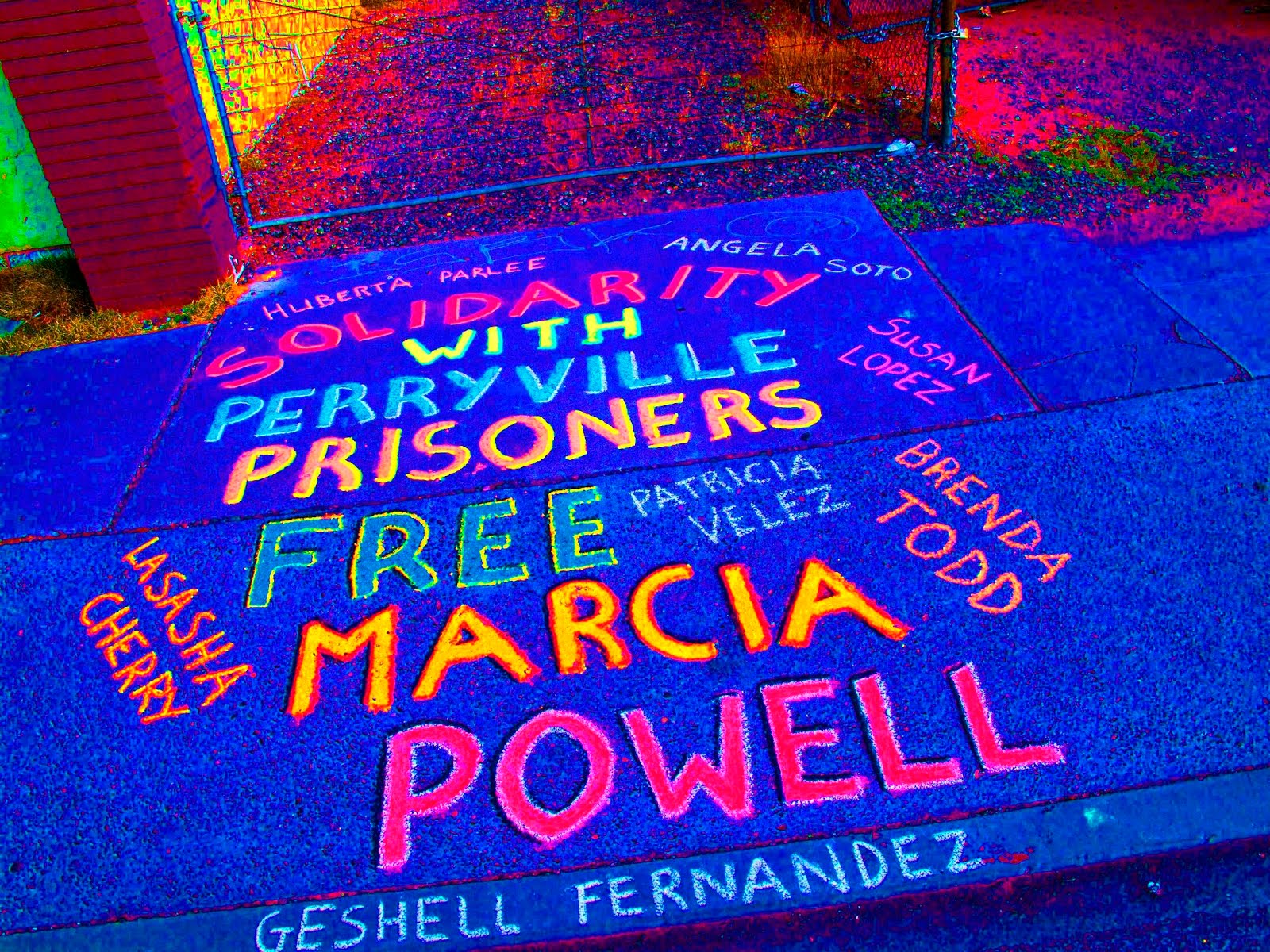

FreeMarciaPowellchalk3small.jpgMargaret Jean Plews
PO Box 20494
Phoenix, AZ 85036
480-580-6807


"Our strategy should be not only to confront empire, but to lay siege to it. To deprive it of oxygen. To shame it. To mock it. With our art, our music, our literature, our stubbornness, our joy, our brilliance, our sheer relentlessness, and our ability to tell our own stories..."


- Arundhati Roy

June 7, 2014

The Honorable Eric H. Holder, Jr.
Attorney General, US Department of Justice
950 Pennsylvania Avenue, NW
Washington, DC 20530-0001

Dear Attorney General Holder;

I am writing to provide a citizen’s rebuttal of Governor Jan Brewer’s statements of May 1, 2014 in her letter to you regarding the Prison Rape Elimination Act, which grossly misrepresented conditions in the state prison system during her reign. I am also intending this letter to serve as a formal request for a CRIPA Investigation into the pervasive patterns and practices at the Arizona Department of Corrections that place prisoners at exceptionally high risk for sexual victimization and complications from unresolved trauma, especially women, the mentally and otherwise-impaired, and LGBT prisoners.

I am emailing this letter with relevant links embedded, but will also be snail- mailing a copy to you with supporting documents (as well as some of my artwork, memorializing the ghosts of Jan Brewer and Chuck Ryan).

By way of introduction, I am the author/editor of the blog ARIZONAPRISONWATCH.ORG, which I began writing five years ago after the death of prisoner Marcia Powell revealed disturbing practices and attitudes at the Arizona Department of Corrections. My particular concern was the mentally ill women at ASPC-Perryville, at first. I recognized in Marcia’s life story the same elements of the numerous women I had come to know and love in my many years working with people who were trying to survive while homeless, addicted and severely mentally ill in Ann Arbor. I also identified with her - I myself am a recovering alcoholic and addict, and could have landed in prison under draconian drug war and repeat-offender sentencing  had I been caught at any number of things earlier in my life, especially if it was in Arizona (what but a “repeat offender” is an addict, anyway?). I also have bi-polar disorder and a bad attitude when it comes to authority, and could have easily been in Marcia’s cage that day myself.

If you are unfamiliar with the case, Marcia was doing 27 months for a $20 blow job she agreed to give an undercover Phoenix cop one fateful day, and died  in a cage in the Arizona sun in May of 2009, at ASPC-Perryville. That was after an extended “suicide watch” in the 107 degree heat, during which time a prisoner is supposed to be checked on every 10 minutes.  After ignoring Marcia’s pleas for relief for four hours (one guard walked away offering no aid knowing she had even defecated on herself) -  officers eventually noticed she had collapsed from the elements with second degree burns on her body and her organs failing; her core temperature at the hospital still exceeded the ability of thermometers to read it, which only went as high as 108 degrees. Not realizing she had a legal guardian and an adoptive mother, Ryan pulled the plug on her life support before the stroke of midnight - she died shortly thereafter.


 chalk art by margaret j plews                                          photo by PJ Starr

AZ DOC Central Office, Phoenix
(Thanksgiving 2011)

DOC officers never expected that Marcia Powell would die out there because they had just left another woman in that cage for 20 hours 3 days earlier, and she didn’t die. See, Marcia’s death was horrific, but it’s not really shocking that it happened - the only wonder was that the DOC got away with punishing prisoners in the heat that way for so long.

That was less than five months into Charles Ryan’s tenure as Interim Director at the Arizona Department of Corrections, but he had begun disassembling the more rehabilitative and empowering programs his predecessor had implemented and imposing new policies immediately upon taking office. A former DW of Ryan’s alleged to the AZ Attorney General that the change the new director made about how to house cellies resulted in at least two homicides within the first 18 months of his rise to power there.  But Ryan had moved up through the ranks under the more brutal directors whose bullying style of management he appears to have emulated, and thus played a large role for decades in cultivating the policies and ethos at the AZ DOC that are so deeply hostile towards prisoners who exercise their right to not be subjected to cruel and unusual punishment. That tendency to resolve issues with violence or the threat of it trickles down from admin to officers to prisoner, and eventually ignites the flames that can bring a prison to its knees.

The good governor talked about Arizona’s “long traditions” of protecting citizens in custody - wow, is she out of touch. She hasn’t read Prof. Mona Lynch’s “SUNBELT JUSTICE” yet, about the trailblazing role the state has played in implementing draconian sentencing and correctional practices over the past 3 decades - the increase in criminalization for politics and profit that the rest of the country has seen the folly of and begun to abandon.

Its actually because of this state’s long tradition of depriving prisoners both of their rights as well as the most basic tools they need in order to fight for them that the AZ DOC is in such shameful condition now. Arizona’s 1990 constitutional amendment excluding prisoners from the definition of crime victim (and related rights and resources), the Lewis v Casey decision in 1996 eliminating the right of prisoners to access a law library among other things, and the Clinton-era Prison Litigation Reform Act (heavily lobbied for by then DOC Director Terry Stewart) were collectively devastating.

I have volumes of letters that will lead you to both victims and perpetrators of countless civil rights abuses precisely because the grievance procedure on most yards is a sham and the DOC obstructs efforts by prisoners to file suit by creating obstacles - especially for illiterate, Spanish-speaking, and mentally ill or developmentally disabled prisoners. In fact, the DOC has NO POLICIES translated into Spanish, despite nearly 20% of their population being foreign nationals, mostly from Spanish-speaking countries. I’ve been recruiting people to do the translations myself, as this is not a concern of the DOC’s so long as no Spanish-speaking prisoners grieve the lack of Spanish-language policies.

This means that Spanish-speaking prisoners (and other non-English-speakers) apparently need to rely on the skills of untrained staff and fellow prisoners who happen to speak some dialect of Spanish when they need to speak to medical, for example, or appeal a disciplinary action, or grieve their housing assignment. Most just suffer their time in silence.

If prisoners could fight abuse and neglect more effectively themselves, the DOJ and ACLU wouldn’t have to do it for them, and you know it as well as I do, Mr Holder. So does the AZ DOC - they put an extraordinary amount of energy into preventing prisoners from learning to articulate their grievances and use persuasion, negotiation and civil law to effectively change their world. There’s a prisoner petition, of sorts, going around that expresses well the barriers they encounter on their way to the courts while trying to exhaust administrative remedies, and offers some proposed solutions, as I recall. It is worth a look by your people.

As a result of a disempowered prisoner population (and, some argue, extremely weak correctional officers unions in AZ), the state prisons are fire traps, and prisoners often complain they are in decaying facilities with mold growing freely in corners, rats and roaches competing for space with the people, feces and blood smeared on the wall in suicide watch cells, inoperable hot water heaters in the winter and non-existent air conditioning in the summer, and scarcely enough food in the sack-lunch “sedentary diets” given to those in detention, administrative segregation and maximum security to keep them from starving to death. More prisoners are fleeing the violence on the yards than are being punished for perpetrating it.

AZ DOC’s medical and psychiatric care is not just deplorable in its negligence, it’s outright abusive, and the DOC has as much to do with that as any of the other parties involved: Parsons v Ryan was filed before the system was even privatized, after all. When I started blogging on the prisons the only thing one could find about AZ DOC on the internet was pretty much what the state wanted you to see. Now you can easily Google “arizona prison health care” to see how much things got worse when Wexford and Corizon came in to feed off of the sick and dying; Director Ryan has lost control over the department’s squeaky clean public image, among other things. His own well-funded propaganda machine is failing him, as are all levels of management and administration, apparently.


 THE FIREHOUSE, Phoenix AZ
40-foot sidewalk mural memorializing the ghosts of jan brewer...


I met with director Ryan and his classification staff in December of 2013, along with Dianne Post from the NAACP here, the primary author of a lengthy letter to him about gay and trans prisoner safety based on my correspondents.  I don’t think he realized how much of what he and his people had to say was disturbing to the outside observer; some of the documents from that meeting - detailing how serious the need for safety is in the AZ DOC - are in the packet.

According to the DOC, 75% of detention cells are full of guys who are unacceptable to or just plain uncooperative with the racialized gangs running the yards - those are the prisoners I hear the most from. The guys pass my name and addy around the detention cells as they do the 805 dance from prison to prison, because I send them the info they need to fight the DOC - stuff like the Jailhouse Lawyers Handbook. It costs me a few hundred bucks a month in printing and postage to keep up with the need for assistance...but, some people spend their time and money on their gardens or pets or kids - I just happen to be a little eccentric about helping the underdog.  I think its a worthy investment, helping people help themselves.

Those prisoners filling the detention cells while fleeing the violence are either seeking Protective Custody (PC) or being punished for refusing their General Population (GP) housing assignments (with “refusal to house” tickets ) after being denied PC. The guys complaining about the assaults extortion and murders, in fact, are overwhelmingly being denied PC and maxed out (ie their good time and privileges are lost and their classification scores zoom up) on major disciplinary tickets for not doing anything to hurt anyone, while the ones behind the extortion, assaults and murders, drug trade and other evils are still free to dominate the prison yards and dictate the culture - often empowered by corrupt officers who want the gangs to help keep the grievances down on the yard, or to keep the assaults just between prisoners, or who just want to line their pockets to buy a new gun or truck.

I have read the Does v Stewart proposed settlement, by the way, and am well-familiarized with DOC policy - I can assure you that both the Does v Stewart agreement and the DO805 policy are routinely being blatantly violated by administrative staff at Central Office. I can say that with certainty after receiving hundreds of letters from prisoners and half as many more calls from family members over getting folks into safe housing since last winter. I have ample evidence the DOC is denying PC to almost ALL prisoners who seek it without the aid of an attorney or the very expensive assistance of Donna Hamm from Middle Ground Prison Reform.

(She’s done a lot of good work, don’t get me wrong - she just costs a pretty penny.)

Interestingly, Ms. Hamm, who charges a flat fee of $2500 to advocate for PC housing for a prisoner, claims a 85- 90% success rate for her clients, while about that same percentage of all PC requests each month are denied, according to the DOC, leaving hundreds of guys in detention each month awaiting the PC verdict. That alone should raise red flags that the DOC isn’t really using any real criteria when they decide who goes to PC and who goes back to the hole in the next GP yard to try again(or get killed), other than that prisoner’s or their family’s ability to litigate them.

And they don’t do the mental health checks they’re required to do on each guy who is turned down for PC to make sure he doesn’t kill himself out of terror. They can’t possibly meet that demand - Corizon isnt even meeting its minimum mental health care mandates.  Thus, I believe guys are still probably killing themselves in the wake of PC denials, like Rosario Rodriguez-Boroquez did in the fall of 2010. A rape victim in the hole on the same MAX unit in Florence followed in his footsteps a week later. That second prisoner might have been saved had the DOC debriefed affected prisoners, they way they do with staff after suicides, homicides and traumatic deaths of prisoners or staff; correctional “best practices” would suggest they should.

Over the course of the past 12 months I’ve corresponded with approximately 35 gay and transgender prisoners alone, some of whom the Navajo Nation’s Human Rights Commission and the NAACP of Maricopa County  have already contacted the DOJ about (and have heard nothing back). In the fall of 2013 a collective of concerned community members convened to study the data from my queer correspondents and draft a letter to Charles Ryan with concerns about the LGBT population being routinely denied PC by his staff when they seek it, even after reporting to the DOC that they had been sexually assaulted or exploited, extorted or beaten because of their sexual orientation or gender identity (the AZ DOC houses transgender women on GP yards in all-male prisons, FYI). In fact, right now there are several gay and transgender prisoners still in GP who have been trying to get into PC for up to and over a year now, unsuccessfully.

Most recently, one gay prisoner who I had intervened personally for to advocate that he receive PC was denied PC and subsequently raped by his cellie, only to be denied PC again and placed in another GP yard. He had initially sought PC because his crime was widely publicized and the media indicated that his male lover was an accomplice - he was  marked man on the yards, no matter what prison they put him in, and they knew it. That was not only deliberate indifference to his safety, I believe endangering that vulnerable prisoner -repeatedly -  was an act of malice and spite in retaliation for my criticisms of the DOC’s staff who make those decisions. And that, sir, is a federal crime, I believe, for a state agent to do. Mr Ryan cannot be trusted to hold those staff responsible for harming that victim, the only party to his rape - to my knowledge - who sits in a detention cell tonight. My correspondence with Director Ryan and his staff about that case is enclosed in the packet.

Even though the victim in the above case had to be taken to a hospital and rape kit was done, there’s no reason to think the perpetrator will actually be held responsible or that further rapes will be discouraged by how this one will be handled. According to the AZ DOC’s current PREA report as posted on their website, out of 54 alleged “inmate-on-inmate unwanted sexual acts” and 30 alleged “inmate-on-inmate abusive sexual contacts” (I think they mean RAPE!) reported to them in 2012, absolutely none could be substantiated by the DOC’s CIU. Either the entire DOC prisoner population lies about rape and it never really happens in our state, or the DOC has no sincere commitment to either preventing it or responding effectively to it when it occurs.

Why should anyone even report their sexual victimization to the DOC, I’m asked? They end up being labeled as a snitch and sitting in the hole for months on end seeking PC, while the perpetrator gets off scott free to rape again. It’s especially disturbing to prisoners when the perp is a gang leader or enforcer, too - which is too often the case, particularly in re: the exploitation and abuse of transgender prisoners. “PREA reporting” has become a sick joke at the AZ DOC - it only stigmatizes the victim, who too often gets no counseling, nor are they very often placed in protective custody or mental health programs beyond the term of the rape investigation, even though research shows that most prisoners are at exquisite risk for even further victimization and deterioration of their mental status once they are raped the first time.

In addition to the recent example of the prisoner who was deliberately placed at risk by DOC staff with a bone to pick with me, I know of one gay prisoner who was verbally abused expressly for being gay after he reported rape (along the lines of you deserved it you fucking fag), in an incident in which he ended up biting staff while being taken down when he refused to sit on the floor to take more of the abuse. The rape victim got an extra year and half added onto his sentence as a result, and had to beg his judge to tell the DOC to place him in PC before they finally relented and did so. I believe he was more traumatized and harmed (by way of being charged with assaulting the staff) by the DOC’s response to his rape report and request for PC than he was by the actual sexual assault on him in the first place.. He is more than willing to make a statement if you will interview him.

I’m also wondering if the DOC ever reported the suicide of Forrest Day as a potential PREA issue. She had reported to her sister before she died that she was being sexually pressured/propositioned by an officer which she found disturbing, but his identity wasn’t revealed to anyone before she was found hanging in her cell, so he couldn’t be investigated. It no doubt never would have been substantiated anyway - you know how it is, when it comes down to the word of a prisoner against a crooked cop: the bad guys in power always win. So, again, why bother reporting rape in Arizona’s DOC even if PREA was implemented, the prisoners want to know. What would be any different than it is now, in practice, even if the DOC did say they were on board with the feds? The culture is so misogynistic and transphobic that it will take not only re-training, but years of just cleaning house - all those good old boys of Chuck Ryan’s and Terry Stewart’s need to go in order to turn this Titanic around.

That isn’t about to happen if Jan Brewer  is left to her own devices here, though, because she has been unmoved by the needless tragic deaths, the abysmal medical care,  or the DOC’s brutal response to those trying to simply flee the violence - and its not like I haven’t been emailing her staff my blog posts all this time - they know, at least, even if she doesnt. No matter what new atrocity is perpetrated on prisoners at the AZ DOC, Jan stands by her man, and so is either completely fooled by him and sheltered from public opinion, or she is fully aware of all that I’ve told you about, and is flat out lying to you in that May letter. If that’s the case, I’d like to know why they’re so damned determined to keep the DOJ out of their prisons.

Either way, be it due to ignorance or complicity with evil, Jan Brewer has consistently failed to provide any leadership around protecting prisoners - not even the children. She says that Arizona is a “leader” in protecting our most vulnerable people, especially kids and the mentally ill. After all, everything she’s done to improve mental health care and child protection is going to be her legacy - which is truly sad, because she hasnt done much on those fronts short of the medicaid expansion, which was to save the hospitals from going under as much as it was for the good of the poor here.

I dont know if she recalls - or ever even knew - that the last kid to suicide at the Adobe Mountain Detention Center run by the AZ Department of Juvenile Corrections did so after some of the other kids relentlessly bullied him for being gay and mentally ill. It seems the staff didn’t know how to deal with either queer kids or serious mental illness. I hope they do now. Charles Flanagan who took over the AZDJC several years ago, has not invited nearly the scrutiny of his department by me that Ryan has, so he might be doing something right there - or at least not so horribly wrong as his former boss. I’ll be terribly disappointed if he advised the Governor not to comply with PREA as well, though.

What I’m saying here is that Jan Brewer is either deliberately whitewashing the prison picture here, or she just doesn’t know what she’s talking about when it comes to prison rape, plain and simple. I can verify myself that Chuck Ryan knows everything I’ve told you of and more because most of what was reported to me along those lines I passed on to him, personally. I have lots of emails documenting it all.

The problem is that Ryan doesn’t tell the truth about any of this, either - he even insists to the legislature that there’s NO SOLITARY CONFINEMENT practiced at the AZ DOC (that’s just semantics, but the legs accept his answer as evidence that the ACLU is hysterical and over-reacting) -  so you can’t count on him to give you an accurate assessment of whether or not the AZ DOC is doing its job when it comes to protecting prisoners from violence, exploitation,  and rape.

No, Mr. Holder, you really need to come talk to me and the families I work with- not just have the FBI spy on me and my buddies in black. Look at my files and analyze my data yourselves. Visit my correspondents. Chat with former employees like former Eyman DW Carl Toersbijns or former Perryville officer Gary Bullock, former ASPC-Lewis Lieutenant Chuck Bauer, former Corizon employee, Teresa Short, AZ State Representative Chad Campbell, who has called for Ryan’s resignation, or any number of other parties to this disaster who I could introduce you to so you can verify mine and the the prisoners’ accounts of prison conditions and the many assaults on their safety - including sexual assaults and exploitation -  in the AZ DOC.

While you’re at it, subpoena the records from the AZ Corrections and Peace Officers Association - they had thousands of DOC employees sign onto a letter of no confidence in Chuck Ryan to Jan Brewer not two years into his tenure. That letter alleged that, among other things:

“...There exists, within ADOC administration, a well-known pattern of obstructing the disclosure of hazards in time to prevent accidents, injury, illness, and deaths. Tragically, in these instances, danger is not "imminent" - it is past, and too late to respond. Employees are routinely ordered to falsify documents and when they proactively seek to report identified hazards, they face punishment and retaliation. Obtaining an accurate account of the range and extent of violations will be difficult from records alone. It is unlikely that ADOC will disclose information without well-planned intervention by authorities.”


These are strikingly similar to the allegations that prisoners make, which are often dismissed as  “unsubstantiated”. The Governor completely ignored the union’s letter, by the way, so its not the credibility of the source that's really the issue - it’s simply a critique she doesn’t want to hear.

In addition to the letters I get from current AZ DOC prisoners, I’ve reviewed hundreds of  death reports since the the start of the current administration. I call tell you that prisoners routinely die of both indifference and  outright abuse here, and Charles Ryan’s DOC sometimes uses their Criminal Investigations Unit to cover up homicides they didn’t feel like pursuing or listing for the feds as such.  Like PC and SP. The AZ DOC’s inspector general’s office didn’t even have the decency to tell PC's mother that his death was more likely than not a homicide, instead of a suicide. They just left her believing her child had taken his life. Fortunately, PC’s mom never bought it and had her own autopsy done - which revealed that there was plenty of evidence he was murdered the DOC never even bothered to look at...

(section edited out)

I dont know if the CIU is corrupt or just has an irresponsible ethos that has no regard for the survivors of victims of violence in their custody. Maybe they are all just lazy - though I suspect the Ryan administration calculated that they would be more liable to a mother whose child was murdered instead of one whose child committed suicide in custody, and decided that if she wasn’t going to sue over  a suicide, they better not tell her it was murder, or someone will start to dig...

(section edited out) 

In any case, the DOC can’t be trusted to investigate themselves and be forthright with their discoveries, and the ACLU is already busy with the health care and psychiatric concerns, including the abuse of solitary confinement for mentally ill prisoners. That’s why we need the feds in on this matter of prisoner safety and prison rape now. Charles Ryan’s Criminal Investigations Unit has no credibility with the prisoners, the staff, or the advocates who know what’s going on in there. Nor do his media and legislative liaisons - they outright lie to the public and elected officials about the heinous behavior of their employees and the corporate jackals who feed off the imprisoned population. Just ask the journalists who have been covering the DOC under Ryan’s tenure - like KPNX’s Wendy Halloran, who won an Emmy for pursuing the truth about the suicide of Tony Lester, or the AZ Republic’s Bob Ortega, who did a fantastic series on “Arizona’s Other Death Row” - that is, the mainstream prison population, which he noticed was dying by suicide, drug overdose, and homicide at unusually high rates after Ryan had been in charge for awhile.

I once had a contact at the DOJ’s Special Litigation Section - Aaron Zisser. I even sent him all the death records my mother bought from the AZ DOC for me to analyze. But I think Special Litigation abandoned AZ awhile ago, perhaps thinking the ACLU et al have it covered. Not hardly.  And Ryan knows no one will hold him accountable for prison rape if the feds don’t - just look at his annual reports. For the past two years in the Five-Year Plans, Director Ryan has managed to invisibilize rape victims in his custody - its not even an institutional goal to reduce the incidence of sexual assaults in the prisons anymore, much less a priority.

Do you understand where I’m coming from here, Mr Holder?

(section edited out)

By the way, Arizona’s sole Protection & Advocacy authority, the AZ Center for Disability Law, won’t help or visit or investigate abuse reports from SMI prisoners under any circumstances. It appears that they only joined Parsons v Ryan in name because they were coerced into doing so. Now, they are the only ones in this state with the authority to get into those prisons on demand to see disabled individuals reporting abuse, and yet they adamantly refuse to exercise it. Is that legal, for a P&A agency to flat out discriminate against an entire population of disabled people solely because the institution housing and abusing them is a prison or jail, instead of a school or a nursing home? If they refuse to exercise that authority, another agency should be identified that will do so, and should be funded to do so. That’s got to be unconstitutional.

Along those lines, I want to quote from a letter I received from the women’s prison just yesterday - this is from (a prisoner) on Death Row, in a building where other maximum security prisoners - like the mentally ill - are held as well. She (wrote) despite risking retaliation from the state because she is so troubled by what she’s hearing and is afraid the women who cry and plead all day and night are too mentally impaired, traumatized, and intimidated to know how to get help themselves via the grievance process and courts…

“They have watch cells below us and I’m very concerned about our mentally ill being pepper-sprayed and drug around naked by male guards and videoed by male guards over the simplest issue. They yell at the mentally ill, scare them. then when they don’t comply (usually strip out) they spray them. They are forced to strip out 3-4 times a day with male guards walking all over. I hear some of them crying “I don’t want to get naked”. I understand security, but not these measures on the mentally ill…”


That sounds like a violation of the agreement the DOC made with the AZDOC some 15 or so years ago to keep a sexual harassment/abuse CRIPA complaint from proceeding to trial, is it not? Let me remind you that I myself have a major mood disorder and PTSD - is this the kind of treatment I can expect as an American citizen in our women’s prisons, should I ever find myself there?

(She) also reports the male officers don’t announce themselves on Lumley. That comes as no surprise - as indicated by the good governor’s letter to you, the DOC doesn’t think it’s necessary for them to do so, even though they are citing women for sexual offenses if they accidentally expose themselves while changing, or toileting, or showering. You know as well as I that most women in prison - especially the severely mentally ill - are already traumatized. Best practices would not say that security demands the male guards come through without announcing themselves. Best practices in corrections now would look at trauma-informed care more closely than the security aspect of that  and say those women are being routinely retraumatized and violated by the AZ DOC’s policies and practices for no good penological reason. They are just not wanting to make sure female staff are available at all times for the women prisoners, though they are quite plentiful in the men’s prisons.

Well, I’ve covered a lot of ground, and there still so much more. I wish we could meet to discuss PREA and CRIPA matters further in person, but I know you have a lot on your hands already, so please have the appropriate staff contact me as soon as possible about this matter - I and the prisoners are requesting a DOJ CRIPA Investigation into these patterns and practices of violating prisoners civil rights, as well as the Governor’s decision to not bother with PREA mandates anymore. At the very least, you should call her out on that.

Thank you so much for reading this through, Mr Holder, if you’ve made it this far. I will be eagerly anticipating your reply. So will the prisoners and their loved ones.

Sincerely,

Margaret Jean Plews

Monday, June 9, 2014

Jan Brewer to AG Holder on PREA: Whitewash of prison rape.

Below is Governor Jan Brewer's letter to the US Attorney General, Eric Holder, explaining why she doesn't think Arizona should comply with the Federal Prison Rape Elimination Act (PREA). I posted my own letter to Holder to the DAILY KOS today...


Sunday, May 25, 2014

AZ PRISON ALERT! Tell Brewer to order DOC to prevent prison rape/implement PREA!

UPDATE: JUNE 13, 2014

THE GOVERNOR ALREADY KNOWS ALL THIS AND DOESN'T CARE, SO DONT BOTHER WRITING TO HER. READ BREWER'S LETTER TO THE DOJ HERE, INSTEAD, THEN MINE, AND THEN WRITE TO THE US ATTORNEY GENERAL TO DEMAND AN INVESTIGATION.

PEGGY PLEWS

------------


 "Justice for Victims of Prison Violence"
Crime Victims' Rights Week (APRIL 2013) 

Governor Brewer has apparently informed the federal government that Arizona has no intentions of protecting its prisoners from rape by abiding by the Prison Rape Elimination Act (PREA), which is now supposed to be going into effect across the country. Given the current conditions in Arizona's state prisons, this should be no surprise. This is just one more piece of evidence that AZ Department of Corrections Director Charles Ryan has no regard whatsoever for the health, safety, or welfare of his prisoners: his actions consistently speaks louder than his words. And we can't let it go this way without a fight. The Department of Corrections (DOC) sucks up over 10% of the state budget, but NO ONE wants to hold them accountable for how that money is being spent, for some reason.

Rejecting the PREA standards means the state actually loses federal funding for the prison system, so there must be some serious problems preventing the DOC from thinking they could comply. As folks may recall, the NAACP sent the AZ DOC Director, Charles Ryan, a letter last fall expressing concern for the safety of gay and transgender prisoners in his custody, as we had received numerous complaints that they were being targeted with violence and the DOC was routinely, repeatedly, refusing to place those who needed it into protective custody (PC), leaving them to be brutalized in general population (GP) or giving them disciplinary tickets and punishment for refusing to house in GP. Ryan responded with his assurances that he cares about each and every one of his prisoners, of course, and wouldn't dream of letting them get hurt, if he can help it.


I've also received reports of DOC staff responding to rape victims with abusive language, harsh housing assignments, loss of privileges, accusations of lying, and hate speech and violence in response to a gay prisoner who was raped. Most often the victim is put in the hole during a brief "investigation" ("Hey, did you rape Joe? He says you did. NO? Oh, sorry to bother you then...."). Once the DOC investigates and fails to substantiate anything, the victim is then moved to another GP yard to be further traumatized and violated, while the accused (often a prisoner in a position of power on the yards) is left in place to brutalize others - this teaches rape victims at the AZ DOC not to speak up at all, which means there are likely far more prison rapes in our state than are reported. 


The AZ DOC is so incapable of adequately investigating rapes that occur in their facilities, in fact, that in 2013, out of more than 80 allegations of inmate-on-inmate "non-consensual sexual acts" (they wont even call it rape) or "abusive sexual contact" they weren't able to substantiate a single one - not a single rapist in their custody was found to have done a thing as of the time their 2013 PREA report was due. I find that astonishing - I'd fire the whole DOC Criminal Investigations Unit over that. Maybe that's why they don't want to comply with federal standards protecting prisoners from rape - Director Ryan clearly must not think there really is such a thing as rape in his prisons.


I hope all you families out there bombard the Governor's office this week with complaints about her decision to allow the DOC to refuse to comply with PREA guidelines, and demand that she take responsibility for investigating the escalating violence against gay and trans prisoners, the brown on black race war, the flourishing heroin trade, the control of most general population yards by gangs, and the horrendous disaster that the privatization of health care at the DOC has been. Please cc your correspondence to the Governor's office to the local media, too. Contact info is below.


One thing which makes it easier for Arizona to get away with rejecting PREA standards, I'm sure, is the fact that the state's "Victims Bill of Rights", as enshrined in the AZ Constitution, deprives one class of people of the same rights everyone else in this state gets when they become crime victims: individuals "in custody for an offense". Even Walmart has more legal standing in court as a crime victim than actual human beings in state custody have. That means that if your child is murdered in custody - even by agents of the state - you also have no "victims rights" guaranteed to you as a survivor (no wonder the DOC leaves so many homicides unsolved...).


The Victims' Bill of Rights for the AZ Constitution was engineered by the state' prosecutors who campaigned hard with crime victims groups to have voters approve the constitutional amendment in 1990. The primary author of the bill, ASU law professor Steve Twist, also thinks everything is fine in the most poorly run state prison system in the country, and clearly has no compassion for crime victims in custody - not even those prisoners still considered innocent until proven guilty. 

Thanks to a big push among legislators from Bill Montgomery, Steve Twist's non-profit organization serving crime victims will get a huge boost in funding in coming years. I just don't know how an organization which self-identifies as the "ARIZONA VOICE FOR CRIME VICTIMS" can refuse to acknowledge as a crime victim a woman whose life was destroyed when her son was murdered in prison, or a mentally impaired juvenile in detention being sexually abused by an adult predator in uniform. 

It seems to me that if he really cared about ending the violence and evil humans perpetrate on eachother in this world, Steve Twist would be urging Governor Brewer to reconsider her position on prison rape and implementing the PREA standards across the AZ DOC. The failure to implement PREA standards will place kids in the juvenile and adult criminal justice system at greater risk of sexual abuse, too - and Steve Twist is on Brewer's Children's Protective Services Task force, so it's not like he wouldn't have her ear on this issue. Please especially write to him if you are a survivor of prison violence. He needs to hear from you, now, not me.

STEVEN J. TWIST
ARIZONA VOICE FOR CRIME VICTIMS
P.O. Box 12722
Scottsdale, Arizona 85267
(480) 600-2661

If you folks who care about prisoners don't contact the Governor and media on this, your loved ones will be at even greater risk in custody in this state than they are already, so please, everyone, call or write both the Governor and Gannett News and protest her decisoon on PREA.

Here is the contact info you need:


The Honorable Janice K. Brewer
Arizona Governor
Executive Tower
1700 West Washington Street
Phoenix, AZ 85007
WEB CONTACT FORM
(602) 542-4331

Producers and Editors
AZ Republic/ KPNX CH 12 News
200 E. Van Buren
Phoenix, AZ 850o4
(602) 444-8000


------------------------

Some States Opting out of Federal Prison Rape Law

ABC NEWS
May 24, 2014 (AP)
By REBECCA BOONE Associated Press

Several states are refusing to comply with a federal law designed to reduce sexual assaults in prison, with governors criticizing the decade-old law as counterproductive and too expensive to implement.

The governors of Idaho, Texas, Indiana, Utah and Arizona have informed U.S. Attorney General Eric Holder that they won't try to meet the standards required under the Prison Rape Elimination Act. Governors were required to certify by May 15 that their states either met the standards designed to curb widespread sexual abuse behind bars, or to promise that they were actively working toward that goal.

"Idaho supports the spirit and intention of PREA and the National PREA Standards, but a law with good intent has evolved into a law with too much red tape," Idaho Gov. C.L. "Butch" Otter wrote in a letter to Holder sent five days after the deadline. It would cost the state millions of dollars to meet some of the standards, Otter said, and he believed the cost would have little ultimate benefit. Besides, the governor said, the state has taken substantial steps to reduce sexual victimization in correctional facilities.

Texas Gov. Rick Perry told Holder in April that his state wouldn't comply because the rules were too costly and violated states' rights. Perry's letter also encouraged other states to reject the federal law, and said that instead, his state would continue the programs it already has to reduce prison rapes. Perry's spokesman Rich Parsons said Friday that Perry sent a subsequent letter last week to Holder, contending that some PREA standards are in conflict with Texas state laws.

Brenda Smith, a former commissioner on the National Prison Rape Elimination Commission which helped create the PREA standards, said the decision by some states to opt out is shameful.

"These are not some high falutin', unreachable standards. These are things that are constitutional, based on best practices that have been determined in the field and in the courts," Smith said. "As a state you can move over to the sidelines, but people in custody don't get to move over to the sidelines. Providing them safety from sexual abuse is the minimum we can do."

At least 10 more states — Alaska, New York, Ohio, California, Washington, Oklahoma, West Virginia, Colorado, Mississippi and Illinois — have said that they can't meet all the requirements yet, but are actively working toward that goal. New Mexico says it's fully compliant with the law.

Leaders of Just Detention International, an organization that works to end sexual abuse in detention facilities, said they were encouraged that most states are working toward PREA compliance.

"We want actual certifications to be meaningful, so states should certify only when they know that they are in full compliance," said the organization's executive director Lovisa Stannow in a prepared statement. "Until then, the Department of Justice must strictly monitor states to ensure that they are using their federal funds appropriately. No state should be meeting its five percent financial commitment by diverting funds away from essential inmate services like rape crisis counseling - doing so would run counter to the intent of PREA."

The Prison Rape Elimination Act was passed unanimously by Congress in 2003. The next several years were spent developing PREA standards, and in 2012 those rules went into effect. The Department of Justice is expected to publish a list of PREA-compliant states by September.

The major provisions of PREA are designed to change the culture of prisons to one that has zero tolerance for sexual victimization; to change prison facilities so that there are fewer opportunities for rape to occur; and to change reporting policies so that inmates have a safe way to report a crime and a safe place to go if they are sexually victimized.

The law's only enforcement mechanism is a partial loss of grant funding. States that don't comply with PREA can lose up to 5 percent of the federal grant money they receive for corrections. States can keep the money if they promise to use it to come into compliance with the law.

The potential human impact is huge: The Department of Justice says that at least 216,000 of U.S. prisoners were raped or sexually abused behind bars in 2011, and cautions that the number is likely low, because prison rapes are seldom reported. The ACLU estimates that about 2 million people have been raped or sexually abused behind bars since PREA was enacted by Congress.


Saturday, October 12, 2013

NAACP to Charles Ryan re: Endangered Prisoners (Gay/Trans safety).


QUEER PRISON WALLS
chalk art by Margie Diddams
Photography by Margaret Jean Plews
Phoenix City Hall (02/26/2103)


RYAN'S RESPONSE to this letter (10/10/13) is HERE


Over the course of the past few years I've received extensive correspondence from prisoners who report being extorted, assaulted, raped, coerced, exploited, and so on in the general prison population who were seeking protective custody, which is what the letter below is responding to. The letters from transgender women in men's prison being denied protective segregation have been most urgent and compelling. 

Thus there is a focus on the needs of gay men and transgender women in the men's prisons in my work with prisoners that may seem to minimize the safety concerns of transgender people, bi-sexual women, and lesbians in the women's prison, Perryville. Those issues are addressed to some degree in the overview of literature and research Dianne did in this letter, but what happens at Perryville deserves it's own letter - and first I need to organize with those prisoners more.

I attempted to address issues with the AZ DOC that I was seeing affect a large number of gay men and transgender women in their custody reporting they are in danger, but they declined to really converse with me about it, and they continued to deny many of these individuals' protective custody placements despite compelling arguments. Frustrated with the case-by-case way I was handling gay and transgender prisoners' complaints in the men's prisons (and losing), I turned to some folks in the community for help figuring out how to best help them.

Several concerned parties have been meeting in the community for the past several months, now, while corresponding with this group of prisoners. The letter below (researched and authored by National Lawyer's Guild and NAACP volunteer Dianne Post) and a growing network of support is what we have to show for our work. 

Hooray for the NAACP for stepping up for queer people's rights and putting this on their letterhead without hesitation! I think this may be historic. Since sending this letter, numerous individuals and community organizations have offered to sign on as well. We will soon be issuing a statement from that larger group endorsing this document and asking to be part of the conversation about queer prisoner safety. Ryan, not surprisingly, has yet to respond to the NAACP. You'd think he'd know better than to ignore these folks on questions of civil rights violations

Those of you interested in joining a collective working on this issue, please contact me. We're organizing as the Seawright Prison Justice Project - please friend and message me if you're on Facebook.  My number is 480-580-6807.Our next meeting is October 22, 2013 at 7pm at my place.

Big thanks goes out to all those prisoners who have offered to tell their stories far and wide, whatever the risk, to improve the circumstances of the rest of their brothers and sisters behind bars. They are the real heroes.

 Any LGBTI prisoner currently seeking protective custody should add this letter to their 805 claim as supporting evidence of their exquisite vulnerability to violence in custody. If you know a prisoner for whom this letter may apply, please send it to them and ask them to write to me, Peggy Plews, at PO Box 20494 Phoenix AZ 85036.


-------------------------------------


9 September 2013


Director Charles Ryan
Arizona Department of Corrections
1601 W Jefferson St
Phoenix, AZ 85007


   Re:  Treatment of LGBTI prisoners


Dear Director Ryan,


We contact you today as civil rights organizations and persons who are concerned about the treatment of LGBTI prisoners in the Arizona Department of Corrections.  We hope that we can resolve this issue with the Department through a consultative, community participation process that results in a win/win solution.


We have complaints from eighteen LGBTI prisoners.   The complaints come from Lewis, Tucson, Florence, Yuma, and Eyman, and from several different yards within those prisons. Complainants report having been moved multiple times and encountering similar problems across the prison system. Thus the problem seems to be widespread and statewide.


The complainants are four Caucasians, five Mexican-Americans, five Native Americans, two Mexican Nationals, and two African-Americans.  Eleven identify as gay and seven as transgender persons. Of the seven transgender prisoners, five identify as Native American, one as Mexican- American, and one as Caucasian.  Because almost all of the transgender complainants are Native American, we think perhaps there may be ethnic discrimination occurring here as well as LGBTI discrimination.


Of those complainants, fourteen have made requests for protective segregation, and four were already approved for PC as of the time they contacted work group members. Of those fourteen who have requested PC, only six have been approved (two within the past two weeks who remain in detention cells awaiting placement). Most of those approvals for PC occurred only after numerous denials and aggressive intervention from the outside. Eight prisoners are still trying to get into safer housing.  Eleven of the PC requesters report that they have already been victims of prison violence; the rest have at least been threatened with violence.

Eight of the PC requesters received at least one violation for Refusing to House when staff declined to process their refusal as an 805 request instead. Refusing to house is a major disciplinary violation, which increases prisoners' custody levels and has resulted in seven of the eighteen gay/trans prisoners being  housed in maximum security settings, (six in the Supermax facility, and one in Florence Central). It's questionable how many of those maximum security placements are appropriate, especially since three gay/trans individuals so placed are scored as medium security prisoners.


Danger to LGBTI persons in correctional institutions.


It is undisputed that prison is a very dangerous place for the LGBTI population, and that they are extremely vulnerable inmates for whom the prison administration must take special care to protect.  Jamie Fellner, a member of the national PREA commission, stated, “ (T)hat pervasive sexual violence in prison happens because of poor management, bad policies, and a lack of commitment to preventing it.”   Two main concerns are initial placement for transgendered and intersex persons (male or female prisons) and placement in general or protective custody.    Obviously, ADOC is well aware that homosexuals are targeted for physical, sexual or verbal abuse in prison as this was your argument for your policy in Whitmire v. Arizona, 298 F.3d 1134 (9th Cir. 2002).  


Some prisoners state that they do not want protective custody because it makes them more vulnerable to harassment and assault by correctional officers and it restrains their liberty and access to vocational and recreational programs.  Doe v. Bell, # 112508/02, Supreme Court of the State of NY, County of NY, January 7, 2003, ruled that it’s not enough to provide one small place for LGBTI to go to, the institution must provide safety for all inmates in all places.


Every person who was interviewed in the study reported some form of harassment and/or assault during imprisonment including verbal harassment, physical and sexual assault, humiliation, prostitution and rape by guards and other employees as well as by prisoners often with the tacit permission of the guards.  Group showers were extremely dangerous for this population.


Forced sexual acts puts the LGBTI population at extremely high risk for sexually transmitted diseases, especially when condoms are prohibited, including HIV and hepatitis, both of which are widespread in U.S. correctional facilities.  Many LGBTI prisoners who were infected then complained of denial of basic care and discriminatory providers.  Untreated transsexual prisoners have a suicidality of 20-30%, which is reduced to 1-2% after treatment.


Joseph Eldridge, # 14748 has filed a very similar complaint against AZ DOC on April 30, 2013, 2:13-cv-00888-DGC-AFM, alleging sexual victimization, physical assault and complicity by the guards.  


In 2011-12, an estimated 4.0% of state and federal prison inmates and 3.2% of jail inmates reported experiencing one or more incidents of sexual victimization by another inmate or facility staff in the past 12 months or since admission to the facility, if less than 12 months. Patterns of inmate-on-inmate sexual victimization in 2011-12 were consistent with patterns in past surveys. Rates reported by prison and jail inmates were higher among females than males, higher among whites than blacks, and higher among inmates with a college degree than those who had not completed high school. Among state and federal prison inmates, an estimated 6.3% of those identified with serious psychological distress reported that they were sexually victimized by another inmate. In comparison, among prisoners with no indication of mental illness, 0.7% reported being victimized by another inmate.


Among heterosexual males, an estimated 3.5% reported being sexually victimized by another inmate. In comparison, among males who were bisexual, 34% reported being sexually victimized by another inmate. Among males who were homosexual or gay, 39% reported being victimized by another inmate.


Female heterosexual inmates reported lower rates of inmate-on-inmate victimization (13%) and staff sexual misconduct (4%) than female bisexual inmates (18% and 8%, respectively).  Among female homosexual or lesbian inmates, the rate of inmate-on-inmate sexual victimization was similar to that for female heterosexual inmates (13%), while the rate of staff sexual victimization was at least double (8%) that for female heterosexual inmates (4%).


The rate of inmate-on-inmate sexual victimization for males was higher among non-Hispanic white inmates (5.9%) and inmates of two or more races (9.5%) than non- Hispanic black inmates (2.9%).  Among male former state prisoners, the rates of staff sexual misconduct were higher for those of two or more races (11.3%) and black non-Hispanics (6.5%) than for white non-Hispanics (4.5%) and Hispanics (4. 0%).


The rate of staff sexual misconduct was higher for male inmates ages 20 to 24 (7. 9%) than for male inmates ages 25 to 34 (5.2%), ages 35 to 44 (3.5%), and age 45 or older (2.0%).  Among female former state prisoners, rates of staff sexual misconduct were lower for those ages 35 to 44 (3.1%) and age 45 or older (1.6%), compared to those ages 20 to 24 (6.7%).


Most victims of staff sexual misconduct (87%) reported only perpetrators of the opposite sex. Among victims of staff sexual misconduct, 79% were males reporting sexual activity with female staff. An additional 5% were males reporting sexual activity with both female and male staff.  Among male former inmates, inmate-on-inmate and staff-on-inmate victimization rates were higher in facilities under a court order or consent decree, higher in facilities reporting a major disturbance in the twelve months prior to the most recent facility census, higher in facilities with medium or greater security levels, and higher in facilities with a primary function of housing general population than in facilities without these characteristics.  Among former inmates who had been tested for HIV (90%), those who had been sexually victimized by other inmates or by staff had significantly higher percentages for HIV positive (6.5% and 4.6%, respectively) than those who had not been victimized (2. 6%).


From this U.S. government data, it is clear that both men and women are at risk from both inmates and guards.  White men are more at risk from inmates, men of color from guards.  The LGBTI population, both male and female, is at higher risk than the heterosexual population.  


The Center for Evidence-Based Corrections at the University of California-Irvine examined violence in correctional centers finding in 2007 that 41 percent of transgender inmates face violence, compared to two percent among a random sample of inmates in the same California prisons. Nationwide, the Bureau of Justice Statistics said in a report recently that an estimated four percent of state and federal prison inmates were sexually victimized by prison staff between 2011 and 2012. The rate of sexual victimization among prisoners themselves was lower: 2.4 percent.   Thus it is clear that inmates are more at risk from staff than from inmates. Yet, you do not report staff on inmate violence on your website assault reports.


The Department of Justice released a report in 2009  looking at ways to prevent staff sexual abuse of prisoners since it is a crime to engage in any sexual contact with or without “consent”.  Such action puts the employee at risk of criminal charges and administrative discipline.  Such personnel have been found to have also engaged in other prohibited practices such as providing contraband, accepting bribes, and lying to investigators.  


The Prison Rape Elimination Act of 2003 (PREA) makes it a top priority for prison officials to prevent sexual abuse. Yet at the Bureau of Prisons (BOP), allegations of misconduct doubled from 2001-2008, faster than the growth of prisoners or personnel.  These allegations were at 92 of 93 BOP sites and against every occupational category except human resources.  The occupational categories that had the highest rates of allegations were food services, recreation, and education and vocational training. They also found that the majority of allegations (65 percent) involved accusations of criminal sexual abuse rather than non-criminal sexual misconduct.


They pointed out that simply segregating and then transferring victims can have negative impacts on them and reduce their willingness to report abuse again and to cooperate with investigations.  In effect, the institution was punishing the victim rather than the perpetrator.


Many of our complainants have stated the same problem.  When they refuse to house with a dangerous inmate, they are punished with an increase in their score, or sent to the special management units, resulting in inappropriate use of maximum security cells.  Such use of maximum-security cells would violate DOES v. Terry Stewart, CIV 96-0486 PHX WFN 13 July 2000.  Does was a class action of all protective segregation inmates and the DOC was permanently enjoined from transfer of protective segregation inmates to maximum security GP yards.


One part of the mandated plan included that “No inmate will ever be forced into general population.”  Many of complaints we have received are about being forced to remain in the general population after the inmate has reported an assault.   Nearly every one of these inmates was repeatedly assaulted while being denied 805 status.  


The plan specifies that even if there is no verified information suggesting a need for protection, or the victim cannot identify the attacker the staff has to investigate, evaluate and protect the victim.  That is not happening. (MR) Policy 805.1, 1.2.1.2 says that inability or unwillingness to identify the perpetrator cannot be the sole reason to exclude from protection.  Thus, obviously it is being used as one criteria, which is not permitted under PREA standards.


According to the agreement, every inmate who requires protection receives it at once and for as long as it is needed, they must be immediately placed in secure segregated housing, staff are required to use specified criteria in their assessment, each decision must be documented, well-reasoned and reviewed. In the MR case, the refusal simply states “no evidence” but shows no indication that any specified criteria were used or what investigation had been done.  That kind of blanket denial does not meet the requirement of a “well-reasoned” decision. In the MR case, apparently on appeal the committee said there were other options, but did not outline what those were.


The Department of Justice report made a series of recommendations including:  


Create an alternative to automatically isolating and transferring prisoners that allege abuse;


Develop procedures to ensure that victims receive appropriate psychological and medical assessments;


   Trainings for staff be updated and strengthened;


Policies and procedures be revised to give specific guidance on protocol to respond to sexual abuse allegations and for victim services;


   Regularly assess the implementation of the program.  


Male prison society obviously puts transgender and gender-variant prisoners with feminine characteristics at great risk.  Prison staff and authorities must share the blame as well because they create the conditions of confinement that foster and perpetuate this violent prison society, and even go so far as to collude with perpetrators to victimize LGBTI prisoners and others for whom they have particular disdain.  In fact, the famous case of Farmer v. Brennan, 511 U.S. 825 (1994) that created the “deliberate indifference” standard was on behalf of a transgender victim of physical and sexual assault.  


When officials do investigate allegations of sexual assault, they often disbelieve complaints reported by gay or bisexual prisoners, they often conclude no rape occurred if there are no wounds from a fight, they fail to provide medical care and counseling to the victim, and if they discipline the perpetrator, he often ends up back in the same housing area as the victim exposing the survivor to retaliation.  


Human Rights Watch (HRW) also found that prison staff tends to single out the LGBTI community for harassment.  Like BOP, HRW found that internal control procedures were lacking, victims were exposed to further harassment and retaliation, the process was riddled with conflict of interests and violations of confidentiality were rampant.  Clearly an outside panel is necessary to review procedures and audit results.


In addition to sexual assaults, LGBTI prisoners often receive homophobic and transphobic slurs and name calling, are forced to submit to demeaning and often public strip searches or nudity, receive disproportionate punishment for minor infractions of rules, are treated as sexual predators regardless of the underlying conviction and denied medical care.  In fact, prisoner AV at Lewis claims that he is harassed by officers and the deputy warden and is repeatedly subject to hostile remarks.  


While administrative segregation (ad-seg) provides some protection from other prisoners, they tend to house prisoners in even harsher and more restrictive conditions. Stigma also attaches to prisoners housed in medical wards, compounding their marginalization among other prisoners and exposing them to further persecution from prison staff.


Prisoners doing terms in ad-seg lose privileges they enjoyed in general population, endure harsher restrictions including reduced space in cells and in their exercise yards, and are isolated from direct contact with all other prisoners besides their cellmates, if they have one. Prisoners in isolation are also at risk from even more severe abuse by prison staff, because ad-seg prisoners are assumed to be more dangerous and because there are few others around to witness their misconduct.


Administrative segregation is therefore not an acceptable long-term solution to house LGBTI prisoners. Separate medical wards that do not additionally punish prisoners housed there can provide at least a temporary refuge for LGBTI prisoners but being housed in a medical ward still stigmatizes LGBTI prisoners as sick and diseased, a stereotype already widespread in this society. This can lead to further victimization by other prisoners and prison staff, since this society views stigmatized illnesses like HIV/AIDS (and supposed illnesses like transgenderism) as worthy of moral condemnation and ostracization.


One study of California prisoners found that 59 percent of transgender women housed in men’s prisons had been sexually abused while incarcerated, as compared to four percent of non-transgender inmates in men’s prisons. Making matters worse, transgender inmates often face prejudice and discrimination in the aftermath of an assault.  The majority of transgender survivors are subjected to repeated sexual assaults (as many of our complainants allege). Yet many remain silent to avoid transfer to solitary confinement where they are locked in a tiny cell for 23 hours a day and cut off from vital services and programs.


The knowledge that the LGBTI population is at particularly high risk of sexual assault in prisons is longstanding, pervasive, well-documented and expressly noted by prison officials in the past.  In fact, in DOES v. Terry Stewart, CIV 96-0486 PHX WFN 13 July 2000, a class action for the protection of protective segregation inmates, the current AZ DOC director, Charles Ryan, was deputy director at the time and was personally involved in  the plan and procedures and promised the court that he would continue to take personal interest in Protective Segregation issues.  In fact, he conducted the policy and operation review project to update staff and conducted training on it.    


Further, prisons officials across the state have received numerous administrative complaints about the sexual assaults and requests for 805 Protective Custody.  For example, Prisoner A was assaulted and states that it was documented in an incident report yet he was denied 805 status.  Prisoner B was raped and beaten at least three times, this was documented; yet he has been denied 805 status nine times.  Prisoner C was assaulted with attendant medical records; yet has been denied 805 several times.


Prisoner D was raped and assaulted and had to go to ER; yet has been denied 805 status twelve times.  Prisoner E was threatened, put in lockdown but denied 805 status numerous times.  Prisoner F received death threats and was put in lockdown but denied 805 status.  Prisoner G had to wait and re-apply for 805 after an assault.  Prisoner H petitioned for a year before he was granted 805 and was beaten several more times while waiting.  Prisoner I was denied 805 four times during which she was repeatedly assaulted.  


Physical assault is a reason for 805 status (805.02, 1.5.1) as is threats (805.02, 1.5.2) and sexual assault and threats (805.02, 1.5.3).  Change of gender is a consideration (805.02, 1.5.9) but nowhere is LGBI mentioned in the considerations.  805.02, 1.5.8 does mention size, build and age which could be used for some, but not all, LGBI prisoners.  Given the well-known and documented threat to the LGBI prisoners, it is imperative that 805.02 be revised to include LGBI.  


Recent events indicate LGBTI prisoners are not being protected in spite of knowledge of the danger.  In 2006, inmate DS filed a complaint with the FBI regarding repeated sexual harassment and assault. The FBI investigation revealed that the same guard she complained of had a history of complaints from other prisoners.  DS_2 was murdered for his homosexual relationship and a lawsuit against DOC is pending.  TS committed suicide because of the violence he was subjected to.  ArizonaPrisonWatch has communicated with the department on this issue regularly for years.  Most recently, Joseph Eldridge, # 14748 filed such a complaint against AZ DOC on April 30, 2013, 2:13-cv-00888-DGC-AFM alleging sexual victimization, physical assault and complicity by the guards.  


Many prisoners who report a sexual assault are subjected to insensitive questioning soon after the attack. Some staff responds to requests for help with indifference and jokes. Such inappropriate reactions can cause inmates to suffer so- called “second rape,” with an emotional impact equal to that of the sexual assault.


The lack of confidentiality means the prisoner is labeled a snitch risking further retaliation, and a reason for 805 status (805.02, 1.5.2). It is no wonder that prisoner rape is one of the nation’s most seriously under-reported crimes.  Prisoners need confidential counseling, comprehensive testing and treatment for STDs and housing options that protect them but do not restrict their access to programmatic and rehabilitative services.  Only then will victims feel free to report the abuse they suffer.


“Sexual abuse of lesbian, gay, bisexual, transgender, and queer (LGBTQ) inmates constitutes one of the most rampant and ignored human rights violations in the U.S. today.   In a 2007 academic study, funded by the California Department of Corrections and Rehabilitation and conducted at six California men’s prisons, 67 percent of inmates who identified as LGBTQ reported having been sexually assaulted by another inmate during their incarceration, a rate that was 15 times higher than for the inmate population overall.  One study found that nearly 75 percent of prisoner rape survivors in men’s facilities and 57 percent of survivors in women’s facilities were sexually abused more than once, and 30 percent of all prisoner rape survivors endured six or more assaults. In the worst cases, gay and transgender prisoners become sex slaves, are treated like the perpetrators’ property, and sold to others within the facility.”


“For LGBTQ survivors, the trauma is heightened by the institutional apathy and homophobia they regularly face. Corrections staff tend to confuse homosexuality and transgender status with consent to rape, and trivialize the problem. LGBTQ inmates frequently describe officials ignoring or even laughing at reports of sexual violence. To make matters worse, LGBTQ inmates who report abuse are often subjected to further attacks, humiliating strip searches, and punitive segregation.”


Prisoner rape victims are highly vulnerable to contracting HIV and other sexually transmitted diseases.  In 2004, the HIV prevalence rate inside U.S. prisons was more than four times higher than in society overall;  hepatitis C rates were 8 to 20 times higher; and chlamydia, gonorrhea, and syphilis rates are likewise significantly higher. Ninety-five percent of prisoners are released to carry these diseases into the public.  Harm reduction measures such as condom distribution, which some prisons have, would go far towards reducing the infection rates.


You cannot deny knowledge of the problem by simply refusing to verify the facts or pretending not to connect the dots.  Given the voluminous information you have had about this problem over the years and the requirements of PREA, you clearly have both objective and subjective knowledge of the enormity of sexual violence occurring in Arizona prisons.


Standards for dealing with violence toward LGBTI prisoners.


In an overview of administrative segregation policies across the country, the researchers found that, “At the formal policy level, most permit placement in segregation based on a wide range of rationales. The elasticity suggests that administrative segregation may be used for goals other than incapacitation. In exchanges about our inquiry into administrative segregation, several commentators referred to the potential for its overuse based on what is colloquially known as being “mad” at a prisoner, as contrasted with being “scared” of that individual.”    It also seems that being LGBTQI is another category of prisoners in which administrative segregation is used because officials don’t “like” the prisoner.


Arizona is one of only twelve jurisdictions where an individual officer decides whether to place an inmate in administrative segregation.  A much better practice (thirty-one jurisdictions) a committee makes the decision and in two, a hearing officer makes a recommendation to a committee.  Arizona should consider changing its practice, to not have a committee review until after the deputy warden has made his suggestion, in conformity with the majority of states.


Arizona is only one of eight jurisdictions that do not specify that inmates can present evidence.  A much better practice is to follow the lead of the thirty jurisdictions that authorize inmates to present evidence by oral, written or documents and/or to call witnesses.  Arizona should revise its practice.


Arizona is one of twenty jurisdictions that do not specify if inmates can be represented at a hearing.  Again our policies lag behind those of other states and need to be updated


The majority of jurisdictions (30) require an initial review of administrative segregation within seven days, six states in three or less.  Nine states require a review within thirty days, two states require sixty days, and six states ninety days.  Arizona seems to be completely out of step with the rest of the nation in only requiring a review in six months.


The National Prison Rape Elimination Commission (NPREC or Commission) has developed national standards that will help eliminate prison rape and other forms of sexual abuse in confinement because, “Sexual abuse of people in confinement violates their basic human rights, impedes the likelihood of their successful reentry into the community, and violates the Government’s obligation to provide safe and humane conditions of confinement. No prison sentence, regardless of the crime, should ever include rape. A core priority of any confinement facility must be safety, which means protecting the safety of all—the public, the staff, and the inmate population.” The Prison Rape Elimination Act (PREA) of 2003 requires agencies to comply with the national standards proposed by the Commission and approved and promulgated by the Attorney General to eliminate sexual abuse in confinement or suffer a loss in funding.  National Former Prisoner Survey, 2008


On May 17, 2012, the U.S. Department of Justice released national standards aimed at eliminating sexual abuse in prisons, jails, youth detention facilities, halfway houses, and police lock-ups as mandated by the Prison Rape Elimination Act (PREA) of 2003. They require that corrections facilities take concrete steps to protect inmates from sexual abuse – whether perpetrated by staff or by inmates.  The standards cover prevention and response planning, training, education and screening, detection and response including reporting, investigation, discipline, and medical care, monitoring including data collection and audits, and a number of supplemental standards and appendices dealing with responsibility of medical examiners, training, data collection, and needs assessment. The standards became applicable to the states in August 2013.  


The standards recognize the importance of outside agencies in supporting efforts to reduce sexual abuse in prisons which is why PREA standards require that corrections agencies have to work with community groups.  Institutions have to provide inmates with contact information, reasonable communication possibilities in as confidential a manner as possible and disclosure when the communication is not confidential.  The existing AZ DOC inmate brochure regarding PREA and Sexual Assault does not have such contact information.


Victims must be provided with timely access to medical treatment, crisis intervention services, and ongoing medical and mental care.  The standards require a coordinated response, a forensic exam by a qualified person, evidence collecting protocols that meet national standards, that the victim have access to emotional support, information and referrals, treatment for sexually transmitted infections and for women, emergency contraception.  These services are mandatory on state and local facilities whether or not the victim can or will name the perpetrator.  In 805.01, 1.2.1.2 it states that the inability or unwillingness to name the perpetrator may not be the sole reason to exclude the prisoner from protective custody; however, under the PREA standard, they must be given the full benefit of victims services.  


Illinois spent ten years revising their policy toward transgender prisoners in order to avoid a costly lawsuit.   The new guidelines require a psychiatric assessment of how vulnerable or predatory a transgender inmate is when considering placement.  It also updates the role of the Gender Identity Disorder committee that addresses placement, security concerns and medical treatment.  During the assessment period (usually a month) the inmate is placed in a single cell without a roommate and showers alone.  


In 2002, the National Lawyers Guild (NLG) and the city of San Francisco Human Rights Commission created a protocol for housing transgender inmates safely and humanely in correctional setting.   Among other procedures, these protocols allow inmates to choose the gender of the person who searches them, respects objections of an inmate to pairing with a certain cellmate for fear of assault, allows complaints out of the chain of command so inmates don’t have to file the complaint with the abuser, and includes outside independent monitoring.  


Prison Rape Elimination Act (PREA)


PREA requirements apply to all detention facilities, including federal and state prisons, jails, police lock-ups, private facilities, and immigration detention centers. PREA requires that facilities adopt a zero-tolerance approach to this form of abuse and states that sexual assault in detention can constitute a violation of the Eighth Amendment of the U.S. Constitution.


The institution must prevent sexual abuse by, among other things, maintaining a zero-tolerance policy toward sexual abuse, designating a PREA point person, screening inmates for risk, documenting adequate staffing, training employees including about the unique vulnerabilities of the LGBTI inmates, not hiring abusers, preventing juveniles from being housed with adults, banning cross-gender pat-downs and examinations solely to determine genital status, preventing improper viewing by opposite sex staff, restricting the use of solitary confinement as a means of protecting vulnerable inmates, and working with outside entities that adhere to these policies.  


The standards require that inmates be screened for risk of being sexually abused or sexually abusive and that screening information be used to inform housing, bed, work, education, and program assignments. The goal is to keep inmates at high risk of victimization away from those at high risk of committing abuse. Upon learning of an allegation of abuse, staff must separate the alleged victim and abuser and take steps to preserve evidence. Nowhere in your 805 policy is the preservation of evidence noted. However, facilities may not simply place victims in segregated housing against their will unless a determination has been made that there is no available alternative means of separation, and even then only under specified conditions and with periodic reassessment.


The institution must detect abuse by making inmates aware of the policy, must facilitate multiple and third-party reporting options, must prevent retaliation, and must assist those with disabilities and limited English. In addition, transgender and intersex inmates must be given the opportunity to shower separately from other inmates.


The agency may not impose a time limit on when an inmate may submit a grievance regarding sexual abuse. According to PREA standards, a grievance system cannot be the only method and should not be the primary method for inmates to report abuse.  You must have multiple internal reporting mechanisms as well as an external reporting structure for such complaints.  The standards require that agencies provide at least two internal reporting avenues, and at least one way to report abuse to a public or private entity or office that is not part of the agency and that can allow inmates to remain anonymous upon request. An agency must also provide a way for third parties to report such abuse on behalf of an inmate.


The institution must respond to sexual abuse by timely and appropriate medical and mental health care, if possible access to victim advocates from rape crisis centers outside or if not, have a trained person inside, establish evidence protocol, investigate all allegations with a preponderance of the evidence standard, discipline staff with termination as presumptive sanction for staff who commit sexual abuse, discipline inmates only when they are the perpetrators of abuse, allow inmates opportunity to file grievances regarding sexual abuse, maintain records of incidents of abuse and use those records to inform future prevention planning.  


The Policy Review and Developmental Guide has a very useful series of questions about each PREA standard and whether your policy complies.  It would be a very good place to start to revise your policies and operations to implement the requirements of PREA.


You have alleged that you do not keep records of sexual assault based on LGBTI status.  According to PREA, in collecting data on sexual incidents, the facility “shall consider whether the incident or allegation was motivated by ... gender identity; lesbian, gay, bisexual, transgender, or intersex identification, status, or perceived status ... or was motivated or otherwise caused by other group dynamics at the facility.” Given this requirement, what is the Arizona DOCs plan for gathering such statistics to comply with PREA?


The standards require that each facility be audited every three years to assess compliance. Those that do not comply with the standards are subject to a five percent reduction in funds they would otherwise receive for prison purposes from the department unless the governor certifies that five percent of such funds will be used to enable compliance in future years.  The first year of the PREA non-compliance penalty period is fiscal year 2014, which will commence on October 1, 2013, and end on September 30, 2014.  The standard for prisons can be found at 28 C.F.R. §§ 115.11 – 115.93.


Because the PREA requires the Bureau of Justice Statistics to carry out a comprehensive statistical review and analysis of the incidence and effects of prison rape for every calendar year, BJS developed the National Prison Rape Statistics Program (NPRSP), a series designed to collect multiple measures on the incidence and prevalence of sexual assault. This would also be a program model for Arizona.


NPRSP includes four separate data collection efforts: the Survey on Sexual Violence (SSV), the National Inmate Survey (NIS), the National Survey of Youth in Custody (NSYC), and the National Former Prisoner Survey (NFPS). Each of these collections is an independent effort and, while not directly comparable, provide various measures of the prevalence and characteristics of sexual assault in correctional facilities. Incidents reported to or observed by correctional or medical officials collected in the SSV administrative records survey may be an under-representation of actual incidents.


Allegations made anonymously by inmates and youth in the NIS, NSYC, and FPS may be an over-representation of actual incidents, although it is possible this over-reporting is offset by some victims who, despite the protocols enacted to assure confidentiality and encourage reporting, remain fearful of retribution or ridicule and fail to report sexual victimization. By using more than one method and measure, the data collections can together provide a deeper understanding of sexual victimization in correctional facilities. These would certainly be good tools for Arizona and would be compatible for use with the national statistics.


In order to comply with PREA, AZ DOC must realize that LGBTI people in detention are particularly at risk of sexual abuse as shown from government and academic studies and statistics from the Bureau of Justice Studies. Transgender people are at especially high risk needing more protection in both male and female prisons (citations omitted).   What is required is individualized classifications, individualized medical determinations,


and no protective segregation that constitutes a denial of the same privileges and programs as other prisoners.   Staff must distinguish between sex abuse and consensual behavior.  Consensual behavior can be prohibited but it cannot be punished like sexual abuse.


Use of Administrative Segregation


Since lesbian, gay, bisexual, transgender, and intersex (LGBTI) individuals—both adults and youth—under custodial supervision are one of the groups most at risk for abuse,  “corrections administrators need to do more to identify those who are vulnerable and protect them in ways that do not leave them isolated and without access to rehabilitative programming.” Administrative segregation, and the ensuing isolation from the general population for purposes of “safety,” often exacerbates mental health conditions such as depression or gender dysphoria. In addition, isolation from the general population often means limited or no access to programming, regular visitation, or health care, all of which are necessary for LGBTI populations. Likewise, data suggest that special population units (such as those on Rikers Island and the San Francisco County Jail) have not kept inmates who identify as LGBTI any safer.”


Although it is permissible to place vulnerable inmates in administrative segregation in some circumstances, agency officials will not be able to rely on this measure as long-term protection for LGBTI inmates.  Agency officials may, however, segregate LGBTI inmates as a temporary measure when there are specific circumstances, such as upon admission (while determining an appropriate long-term placement) or immediately following an assault and during a pending investigation.


The final PREA standards require adult prisons and jails to conduct an intake screening within 72 hours of an inmate’s arrival to assess that inmate’s risk for sexual victimization or abuse. Inmates may not be disciplined for refusing to answer questions and may not be placed in areas based solely on their identification or status except under legal order.  The institution must decide on a case-by-case how best to protect the inmate and that includes taking into account the inmates views.  Placements must be assessed at least twice a year.


Legal Context


Farmer v. Brennan, 511 U.S. 825, 829 (1994) established that rape is not part of the penalty of any prisoner.  Farmer was a transgender prisoner placed in a male prison, the very kind of prisoner most at risk.  While prisons are not mandated to be comfortable, they must be reasonably safe and the conditions under which prisoners live are subject to scrutiny under the Eighth Amendment.  (p. 832) That prison officials have a duty to protect prisoners from violence at the hands of other prisoners and staff is well settled constitutional law.


Farmer established the “deliberate indifference” standard for inmate health and safety.  (p. 836-7)  To consciously disregard a substantial risk of serious harm meets that standard when a prison official acts or fails to act despite his knowledge of the substantial risk of serious harm. (p. 842) While the requisite knowledge of the substantial risk is a question of fact, inference can be made from circumstantial evidence, and a factfinder can conclude that a prison knew of a substantial risk from the very fact that the risk was obvious.  When the risk is longstanding, pervasive, well-documented or expressly noted by the prison officials in the past e.g. because of prior law suits, outside organization advocacy and a multitude of inmate grievances, then that official had actual knowledge.  (p. 843)  Farmer specifically mentions inmate rape as being so common and uncontrolled that it is obvious, and it does not matter if officials know precisely who will rape who.  (p. 844) The right of prisoners to be free from assault is well established and qualified immunity will not apply under either the Eighth Amendment or 42 U.S.C. §1983.  Schwenk v. Hartford et al, 204 F. 3d 1187 (9th Cir. 2000), Powell v. Schriver, 175 F.3d 107 (2d Cir. 1999).  


Nor can a LGBTI prisoner be routinely placed in administrative segregation without procedural safeguards.  Enomoto v. Wright, 434 U.S. 1052, 98 S. Ct. 1223, 55 L. Ed. 2d 756 (1978). Segregation of LGBTI inmates can be done for protection, under review and when the person is not denied access to all programs or services.  Estate of DiMarco v. Wyoming Dept. of Corr., 473 F.3d 1334, 1342–43 (10th Cir. 2007)  Corrections officials must create an appropriate intake classification scheme to identify and house LGBTI inmates rather than segregating them.  Gay Inmates of Shelby County v. Barksdale, 819 F.2d 289 (6th Cir. 1987)  Such isolation violates Fourteenth Amendment due process.  RG v. Koller, 415 F. Supp. 2d 1129 (D. Haw. 2006)  and Eighth Amendment rights, McCray v. Burrell, 516 F.2d 357 (4th Cir. 1975).   Long term segregation from the general population also violates due process rights.  DiMarco v. Wyoming Dep’t of Corrections, 300 F. Supp. 2d 1183 (D. Wyo. 2004) Blanket policies are not acceptable especially when they involve harsh conditions.  Tates v. Blanas, 2003 U.S. Dist. LEXIS 26029 (E.D. Cal. Mar. 6, 2003) This policy is reinforced in the PREA standards.


At the same time, prison officials cannot remain indifferent to the special vulnerability of LGBTI inmates and the harm facing them.   Taylor v. Michigan DOC, 69 F.3d 76 (6th Cir. 1995) To do so opens the prison to damages especially when the prisoner is housed with a known predatory inmate, Greene v. Bowles, 361 F.3d 290 (6th Cir. 2004) as at least one prisoner has alleged. Deliberate indifference will be found when prison officials continue to house a gay person in the general population, where he was gang raped and sold as a sex slave for over 18 months. Johnson v. Johnson, 385 F.3d 503, 527 (5th Cir. 2004)


At least three prisoners have complained of repeated assaults as they applied and re-applied for 805 status. A prisoner still retains constitutional protections. Wolff v. McDonnell, 418 U.S. 539, 555, 94 S.Ct. 2963, 2974, 41 L.Ed.2d 935 (1974).  Ignoring the risks to transgender inmates by housing them with male inmates, after being advised to house with females, is a constitutional violation.  The safety or the prisoner outweighs other interests.  Crosby v. Reynolds, 763 F. Supp. 666 (D. Me. 1991)


Conclusion


It is also well established that no one, including prisoners, may be discriminated against because of who they are rather than what they do.   Robinson v. California, 370 U.S. 660 (1962) Further, prisoners retain rights not inconsistent with their status as a prisoner.  Turner v. Saffley, 482 U.S. 78 (1986)  Treating LGBTI prisoners differently based on their status as LGBTI violates constitutional norms. See Doe v. Sparks, 733 F. Supp. 227 (W.D. Pa. 1990) regarding denying same-sex partners visitation rights.  Arizona has had its own challenge regarding the denial of same-sex kissing and hugging among nonfamily members during prison visits, Whitmire v. Arizona, 298 F.3d 1134 (9th Cir. 2002).  Blanket discriminatory policies applied to the LGBTI community will not withstand scrutiny.   As PREA requires, individualized assessment is mandated.


Because of our concerns we are asking to meet and discuss with you ways to move forward and ensure constitutional and real protection for all inmates, especially LGBTI.  We are concerned about PREA compliance including statistics and training, ensuring a multitude of complaint paths including outside the prison, modification of 805 language to include LGBTI as a factor, and moving to national standards with a committee making the first decision on 805 status, a more frequent review of PC placements and an outside audit.  We would also like to explore harm reduction measures such as condom distribution for health protection.


We are also concerned that ADOC is no longer in compliance with Does v. Stewart.  We believe that an inquiry into compliance by the previously appointed prison expert for the Does case, Steve Martin, should be funded by ADOC including an audit of maximum-security cells and use of such cells for 805 prisoners who are LGBTI.


We appreciate hearing from you within two weeks.  Thank you for your consideration.


Sincerely,


Arizona Prisoner Justice Working Group
Dianne Post, Attorney, Legal Redress, Maricopa County Branch NAACP
Margaret Jean Plews, Arizona Prison Watch / Survivors of Prison Violence-AZ
Margie Diddams, ASU Doctoral Candidate / Prisoners Are People


Cc:  Larry Hammond, Attorney
      Dan Pochoda, Legal Director, ACLU of Arizona
      Plaintiff’s counsel on Does v. Stewart
      Calvin Lee, Staff Attorney, Navajo Nation Human Rights Commission
      Varvara Phillips, Investigator, Navajo Nation Human Rights Commission
      Antonia D'Orsay (This Is How)