Retiring Arizona Prison Watch...


This site was originally started in July 2009 as an independent endeavor to monitor conditions in Arizona's criminal justice system, as well as offer some critical analysis of the prison industrial complex from a prison abolitionist/anarchist's perspective. It was begun in the aftermath of the death of Marcia Powell, a 48 year old AZ state prisoner who was left in an outdoor cage in the desert sun for over four hours while on a 10-minute suicide watch. That was at ASPC-Perryville, in Goodyear, AZ, in May 2009.

Marcia, a seriously mentally ill woman with a meth habit sentenced to the minimum mandatory 27 months in prison for prostitution was already deemed by society as disposable. She was therefore easily ignored by numerous prison officers as she pleaded for water and relief from the sun for four hours. She was ultimately found collapsed in her own feces, with second degree burns on her body, her organs failing, and her body exceeding the 108 degrees the thermometer would record. 16 officers and staff were disciplined for her death, but no one was ever prosecuted for her homicide. Her story is here.

Marcia's death and this blog compelled me to work for the next 5 1/2 years to document and challenge the prison industrial complex in AZ, most specifically as manifested in the Arizona Department of Corrections. I corresponded with over 1,000 prisoners in that time, as well as many of their loved ones, offering all what resources I could find for fighting the AZ DOC themselves - most regarding their health or matters of personal safety.

I also began to work with the survivors of prison violence, as I often heard from the loved ones of the dead, and learned their stories. During that time I memorialized the Ghosts of Jan Brewer - state prisoners under her regime who were lost to neglect, suicide or violence - across the city's sidewalks in large chalk murals. Some of that art is here.

In November 2014 I left Phoenix abruptly to care for my family. By early 2015 I was no longer keeping up this blog site, save occasional posts about a young prisoner in solitary confinement in Arpaio's jail. I'm deeply grateful to the prisoners who educated, confided in, and encouraged me throughout the years I did this work. My life has been made all the more rich and meaningful by their engagement.

I've linked to some posts about advocating for state prisoner health and safety to the right, as well as other resources for families and friends.

until all are free -

MARGARET J PLEWS (June 1, 2015)
arizonaprisonwatch@gmail.com


INDIGENOUS ACTION MEDIA

INDIGENOUS ACTION MEDIA
ANTICOLONIAL zines, stickers, actions, power

Taala Hooghan Infoshop

Kinlani/Flagstaff Mutual AID

MASS LIBERATION AZ

MASS LIBERATION AZ
The group for direct action against the prison state!

Black Lives Matter PHOENIX METRO

Black Lives Matter PHOENIX METRO
(accept no substitutions)

BLACK PHX ORGANIZING COLLECTIVE

BLACK PEOPLE's JUSTICE FUND

PHOENIX: Trans Queer Pueblo

COVID Mutual AID PHOENIX

AZ Prison Watch BLOG POSTS:


Showing posts with label torture. Show all posts

Wednesday, October 15, 2014

US bandys semantics to UN Committee on Torture "no solitary confinement here!".


From the excellent blog, Solitary Watch. When it comes to the hell of solitary confinement (among other things), I assure you, the US Government lies. So does the AZ DOC...

-------------------from SOLITARYWATCH.com------------

U.S. Government Tells UN Committee on Torture: “There Is No Systematic Use of Solitary Confinement in the United States”

SOLITARYWATCH.com


Today, dozens of advocates will travel from around the country to Washington, DC, to take part in what are called “Civil Society Consultations” with representatives of the U.S. government on the subject of the United Nations Convention Against Torture and Other Cruel, Inhuman or Degrading Treatment or Punishment (CAT).

As a signatory of CAT, the United States Government is required prepare a “Periodic Report” to the UN’s Committee Against Torture about its adherence to the Convention. In this report, the United States must respond to questions, observations, and recommendations for change issued by the Committee.

The U.S.’s latest Periodic Report, prepared by the State Department and due to be presented in Geneva in November, runs to more than 100 pages. The government addresses 55 separate items raised by the Committee Against Torture, on its conduct in the “war on terror” and also on its civil justice system.

CAT forbids “any act by which severe pain or suffering, whether physical or mental, is intentionally inflicted on a person” for the purposes of intimidation, coercion, forced confession, or punishment, “when such pain or suffering is inflicted by or at the instigation of or with the consent or acquiescence of a public official or other person acting in an official capacity.”

Unsurprisingly, the United States asserts that it is in all cases in alignment with CAT. It’s safe to say that most of the advocates permitted to testify at the State Department today will differ, to some degree, with that assertion. Some have even created “shadow reports” to the U.S. Periodic Report.

In what is pretty clearly a pro forma review process, each of the 21 representatives of “civil society” will have three minutes to address their concerns to members of the U.S. State, Justice, and Homeland Security Departments, who will then have the opportunity to respond. The entire session will take just two hours.

For advocates working on solitary confinement, the key item comes on page 73 of the U.S. Periodic Report. Amid questions regarding the treatment of immigrants, the death penalty, police brutality, and prison rape, item 37 asks the U.S. government to do the following:
Please describe steps taken to improve the extremely harsh regime imposed on detainees in “super-maximum security prisons”, in particular the practice of prolonged isolation.
The assurances provided by the United States should be read in full, but we are publishing a few choice sections here. For example, the U.S. report insists that the U.S. Constitution, as interpreted by the courts, offers sufficient protection against the ravages of solitary confinement to all people in prison, and especially to children and people with mental illness.
The U.S. Constitution, along with federal and state laws, establishes standards of care to which all inmates are entitled…U.S. courts have interpreted the Eighth and Fourteenth Amendments of the U.S. Constitution as prohibiting the use of solitary confinement under certain circumstances, especially with regard to inmates with serious mental illness or for juvenile detainees. (Specifically, under the Eighth Amendment’s prohibition against “cruel and unusual punishments,” correctional facility administrators may not subject inmates to solitary confinement with deliberate indifference to the resulting serious harms, including suicides, suicide attempts, and serious self-injury. See Farmer v. Brennan, 511 U.S. 825, 843 (1970); see also, e.g., Madrid v. Gomez, 889 F. Supp. 1146, 1265 (N.D. Cal. 1995) (using prolonged solitary confinement on prisoners with serious mental illness can be “the mental equivalent of putting an asthmatic in a place with little air to breathe”)…
People with mental, physical, and psychological disabilities are not punished with solitary confinement, the U.S. reports asserts:
The Americans with Disabilities Act of 1990 (ADA) and the Rehabilitation Act of 1973 (Rehabilitation Act) restrict and regulate the use of solitary confinement for persons with disabilities. Title II of the ADA, 42 U.S.C. 12132, applies to state actors, while the Rehabilitation Act applies to federal correctional facilities and correctional facilities receiving funds from the federal government. Both statutes prohibit the use of solitary confinement in a manner that discriminates on the basis of disability instead of making reasonable modifications to provide persons with disabilities access to services, programs, and activities, including mental health services. See Pa. Dep’t of Corr. v. Yeskey, 524 U.S. 206, 210 (1998).
Likewise, according to the report, children cannot be placed in solitary confinement (or at least, “only as a last resort”:
PREA [Prison Rape Elimination Act] restricts the use of solitary confinement for juvenile inmates and inmates who are the victims of sexual violence. Under implementing regulations, juveniles “may be isolated from others only as a last resort when less restrictive measures are inadequate to keep them and other residents safe, and then only until an alternative means of keeping all residents safe can be arranged.” 28 C.F.R. 115.342. The regulations also set time limits and other limitations on the use of solitary confinement on juvenile inmates. With regard to adult inmates at high risk for sexual victimization, the regulations establish conditions on placement in segregated housing and provide that if such inmates are placed in segregated housing, they are to have access to programs, education, work opportunities, and other services to the extent possible. 28 C.F.R. 115.43(a)-(b).
In fact, there is “no systematic use of solitary confinement in the United States” at all! Not even at the notorious federal supermax, ADX.
As stated in a letter of November 30, 2011, responding to a request from the Special Rapporteur on Torture and Other Cruel, Inhuman or Degrading Treatment or Punishment, “[t]here is no systematic use of solitary confinement in the United States.” Noting that the Special Rapporteur had cited the U.S. Penitentiary, Administrative Maximum (ADX) facility as an example of a facility that places inmates in solitary confinement, the letter provided information including the following:
Security requirements at the ADX mandate restrictive procedures for movement of inmates and physical interaction with staff. For security reasons, inmates in General Population spend most of their day in individual cells. They are not deprived, however, of human interaction. Inmates can speak with (but not touch) one another in the recreation yards, and can communicate with the inmates housed on either side of their cells. The Warden, Associate Wardens, Captain, and Department Heads perform weekly rounds so they can visit with each inmate. Correctional Officers perform regular rounds throughout all three shifts on a daily basis. A member of an inmate’s Unit Team visits him every day, Monday through Friday, except on holidays. Inmates receive regular visits from medical staff, education staff, religious services staff, and mental health staff, and upon request if needed. In addition, General Population inmates are permitted five non-contact social visits per month and two fifteen-minute phone calls. Inmates in less restrictive housing units are permitted even more social visits and phone calls. Inmates can also send and receive personal correspondence.
Virtually everything we have published in the last five years on Solitary Watch refutes these assurances. So do the lives of the thousands of men, women, and children who have been driven to despair, to madness, to self-harm, or to suicide–all by a practice which, according to their government, is neither cruel, inhumane, degrading, or torturous.

Sunday, May 11, 2014

Amy Goodman: Solitary is torture. Time for it to end.


Solitary Confinement Is Not the Answer

http://www.truthdig.com/report/item/solitary_confinement_is_not_the_answer_20140507/
Posted on May 7, 2014 TRUTHDIG
By Amy Goodman

There has been much attention, and rightly so, on the CIA’s extensive use of torture, which the Senate Select Committee on Intelligence is said to have documented in its still-classified 6,000-page report. The use of torture is not limited to the CIA, however. It is all too common across the United States. Solitary confinement is torture, and it is used routinely in jails, prisons and immigration detention facilities here at home. Grass-roots movements that have been pressuring for change are beginning to yield significant results. The coalitions include prisoners, their families, a broad swath of legal and social-justice groups and, increasingly, prison guards and officials themselves.

One official who worked to reduce the use of solitary confinement was Tom Clements. The executive director of Colorado’s Department of Corrections, Clements was at home on March 19, 2013, when his doorbell rang. As he opened the door, he was gunned down, murdered by Evan Ebel, who had been released from solitary confinement directly to the street less than two months earlier. The small, nonprofit Colorado Independent was the only outlet to link the murder to the psychological damage that Ebel suffered in solitary confinement. Another ex-prisoner who corresponded with Ebel disclosed text messages with him, shortly before Ebel killed Clements. One text read, “im just feeling peculiar & the only way i know i know to remedy that is via use of ‘violence.’”

Ironically, Clements was trying, successfully, to reform Colorado’s solitary-confinement policies, referred to there as “administrative segregation.” A year before his murder, Clements told The Colorado Independent’s Susan Greene, “There’s a lot of research around solitary and isolation in recent years, some tied to POWs and some to corrections ... long periods of isolation can be counter-productive to stable behavior and long-term rehabilitation goals.” He was concerned with the direct release of prisoners from solitary back into the community, a practice that likely contributed to his murder. His successor, Rick Raemisch, continues to pursue the reforms started by Tom Clements. Raemisch subjected himself to over 20 hours in solitary, and emerged even more committed to changing the system.

Juan Mendez, the United Nations special rapporteur on torture, issued a special report on solitary confinement in 2011, concluding “Segregation, isolation, separation, cellular, lockdown, Supermax, the hole, Secure Housing Unit (SHU) ... whatever the name, solitary confinement should be banned by states as a punishment or extortion technique.” His latest full report on global torture includes several noted alleged excesses by the United States, including abusive solitary confinement practiced from Afghanistan to Guantanamo Bay to New York state, Louisiana and California.

In California, prisoners went on hunger strike for months last year, protesting solitary confinement, gaining widespread public support and achieving some of their demands. In Louisiana, Albert Woodfox has been in solitary confinement for more than 42 years, found guilty of murdering a prison guard, despite the lack of any physical evidence linking him to the crime and eyewitnesses placing him elsewhere at the time.  Courts have ordered his release three times, the most recent of which was appealed by the state of Louisiana. A federal appeals court is expected to decide on his case soon.

Studies have found that irreversible psychological damage can occur after just 15 days in solitary confinement. The UN’s Mendez alleges that New York state’s prison system is excessively harsh in its use of solitary. The New York Campaign for Alternatives to Isolated Confinement is pushing a bill, the Humane Alternatives to Long-Term (HALT) Solitary Confinement Act. The bill would limit such confinement to 15 days, and create special treatment facilities for prisoners suffering from mental illness, and grant more time outside the cell, including contact with others.

Even prison guards are weighing in against solitary. In Texas, Lance Lowry, president of AFSCME Local 3807 of the Texas Correctional Employees, wrote an open letter to Texas prison officials that called on them to reduce the use of solitary confinement, including on the state’s death row. He told me on the “Democracy Now!” news hour, “What we found is the overall use of solitary confinement in Texas was not serving its intended purposes. We went from a couple hundred lock-up cells to over 8,000 at one point.” Recidivism, violence and the overall financial costs of incarceration are all increased by the use of solitary confinement.

Most importantly, it’s torture. It’s time to put an end to solitary confinement.

Denis Moynihan contributed research to this column.


Amy Goodman is the host of “Democracy Now!,” a daily international TV/radio news hour airing on more than 1,200 stations in North America. She is the co-author of “The Silenced Majority,” a New York Times best-seller.
© 2014 Amy Goodman

Saturday, April 26, 2014

DOJ to Ohio: Abuse of Solitary Confinement harming mentally ill youth.

This practice is far too common with kids in Arizona, as well...

-----------

Department of Justice
Office of Public Affairs
FOR IMMEDIATE RELEASE
Wednesday, March 12, 2014
 
Justice Department Seeks Temporary Restraining Order to Stop Ohio Department of Youth Services from Excessively Secluding Boys with Mental Health Needs
 
Today, the Justice Department sought a federal court order temporarily restraining the Ohio Department of Youth Services (DYS) from unlawfully secluding boys with mental health needs in its juvenile correctional facilities.  The requested order would require DYS to abide by safeguards in its use of seclusion until a final ruling on the claims that DYS’ seclusion practices violate the constitutional rights of boys in DYS custody.  In conjunction with its request for a temporary restraining order, the department sought to expand its existing complaint regarding the Scioto Juvenile Correctional Facility, to include claims of unlawful seclusion at all of the DYS facilities.
 
The department’s request for a restraining order detailed the state’s excessive use of seclusion, including the following information:  

·          In the second half of 2013, the state imposed a total of almost 60,000 hours of seclusion on 229 boys with mental health needs;
·          One boy spent 1,964 hours in seclusion over six months; the state gave another boy 21 straight days of seclusion;
·          Ten boys at one facility spent over 10 percent of their time in custody in seclusion;
·          While secluded, several boys were on suicide watch, had suicidal thoughts or hurt themselves.  

“The Ohio Department of Youth Services must stop violating the rights of youth in its custody through unlawful seclusion,” said Acting Assistant Attorney General Jocelyn Samuels for the Justice Department’s Civil Rights Division.  “The way in which Ohio uses seclusion to punish youth with mental health needs, victimizes one of the most vulnerable groups in our society.”
 
“Ohio’s juvenile correctional facilities must comply with the Eighth and 14th Amendments,” said U.S. Attorney Carter Stewart for the Southern District of Ohio.  “We will remain vigilant in protecting the constitutional rights of all our citizens, particularly young people and those with mental illness.”
 
“The facts in this case reveal a serious disregard for the rights of young people with mental health needs in Ohio’s custody,” said U.S. Attorney Steven M. Dettelbach for the Northern District of Ohio.  “The Ohio Department of Youth Services has a responsibility to ensure the health and safety of these young people, including providing appropriate mental health treatment, so that they can overcome challenging behaviors and return to the community to become successful adults.”
 
Following an investigation under the Violent Crime Control and Law Enforcement Act of 1994 and the Civil Rights of Institutionalized Persons Act (CRIPA), the Justice Department issued findings in May 2007 detailing significant constitutional deficiencies regarding use of physical force, grievance investigation and processing and use of seclusion.  In June 2008, the department entered into a consent decree with the state to correct these deficiencies at the Scioto Juvenile Correctional Facility.  However, the recent discovery that DYS continued to unlawfully seclude boys with mental health needs at Scioto Juvenile Correctional Facility and had moved boys to other DYS facilities also using unlawful seclusion prompted the department today to seek a temporary restraining order and an order allowing it to add the remaining DYS facilities to its complaint.
 
This case is being litigated by attorneys from the Special Litigation Section of the Civil Rights Division, the U.S. Attorney’s Office for the Southern District of Ohio and the U.S. Attorney’s Office for the Northern District of Ohio.  Copies of both motions and additional information about the Civil Rights Division will be available on its website.

Sunday, March 2, 2014

Resistance from Solitary and Beyond: The Great California Prison Hunger Strike.

Incredible story of prisoner solidarity and resistance, from New York Magazine. There are postcards with artwork by some of the SHU collective members who staged this hunger strike at the Firehouse Gallery, 1015 N. 1st. Street, PHX for anyone interested in supporting them.

-----------------------------------

The Plot From Solitary

New York Magazine

Four alleged members of rival gangs launched a hunger strike 30,000 strong from the isolation of their Supermax cells. Was the prison system that corralled them not strong enough, or is solitary confinement an impossible idea?

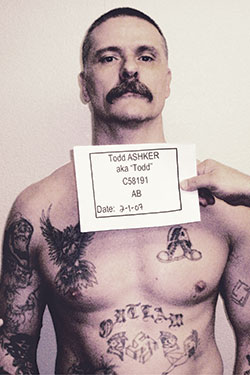
Todd Ashker, alleged member of the Aryan Brotherhood.   
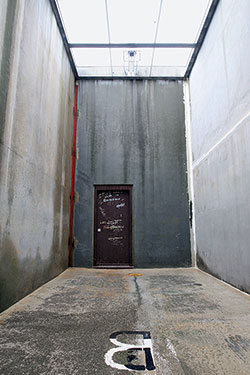
On July 8 of last year, a 50-year-old man named Todd Ashker, an inmate at California’s Pelican Bay State Prison, began a hunger strike. He had compiled a list of demands, but the essential one was that the policy that dictated the terms of his imprisonment be abolished. Ashker was housed in Pelican Bay’s Security Housing Unit, the most restrictive prison unit in California and a place of extreme isolation. Convicts stay in their cells 23 hours a day and leave only to exercise in a concrete room, alone; their meals are fed into their cell through a slot. Other than an awareness that they are staring at the same blank wall as seven other men kept in their “pod,” they are completely alone. Ashker has been there since 1990; in his view, he has been subject to nearly a quarter-­century of continuous torture. “I have not had a normal face-to-face conversation with another human being in 23 years,” he told me recently, speaking from the other side of a thick plate of glass.

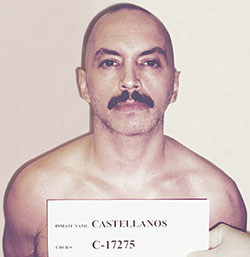
The sheer length of time inmates spend here has made Pelican Bay a novel experiment in social control. The California prison system allows any confirmed gang member to be kept in the SHU indefinitely, with a review of his status only every six years. (Prisoners who kill a guard or another inmate, by contrast, are given a five-year term in the SHU.) This policy has filled Pelican Bay with men considered the most influential and dangerous gang leaders in California. Ashker, allegedly a senior member of the Aryan Brotherhood, had for years shared a pod with Sitawa Jamaa, allegedly the minister of education of the Black Guerrilla Family, and Arturo Castellanos, allegedly an important leader of the Mexican Mafia. In the next pod over was Antonio Guillen, allegedly one of three “generals” of Nuestra Familia. According to the state, these men have spent much of their lives running rival, racially aligned criminal organizations dedicated, often, to killing one another. But over a period of years, through an elaborate and extremely patient series of conversations yelled across the pod and through the concrete walls of the exercise room, the four men had formed a political alliance. They had a shared interest in protesting the conditions of their confinement and, eventually, a shared strategy. They became collaborators.

The men planned for the hunger strike meticulously. They had staged two more modest strikes in 2011, and afterward some had staged private fasts in their cells to try to learn how long they might be able to go without food. The four men had spent the spring putting on weight. Ashker had calculated how much water he needed to drink to keep his electrolytes ­balanced, his heart pumping: 240 ounces a day. In June, the men sent letters to an activist group detailing their grievances, explaining when the strike would begin, and asking other prisoners to join them. In letters to families and friends, they spread the word. Corrections officers throughout the state heard the news; on July 2, a few senior officials visited from Sacramento to meet with the prisoners and measure their intent. They left ­convinced the men were serious. Then, a few days later, the prisoners stopped eating.

The severity of his isolation meant that as the strike began, Ashker had little idea of what effect it was having or how many other prisoners had decided to join him. It turned out to be the largest coordinated hunger strike in American history. On the first day, 30,000 prisoners across the state refused their meals. Three days in, more than 11,000 still had not eaten. “We had expected hundreds, even thousands,” says Dr. Ricki Barnett, a senior official in the state’s correctional health-care system. “We did not expect tens of thousands.”

From the beginning, even the most basic matters about the strike—what Ashker and the others were after, why so many people joined them, what the strike ­demonstrated—were opaque, and profoundly disputed. To the prisoners and their supporters, this was a protest against barbaric treatment, and the SHU was both an outrage in itself and a symbol of the arbitrariness and brutality of the prison system across the nation. The strike’s leaders had challenged the SHU’s constitutionality in court, arguing that the limits it placed on social interaction violated the Eighth ­Amendment’s prohibition on cruel and unusual punishment, and they had watched closely as a few other states, some pressured by prisoners and others mandated by judges, had de-emphasized solitary confinement. They believed they were part of a human-rights movement. But the prison officials saw something far simpler at work: a tactical maneuver by the gangs, acting in collusion, to end a system that had made it much more difficult for them to operate as they pleased.

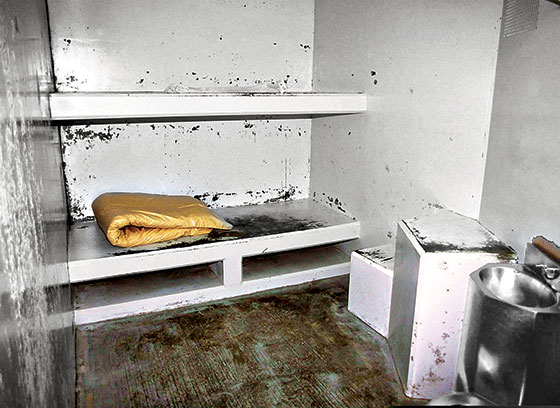
A cell in the Pelican Bay SHU.  
No one had any idea how long the strike would last. For an action like this to have any effect, the four prisoners believed, it needed to be open-ended—the risk needed to mount that they might die on the prison’s watch. Ashker had studied the story of Bobby Sands, the IRA hunger striker who had lasted 66 days and whose death was horrible: He had gone blind, had begun to bleed from bedsores, had lost his mental capacities. The prison health department had done its own research and distributed a medical notice to all state inmates: Those without other health conditions can in most cases expect to live at least several weeks on a hunger strike. This was a tentative statement, though. Hunger strikes are rare enough that there is no good data, and the doctors had been reading up on histories of Civil War internment camps.

Jamaa thought his fellow inmates might need some concrete encouragement. His private fast the previous fall had lasted 33 days, and he believed he could have gone longer. Soon after last summer’s strike began, the four leaders were moved from the SHU to a unit called Administrative Segregation, and Jamaa, entering the unit, started to holler, “Forty days and 40 nights! Forty days and 40 nights!” If prisoners can be counted upon to know any literature, it is the literature of suffering that in the Bible precedes redemption. Jamaa had chosen his slogan with intent: They were Moses in the desert. At night, Jamaa would drop on his knees, put his mouth to the crack between the door and the floor, and yell: “Forty days and 40 nights!” Soon, new hunger strikers arriving in AdSeg were shouting the slogan as they were hustled in. It was then that Jamaa began to believe their movement had some possibility, some momentum.

At first, the fasting prisoners at Pelican Bay were lethargic. Then, after about a week, the nurses found them suddenly chatty and energized. “There were these pockets of brilliant clarity,” says Bill Woods, the chief nurse at the prison. “There is a certain point where your body equalizes out. It has this mechanism to survive.” In their temporary home at AdSeg, the hunger strikers exercised outdoors in individual metal cages, which for some prisoners provided their first view of the horizon in decades. Frogs crawled into the cages; the prisoners could see small wildflowers in the grass. For the first time in years, the men could look into one another’s faces. Jamaa told his sister, 20 days in, that he thought they could last another 60 days, which terrified her. When lawyers asked how they were holding up, one of the prisoners replied, “Not too bad. I can feel the breeze.”

This didn’t last. By late July, the prisoners in AdSeg were cold all the time. Ashker developed a constant pain underneath his collarbone. He started to notice symptoms of claustrophobia—tightness, panic—which in all his time in isolation he had never suffered before. Ashker has a thick chest, and he was convinced that the pain was his body consuming itself, hunting for nutrients. “I could feel the muscle flowing off my body,” he told me.

Over time, the Corrections Department emptied most of AdSeg, transporting dozens of hunger strikers to the state prison at Sacramento, closer to major hospitals. Ashker and his three collaborators were considered too influential and dangerous to transport, and so they were left behind—four prisoners alone, spaced out in an ­otherwise empty corridor of cells as long as a city block. On the weekends, they met with attorneys, and they learned that though the hunger strike had greatly diminished, a hundred prisoners around the state were still refusing food. At night, sometimes, they would try to strategize, shouting at one another underneath their doors, but often they found they were too weak to make themselves heard, and so they would return to their bunks and cover themselves with blankets to conserve energy. It was in this manner that the leaders of the California prison hunger strike approached the end of a summer spent without food, in the same way that they had spent much of their adult lives: in tense, anticipatory solitude.

Picture yourself in a car heading north from San Francisco. Six hours after you leave that spotless city—after you pass the blissful yuppie towns of California wine country, and then the redwoods and hippie outposts of Mendocino and Humboldt, and then two hours of vacant, foggy coast north of Eureka—you arrive in Crescent City, 13 miles from the Oregon border. Physically, culturally, Pelican Bay is as remote from the rest of California as the state’s borders permit. Plaques in the motels warn visitors of the danger of tsunamis. Topographically speaking, the place is a fortress of isolation: Alaska-like, rocky and vertical and misty. It is an amazing place to put a prison.

An exercise yard in the Pelican Bay SHU.  
It is also an amazing prison. Pelican Bay opened in 1989 in response not just to the escalation of crime during the 1980s but to the particular shape that crime had taken. In California, where the inmate population had quadrupled in a decade, prison gangs had been strengthened by the sheer number of people moving through the system. What were at first temporary self-defense cadres became more permanent, and powerful, until they grew into umbrella groups of street gangs. In 1989, a member of the Black Guerrilla Family, a gang formed in prison, shot and killed Huey Newton, the founder of the Black Panther Party, on a West Oakland street. Within a few years, senior leaders of the Mexican Mafia, another prison gang, were asserting control over all of the Hispanic street crews in Southern California: The Mafia taxed street drug sales in return for protecting affiliated gang members who entered the system. Throughout the ’80s, the state had been building ever-more-restrictive units in an effort to quarantine the most influential gang leaders, but none had been effective enough. Pelican Bay was meant to solve that problem.
“From the time it opened, Pelican Bay was seen as having some historical significance,” says Craig Haney, a psychology professor at the University of California, Santa Cruz, who studies prisons. “Many of us saw Pelican Bay as perhaps the wave of the future, and that’s what it became.”


The Pelican Bay SHU, which houses 1,100 prisoners in almost as many cells, takes up half of the prison and operates under policies designed less to punish prisoners than to isolate them from other members of their gangs. Arriving inmates are often told that there are only three ways to leave the SHU: “Parole, snitch, or die.” But parole boards routinely inform SHU inmates that they will not be granted parole until they agree to leave their gang and explain its operations, a formal process known as debriefing. Doing so would send them back to a regular prison, where they would likely become gang targets. So many SHU inmates believe they only really have one option. “A while back, I realized I was probably going to spend the rest of my life in the SHU,” Ashker told me.

Haney visited Pelican Bay three years after it opened and surveyed 100 SHU inmates as an expert consultant to a prisoner lawsuit challenging the unit’s constitutionality. On his first day at the prison, the psychologist saw such florid psychosis that he called the attorneys and urged them to emphasize the confinement of the mentally ill. Once Haney began his interviews, he found serious psychological disturbances in nearly every prisoner. More than 70 percent exhibited symptoms of “impending nervous breakdown”; more than 40 percent suffered from hallucinations; 27 percent had suicidal thoughts. Haney noticed something subtler, too: A pervasive asociality, a distancing. More than three-quarters of the prisoners exhibited symptoms of social withdrawal. Even longtime prisoners reported feeling a profound loss of control when they entered the SHU, in part because they weren’t sure whether they’d ever be released. Many reported waking up with a rolling, nonspecific anxiety. The SHU “hovers on the edge of what is humanly tolerable,” wrote Thelton Henderson, the federal judge who decided the prisoner lawsuit in 1995. You can sense a vast uncertainty in that first word, hovers. The judge ordered major reforms—the seriously mentally ill, for instance, could no longer be housed there—but he let the SHU stand.

That was more than 18 years ago. Some of the same prisoners are still there. Haney returned to Pelican Bay last year, for a ­follow-up study, and found that these ­patterns of self-isolation had deepened. Many inmates had discouraged family members from visiting, and some seemed to consider all social interactions a nuisance. “They have systematically extinguished all of the social skills they need to survive,” Haney says. Those inmates who do comparatively well tend to replace the social networks outside the SHU with those within it—which, in a society composed of alleged gang members, often means gangs. “In isolation,” he says, “gang activity is the only contact that is possible; it is the only loyalty that is possible; it is the only connection that is possible.”

This is one way of understanding the paradox of American mass incarceration: There are 2.4 million prisoners across the country, four times more than in 1980, and Supermax facilities managed similar to Pelican Bay in at least 44 states, and though this corresponds with a dramatic drop in street crime, the system of prison gangs has flourished. In Pelican Bay, there are significantly fewer murders in the prison than there were a decade ago, but the gangs’ power has hardly softened: Prosecutors allege that current SHU inmates manage the affairs of street gangs in Los Angeles and direct negotiations with Mexican cartels. Elsewhere, the situation is even less stable. Baltimore’s city jail had, by 2012, fallen so ­completely under the control of a prison gang that, according to prosecutors, its leader not only maintained a network of guards who smuggled in drugs and weapons, but also impregnated four guards while behind bars. Last year in Colorado, an alleged member of a white prison gang, who had served several years in SHU-like isolation, assassinated the executive director of the state’s prison system on the official’s own doorstep.

Arturo Castellanos   
These are signs that the system either isn’t working well enough or isn’t working at all. Over the summer, when international television broadcasts began to pick up the news of the hunger strike and demonstrations were staged in Berkeley and Los Angeles and celebrities like Jay Leno and Bonnie Raitt wrote letters of support, Ashker and the others began to talk more broadly about what was possible. “A worldwide movement against solitary confinement,” Ashker explained. This was rhetoric, but sometimes the medium is more important than the message. The fact of the hunger strike—that men who had spent decades in as restrictive a prison as has been devised had convinced a quarter of the state’s prison population to starve itself—did not necessarily prove that their conditions amounted to torture. But it did suggest something else: that perhaps human isolation of the kind that Pelican Bay was built to achieve was impossible. Every hunger strike is a form of Roman advertising, a demand to be recognized: I am still here. The leaders of the Pelican Bay hunger strike, conscious of it or not, were making a second statement, too: Look at what we can do. 

In 1987, Ashker killed another white inmate at New Folsom prison, entering the man’s cell and stabbing him 26 times. Prosecutors were convinced the murder had been an Aryan Brotherhood hit, ordered because the victim had refused to cut the gang in on his methamphetamine deals. When the case came to trial, Ashker persuaded his court-appointed attorney, Philip Cozens, to call another inmate, an Aryan Brother named Paul Schneider, as a witness. Prison guards brought ­Schneider to the courthouse in leg irons, and he and Cozens spoke about the upcoming testimony in a side corridor. When the conversation had finished, and Cozens, back turned, was walking away, Schneider attacked the lawyer from behind, with an eight-inch blade he had hidden in his rectum. Cozens survived the stabbing. He believes that Ashker was behind the attack, that the knifing was an attempt to provoke a mistrial. But the judge refused to halt the case, and Cozens, now accompanied by a bodyguard, continued to serve as defense counsel. Ashker was convicted of second-degree murder. Schneider wound up testifying anyway. Ashker, he ­reportedly told the jury, was “a good white dude.”

Ashker got his first swastika tattoo when he was 19, a seventh-grade dropout in prison for burglary. He says he was motivated partly by white pride and partly by the sheer juvenile thrill of doing something outrageous. He describes himself then as “a rebel at heart.” This identity exchange happens often in prison: an inmate fuzzes out the specific parts of his personhood and instead inhabits the most threatening idea of his race. But that tattoo, and the others that followed, have a context, prison officials say: They advertised that he was affiliated with the Aryan Brotherhood, the white prison gang that was then warring with the Black Guerrilla Family. Ashker denies membership in a gang, but by 1990, three years after the murder, prison officials had pinpointed him as an Aryan Brother. Pelican Bay was built to house “the worst of the worst.” Ashker fit the bill. In he went.

Ashker is six feet tall, with a handlebar mustache and somewhat wild eyes, but his speech is direct and tautly compressed. Even his handwriting exhibits extreme control: His script is impeccable. “Eager to talk,” is how a fellow inmate describes him. “They don’t give us a lot of time,” Ashker said tensely when we met. Because Ashker has few connections to family (his mother has visited exactly once, in 1993) and because there are few whites in the Pelican Bay SHU, the pressures of isolation fell more heavily on him than on most other prisoners. “You do a lot of self-­reflection—you don’t have a choice,” he said. “If you think too much about the past, or the future, it gets real depressing. I look at it as, my life has been a waste of space.” He said this very matter-of-factly.

Prisoners in the SHU look for a salve against this abyss or a distraction from it. Often they nurse a grievance. “You get through the first four or five years on anger alone,” Jamaa told me. Ashker is, unexpectedly, an optimist, and he learned to channel his anger through the law. Shortly after moving to the SHU, he was shot in his right arm by a guard. Three weeks later, while under treatment by prison doctors, an artery in his arm burst and he nearly lost his hand. Ashker sued, and a federal jury awarded him $225,000. This opened his mind. He earned a paralegal’s certificate through a correspondence course. He has now sued the prison system 15 times—for forbidding SHU inmates from sending letters to inmates in other prisons, for refusing to let him buy thermal shirts to keep his injured arm warm. Once, after Ashker had represented himself at a legal hearing in San Francisco in which the judge ruled in his favor, he was driven back across the Golden Gate Bridge in chains. It was one of those perfect California days—sun shining everywhere. “There are these moments,” he told me, remembering, “when you realize that you are still alive.”

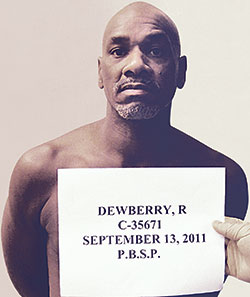
Sitawa Jamaa (known by officials as Ron Dewberry)  
In 2006, authorities at Pelican Bay reorganized the SHU. Until then, the prison had often rubber-stamped SHU inmates’ requests to be moved to another pod, meaning that members of the same gang were often housed together. The reorganization created a prison within a prison within the prison, moving the most influential leaders of each gang to a wing called the Short Corridor, isolating them from lieutenants who had been doing their bidding. Which is how, not by accident but by some warped genius of institutional design, four men with what officials believe to be vast influence over the entire state’s inmate population came to be housed within shouting distance.

The men were wary around one another at first. But they were aging, and perhaps growing more reflective, and they had nothing to do but talk with neighbors they couldn’t see; the experience of the SHU is monotony in motion. Guillen talked about his son, who had been arrested; Castellanos about his brother, who was also in the SHU. They had grievances in common, too: Their isolation in the Short Corridor seemed to confirm to them that they had been singled out. Ashker grew particularly close to an older, politically minded white inmate on the pod named Danny Troxell. Eventually, ­Troxell and Ashker became something of a revolutionary book club. They read Naomi Wolf, Howard Zinn, Michel Foucault. The ideas that stayed with Ashker the longest came from Zinn: that they were all members of a single prisoner class and that racial animosities had been leveraged by the guards to divide them. “One of their purposes,” he told me, “is to sever all your ties to humanity.”

By 2009, Ashker was corresponding with a sociologist at SUNY-Binghamton named Denis O’Hearn, and on O’Hearn’s suggestion, he read a copy of a book the professor had written, a biography of Bobby Sands. O’Hearn had, in his book, emphasized that even though Sands had died during his protest, he had achieved a great deal in winning political sympathy for his cause. In studying Sands, Ashker read of an ancient Irish tradition called the King’s ­Threshold, in which a commoner who believed that he had been wronged by a nobleman would fast on the aristocrat’s door to gain attention and public sympathy. Ashker found this incredibly moving. He and Troxell began to talk about Sands’s example and about the risks and possibilities a hunger strike might offer. Jamaa, a studied revolutionary who had been reading about Sands and other hunger ­strikers for two decades, listened to Ashker’s epiphany with jaded amusement. But he did listen. “Every time we’d start talking about it, we’d notice the pod going quiet—we knew people were listening,” Ashker told me.

What Ashker and Troxell represented was a kind of “split faction” within the Aryan Brotherhood, Lieutenant Jeremy Frisk explained in a ­conference room in Pelican Bay’s headquarters building earlier this winter. Projected onto a screen was a diagram of the Aryan Brotherhood’s hierarchy. The three men at the top of the diagram, who he said composed the gang’s “commission,” had been ambivalent about the project, in part because Ashker was not especially popular within the Brotherhood and in part because they saw little advantage. But Guillen, Castellanos, and Jamaa, Frisk said, each had more personal pull among their racial groups. The Black Guerrilla Family has long been the most political gang, and its members could be expected to participate. The Pelican Bay gang-investigations unit soon noticed coded messages discussing the wisdom of a hunger strike passed among members of the two Hispanic groups and to their allies on the outside. In these deliberations, Frisk believes, Castellanos and Guillen were decisive. “Castellanos is, if not the most influential Mexican Mafia member, right there at the top. Once you put his name on something with orders, the southern Hispanics are going to do it,” he said. “And Guillen is the street-regiment general for the NF.” One former Nuestra Familia member says that his gang’s participation had been all Guillen’s doing: “It was Chuco Guillen, 100 percent.”

To see the yard as the prison guards do is to become alert to a hidden social physics in which the real actors are not individuals but networks. There is never just a hotheaded punch to a guard’s cranium, never just an enterprising drug dealer caught smuggling in supply. Political protests are never just that; they are always a conversation, in thug semiotics, among gangs and between gangs and guards, each move deliberated over with great care by a council of elders isolated in solitary cells. Guards talk with respect about the ingenuity of gang leaders, and with exasperation at the ends to which it is put (“a waste of human talent,” Frisk says about the SHU). Prison officials believe that gangs control most of what goes on among the state’s inmate population. In the high-security prisons, “almost everything happening out there has some influence of gang activity,” says Michael Stainer, a deputy commissioner of the California prison system.

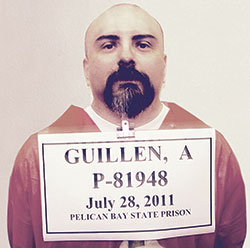
Antonio Guillen  
This means that most convicts sentenced to prison in California are also sentenced to a relationship with a gang. Each of the four major gangs in the system enjoy something close to a racial monopoly on membership: the Aryan Brotherhood for whites, the Black Guerrilla Family for African-Americans, the Mexican Mafia for Hispanics from the southern part of the state, and Nuestra Familia for Hispanics from the Central Valley and farther north. Prisons sometimes institute separate exercise schedules for each racial group, and it is very rare to find two cell mates in California from different ones. These practices have helped to reduce gang conflict but also, obviously, strengthen the gang system. ­Corrections officials at Pelican Bay will often switch, sometimes in midsentence, between referring to a “gang” and a “race” and a “group.”

This ambiguity has long been institutionalized in the “validation” process through which alleged gang members are committed to the SHU. Investigators must document three pieces of evidence confirming an inmate’s gang membership. Often this is a tattoo or the statement of an anonymous informant. But expressions of ­ethnic identity and radicalism—black nationalist writings, for instance—can also be counted as gang-related. Even social ­relationships between members of the same ethnic group can be outlawed: Some prisoners have been validated for speaking with a known gang member from their own racial group. The prison officials, Jamaa told me, “blur the line between what is a gang and what is a racial group. They have to, because they don’t understand where a gang ends and a racial group begins.”

Pelican Bay is a strange hybrid of a place: Systems of isolation and communication vie constantly for control. SHU prisoners learned the architecture of the toilet drains and have used them to shout messages to other pods. Members of Nuestra Familia developed a system of information exchange through the law library—ghostwriting messages in legal books and then sending coded messages in letters to family members explaining which page in which book fellow gang members ought to consult. In gang lore, Pelican Bay has assumed a mythic place: The Mexican Mafia calls it La Playa Azul (“the Blue Beach”), and the bylaws of Nuestra Familia stipulate that its core leaders must be housed there. When a court order temporarily increased mail monitoring at Pelican Bay last fall, Frisk heard from gang investigators in the Los Angeles area: The crews were saying that there were no instructions coming from headquarters, that they did not know what to do. But most of the time, despite extreme restrictions, gangs find a way to function. “All Aryan Brotherhood decisions, including membership and the decision to murder another member, are conducted by vote,” says Bryan Elrod, a former Aryan Brotherhood member who recently “debriefed” and was transferred out of Pelican Bay. “Sometimes it could take months to complete voting in SHU.” But the votes did happen.

The central mystery of this summer’s hunger strike lies in its scope. Why did 30,000 prisoners around the state join a protest called by four men in the SHU? Most prison officials contend that these prisoners were prodded by the gangs. “There was a high element of coercion going on,” Stainer says. Many of the inmates who went on strike lasted just three days—proof, another senior prison official told me, that many participants were only joining to get credit from their gang. Javier Zubiate, a former Nuestra Familia member, was asked during his debriefing interviews why he had joined the strike. He said that he had seen the public letter from Antonio Guillen, and “we took that as an order from a general.”

Even so, prison officials had documented only one example of explicit coercion: an inmate at Corcoran state prison who was beaten after he refused to help his cell mate participate. Beyond that, there was nothing violent. In Pelican Bay, things were quiet. “They had said that they wanted the protest to be peaceful, and by and large it was,” says Clark Ducart, the chief deputy warden. Which suggests that perhaps the protesting prisoners were motivated by something other than simply pressure and that the allegiance they feel to their gang is not only a matter of intimidation and racial supremacy.

At every stage in the criminal-justice system, its basic moral complexity recurs: What part of a criminal act is an individual’s responsibility alone, and what part is the consequence of his circumstances—of poverty or racial alienation? In Pelican Bay, the prisoner is treated not as an individual but as a soldier for the group to which he belongs. The crucial question the validation process has asked, for years, has not been “What has this man done?” but “To what does this man belong?” But there has been a self-fulfilling element to this approach: Treat prisoners as racial blocs and all social networks as if they are gangs, and for all of its essential violence and brutality, the gang will retain some of the warmth, the underlying human attachment, of the social network on which it is built. “To this day, I love some of those men,” Elrod told me earlier this month from the secure unit at Kern Valley State Prison where he is now housed to keep him safe from the revenge violence of his former brothers.

Once the Short Corridor Collective, as Ashker and his conspirators started to call themselves, had a hunger strike in mind, even ordinary grievances acquired weight. In 2011, the SHU was put on lockdown after a disturbance in the general population. “We hadn’t even done anything,” Ashker told me. “I said, ‘Hey, this is just gonna be the norm. Everything that happens, they’re gonna come back on us.’ ” Among the Brotherhood, word circulated that Ashker and Troxell were “willing to go out in a box.” Jamaa wrote letters to prisoners-rights groups; if the Collective was serious, they needed some support from outside. That summer, the Collective staged their first two brief hunger strikes, which resulted in minor victories, like getting a pull-up bar and a handball in the exercise room. Even here, though, gang activity and political activity were hard to separate: Elrod says that when he and Ashker were briefly moved into AdSeg together, they took the chance to discuss Aryan Brotherhood business.

The next year, the Collective published a joint letter calling for the cessation of all hostilities among racial groups in prison. Jamaa had written the original draft and read it out to the others on the cell block, who each helped to edit it. To the four men in the Collective, the document felt like a great accomplishment, an end to the interracial prison wars in which they had spent their adult lives. They had some hope that the truce could eventually extend to the streets. “This is an historical document,” Jamaa said. “We are a prisoner class now.”
They asked the Corrections Department to post the letter in each of their facilities, and they imagined videos broadcast in prisons around the state in which they urged inmates to cooperate rather than to fight one another. The officials refused and issued Castellanos a rules violation when he discussed it with his family. The men in the Collective took it hard. Soon those same family and neighborhood networks that prison officials believe are often used to convey gang commands out to the street were carrying news of a coming hunger strike, and inside the Short Corridor the inmates were putting on weight in anticipation.

It felt freezing in AdSeg, all the time. The four remaining prisoners were convinced that the guards were blasting in cold air, trying to freeze them into ­submission. But each time the prison doctor, Donna Jacobsen, visited the AdSeg, she checked the thermometer, and it always read normal. Their bodies, she thought, must simply have lost the ability to regulate temperature.

Negotiations were static. The prisoners were demanding face-to-face meetings with top state correctional officials; these were refused. But the medical threat was escalating. Jacobsen, a former HIV physician from Miami, was focused less on the prisoners’ steady deterioration than on what might happen to them once they started to eat again. “Being on hunger strike isn’t the riskiest part; it’s the refeeding that can be incredibly dangerous,” Jacobsen says. The longer the prisoners went without nutrients, the more their electrochemical systems slipped out of balance. Refeeding “can basically stop your heart if you don’t have the right levels.” Her staff had offered vitamin supplements to the men to try to stabilize their electrolytes. After some initial resistance, they were accepted. But there was a paradoxical effect: “The vitamins rejuvenated us,” Jamaa told me. When a low-ranking official from Sacramento came up to meet with the prisoners, Jamaa rebuffed him. “I said, ‘I’m willing to die right now.’ ”

Each weekend, a veteran Oakland activist lawyer named Anne Butterfield Weills made the long drive up to Crescent City to meet with the prisoners. “I literally saw them shrink,” Weills says. She received a call from strikers who had been transported down to Sacramento: Did Ashker, Jamaa, Castellanos, and Guillen want them to continue to strike? What should they do? Newspaper and television stations were reporting a macabre daily watch—how many men were still on strike, how long had they each gone. One hunger striker had died already, though the coroner would later rule that he had strangled himself. There were still 69 men who had not eaten at all in more than 40 days, and many of them had written letters saying they would not cave. Weills was spending some of her time at Pelican Bay working on advance medical directives.

Then the standoff ended. On the 43rd day of the strike, Judge Henderson (the same judge who had, nearly two decades earlier, ordered reforms to the SHU) issued an order giving the state permission to force-feed prisoners who were at “near-term risk of death or acute bodily injury.” The order also allowed the state to override prisoners’ Do Not Resuscitate orders, if it had a reason to believe they had been coerced. Health officials, worried about the escalating risks, had joined the Corrections Department’s petition for the order. “I was concerned that the 40 or 50 leftover people might die,” says Barnett, the senior official at the department.

The leaders of the strike “were blindsided,” Weills says. The protocols for force-­feeding, in place for a decade at the Guantánamo Bay prisons, are medically straightforward but still deeply invasive: A tube is inserted up a patient’s nose and down into his stomach, and restraints are used if the patient physically resists. Of the dozens of prisoners on strike, the leaders wondered, how many would go through with force-feeding? And would there be any power in resisting? “Our leverage was the threat of death,” Ashker told me. Now that was gone.

Until this point, the prisoners had thought of the guards—and, more broadly, the state—as their captors. But the state is also their warden and their protector: A prison is designed to separate convicts from society and prevent them from doing more harm, but also to shelter them and keep them alive. The judge’s order returned repeatedly to the problem of coercion. The specter of gang influence was so strong, Henderson’s ruling suggested, that the state could not trust that a prisoner’s advance medical directive had been made freely—that he had made his own decision about the terms under which he was willing to die. The strike leaders had thought that by volunteering to risk their own deaths they could compel the state to see them as individuals, and that in at least this one instance they could reassert freedom of control over their lives. But they had been wrong.

The men were still not eating, but they were debating how to proceed. Two prominent state legislators offered to hold a special hearing on conditions in the SHU. During the first hunger strikes, in 2011, Jamaa had been the hard-liner, but he is also the most politically attuned, and the promise of ongoing legislative scrutiny, something the prisoners had never managed to win, seemed to him a breakthrough. “That is a victory,” he told the others.

Eventually, somewhat reluctantly, they all agreed. On September 5, the 59th day of the hunger strike, the leaders of the Short Corridor Collective announced that they were “suspending” their action. The next day, Jacobsen met with each of the prisoners in their cells to explain the dangers of refeeding and the ideal way to manage it. Their sustenance once more in the hands of the state, they were gingerly, carefully, fed.
The end of the hunger strike was so deflating that it wasn’t until the second legislative hearing into SHU conditions was held, this month in Sacramento, that it began to seem plausible that Jamaa had been right, and that the hunger strikers had won something meaningful. At that hearing, even officials with the Corrections Department seemed to acknowledge that change to the SHU was inevitable. “We all agree that it is far too easy to get in and too hard to get out, and the stays in this environment have been far too long,” Martin Hoshino, an undersecretary of Corrections, testified. Hoshino and Stainer presented the Department of Corrections’ new validation process, which is meant to emphasize not associations but behavior. Tom Ammiano, the chair of the Assembly’s Committee on Public Safety, introduced a bill that would prohibit any prisoner from being kept in isolation indefinitely.

Prison policy is usually shaped out of public view, but the duration and visibility of the hunger strike has helped make the subject politically urgent. Last week, New York State agreed to extensive new restrictions on whom it could confine to its SHU. This week, in Washington, the Senate Judiciary Committee is holding a hearing titled “Reassessing Solitary Confinement.” Other states have also curtailed the use of isolation recently—Indiana, where change was compelled by a federal judge’s ruling, and Maine, Mississippi, and Colorado, which had faced pressure from prisoners’-rights groups. These changes are too few to constitute a total rejection of the practice. But for the first time, it has begun to seem plausible that the American attachment to this special kind of imprisonment is not a national peculiarity so much as a generational one, and that a 25-year experiment may be ending.

To Ashker, these changes are the subject of much attention and contemplation. But they are also very abstract. Since the hunger strike, he has been more isolated than ever. Before last year’s strike began, he was moved to a new pod, which had the effect of breaking up the Short Corridor Collective and separating him from Danny Troxell, his good friend. Troxell had given Ashker a small photograph of himself as a memento. When the guards found it, they took it away and gave Ashker a major rules violation for having secreted it. “They said it was gang-related,” he said bitterly when we spoke in December. “I mean, it’s a photograph.”

His television has been taken away from him as a consequence of the rules violation. For all of his legal endeavors and strategic planning, he has received only two social visits since 2007. He is the only white man in his new pod and is surrounded by strangers speaking Spanish. On some Sunday afternoons, he listens to a D.J. called Sista Soul on a public radio station that broadcasts from Humboldt County and plays recorded messages to the men in Pelican Bay sent in by family members, ex-girlfriends, female pen pals. A rare recent call for Ashker, from a woman whom he has never met: “This is a shout-out of love and admiration to Todd in the SHU from Julie in Western Australia. I hope hearing my voice brightens your day. Bye for now, my love.”

He has had trouble getting comfortable in his new cell. The problem is his mattress. It is too short, and his feet dangle off the end. It is also too thin. “As soon as I laid on it, it flattened out,” he told me. He tried shaking out the padding, smoothing it out with his palm. “It’s good for a minute, but then as time passes, it collapses again.” The padding is now permanently separated to the sides of his mattress, so that as he enters his sixth decade of life, he is sleeping on a thin plastic sleeve on a stone bench.

“I feel like exploding,” Ashker said.

Thursday, January 23, 2014

Nader calling solitary what it is: Torture.


 America's Invisible and Costly Human Rights Crisis

Ralph Nader
Posted: 01/21/2014 2:28 pm


When the news broke years ago that U.S. forces were using torture on prisoners at Guantanamo Bay detention camp, many politicians and the public expressed appropriate horror. There was shock and disappointment that our country would resort to such inhumane, abusive actions against our fellow human beings, most of whom then were innocent victims of bounty hunters in Afghanistan.

With this frame of reverence in mind, it is unfortunate that many Americans do not contemplate -- or are simply unaware of -- blatant torture occurring in prisons every day right here in the United States. This form of physical and psychological violence is called many things: "isolation", "administrative segregation", "control units", "secure housing" and by its most well-known designation, solitary confinement. This practice of imprisonment is widely used across our nation with disturbingly little oversight and restriction. The full extent of the use of solitary confinement is truly alarming -- it is most certainly a human rights abuse and a blight on our national character.

Imagine yourself being locked in a small windowless room for days, weeks, or years... perhaps even for the majority of your life. You receive food and water through a small slot and have little-to-no human contact -- you might go days or weeks without speaking to another person. You are allowed out for perhaps an hour a day for some exercise. This is the living reality for tens of thousands of Americans in our prison system. Self-mutilation and suicide attempts among those in solitary confinement are far too common. Not surprisingly, studies have shown that the majority of prison suicides are inmates who were being held in solitary.

Many more studies have shown that solitary confinement has a severe psychologically damaging effect on human beings. For prisoners already suffering from mental illness, it exacerbates their problems. Senator John McCain wrote of his experience in solitary confinement as a P.O.W. in Vietnam: "It crushes your spirit and weakens your resistance more effectively than any other form of mistreatment."

Many might dismiss and even justify punishment by solitary confinement by convincing themselves that those subjected to it are "bad people." But this is a gross misunderstanding of its common use in our prisons. Many prisoners held in solitary are mentally ill, mentally handicapped, or illiterate. Some are placed in solitary purportedly for their "safety" to protect them from themselves or from other prisoners.

Some put in solitary are children as young as 14 or 15. What type of prison infraction would result in a 15 year old being locked up in solitary? -- "15 days for not making the bed; 15 days for not keeping the cell door open; 20 or 25 days for being in someone else's cell" are some, according to a report on the issue by Human Rights Watch.

Journalist James Ridgeway calls the use of solitary confinement "a second sentence." The first sentence is, of course, being sent to prison. The second sentence is totally decided by the warden and guards without appealable criteria. As such, the act of disobeying instructions or vaguely interpreted prison rules or the whim of the warden can warrant a lengthy stay in solitary. The lack of accountability in this area is notorious and critical. For many prisoners, a stay in solitary is a death sentence.

Ridgeway, along with Jean Cassella, founded Solitary Watch (solitarywatch.com) in 2009. Their goal is to bring attention to what really goes on in America's prisons, which are subjected to so little public exposure of their daily operations.

The United States is the world leader in locking people up. There are currently about 2.3 million imprisoned people in the United States. About 25 percent of them are there for nonviolent drug offenses, victims of the insatiable "prison-industrial complex" which costs taxpayers billions of dollars every year. Of these millions of inmates, it is estimated that as many as 80,000 are being held in solitary confinement according to Solitary Watch. Prisons are not required to provide data on how and when they use this highly questionable method of incarceration. Over 40 prisons are considered "supermax" facilities where the majority of cells are solitary units. These prisons alone account for about 30,000 people.

For-profit corporate-owned prisons like solitary confinement because it extends a prisoners' sentence. It is also far more expensive to keep prisoners in solitary confinement -- one study estimates that the average cost of housing an inmate in a supermax prison is $75,000, as opposed to $25,000 per cell in a regular state prison. This cost is passed along to taxpayers.

Imagine how things might change if more ordinary Americans had access to inspect the prisons their tax dollars pay for. A precedent for this exists. In Great Britain, "Independent Monitoring Boards" offer a unique civic perspective on regulating what happens inside prison walls. Ordinary citizens are able to volunteer to be these independent monitors. Volunteers are allowed unannounced access to prison facilities anytime, day or night. The volunteers are free to tour the prison, speak with the inmates, sample the food, and inspect the clothing and the state of medical care.

(Read Solitary Watch's article on British Prisons here.)

Such an idea of citizen responsibility might seem highly unusual to most Americans to whom prisons are largely out of sight and out of mind. The first step in addressing this crisis of abuse is raising awareness.
Reporters are rarely given full access to prisons so they can report on what is going on inside. Let the press in! The best source of information about the state of our prisons is the prisoners themselves -- but press access to them is restricted and the Department of Justice is not listening to their appeals. With this barrier in place, prisons are virtually shut off from any accountability or independent oversight. Wardens and guards are the only ones making decisions about the treatment of many prisoners.

And where are the judges? All judges -- federal, state, and local should have firsthand knowledge of the conditions in prisons so that they can make better informed decisions when sentencing those who come before them.

Here's a bold suggestion that might move the needle. All nine members of the United States Supreme Court should spend 48 hours in solitary confinement. Imagine how quickly the treatment of our incarcerated population would change if those at forefront of our judicial system had a small taste of what it is like to be locked in a tiny cell, alone, with no human contact for such an amount of time. Just 48 hours! There is precedent for some state judges actually spending time in prison years ago.

Some prisoners, such as Herman Wallace, have spent the majority of their lives suffering under these conditions. Wallace spent 41 years in solitary confinement while maintaining his innocence. The warden of the Louisiana prison where he was held ascribed his "Black Pantherism" as the reason. Wallace was released in October of last year and died three days later at the age of 71. These acts of astonishing cruelty should not happen in a country governed by the rule of law.

Too many people overlook the plight of prisoners, deeming them criminals and not concerning themselves with the plights of people they feel have no place or say in our society. There is little recognition of wrongful convictions and the role of rehabilitation that has worked in other western countries with far less recidivist rates then in the U.S. This mindset is a major obstacle in drawing attention to the inhumane treatment inmates often receive in our justice system.

The legendary investigator Jim Ridgeway says of the Solitary Watch project: "We're not trying to let criminals out. We're just trying to let people know what is going on."

For those who want to do something now, consider donating to Solitary Watch's campaign "Lifeline to Solitary." This lean and efficient campaign means to establish contact with prisoners held in long-term solitary. This connection serves two purposes -- it allows Solitary Watch to correspond with prisoners and report on their conditions. Secondly, it provides those in isolation a key connection to the outside world and a reminder that they do matter. Visit the Lifeline to Solitary fundraising page here.

Prisons are a grim and unpleasant part of our system of justice. That said, we can do much, much better about how to humanely treat people who are serving their time often under grotesquely long sentences for non-violent crimes.

Tuesday, June 11, 2013

Quakers and ACLU slam new Arizona SUPERMAX plans.


the ghosts of jan brewer, at the capitol this spring...
 

Below are more echoes of "STOP the MADNESS!" from the community...we'll see if our legislators bother to hear...


Sunday, July 22, 2012

Prisoners are still Persons: Solitary destroys the soul....

For those who missed it, an excellent and pointed editorial on solitary confinement by Colin Dayan, with links at the bottom to more the NY Times has done on the issue...

Here is also the link to the American Friends Service Committee 2007 project: "Buried Alive", about solitary confinement in Arizona.

And for those of you with loved ones in isolation/special management/control units, here's a manual to print up and send them: SURVIVAL IN SOLITARY


-----------from the New York Times------------

Opinions: Destroying the soul

New York Times (JULY 5, 2012)

Colin Dayan is Robert Penn Warren professor in the humanities at Vanderbilt University and the author of “The Law Is a White Dog: How Legal Rituals Make and Unmake Persons.”
 
We as a nation are guilty of the most horrific treatment of prisoners in the civilized world. In March, 400 prisoners in California’s Security Housing Units, as well as a number of prisoners’ rights organizations, petitioned the United Nations asking for help. Since then, the Center for Constitutional Rights has filed a federal lawsuit on behalf of prisoners at California’s Pelican Bay State Prison who have each spent between 10 and 28 years in solitary confinement . A class-action suit in Arizona challenges inadequate medical and mental health care that subjects prisoners to injury, amputation, disfigurement and death — especially in prolonged solitary confinement. 

Supermax detention is the harshest weapon in the U.S. punitive armory. Once, solitary confinement affected few prisoners for relatively short periods. Today, most prisoners can expect to face solitary, for longer periods and under conditions that make old-time solitary seem almost attractive. The contemporary state-of-the-art supermax is a clean, well-lighted place. There is no decay or dirt. And there is often no way out.

This is not the “hole” portrayed in movies. As a sign of professionalism and advanced technology, extreme isolation and sensory deprivation constitute the “treatment” in these units. Supermaxes modify inmates’ spatial and temporal framework, severely damaging their sense of themselves: a terrible violence against the spirit and a betrayal of our constitutional and moral responsibilities.

More than a decade ago, I began visiting the “Special Management Units” at the Arizona State Prison Complex-Eyman in Florence. I completed a series of interviews in an attempt to understand this new version of solitary confinement. Prisoners there are locked alone in their cells for 23 hours a day. Their food is delivered through a slot in the door of their 80-square-foot cell. They stare at unpainted concrete walls onto which nothing can be put. They look through doors of perforated steel, what one officer described to me as “irregular-shaped Swiss cheese.” Except for the occasional touch of a guard’s hand as they are handcuffed and chained when they leave their cells, they have no contact with another human being.

In this condition of enforced idleness, prisoners are not eligible for vocational programs. They have no educational opportunities; books and newspapers are severely limited; post and telephone communication virtually nonexistent. Locked in their cells for as many as 161 of the 168 hours in a week, they spend most of the brief time out of their cells in shackles, with perhaps as much as eight minutes to shower. An empty exercise room — a high-walled cage with a mesh screening overhead, also known as the “dog pen” — is available for “recreation.”

These are locales for perpetual incapacitation, where obligations to society, the duties of husband, father or lover are no longer recognized. An inmate wrote me, “People go crazy here in lockdown. People who weren’t violent become violent and do strange things. This is a city within a city, another world inside of a larger one where people could care less about what goes on in here. This is an alternate world of hate, pain, and mistreatment.”

Situated on 40 acres of desert, Special Management Unit 2 is surrounded by two rings of 20-foot-high fence topped with razor wire, like a nuclear-waste storage facility. During my visits, I learned that those who have not violated prison rules — often jailhouse lawyers or political activists — are placed apart from other prisoners, sometimes for what is claimed to be their own protection; sometimes for what is alleged to be the administrative convenience of prison officials; sometimes for baseless, unproven and generally unprovable claims of gang membership.

We citizens are proud of our history. We are a nation of laws. But what kind of laws? Laws that permit solitary confinement, with cell doors, unit doors and shower doors operated remotely from a control center, with severely limited and often abusive physical contact. Has society’s current attention to the death penalty allowed us to forget the gradual destruction of mind and loss of personal dignity in solitary confinement, including such symptoms as hallucinations, paranoia and delusions?

The philosopher Jeremy Bentham came to believe that solitude was “torture in effect.” Other 19th-century observers, including Charles Dickens and Alexis de Tocqueville, used images of premature burial, the tomb and the shroud to represent the death-in-life of solitary confinement. Some 25,000 inmates are languishing in long-term isolation in America’s supermax prisons, with as many as 80,000 more in solitary confinement in other facilities.

A Senate Judiciary Committee panel heard testimony last month on solitary confinement. I hope that someone reminded lawmakers of Justice William Douglas’s words nearly 40 years ago: “Prisoners are still ‘persons.’ ” 
 
More on this debate:
 
Anita Kumar: House kills study to reduce solitary confinement in prisons

Thursday, March 15, 2012

NY TIMES: Solitary wastes lives, money, and sanity.

Abolishing solitary confinement as we know it can be done, people, and work out for the better for all of us - if Mississippi can do it, so can Arizona. The vast majority of prisoners do return to their communities after all, and we would be wise not to destroy their sanity and humanity while "rehabilitating" them beforehand. 

This state, unfortunately, is constructing 500 more Supermax beds as we speak, however - no public hearings, no way to stop them...what a waste of precious resources. No one at the ADC seems to know what "evidence-based practice" means or why they should study up on it. For that reason, crime in this state will never really be impacted by the rate at which we incarcerate people - all the state is doing is setting people up to repeat again.


Our state facility for the seriously mentally ill
SUPERMAX in Florence, AZ


------------from the New York Times-------------

 Prisons Rethink Isolation, Saving Money, Lives and Sanity


CHANGED ATTITUDES Christopher B. Epps, Mississippi's commissioner of corrections, said he used to believe that difficult inmates should be locked down as tightly as possible, for as long as possible. “That was the culture, and I was part of it,” he said.

PARCHMAN, Miss. — The heat was suffocating, and the inmates locked alone in cells in Unit 32, the state’s super-maximum-security prison, wiped away sweat as they lay on concrete slab beds.

Kept in solitary confinement for up to 23 hours each day, allowed out only in shackles and escorted by guards, they were restless and angry — made more so by the excrement-smeared walls, the insects, the filthy food trays and the mentally ill inmates who screamed in the night, conditions that a judge had already ruled unacceptable. 

So it was not really surprising when violence erupted in 2007: an inmate stabbed to death with a homemade spear that May; in June, a suicide; in July, another stabbing; in August, a prisoner killed by a member of a rival gang. 

What was surprising was what happened next. Instead of tightening restrictions further, prison officials loosened them. 

They allowed most inmates out of their cells for hours each day. They built a basketball court and a group dining area. They put rehabilitation programs in place and let prisoners work their way to greater privileges.
In response, the inmates became better behaved. Violence went down. The number of prisoners in isolation dropped to about 300 from more than 1,000. So many inmates were moved into the general population of other prisons that Unit 32 was closed in 2010, saving the state more than $5 million. 

The transformation of the Mississippi prison has become a focal point for a growing number of states that are rethinking the use of long-term isolation and re-evaluating how many inmates really require it, how long they should be kept there and how best to move them out. Colorado, Illinois, Maine, Ohio and Washington State have been taking steps to reduce the number of prisoners in long-term isolation; others have plans to do so. On Friday, officials in California announced a plan for policy changes that could result in fewer prisoners being sent to the state’s three super-maximum-security units. 

The efforts represent an about-face to an approach that began three decades ago, when corrections departments — responding to increasing problems with prison gangs, stiffer sentencing policies that led to overcrowding and the “get tough on crime” demands of legislators — began removing ever larger numbers of inmates from the general population. They placed them in special prisons designed to house inmates in long-term isolation or in other types of segregation. 

At least 25,000 prisoners — and probably tens of thousands more, criminal justice experts say — are still in solitary confinement in the United States. Some remain there for weeks or months; others for years or even decades. More inmates are held in solitary confinement here than in any other democratic nation, a fact highlighted in a United Nations report last week. 

Humanitarian groups have long argued that solitary confinement has devastating psychological effects, but a central driver in the recent shift is economics. Segregation units can be two to three times as costly to build and, because of their extensive staffing requirements, to operate as conventional prisons are. They are an expense that many recession-plagued states can ill afford; Gov. Pat Quinn of Illinois announced plans late last month to close the state’s supermax prison for budgetary reasons. 

Some officials have also been persuaded by research suggesting that isolation is vastly overused and that it does little to reduce overall prison violence. Inmates kept in such conditions, most of whom will eventually be released, may be more dangerous when they emerge, studies suggest. 

Christopher B. Epps, Mississippi’s commissioner of corrections, said he found his own views changing as he fought an American Civil Liberties Union lawsuit over conditions in the prison, which one former inmate described as “hell, an insane asylum.” 

Mr. Epps said he started out believing that difficult inmates should be locked down as tightly as possible, for as long as possible. 

“That was the culture, and I was part of it,” he said. 

By the end of the process, he saw things differently and ordered the changes. 

“If you treat people like animals, that’s exactly the way they’ll behave,” he now says. 

A Very Costly Experiment 
 
James F. Austin held up the file of an inmate in Unit 32 and posed a question to the staff members gathered in a conference room at the Mississippi Department of Corrections headquarters in Jackson. 

“O.K., does this guy really need to be there?” he asked. 

It was June 2007, and the department was under pressure to make court-ordered improvements to conditions at Unit 32, where violence was brewing. Dr. Austin, a prison consultant, had been called in by the state. As the discussion proceeded, the staff members were startled to discover that many inmates in Unit 32 had been sent there not because they were highly dangerous, but because they were a nuisance — they had disobeyed orders, had walked away from a minimum-security program or were low-level gang members with no history of causing trouble while incarcerated. 

“He started saying, ‘You tell me what kind of person needs to be locked up,’ and it wasn’t near the numbers that we had,” said Emmitt L. Sparkman, deputy commissioner of corrections. By the time they were done, the group had determined that up to 80 percent of the 1,000 or more inmates at Unit 32 could probably be safely moved to less restrictive settings. 

Like many such prisons, Mississippi’s supermax, opened in 1990, owed its existence to the fervor for tougher punishment that swept through the country in the 1980s and 1990s. 

“There was an incredible explosion in the prison population coupled with a big infusion of gangs,” Dr. Austin said. “Riots were occurring. Prison officials were literally losing control.” 

Some states built special units to isolate difficult prisoners — “the worst of the worst,” prison officials said — from the general prison population. Others retrofitted existing prisons or established smaller units within larger facilities. The federal penitentiary in Marion, Ill., was locked down in 1983 after the murder of two prison guards, its inmates confined to cells 23 hours a day and then kept that way permanently. In 1989, California opened Pelican Bay State Prison in Crescent City, a remote town near the Oregon border, specially designed to control inmates in conditions that minimize human interaction.
By 2005, 44 states had supermax prisons or their equivalents. In most, inmates were let out of their cells for only a few hours a week. They were fed through slots in their cell doors and were denied access to work programs or other rehabilitation efforts. If visitors were allowed, the interactions were conducted with no physical contact.
And while prisoners had previously been sent to isolation for 10 or perhaps 30 days as a temporary disciplinary measure, they were now often placed there indefinitely.
Asked to explain the purpose of such confinement, prison wardens surveyed in 2006 by Dan Mears, a professor of criminology at Florida State University, cited “increasing safety, order and control throughout prison systems and incapacitating violent or disruptive inmates.”
But beyond that, said Dr. Mears, who called the rise of supermax prisons “a big, very costly experiment,” the goals seemed murky. Who exactly were “the worst of the worst”? How many people really needed such harsh control, and for how long? And how should the effectiveness of the prisons be judged, especially when measured against the costs of building and operating them?
Dr. Mears said there were no clear answers; indeed, he said, it is virtually impossible to determine how many inmates are in supermax prisons in the United States because there is no national tracking system and because states differ widely in what they call segregation units. “I don’t know of any business that would do this, not something that costs this much, with so little evidence or clarity about what you’re getting,” Dr. Mears said.
With no precise definition of who belonged there, prison systems began to send people to segregation units who bore little resemblance to the serial killers or terrorists the public imagined filled such prisons.
“Certainly there are a small number of people who for a variety of reasons have to be maintained in a way that they don’t have access to other inmates,” said Chase Riveland, a former head of corrections in Colorado and Washington State who now serves as an expert witness in prison cases. “But those in most systems are pretty small numbers of people.”
Mr. Epps, who is president-elect of the American Correctional Association, likes to say prison officials started out isolating inmates they were scared of but ended up adding many they were simply “mad at.”
‘The Real Damage’ 
 
In 1831, the French historian Alexis de Tocqueville visited the Eastern State Penitentiary in Philadelphia, where prison officials were pioneering a novel rehabilitation method based on Quaker principles of reflection and penitence. They called it solitary confinement.
“Placed alone in view of his crime,” de Tocqueville wrote in a report to the French government, the prisoner “learns to hate it, and if his soul be not yet surfeited with crime, and thus have lost all taste for any thing better, it is in solitude, where remorse will come to assail him.”
But for many prisoners, isolation was as likely to produce mental illness as remorse, and by the late 19th century, enthusiasm for the approach had flagged. In 1890, deciding the case of a death row inmate held in solitary confinement, Justice Samuel Freeman Miller of the Supreme Court wrote that many prisoners fell, “after even a short confinement, into a semifatuous condition, from which it was next to impossible to arouse them, and others became violently insane; others still committed suicide.”
It was the last time the nation’s highest court would address the psychological effects of solitary confinement directly. But lower courts in some states have acknowledged the stress that isolation puts on inmates who are already mentally ill, prohibiting their being placed in solitary except in urgent circumstances.
When Dr. Terry Kupers, a psychiatrist and expert on the effects of solitary confinement, toured Unit 32 for the plaintiffs in the A.C.L.U. lawsuit, he found that about 100 of the more than 1,000 inmates there had serious mental illness, in many cases improperly diagnosed. Some were actively hallucinating. Others threw feces or urine at guards or howled in the night.
In turn, the mentally ill inmates were mistreated by corrections officers, who had little understanding of their condition, Dr. Kupers said.
In a report filed to the court, he described the case of James Coffield, a mentally ill prisoner who had demonstrated “a long history in Unit 32 of bizarre and disruptive behaviors” that prison psychiatrists “characterized as merely ‘manipulative’ and which security staff punished with increasingly harsh force, including repeated gassing with chemicals.”
Mr. Coffield eventually tried to hang himself but failed and ended up in a vegetative state.
Many states continue to house inmates with mental illness in isolation. Some inmates appear to function adequately in solitary confinement or even say they prefer it. But studies suggest that the rigid control, absence of normal human interaction and lack of stimulation imposed by prolonged isolation can cause a wide range of psychological symptoms including insomnia, withdrawal, rage and aggression, depression, hallucinations and thoughts of suicide, even in prisoners who are mentally healthy to begin with.
A study of prisoners in the Pelican Bay supermax, for example, found that almost all reported nervousness, anxiety, lethargy or other psychological complaints. Seventy percent said they felt themselves to be at risk of “impending nervous breakdown.”
“Worse still is the fact that for many of these men, the real damage only becomes apparent when they get out of this environment,” said Craig W. Haney, a professor of psychology at the University of California, Santa Cruz, and an expert on the effects of solitary confinement, who led the study.
In fact, some research has found that inmates released from supermax units are more likely to reoffend than comparable prisoners released from conventional maximum-security prisons, and that those crimes are more likely to be violent. In Colorado, said Tom Clements, executive director of corrections, it turned out that about 40 percent of inmates held in long-term isolation were being released directly to the community with no transition period.
The psychological research has drawn attention, not least from the international community. In a report presented to the United Nations Human Rights Council in Geneva on Monday, Juan E. Méndez, the U.N.’s special rapporteur on torture and other abuse, called for a ban on solitary confinement except in limited situations and singled out the United States for its reliance on the method.
In 2010, the European Court of Human Rights blocked the extradition of four terrorism suspects from Britain, saying it wanted to study whether imprisonment at the federal supermax prison in Florence, Colo., violated a ban on inhuman or degrading treatment.
Yet for states, economic and practical arguments may prove more persuasive than humanitarian concerns.
“It’s just exceedingly expensive to hold someone in a segregation bed,” said Angela Browne, a senior fellow at the Vera Institute of Justice, a nonprofit policy and research group, and head of the institute’s segregation reduction project, which works with states to find alternatives to segregation.
Several states, citing economic reasons, have converted supermax units to more conventional prisons, and a few have closed the prisons altogether. Unit 32 was closed in 2010. The increased costs are largely a result of the staffing required to deliver food and other services to cells and escort prisoners when they are let out.
In 2010, for example, Virginia reported that it cost $89.59 per day to keep a prisoner at Red Onion State Prison, a supermax unit with 399 employees, compared with $60.04 per day at Sussex II State Prison, a maximum-security facility that houses almost 500 more inmates but has a staff of 353.
Gambling on Change 
 
Roy Harper, serving time for armed robbery, kidnapping and other charges, used to wake in his cell at Unit 32 seized with anxiety every morning. “You never know what the day is going to bring,” he said recently.
Sometimes it was flooding from malfunctioning toilets. Sometimes it was inmates setting fires or cutting themselves — two prisoners cut off their own testicles in the time he spent there, he said — and sometimes it was just the sense of isolation he felt, “like being alone in the world.”
Mr. Harper was a prisoner in Unit 32 from the day it opened to the day it closed, 20 years later. But the summer of 2007, he recalled, was worse than most. When the killings began, prison officials first cracked down, taking away the inmates’ fans — the only relief from summer temperatures that approached 100 degrees and, according to an environmental expert who filed a report on the conditions, could feel like 120 or more. They kept prisoners in their cells around the clock, not even allowing them out for exercise, he said.
Mr. Sparkman, the deputy corrections commissioner, viewed the situation as so critical that in July he moved from his home in Jackson to Parchman, where Unit 32 sits on the grounds of the state penitentiary. It was clear that a different approach was needed, he said: “What we were doing, the 23-hour lockdown, was not working.”
But the shift had to be made carefully.
“It was gradual, and it was very controlled,” Mr. Sparkman said. “We started out with one building, identifying those groups that we could let out, and we let some of them out. Some of them we were able to transfer completely out.”
A few guards rebelled at the new orders and resigned in protest. A few others were fired. But by the end of six months, most prisoners were spending hours a day outside their cells or had been moved to the general population of other prisons. A clothing warehouse was turned into a group dining hall, and a maintenance room was converted to an activities center. The basketball court filled with players.
Mr. Harper did not benefit immediately from the changes. He remained in 23-hour lockdown until he worked his way to greater privileges. But he was elated at what he saw, he said, with inmates “working again, walking without chains, going to the yard, going to the chow hall.”
The A.C.L.U. continues to monitor conditions in other prisons in the state. But Margaret Winter, the lead lawyer for the A.C.L.U. in its lawsuit over Unit 32, said she watched the transformation there in wonder, especially as two men who at the beginning of the process seemed deeply entrenched in their views shifted direction. The change, she said, was “stunning.”
Mr. Sparkman said the new approach went against everything he had been trained to do. “If you’d come to me in 2002 and told me I was going to do something like that, I’d say, ‘You don’t know me,’ ” he said. “I’d have probably locked them down for anything that squeaked.”
Mr. Epps looks back at the decision as a nerve-racking gamble.
“Was it scary? Absolutely,” he said. “But it worked out just fine. We didn’t have a single incident.”

Scott Shane contributed reporting from Washington.
This article has been revised to reflect the following correction:

Correction: March 14, 2012
An earlier version of this article misstated the position of Christopher B. Epps, Mississippi’s commissioner of corrections, in the American Correctional Association. He is president-elect, not president. (Daron Hall is the current president; Mr. Epps takes over in 2013.)