Retiring Arizona Prison Watch...


This site was originally started in July 2009 as an independent endeavor to monitor conditions in Arizona's criminal justice system, as well as offer some critical analysis of the prison industrial complex from a prison abolitionist/anarchist's perspective. It was begun in the aftermath of the death of Marcia Powell, a 48 year old AZ state prisoner who was left in an outdoor cage in the desert sun for over four hours while on a 10-minute suicide watch. That was at ASPC-Perryville, in Goodyear, AZ, in May 2009.

Marcia, a seriously mentally ill woman with a meth habit sentenced to the minimum mandatory 27 months in prison for prostitution was already deemed by society as disposable. She was therefore easily ignored by numerous prison officers as she pleaded for water and relief from the sun for four hours. She was ultimately found collapsed in her own feces, with second degree burns on her body, her organs failing, and her body exceeding the 108 degrees the thermometer would record. 16 officers and staff were disciplined for her death, but no one was ever prosecuted for her homicide. Her story is here.

Marcia's death and this blog compelled me to work for the next 5 1/2 years to document and challenge the prison industrial complex in AZ, most specifically as manifested in the Arizona Department of Corrections. I corresponded with over 1,000 prisoners in that time, as well as many of their loved ones, offering all what resources I could find for fighting the AZ DOC themselves - most regarding their health or matters of personal safety.

I also began to work with the survivors of prison violence, as I often heard from the loved ones of the dead, and learned their stories. During that time I memorialized the Ghosts of Jan Brewer - state prisoners under her regime who were lost to neglect, suicide or violence - across the city's sidewalks in large chalk murals. Some of that art is here.

In November 2014 I left Phoenix abruptly to care for my family. By early 2015 I was no longer keeping up this blog site, save occasional posts about a young prisoner in solitary confinement in Arpaio's jail. I'm deeply grateful to the prisoners who educated, confided in, and encouraged me throughout the years I did this work. My life has been made all the more rich and meaningful by their engagement.

I've linked to some posts about advocating for state prisoner health and safety to the right, as well as other resources for families and friends.

until all are free -

MARGARET J PLEWS (June 1, 2015)
arizonaprisonwatch@gmail.com


INDIGENOUS ACTION MEDIA

INDIGENOUS ACTION MEDIA
ANTICOLONIAL zines, stickers, actions, power

Taala Hooghan Infoshop

Kinlani/Flagstaff Mutual AID

MASS LIBERATION AZ

MASS LIBERATION AZ
The group for direct action against the prison state!

Black Lives Matter PHOENIX METRO

Black Lives Matter PHOENIX METRO
(accept no substitutions)

BLACK PHX ORGANIZING COLLECTIVE

BLACK PEOPLE's JUSTICE FUND

PHOENIX: Trans Queer Pueblo

COVID Mutual AID PHOENIX

AZ Prison Watch BLOG POSTS:


Showing posts with label juvenile justice. Show all posts

Tuesday, September 30, 2014

Judge Wake re: Graves v Arpaio: jail medical care still sucks.


I heard some time ago that supervision of the MCSOs health and mental health care services for prisoners was going to be winding down due to their increasing compliance, though I kept hearing horror stories coming out of Joe's jails - like the young woman who lost her unborn child due to food poisoning last winter, soon before the men and women alike tried to launch a hunger strike to protest being fed garbage unfit for human consumption (Arpaio made it sound like they were just upset about going vegetarian - like they really wanted that green bologna and mystery meat back). 

The MCSO is also holding mentally ill children in solitary confinement - which has been shown to be devastating to such prisoners' mental health. I'd love to see the ACLU and Judge Wake take that one on next. Then again, maybe this current suit would cover solitary for those kids, if I can get evidence to the court that it's damaging already-compromised, mentally ill youth, and that their ultra-isolation isn't serving any penological interest. Hmm...


Also, check this link out in re the racial profiling lawsuit against Sheriff Joe and the MCSO, now under orders to reform by US District Judge Murray Snow:

"The ACLU of Arizona has launched a website, ChangingMCSO.org (in English)/CambiandoMCSO.org (in Spanish), so that the public can keep up with the court-ordered reforms of the Maricopa County Sheriff's Office."


--------from the ACLU-AZ---------


Arpaio's Jails Ordered to Stop Endangering Prisoners' Health


Judge Finds Maricopa County Jails Fail to Provide Adequate Medical and Mental Health Care


FOR IMMEDIATE RELEASE
September 30, 2014

CONTACT:
Alexandra Ringe, ACLU national, 212-549-2666media@aclu.org
Steve Kilar, ACLU of Arizona, (602) 773-6007, skilar@acluaz.org

PHOENIX – More than four years after a federal judge put the Maricopa County jails operated by Sheriff Joseph Arpaio under court order for neglect of detainees, that same judge, Neil Wake, has ruled that the jails must remain under the order. Judge Wake found that the jails continue to provide detainees with inadequate medical and mental health care. The American Civil Liberties Union and the ACLU of Arizona showed during an evidentiary hearing that concluded in March that the scarcity and poor quality of the jails' medical and mental health care caused unnecessary suffering.

"Those in charge of Maricopa County's jails can no longer skirt their constitutional responsibility for detainees' health," said Eric Balaban, staff attorney for the ACLU's National Prison Project. "Judge Wake found severe problems with the jails' medical care, from intake to treatment. Detainees have had serious illnesses that the jails' staff missed or ignored, causing permanent injuries and even deaths. With today’s decision, every detainee at Maricopa County should have access to adequate medical and mental health care. At last."

In August 2013, Maricopa County commissioners and the Sheriff asked the court to lift the order placed on it in 2008 – an order which itself resulted from the jails' failure to provide constitutionally adequate health care and abide by the terms of a 1995 federal court order requiring improvements in health services.

As Balaban explained, "Last year, the Maricopa County jails requested an end to the 2008 court order, claiming that they'd done what was necessary for the detainees' mental and physical health. We said, 'Not so fast.' We investigated, bringing medical and mental health experts to the jail, and what we found showed Judge Wake that the jails have a long way to go before his order can be lifted."

In addition to the ACLU and the ACLU of Arizona, Osborne Maledon, P.A., has assisted on the case.

Read the ruling here: https://www.aclu.org/prisoners-rights/graves-v-arpaio

Monday, June 2, 2014

Starve the School-to-Prison Pipeline: Trauma-informed care and restorative practices.

Phoenix, AZ 
(May 2014)
------------------------------------
From SocialJusticeSolutions.org:

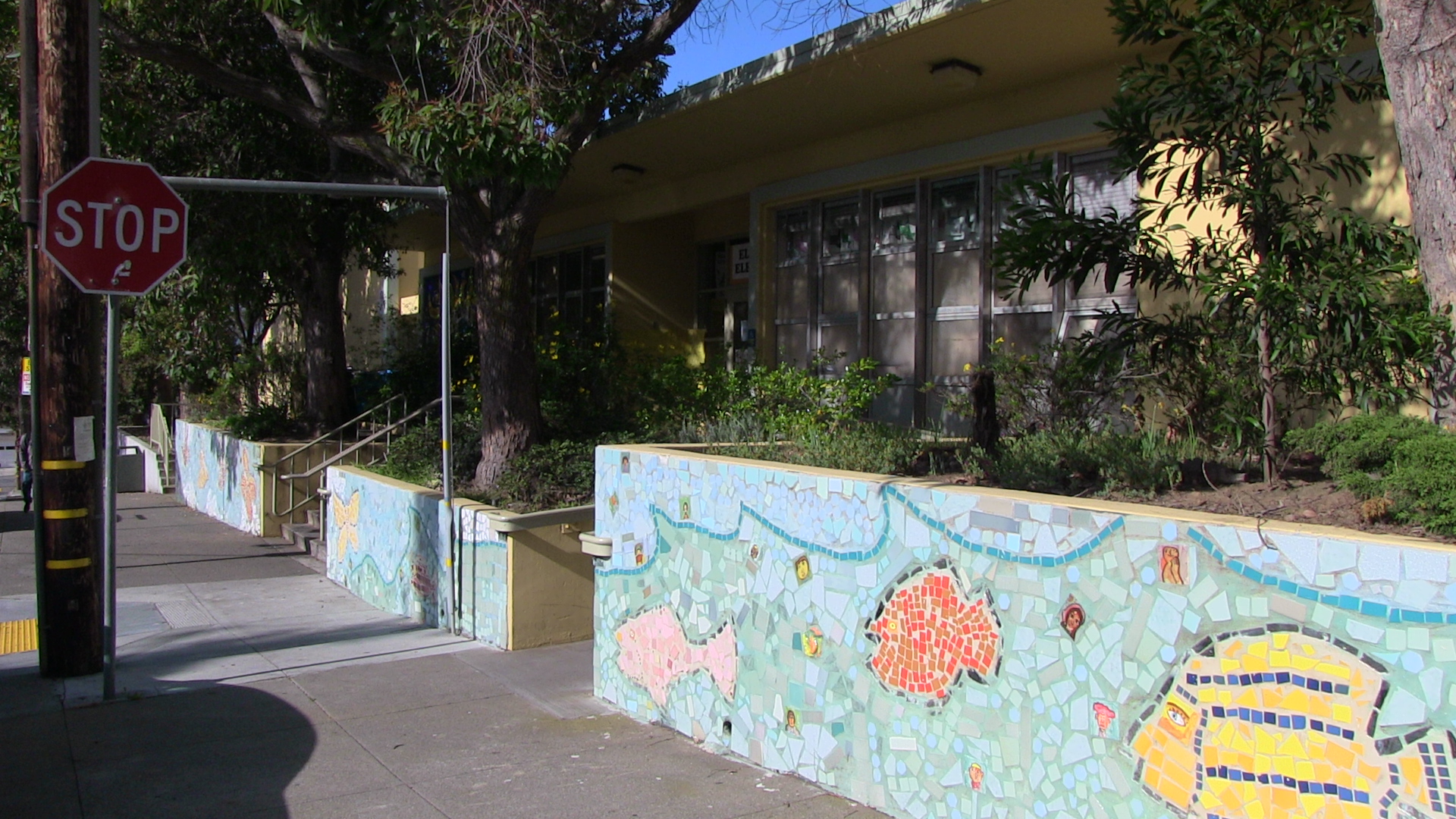
San Francisco’s El Dorado Elementary uses trauma-informed & restorative practices; suspensions drop 89%

Jane Ellen Stevens
Aces Too High
Posted: 1/29/2014 15:59
For one young student – let’s call him Martin — the 2012-2013 school year at El Dorado Elementary in the Visitacion Valley neighborhood of San Francisco was a tough one, recalls Joyce Dorado, director of UCSF HEARTS — Healthy Environments and Response to Trauma in Schools.

“He was hurting himself in the classroom, kicking the teacher, just blowing out of class many times a week.” There was good reason. The five-year-old was exposed to chronic violence and suffered traumatic losses. His explosions were normal reactions to events that overwhelmed him.

This year, Martin’s doing better. That’s because he spent months working with a HEARTS therapist, and that therapist worked with his teachers and other school staff to create a more safe and supportive learning environment. Still, on days when he feels extremely anxious, Martin sometimes asks to visit the school’s Wellness Center, a small, bright room stocked with comforting places to sit, headphones to listen to music, and soft and squishy toys.

“If a student starts to lose it, the teacher can give the kid a pass to go to the Wellness Center,” says Dorado. “The kid signs in, circles emotions on a ‘feelings’ chart (to help the person who staffs the center understand how to help the child). The staff member starts a timer. The kid gets five to 10 minutes. The kid can sit on the couch with a blanket, listen to music, squeeze rubber balls to relieve tension and anger, or talk to the staff member. Kids who use the room calm down so that they can go back to class. It’s not a punishment room. It’s not a time-out room. It’s not an in-school suspension room. It’s a room where you feel better going out than when you went in.”

One day this year, as school staff members are meeting in the Wellness Center, Martin bursts in. “I need to borrow something,” he tells them. “Somebody needs my help.

They are stunned. He has had such a difficult time learning to manage his own feelings, that they’re shocked that he’s helping another child work through her distress. You go right ahead, they tell him. Martin picks up a couple of squeeze balls and takes them to a girl on the playground who’s crying. He shows her how to use them. Then he brings her to the Wellness Center and helps her use some of the other tools. Seeing that she’s in a safe place and in safe hands, he says, “I’m going back to class now.”

“Obviously,” says Dorado, a psychologist who’s also an associate clinical professor in the University of California San Francisco Department of Psychiatry, Child and Adolescent Services, “we’re going to work with him to build that strength.”

In most schools in the U.S., it’s likely that Martin would have been suspended, expelled, or shunted into special education classes. In fact, during the 2010-2011 school year 150,349 out of 3,042,670 – nearly five percent — of elementary school students were suspended or expelled in California.

Instead, because El Dorado Elementary has integrated HEARTS, Martin’s life is on a completely different trajectory than it was a year ago.

So are the lives of many of its other 275 students. The numbers tell the story: In 2008-2009, the year before HEARTS was introduced at El Dorado, there were 674 referrals – students sent to the principal’s office for fighting, yelling, or some other inappropriate behavior.

During the last school year – 2012-2013, there was a 74% drop, to only 175. This year, only 50 referrals have occurred.

There were 80 suspensions in 2008-2009. And although suspensions increased for four years to 150 in 2011-2012, last year they dropped 89%, to only 17. So far this year, only three students have been suspended.

As El Dorado Elementary School Principal Silvia Cordero thought when she first heard about trauma-informed practices: “Why don’t all schools have this?”

Kids who throw chairs in class – that’s a public health issue

“Childhood trauma is a public health issue,” says Dorado as we sit in a coffee shop in Berkeley, CA, late one afternoon to talk about the HEARTS program. “It’s really common, and the way kids react to it gets them into trouble in school.”

In fact, serious and chronic childhood trauma is so common that most people in the U.S. have experienced at least one type out of ten measured by the CDC’s Adverse Childhood Experiences Study. These include physical, sexual or verbal abuse; physical or emotional neglect; and five types of family dysfunction — family violence, living with alcoholic (or other drug-addicted) or mentally ill parents, losing a parent to divorce or abandonment, or a family member who’s in prison.

And almost half the nation’s children have experienced at least one or more types of serious childhood traumas, as measured by a recent survey on adverse childhood experiences by the National Survey of Children’s Health (NHCS). This translates into an estimated 35 million children nationwide. (Since parents responded to the survey, questions about physical, sexual and verbal abuse were excluded, since it was unlikely those would be answered accurately. Hence, 35 million children suffering childhood trauma is on the low side.)

It’s a public health issue, explains Dorado, because the toxic stress caused by chronic trauma can harm children’s brains. Toxic stress alters the brain’s structure and functioning, so that a child is hyper-vigilant. With their trigger reset on “red alert”, they can flip into “fight, fight, or freeze” mode even when they aren’t in real danger. As a result, they can have trouble concentrating, learning, or sitting still. They can erupt into rages, lash out at others or hurt themselves. Or they can withdraw in fear and not participate in anything that’s going on around them. None of this behavior is intentional, says Dorado.

Many teachers and principals think kids’ “bad” behavior is deliberate, and that the kids can control it. But it’s often not and they can’t – not without help, says Dorado. Their behaviors are a normal response to stresses they’re not equipped to deal with. Throwing a punch makes sense if they’re jumping in to defend their mother from an alcoholic raging father; screaming in fury is a normal reaction to a bully who continuously harasses them. But when the raised voice of a teacher or a counselor who’s criticizing them inadvertently triggers the same response, these behaviors look “abnormal, rude, or inappropriate,” says Dorado. “So, they’re getting kicked out of class and disengage from school. That puts our kids at incredible risk for later problems, including imprisonment.”

“We’re trying to change the school culture,” by teaching educators about the underlying neurobiology of trauma, she explains. “When we see aggravating behavior in a kid and ask the question, ‘What has happened to you?’ instead of ‘What’s wrong with you?’, that’s the fundamental reframe. This reframe helps give the behavior a context, engenders compassion, and helps us respond more effectively.”

The good news is that kids’ brains are plastic. If they develop a trusted relationship with a caring adult, if they’re taught how to calm themselves, if they spend more time in a resilience-building environment than a traumatic environment, their brains will heal and they will become happy and eternally curious learning sponges — i.e., their natural state of being.

Keeping everybody’s riders on their horses = happy teachers and kids

In 2007, after San Francisco Chronicle reporter Jill Tucker did a story about the overwhelming number of San Francisco schoolchildren who had PTSD, the San Francisco Unified School District (SFUSD) asked Dorado and Miriam Martinez, then director of the Division of Infant, Child, and Adolescent Psychiatry at UCSF-San Francisco General Hospital, if anything could be done about it.

UCSF was providing therapy to some students, but “we weren’t addressing the larger school culture,” says Dorado. We could bring kids into our offices, process their trauma, teach them how to be calm, and send them back into their classrooms, where they’d inadvertently be triggered again, because teachers weren’t aware of what complex trauma does to kids’ behavior in school.”

Borrowing from the book, Helping Traumatized Children Learn, and the trauma-informed “flexible framework” practices that Susan Cole, Ann Eisner and Joe Ristuccia at the Trauma and Learning Policy Initiative had developed for schools in Massachusetts, Dorado and Martinez developed HEARTS. The Metta Fund and the John and Lisa Pritzker Family Fund provided most of the support for the project. The search for schools to pilot the program began in 2009.

El Dorado Elementary School is located in the Visitacion Valley neighborhood in San Francisco

El Dorado Elementary School is located in the Visitacion Valley neighborhood in San Francisco

“We were looking for schools that understood the whole school mental health approach to trauma, and that understood that this approach was going to help improve their academic achievement,” explains Dorado. They invited five schools to apply and selected three to work with in the 2009-10 school year: El Dorado Elementary, Bret Harte Elementary and Paul Revere PreK-8 School.

Tai Schoeman was principal of El Dorado at the time. The training that Dorado provided “really shifted my thinking about why kids were acting the way they were,” he recalls. “It’s amazing information that I didn’t have access to before that. It completely transformed my understanding about why kids were getting in fights, throwing chairs, and struggling academically.”

El Dorado Elementary, which has 275 students from kindergarten through fifth grade — is a high-needs school, says Schoeman, who was its principal for seven years. Its students, mostly African-American and Latino, live in some of the poorest and most violent neighborhoods in San Francisco. Most students’ families live just above, at or below poverty level.

“There’s already a negative connotation about why these kids are behaving a certain way, especially the boys,” says Schoeman. “What you hear educators saying is: ‘You know how they are.’ They don’t understand that their behavior – fight-flight, confusion of cognition — comes from being exposed to clinical trauma. When you start to see that, then you begin to see that the kids aren’t doing it on purpose. “
 
The teachers learned what happens to a child’s brain when it’s faced with overwhelming stress. “You can think of the two main parts of the brain that come into play as a horse (“the survival/emotional brain,” AKA the limbic system) and the rider (“the learning/thinking brain”, AKA the prefrontal cortex),” says Dorado. “When something happens that reminds the child of their traumatic experiences, the rider falls off the horse. You’re left with a really terrified horse.

“No amount of star charts, reasoning with or demanding explanations from or yelling at that terrified horse will make a difference. It will just make the horse more terrified. That’s because you’re not talking to that child’s thinking brain. You’re talking to a terrified horse. The first thing to do is to get the rider back on the horse by helping the child to feel safe and a little bit in control. Only then can you talk about what happened.
That can take minutes, hours or days, depending on how stressful the triggering event was, if the child was on edge to begin with, or if the child trusts you.” And, she added, sometimes adults’ riders get knocked off their horses too, which can make situations worse if they aren’t aware of it.

The overwhelming response from the teachers was: Wow — this explains a lot of what we see in front of us.
“I was very careful not to tell teachers how to do their jobs,” says Dorado. “I just helped them understand how trauma might affect kids, and to use that information to think through strategies to deal with them.”

Over that first year in 2009-10 – with the teachers’ new awareness, the skills and tools Dorado taught them to help children learn how to calm themselves, and more counseling available for students with the most severe problems — the school climate began to shift.

“After a year, the kids who were throwing chairs and running out of class at the start of school were staying in class, and the reduction in fights was dramatic,” says Schoeman. Before the school began integrating trauma-informed practices, 40 to 50 kids – one-fifth of the school’s students — were erupting into rages or running away every day, and each classroom had four or five students who had serious problems.

Dorado also spent a great deal of time focusing on how stress and trauma affects teachers. “Taking care of our teachers is central to this work,” she says. “We don’t want to lose these incredible educators.”

“We explained how stress and trauma affect us as human beings,” recalls Dorado. “And then we showed what it does to teachers and other school staff. As I named some of the symptoms of burnout, many teachers said, ‘I’m NOT crazy.’ and ‘They don’t teach us this in school.’ The things they experience are why they burn out and leave the teaching profession.”

She offered teacher wellness groups at each of the three schools, and the teachers chose how they wanted to structure the meetings. The El Dorado teachers decided to take walks in the park. Physical exercise (and its accompanying deep breathing), social connections, and being in nature have all been shown to reduce stress, says Dorado.

Dorado says that by helping the teachers, all three schools kept teachers who might otherwise have quit. “One new teacher was so stressed out that she was ready to leave,” she recalls. “Nobody had taught her how to manage a classroom with so many stressed out kids. She’s now one of our best trauma-informed teachers, and enjoys teaching again.”

During 2010-2011, the school integrated another tool — restorative practices. These work well with trauma-informed practices, says Dorado – because they hold students accountable for their actions, teach empathy and focus on the importance of relationships. But restorative practices aren’t as effective without a trauma-informed approach.

“Chronic stress and trauma can get in the way of restorative practices,” she explains. “Restorative practices don’t work if you’re asking a kid who’s crying right after an incident to participate. But it’s useful after somebody’s recovered, after the rider’s back on the horse.”

In fact, it’s important for trauma-informed practices to be paired with any program or framework, including PBIS (Positive Behavioral Interventions & Supports) and Safe &Civil Schools, she says. Without that trauma lens, “we miss components about what makes these approaches work or not work.” For example, knowing that toxic stress affects children in different ways helps kids who are often labeled as “lazy”, “slow learners”, or “unmotivated”. These children slip through the PBIS and restorative practices nets because they sit quietly at their desks and aren’t acting out. But they fall behind, just as those who are suspended and expelled do, and are just as likely to eventually drop out of school.


What also helped Schoeman and the staff change the school climate was developing a data system to identify the location and time of referrals – students who are sent to the principal’s office for behavior issues. Instead of the entire school being considered a disaster, the staff could get a better grip on identifying which students were having the most trouble, why they were being sent to office, and which teachers were sending them.

“By the time I left (in June 2012),” says Schoeman, “there were only 10 or 15 kids who we were dealing with on a daily basis, and, in each class, only one or two had serious problems.”

Everybody needs a beanbag chair and a peace corner

Each classroom at El Dorado Elementary has a “peace corner” where kids can take a break if they need to. Beanbag chairs, books, squeeze toys, blankets, stuffed animals, windmills to blow into, pencils, crayons and paper crowd the peace corners at El Dorado.

“When teachers invite a student to use the corner, it’s not a reprimand,” says Principal Cordero. “It’s a space where kids can pull themselves together. It doesn’t mean they’re in trouble; there are no consequences. Kids spend no more than five minutes there.”

Students who feel an internal volcano brewing, as some of their drawings about toxic stress on the classroom walls show, also have the option of spending a few minutes in a buddy classroom with another teacher with whom they have a relationship. They can stay there five to 10 minutes, and return, without consequences.

This year, the school added the Wellness Center. If a child still can’t calm himself after time in a peace corner or in a buddy classroom, the teacher can send him to the Wellness Center, says Jen Caldwell, the school’s social worker. And if a student’s behavior escalates to a point where a teacher thinks a consequence will help, the student is sent to the Wellness Center to de-escalate, and then to another teacher’s classroom to spend 30 minutes up to the remainder of the day. The consequence is that the child is not participating in learning with his classmates.


The Wellness Center is also where restorative practices take place. “It’s where they may talk with the people they harmed, if they did, to learn how to repair the relationship,” says Caldwell.


If there’s an extreme situation – a physical fight, extreme verbal aggression (think “I’m going to take these scissors and stab your eyes out!”), or being sexually inappropriate – the child could be suspended.

There are several reasons behind the stunning drop in referrals and suspensions this year, say Cordero and Caldwell:

  • The kindergarteners of 2008-2009 are now fifth graders, so most students have been living in the trauma-informed environment for six years. This pre-empts blowouts. “They have the language and are implementing cool-down practices that can get them back on track,” notes Cordero. “I’m referring to the peace corner in the classroom, mindfulness (breathing/meditation), the buddy classroom, and restorative conversations.”
  • The addition of the Wellness Center this year provides an additional place where students go to “reset themselves, where they feel safe and supported to get back on track,” Cordero explains. “These visits to the Wellness Center are not considered referrals to the office. Students with conflicts are sent here too; not the office. The ‘wellness team’ made up of our school social worker, school social worker intern, HEARTS post doc, and behavior coach all staff this room throughout the day.”
  • Teachers and staff have been trained to recognize when a child is triggered, and have the skills to intervene early, so that kids don’t escalate their behavior.
  • “Every student has a positive relationship with at least one grownup in the building,” says Caldwell. “A teacher, a secretary, the behavior coach, a custodian, me…any adult. Having a trusted adult is really important. For some kids, the school staff members are the only consistent adults in their lives.”
  • A before- and after-school program gives kids a safe place to be from 7:30 a.m. until 6 p.m.. Martha Merchant, one of the UCSF HEARTS post-doctoral fellows who works with the children with the highest trauma levels, as well as some of their families, used to be a marriage and family therapist before getting her doctorate. Before she began working in the HEARTS program at El Dorado, she didn’t believe that it was possible to help children without involving their families. But some families don’t have the time, resources or ability to participate in the counseling. Nevertheless, she’s seen children make great strides. Many are at the school most of their waking hours, and that’s enough time in a safe and supportive environment to counteract the time spent in a family environment where caregivers’ suffering may get in the way of them being able to provide a healthy family environment, she believes.
Dorado, Cordero and Caldwell agree that it’s likely – and the data are beginning to show this – that from now on, most referrals and suspensions will come from two places: new students, most of whom are in kindergarten and the first grade; and the classrooms of new teachers who aren’t experienced in the “El Dorado way”. And the best way to decrease those suspensions and referrals is to help the kids and the teachers.


“You can’t punish behavior out of a kid,” says Caldwell. “The old-school model of discipline expects kids to listen to you just because you’re a grown-up. But they won’t, especially when they’re being raised in an environment where grownups are not trustworthy or safe. You have to understand where the students are coming from, develop a relationship with them so that they will trust you, teach them empathy. That’s what’s going to make a successful community.”

Schools can’t do this alone

At the end of the 2012 school year, the original three-year grant for HEARTS ran out. Despite many requests by other schools for the program, Dorado’s goal to expand HEARTS to other schools looked as if it was dead in the water.

But 2013 seemed to be a turning point in the school discipline debate in California. With more research showing that zero-tolerance policies were damaging, especially to minorities, and more pressure across the state and the nation to change the approach to school discipline, the Los Angeles Unified School District – the largest in the state — ended suspensions for “willful defiance”. Some schools in California eliminated suspensions altogether.

SFUSD, which is also considering ending suspensions for willful defiance, revived a restorative practices program that it had let lapse and funded the HEARTS program for one more year at El Dorado and Bret Harte Elementary.


So, after a year of uncertainty, Dorado is partnering with the restorative practices team as well as infusing trauma-informed practices into a district-wide effort to help change school environments that includes PBIS and social-emotional learning. “We’re learning from them; they’re learning from us,” she says. “It’s a good match.” With her colleague, Lynn Dolce, she’s also creating a curriculum for SFUSD mental and medical health staff who will train other schools how to integrate trauma-informed practices.

Tai Schoeman, who’s now assistant principal at A.P. Giannini Middle School, hopes that trauma-informed practices spread to all schools. But he makes this point: “Asking schools to carry out this work in isolation of the rest of society is challenging. In Visitacion Valley there are big barriers to a school having success with this model. The nearest big grocery store is two miles away. There’s only one bus line and the bus comes only once an hour. There’s limited access to medical care. There’s extreme poverty in an isolated community that has gang issues and continuing violence, with criminalization of young men.’

In fact, in the communities where schools are becoming trauma-informed, there’s a growing recognition that schools can’t do this alone. If a community really wants to become healthy, i.e, to reduce crime and health care costs, all the sectors of a community – police, housing, employment, transportation, medical services, economic development, etc. – need to implement trauma-informed practices.

“The American myth is that you can lift yourself up with your bootstraps,” continues Schoeman, “and if you fail, the myth says it’s because you didn’t work hard enough. But we now know through research and data that there are plenty of reasons to debunk this archetype.

“It gives you pause about how poorly kids are treated in this society in so many ways.”


______________________________
This is part of an investigative series into “right doing” – how some schools, mostly in California, are moving from a punitive to a trauma-informed approach to school discipline. The series includes profiles of schools in Le Grand, Fresno, Concord, Reedley, Los Angeles, Vallejo, and San Diego, CA; and Spokane, WA, and Brockton, MA. The series is funded by the California Endowment.

Tuesday, May 20, 2014

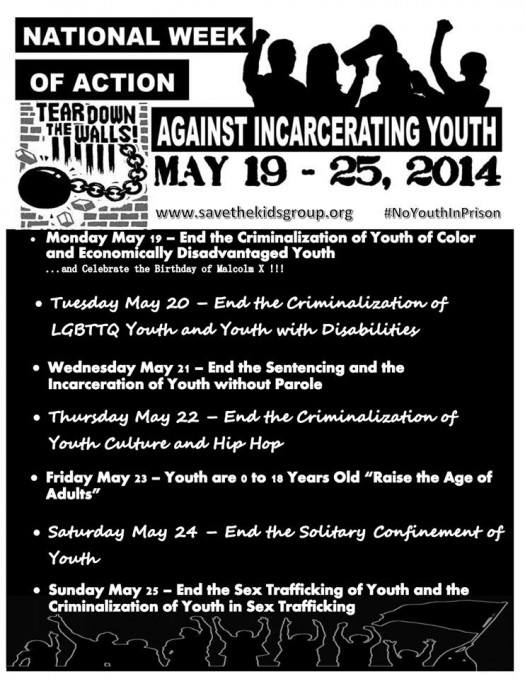
#NOYOUTHINPRISON 2014 Week of Action!


 look what I saw over the I-10 today...
it reminded me this is a special week.
 

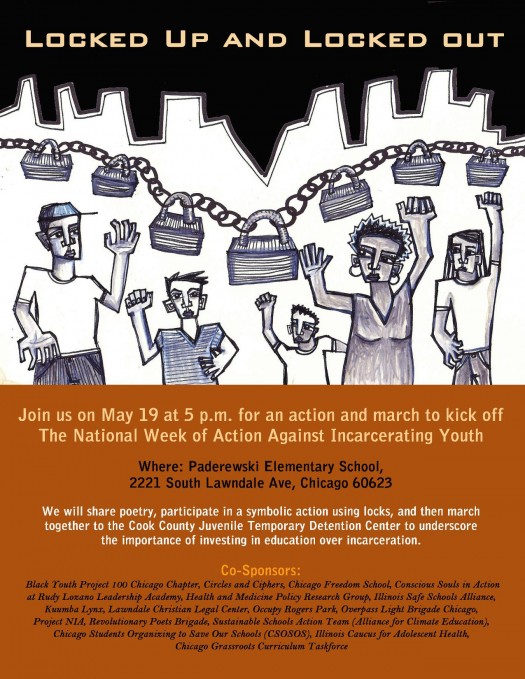
There are very few blogs out there about prison abolition - this has got to be one of the best in the US, authored by Mariame Kaba. Go there all week for more focus on liberating criminalized youth.

Sorry I wasn't more organized for this week - it caught me by surprise. Families, take a lesson from these folks in Chicago: Don't settle for crumbs when you fight for change. Don't just try to make the system "better" - that is, stronger. Insist on making our communities smarter on crime instead, so we can end the violence and despair of incarceration altogether.


#NO YOUTHINPRISON week of action


----------from Prison Culture------------

#NoYouthInPrison: Kicking Off National Week of Action Against Incarcerating Youth

May 19 2014
 

If you’ve read this blog even once, you know that I am against prisons. I am particularly against incarcerating children. Today kicks off the National Week of Action Against Incarcerating Youth.

nationalweekofaction
I write a lot about the prison industrial complex (including the juvenile punishment system) and last year I published a paper with my friend Dr. Michelle VanNatta about alternatives to youth incarceration in Chicago. In the paper, we provided a brief literature review about juvenile detention and incarceration. I am republishing that part here to buttress the case against incarcerating young people.

“There is an urgent need to find constructive ways to respond to young people in conflict with the law. Research compellingly demonstrates that youth placed in juvenile detention centers compared to alternative interventions are much more likely to later spend significant time in prison (Aizer and Doyle, 2013). Juvenile and adult incarceration both create exorbitant financial and social costs (Petteruti, Velázquez, and Walsh, 2009).

Incarceration of juveniles is harmful to young peoples’ development, education, families, communities, and their current and future socioeconomic status (Majd, 2011; Bickel, 2010). Furthermore, incarcerating youth is not effective at enhancing public safety (Butts & Evans, 2011; Petteruti, Velázquez, & Walsh, 2009). Conditions of detention, even when monitored and regulated, often involve serious violations of human rights, such as solitary confinement and sexual violence perpetrated by staff (Beck, Cantor, Hartge, & Smith, 2013; Kysel, 2012; Krisberg, 2009). These abuses harm youths’ physical health, mental health, and social well-being (McCarty, Stoep, Kuo, & McCauley, 2006; Mendel, 2011). Destructive conditions that create lasting damage are even more extreme for youth confined to adult jails and prisons (Arya, 2007; Sarri and Shook, forthcoming; Wood, 2012). The detention process disconnects youth from family and supportive relationships, interrupts education, and makes it difficult for youth to get adequate exercise, healthcare, nutrition, and support.

Incarceration is extravagantly expensive. In 2012, Illinois taxpayers paid an average of $86,861 per year for each youth incarcerated in state prison (Illinois Department of Human Services, 2012). Taxpayers paid an astounding $219,000 per year for each youth confined to the Cook County Juvenile Temporary Detention Center (Civic Federation, 2013). These numbers do not include associated costs, such as government monies used to pay police, investigators, prosecutors, public defenders, judges, court personnel, and others for the arrest, investigation, and adjudication of youth’s criminal cases. Illinois (and the rest of the United States) has made a staggering investment in the criminalization of youth.

Incarceration is traumatic for youth, as evidenced by young peoples’ suicides, suicide attempts, self-harm, and the worsening of mental health symptoms while inside (Hayes, 2009; Ford, Chapman, Hawke, & Albert 2007). The stigma of incarceration follows youth for a lifetime, interfering with education housing, jobs, economic wellbeing, and stable community relationships (Houchins et al, 2009). Disproportionate arrest, prosecution, conviction, and sentencing of youth of color perpetuate and intensify racist injustice throughout the United States (Jones, 2012; US Department of Justice, 2012; Cahn, Nash, and Robbins, 2011). Incarceration can be particularly horrific for gender non-conforming youth, who may be assigned to facilities on the basis physical examinations or identification documents rather than based on the youth’s own gender identity and presentation. Thus, someone who lives in the world as a young woman may be incarcerated at a men’s prison. This exposes the youth to significant danger and trauma (Estrada & Marksamer, 2006).

Finally, there is no conclusive evidence that incarceration in juvenile detention centers safeguards our communities, improves pro-social behavior among those currently or formerly incarcerated, or rehabilitates youth who have engaged in harmful behavior (National Juvenile Justice Network, 2011). Because incarceration is expensive, traumatic, disruptive, and ineffective (Mendel, 2011), exploring alternative strategies for working with youth in conflict with the law offers rich opportunities to promote community well-being while saving money. Carefully implemented, alternatives to detention/incarceration can reduce harm in communities, promote youth development, contain costs, enhance safety, protect human rights, and build a stronger society.”
In short, juvenile detention and incarceration is costly, harmful, and doesn’t improve public safety. We need to STOP LOCKING UP CHILDREN IN JAILS AND PRISONS TODAY.

For our part in Chicago, today we will be kicking off the week of action against incarcerating youth with a march at 5 p.m. Details are HERE. If you are in the city, I hope that you will join us.

by Billy Dee
by Billy Dee

For those in Illinois who are interested in the numbers behind juvenile detention and incarceration, my organization published an updated version of “The Conscious Chicagoan’s Guide to Youth Detention and Incarceration” last week.

Finally, I am always asked for “solutions” as though this is the provenance of a single person. In fact, WE have a collective responsibility of solving our problems TOGETHER. One person didn’t create these problems and they have a long history. It’s going to take ALL OF US to address them properly. Regardless for those in Chicago, I have compiled a list of some ways that you can personally resist the criminalization of young people in our city. Feel free to add your own ideas to the list.


Monday, May 19, 2014

Kids in The Box: Solitary confinement, torture, and our troubled youth.


ACTION: This week in Phoenix, at the State Capitol on Friday, MAY 23 at 5pm, Mothers Against Solitary Confinement will be rallying - please join them if you can. The action is also supported by Puente, Prisoners Are People, Arizona Prison Watch, and the American Friends Service Committee  (AFSC-Tucson).


-----------------

As some folks are aware, the US Attorney General came out publicly last week condemning the abuse of solitary confinement to manage mentally ill juvenile prisoners in particular, and calling for an end to it. His remarks couldn't have been more timely, as I find myself increasingly involved with two mentally ill teens currently being charged as adults for serious crimes, being held in isolation/protective custody in the MCSO jails. Thus, my own focus on juvenile justice of late has been addressing the abuse of solitary confinement of youth in jails, prisons and detention centers. 

The following article is one of the more useful I've come across in terms of compiling the most current and relevant links to documents dealing with solitary and youth. Then there's the cool video at the end - check it out and share it, please.

--------------------

 from the Juvenile Justice Information Exchange:

_DSC0207
Ryan Schill / JJIE

Juvenile Solitary Confinement: Modern-Day ‘Torture’ in the US


As a 17-year-old, Michael Kemp says, he felt like a caged animal.

For six months, his world was reduced to the size of a Washington, D.C., jail cell measuring maybe 8 feet by 10 feet.

During much of his time in solitary confinement, he spent 23 hours a day alone in the cell.

“You just like, ‘Man, I feel like an animal in here. I don’t even feel real … where I’m not even a human being,’" Kemp told JJIE. "You don’t feel like a human being."

Kemp, now 24, who was convicted of armed robbery and says he ended up in solitary because he was caught with a makeshift knife, slept on a mat atop a steel bed in the cinder block cell and had little contact with others except by yelling through a crisscross of bars to other inmates.

lifeinthebox 

“In there by yourself, you can go stir crazy because you ain’t got that interaction,” Kemp said. “You supposed to be growing as an individual, but you ain’t growing. You have no human connection with nobody else. You just in a room by yourself.”

Even now, seven years after his stint in solitary as a juvenile, Kemp says psychic scars remain, and he still tends to isolate himself in his home.

“I might go in the bathroom or be sitting in the living room and I be in there for hours, man, just looking in the mirror or just in a room, just like I don’t know why I won’t be active. I just find myself always isolating myself for some reason, man,” said Kemp, a boyish-looking, slim young man who wears his hair in long braids.

“It’s like if you put a grasshopper in a cup and then you place a top on it and it keeps on jumping and it keeps on jumping and it keep on hitting the top, keep on hitting the top, so when you take the top off, the grasshopper not going to jump out the top of the cup because it’s going to be so used to hitting the top of the cup, and it’s like that’s how it is. Sometimes it feels like I’m in jail when I’m not in jail.”

When you think of solitary confinement, perhaps you think of North Vietnamese POW camps like the one where John McCain spent more than five years in captivity or Alcatraz, where the “Birdman” Robert Stroud made solitary famous, or today’s Supermax prisons that house hardened adult criminals.

But in fact, thousands of juveniles also endure solitary confinement each year in the United States, often in tiny cells for 22 to 24 hours a day with little human contact, even though a growing number of experts say the practice causes irreparable psychological and developmental harm to youths.

Consider:
  • In April 2012, the American Academy of Child & Adolescent Psychiatry issued a statement concluding that solitary confinement of juveniles could lead to depression, anxiety and even psychosis and called for an end to the practice. “Due to their developmental vulnerability, juvenile offenders are at particular risk of such adverse reactions,” the AACAP statement said. “Furthermore, the majority of suicides in juvenile correctional facilities occur when the individual is isolated or in solitary confinement.”
  • Juan Méndez, the United Nations special rapporteur on torture, has found that solitary confinement can amount to torture and has urged a ban on solitary confinement of children and people with mental disabilities.
  • The National Task Force on Children Exposed to Violence, commissioned by U.S. Attorney General Eric H. Holder Jr., concluded in its final report in December 2012, “Nowhere is the damaging impact of incarceration on vulnerable children more obvious than when it involves solitary confinement.” The task force recommended the practice be forbidden. (The task force was co-chaired by Robert L. Listenbee Jr., who is now the administrator of the federal Office of Juvenile Justice and Delinquency Prevention. Listenbee did not respond to requests for comment.)
  • In his role as OJJDP administrator, Listenbee stated in a July 5, 2013, letter to an American Civil Liberties Union official that “isolation of children is dangerous and inconsistent with best practices and that excessive isolation can constitute cruel and unusual punishment,” which is banned under the Eighth Amendment to the U.S. Constitution.
  • Experts say adolescents are particularly vulnerable to psychological harm caused by solitary – sometimes known as room restriction, restricted engagement, segregation, isolation, lockdown or seclusion – because their brains are still developing.

Laura Markle Downton, director of the U.S. prisons policy and program for the National Religious Campaign Against Torture, which represents 320 religious organizations, said the campaign opposes solitary confinement of juveniles and views it as a form of torture.

“It’s really a moral question first and foremost,” Downton told JJIE. “When you think about if a parent were to lock a child in a closet, let’s say, for an extended amount of time, we would call that child abuse. And yet that’s essentially what we’re doing within our justice system.

“What we know is that isolation does not lead to rehabilitation. It leads to destruction and annihilation, and we believe very firmly as people of faith that this is immoral and that it’s wrong.”


Critics note that solitary – which youths have been subjected to in U.S. juvenile facilities for more than a century – often denies children access to education, mental health treatment, physical activity, and reading and writing material.

Despite widespread concerns about juvenile isolation, however, some correctional officers’ unions and corrections administrators call the practice a necessary option to maintain discipline and ensure the safety and security of facilities.

A November ACLU report calling for a ban on solitary confinement in juvenile detention facilities cited four reasons generally given to justify it: to punish children when they break facility rules; to protect a child from other children; to deal with children deemed too disruptive or out of control; and to isolate a child for medical reasons, including having a contagious disease or having expressed a desire to commit suicide.

Speaking of solitary confinement, Craig Brown, chief lobbyist for the California Correctional Peace Officers Association, which represents correctional officers in the state system, said: “Our feeling was, why ever deprive yourself of a tool? … Corrections is about tradeoffs, and one of the tradeoffs is if you don’t use a tool like this, you disrupt the program for everybody else.”

If the system did not rely on solitary, Brown said: “If you have somebody who is messing things up so other wards who are trying to participate and deal with their issues can’t do it, then what you’ve done is you’ve said, ‘Well, we’re not going to isolate this ward. In exchange we’re going to let him mess up the program for 10 or 15 other guys.’”

Referring to solitary, Brown said, “It’s necessary for programming, it’s necessary for staff safety, it’s for the safety of the other wards – at times.”

California state Sen. Leland Yee, D-San Francisco/San Mateo, a child psychologist, expresses a decidedly different view.

Yee has proposed a bill that would sharply restrict solitary confinement of youths in state and county juvenile correctional facilities.

Yee, who has treated youngsters in prisons, jails and health systems, told JJIE solitary makes youths more dangerous, more antisocial, more likely to reoffend, more likely to commit suicide and more likely to suffer a lifetime mental illness.

In solitary, Yee said: “Kids become depressed, they become disassociated, they begin to sometimes decompose psychologically. So there’s nothing good that comes out of solitary confinement for the youngster. It’s all bad, and it seems to me that if the [state Department of Corrections and Rehabilitation] would just simply pick up a book on psychology and read it, they would understand that this is not a good thing for youngsters and not good for our society in general…. Torture doesn’t help anybody at all.”

Under Yee’s bill, solitary confinement could be used only when a juvenile posed an “immediate and substantial risk of harm to others or to the security of the facility, and all other less-restrictive options have been exhausted.” The bill also specifies that a juvenile be held in solitary only for the minimum time necessary to reduce the risk.

Bill Sessa, a spokesman for the California Department of Corrections & Rehabilitation, which oversees the Division of Juvenile Justice, said state law allows youths to be held up to 23 hours a day in a room in a “behavior treatment unit.” But Sessa said youths have been allowed to leave the rooms an average of six hours a day most of the past year and that youths held in the rooms receive education and counseling.

Of Yee’s measure, Sessa said, “This bill is a solution looking for a problem that doesn’t exist.”

Yee said the department opposed a bill that failed last year that would have restricted solitary confinement of youths in juvenile facilities.

“If [corrections officials] had their way, they’d probably still have torture chambers in the state of California,” Yee said.

New Jersey also has become a focal point in the debate over solitary confinement of juveniles.

The New Jersey ACLU and other organizations petitioned the state Juvenile Justice Commission, in July to ban punitive solitary confinement of youths in juvenile facilities.

In a letter to Kevin Brown, the executive director of the JJC, the petitioners stated, “Solitary confinement is an extreme and inhumane form of punishment that is not evidenced-based, wastes taxpayer money, and jeopardizes public safety; this is especially so when the people being subjected to the punishment are children.”

The JJC, the state agency that oversees juvenile justice in New Jersey, rejected the petition to ban punitive solitary confinement of youths in mid-February.

Sharon Lauchaire, the public information officer for the commission, part of the New Jersey Attorney General’s Office, said the JJC would continue discussions with the ACLU about what is known in the state as “room restriction.”

“We have reviewed our use of room restriction in the past and will continue to do so,” Lauchaire told JJIE. “We will be soliciting feedback from the ACLU and other parties on room restriction.”

The denial of the petition came after a $400,000 settlement in a lawsuit over two boys who had been held in solitary in New Jersey for extended periods – one of them, for about six months.

Policies on solitary confinement of juveniles vary widely across the country.

Even critics of juvenile solitary acknowledge youths who are out of control or a threat to themselves or others may need some time alone but say this should be for minutes or hours, not days – and with close adult supervision.

Some states – including Alaska, Connecticut, Maine, Oklahoma and West Virginia – have banned or restricted punitive solitary confinement of juveniles. And New York State just banned solitary confinement of juveniles held in state adult facilities.

It’s impossible to say how often U.S. juvenile detention facilities use solitary confinement, as neither states nor the federal government publishes such data and almost no detention facilities make the data available to the public.

Amy Fettig, senior staff counsel with the ACLU's National Prison Project, estimated that about 70,000 young people are being held at any given time in juvenile facilities nationwide and that in many facilities solitary confinement is “routine.”

In an October letter, the ACLU and numerous other organizations urged Attorney General Holder and OJJDP’s Listenbee to prohibit solitary confinement of youths in federal custody. In addition, more than 40,000 people have signed a petition calling on Holder to ban solitary confinement of juveniles in federal custody.

And on Feb. 28, U.S. Rep. Tony Cárdenas, D-California, proposed a measure that would ban solitary confinement of youth in federal juvenile facilities.

“Solitary confinement is something that is purely punitive, and it has nothing to do with rehabilitation,” Cárdenas told JJIE.

But despite concerns about the dangers of juvenile solitary expressed by the National Task Force on Children Exposed to Violence and by Listenbee, the U.S. government still has not banned the practice in federal detention facilities.

“There’s no prohibition,” Fettig told JJIE. “It’s sort of like, ‘Put your money where your mouth is.’”
U.S. Sen. Dick Durbin, an Illinois Democrat who chaired a Feb. 25 Senate Judiciary subcommittee hearing on solitary confinement, called on all state and federal facilities to end solitary confinement of juveniles, pregnant women and people with “serious and persistent” mental illness “except under the rarest circumstances.”  (Durbin’s office did not respond to requests to clarify what would constitute those “rarest circumstances.”)

“When it comes to solitary confinement, we know children are particularly vulnerable,” Durbin said. “The mental health effects of even short periods of isolation, including depression and risk of suicide, are heightened among youths.”

Supporters of a ban on solitary in juvenile facilities point out that many youths enter the facilities with mental illness and that solitary aggravates it.


“When you subject [juveniles] to extreme isolation and then you expect their behavior to change, well, that’s living in a fantasy world because you’re actually exacerbating whatever pre-existing problem that kid had,” Fettig said. “Subjecting them to solitary confinement isn’t going to turn them into well-socialized adults. It’s going to inflict more harm on them. So it’s actually completely counterproductive to what the system should be doing, and child abuse should not be mandated by the state.

“You literally are locking a child down with nothing to do, with no interaction, for 23, 22, 24 hours a day. In some ways, it’s common sense to look at the denial of education, the denial of drug treatment, the denial of adequate mental health care that exists in solitary confinement, and think to yourself, ‘Well, what’s going be the result for that kid? How could anything positive ever come from such treatment?’ And the answer is, it doesn’t.”

Bart Lubow, director of the Juvenile Justice Strategy Group at the Annie E. Casey Foundation in Baltimore, said solitary flies in the face of the rehabilitative goal of the juvenile justice system.

“All the evidence about the effects of isolation are that it is counterproductive to the goals of rehabilitation,” Lubow said, “so I don’t know how you can be doing rehabilitation based on that kind of extreme punishment.”

Fettig points out that the U.S. Supreme Court has cited research on adolescent brain development in ruling against extreme punishment for juveniles, including the death penalty and mandatory sentences of life without parole. The high court has based these rulings in part on research showing  that juveniles’ brains are not fully developed, and youths are more susceptible than adults to peer pressure, more impulsive, more likely to take risks, less likely to consider long-term consequences and more amenable to rehabilitation.


The Supreme Court should also ban solitary confinement of juveniles as “extreme punishment,” Fettig suggested.

“That mission in juvenile justice, which is rehabilitation, becomes even more critical in light of the science as well as in light of the top law, the Supreme Court jurisprudence in this country, that has looked at the science and looked at the law and our Constitution,” she said.

“We believe that those theories, that same science and judicial ruling can easily be applied to the most extreme forms of punishment that we see in the juvenile justice system … and that is the use of solitary confinement.”

A ban on solitary is long overdue, in the view of Tanisha Denard.

As a 17-year-old, she spent 2 ½ weeks in solitary at Los Padrinos Juvenile Hall outside Los Angeles.
Denard, now 19, told JJIE she ended up at Los Padrinos for a month because she failed to appear for court dates for truancy tickets she received for being late for school and was put in solitary after refusing to socialize or eat. (She graduated from high school in 2011 and now works as a youth organizer for the Youth Justice Coalition, which fights race, gender and class inequality in Los Angeles County’s and California’s juvenile justice systems.)

While in solitary, Denard came out of her cell only to use the bathroom and to shower and had little contact with others and no reading or writing materials.

If she weren’t in solitary, Denard said, she could have been doing homework or something productive that would have helped rehabilitate her instead of languishing in her cell.

Of solitary, Denard said: “It was dehumanizing. It felt like I wasn’t even a person in society. Nobody could see me. I couldn’t see nobody. So it feels like you not even there.”

Thus, like thousands of other children in the United States each year, Tanisha Denard became all but invisible – in the largely hidden world of juvenile solitary confinement.


Saturday, April 26, 2014

DOJ to Ohio: Abuse of Solitary Confinement harming mentally ill youth.

This practice is far too common with kids in Arizona, as well...

-----------

Department of Justice
Office of Public Affairs
FOR IMMEDIATE RELEASE
Wednesday, March 12, 2014
 
Justice Department Seeks Temporary Restraining Order to Stop Ohio Department of Youth Services from Excessively Secluding Boys with Mental Health Needs
 
Today, the Justice Department sought a federal court order temporarily restraining the Ohio Department of Youth Services (DYS) from unlawfully secluding boys with mental health needs in its juvenile correctional facilities.  The requested order would require DYS to abide by safeguards in its use of seclusion until a final ruling on the claims that DYS’ seclusion practices violate the constitutional rights of boys in DYS custody.  In conjunction with its request for a temporary restraining order, the department sought to expand its existing complaint regarding the Scioto Juvenile Correctional Facility, to include claims of unlawful seclusion at all of the DYS facilities.
 
The department’s request for a restraining order detailed the state’s excessive use of seclusion, including the following information:  

·          In the second half of 2013, the state imposed a total of almost 60,000 hours of seclusion on 229 boys with mental health needs;
·          One boy spent 1,964 hours in seclusion over six months; the state gave another boy 21 straight days of seclusion;
·          Ten boys at one facility spent over 10 percent of their time in custody in seclusion;
·          While secluded, several boys were on suicide watch, had suicidal thoughts or hurt themselves.  

“The Ohio Department of Youth Services must stop violating the rights of youth in its custody through unlawful seclusion,” said Acting Assistant Attorney General Jocelyn Samuels for the Justice Department’s Civil Rights Division.  “The way in which Ohio uses seclusion to punish youth with mental health needs, victimizes one of the most vulnerable groups in our society.”
 
“Ohio’s juvenile correctional facilities must comply with the Eighth and 14th Amendments,” said U.S. Attorney Carter Stewart for the Southern District of Ohio.  “We will remain vigilant in protecting the constitutional rights of all our citizens, particularly young people and those with mental illness.”
 
“The facts in this case reveal a serious disregard for the rights of young people with mental health needs in Ohio’s custody,” said U.S. Attorney Steven M. Dettelbach for the Northern District of Ohio.  “The Ohio Department of Youth Services has a responsibility to ensure the health and safety of these young people, including providing appropriate mental health treatment, so that they can overcome challenging behaviors and return to the community to become successful adults.”
 
Following an investigation under the Violent Crime Control and Law Enforcement Act of 1994 and the Civil Rights of Institutionalized Persons Act (CRIPA), the Justice Department issued findings in May 2007 detailing significant constitutional deficiencies regarding use of physical force, grievance investigation and processing and use of seclusion.  In June 2008, the department entered into a consent decree with the state to correct these deficiencies at the Scioto Juvenile Correctional Facility.  However, the recent discovery that DYS continued to unlawfully seclude boys with mental health needs at Scioto Juvenile Correctional Facility and had moved boys to other DYS facilities also using unlawful seclusion prompted the department today to seek a temporary restraining order and an order allowing it to add the remaining DYS facilities to its complaint.
 
This case is being litigated by attorneys from the Special Litigation Section of the Civil Rights Division, the U.S. Attorney’s Office for the Southern District of Ohio and the U.S. Attorney’s Office for the Northern District of Ohio.  Copies of both motions and additional information about the Civil Rights Division will be available on its website.

Saturday, September 28, 2013

Trauma-informed care coming to the DOJ? New Juvenile Justice Director.

This looks like good news from the juvenile side of the US DOJ. So much is yet to be said for trauma-informed care with those involved with the CJ system, especially youth. I'll be interested to see what this guy brings to the DOJ and the future of youth imprisonment.


KNAU has been doing a lot of decent journalism when it comes to the criminal justice system lately, so tune into them if you can.

---------------------------


USDOJ, OJJDP

Justice Department Pushes New Thinking On Kids And Crime

Originally published on Thu September 26, 2013 7:45 am 

For a man who spent the bulk of his career as a public defender, Robert Listenbee's new role walking around the halls of the U.S. Justice Department may not be the most comfortable fit.

But Listenbee, who became administrator of the Office of Juvenile Justice and Delinquency Prevention earlier this year, says his transition has been smooth. And besides, he says, he couldn't resist the "extraordinary opportunity."

Before he joined the federal government, Listenbee co-chaired the National Task Force on Children Exposed to Violence. Now he's the man in charge of making its recommendations come to life. His report — packed with recommendations about the need for more research and attention on boys, rural areas and the education system — attracted scant attention because it emerged on the same day as the shooting rampage in Newtown, Conn., where Adam Lanza killed 20 children and six adult staff members at the Sandy Hook school.

But more attention could come Thursday in Northern Virginia, where mayors, police chiefs, educators and young people will join Listenbee, Attorney General Eric Holder and Office of Justice Programs chief Karol Mason to talk about reducing gang activity and other violence that affects kids across the country.

"It's important for everyone to recognize that the trauma that comes from exposure to violence is multifaceted," Listenbee says. "Children who are sexually assaulted, boys and girls, experience the trauma very differently from other kinds of exposure. Children who experience community violence ... also have a different kind of trauma. Each one requires a specific type of treatment. ... We are [at] the beginning of this era of understanding the impact of exposure to violence and the kinds of treatment that are needed ... and we're going to be dealing with this for a long time."

He cites an example from his own life, growing up in a small town north of Detroit, where some of his relatives were killed in their teen years. "I know the pain of that kind of a circumstance. I know the difficulty of adjusting to it over time, and actually it never really goes away — you're reflecting on it all the time."

In the old days, treatment for kids incarcerated in a residential facility or detention center focused on changing their behavior. But these days, researchers are searching for better, long-term solutions.

One story from his own long experience with the system, Listenbee says, illustrates the challenge. A girl got into a fight with her mother and with police. She went into residential placement for more than a year. She got out, but got in trouble all over again for taking drugs.

"There was not an inquiry into what happened to her," he says. "When we started examining what happened to her, we found that she had been sexually assaulted as a young child; she had observed a close friend who had been shot to death; her father was in jail for life for an offense that many said he didn't commit. And when I talked to her, I found she was taking drugs to kill the pain."

Listenbee got her psychiatric counseling, convinced a judge to keep her out of the justice system, put an ankle-bracelet monitor on her, and got her back on track. Too many other young girls, he says, need the same kind of intervention.

He points out that the idea that children are different from adults and that there's a need to understand their brain development if they have brushes with the law has won support from the U.S. Supreme Court in several recent decisions. So his office and other parts of the Justice Department are supporting research to understand those differences — and to offer advice to states, where most of the juvenile justice money is spent.

And along with the Education Department, the U.S. Justice Department is working hard to stop what experts describe as a "school-to-prison pipeline."

"We believe firmly that children should be kept in school and out of courts," Listenbee says. "We don't think that kids who are truant, kids who are runaways, kids who engage in various sort of violations of the code of conduct that aren't criminal offenses — we don't think they belong in the juvenile justice system."

Because once children enter that system, he says, research demonstrates they have a very hard time getting out, and often move on to adult jails and prisons.

Monday, February 6, 2012

Dismantling California's Division of Juvenile Justice

Here's what they're doing with juvenile corrections in California. Governor Brewer has been wanting to dismantle the AZ Department of Juvenile Corrections and privatize more services, too. I'm all for abolishing the entire criminal justice system and staring anew, but I don't think we have the same motives or ultimate vision in mind. 
I think the worry that youth will be tried as adults more often - absent state prisons for children - is legitimate, but can be addressed with legislation restricting juvenile transfers. We already know that youth tried as adults are more, not less likely, to re-offend, and we have an idea of what types of evidence-based practice can reduce juvenile delinquency.

In any event, this is worth following. In the meantime, don't be surprised to hear more soon about the AZ Department of Juvenile Corrections downsizing, consolidating resources, increasing privatization of services, and ultimately being dissolved. I think that's precisely what Director Flanagan was hired to do.

--------------------------

Fight ahead over bold California move to close state-run youth prisons
Juvenile Justice Information Exchange
Susan Ferriss January 28, 2012

This story was originally published by the Center for Public Integrity
 
California, often a trendsetter, could make history if it approves Gov. Jerry Brown’s bid to close all state-run youth prisons and eliminate its state Division of Juvenile Justice.

Much depends, though, on whether the state’s politically influential prison guards, probation officers and district attorneys can be convinced — or forced by legislators — to agree to Brown’s proposal. That won’t be an easy sell, due to both public-safety arguments and sure-to-surface haggling over just who pays to house juvenile offenders.

Vowing to restructure government more efficiently, Brown, a Democrat, wants to close the last three of 11 youth prisons that have long been attacked by critics as “expensive failures.” If the state phases out the last three of its aging detention centers, all future young offenders would be held, schooled and treated by California’s 58 counties.

This is the second time since taking office last year that Brown has proposed closing the state juvenile division, which is part of its corrections system. The division’s responsibility has already been slashed dramatically from 10,000 wards in the mid-1990s to about 1,100 in state custody today. Their numbers may be few, but the cost for keeping those youth in state custody runs about $200,000-a-year for every ward.

A host of agendas

The drop in numbers of youths in state custody is due in part to a decline in juvenile crime in California, but also to state legislation in 2007 that blocked counties from sending nonviolent youth offenders to state-run detention centers.

It was a move driven, some argue, largely by California’s massive budget deficits and the desire to lower ballooning incarceration costs. But the decision also dovetailed with an emerging national philosophy favoring locally-based rehabilitation programs over state-run facilities that have been plagued with records of neglect, danger and sexual abuse.

Behind the policy debate: never-ending negotiations over money. The 2007 initiative included millions in state money to counties to devise and provide more effective treatment closer to wards’ home areas and families. Last year, after wrangling with Brown, legislators approved a deal requiring counties to begin paying $125,000 for each ward they sent to the state, if the state’s revenues didn’t improve.

Sure enough, revenues didn’t improve, and now the counties are balking at having to pay the $125,000 per ward they owe. And Brown isn’t collecting. Instead he has resurrected his idea to shut down the state facilities, and give counties even less than he offered before.

Many, but not all, juvenile justice reformers nationwide are cheering Brown’s announcement this month.
“The same phenomenon is happening on the two coasts,” said Bart Lubow, director of programs for high-risk youth at the Annie E. Casey Foundation. He noted that New York State, too, is shifting care for juveniles more to local custody for cost-control and quality reasons.

Gov. Andrew Cuomo’s budget proposal this year includes a deal for New York City to keep most of its offenders locally. Mayor Michael Bloomberg complained in 2010 that it cost New York City $62 million in 2009 to satisfy a requirement that it pay half the state’s costs for jailing, on daily average, fewer than 600 youth offenders from the city.

The state-run jails were far from New York City wards’ families, the mayor argued, and had dubious records, like California’s, with recidivism rates of about 80 percent.

Lubow of the Annie E. Casey Foundation said that if Brown is able to pull off the feat of closing all state facilities, other states will have a model to follow. “California is at the leading edge of a national trend,” he said, “to abandon centralized facilities that are scandal-prone and ineffective.”

What’s best for juvenile offenders?

As it was last year, Brown’s idea is embedded in his proposed 2012-13 state budget announced this month. It will be hashed over publicly and privately before legislators make a decision by a June 15 deadline.

Most legislators in California are Democrats, as Brown is, but they are always under pressure not to appear soft on crime. They are also mindful that California’s correctional workers’ union is a big player in state politics and a heavy donor to campaigns.

This time, given that only three state juvenile facilities remain, legislators are perhaps under more pressure not to overburden counties, which are already coping with fallout from last year’s budget deal.

That deal was considered historic because after years of waffling, legislators authorized a significant shift of certain low-level adult felons to county responsibility. The aim was to cut state costs and satisfy federal court orders to clear California’s overcrowded prisons.

Mark Varela, legislative chairman for the Chief Probation Officers of California, said his group continues to oppose closing the last three state juvenile detention centers, although, individually, there are some probation chiefs in California who favor it and say they are ready.

Varela said opponents’ “concern is that the youth in DJJ [the Division of Juvenile Justice] represent offenders with a high degree of sophistication,“ who could have a “negative impact” on lower-level offenders who might not easily be separated from them in local facilities.

By mixing the populations, Varela said, the more violent youths, some of them incarcerated for murder or sex offenses, could endanger or influence others and undermine their progress.

Hardball in Sacramento

District attorneys, too, are expected to fight Brown’s proposal; indeed, the California District Attorneys Association has already shown it can play hardball on the issue.

In hearings and official letters last year, the association argued that if California youth prisons were no longer on option, it was “inevitable” that for public safety, prosecutors would likely try many more juveniles as adults and send them to adult state prison. District attorneys also argued that if counties had to pay the state $125,000 per ward, more youths would also likely be prosecuted as adults.

Books Not Bars, a prison rights group that backs Brown’s proposal, is preparing to counter the prosecutors’ threat.

The group has crafted a draft bill designed to force counties to pay for minors they send to state prison, Jennifer Kim, a Books Not Bars leader, told the Center for Public Integrity. “We are currently shopping it around the Legislature,” Kim said.

Kim said the bill calls for counties to pay the state the going adult rate — about $52,500 a year — for each minor put in adult prison based on the discretion of a prosecutor.

That’s not as much as the $200,000 a year it costs the state for each ward in existing youth prisons, Kim said. But she said it could help dissuade counties from trying to avoid keeping young offenders by putting them in adult prison.

Kim said that while legislators might be vulnerable to soft-on-crime accusations, they also are under fire after years of chopping education severely, closing parks and stripping down other services. They need to justify, Kim said, spending millions on a system that fails to reform most of its wards, and has a record of documented abuses.

“California could be its own country,” Kim said. “It’s so big. And we can’t figure out how to handle about 1,000 kids? That’s smaller than the high school I went to.”

Like the district attorneys association, the California Correctional Peace Officers Association is also opposed to Brown’s idea.

“We’re very disappointed with the proposal. We feel it is an immense disservice to youth offenders,” JeVaughn Baker, spokesman for the correctional workers’ union, told the Center for Public Integrity.

Baker said that instead of a complete closure, the union favors trying to reduce costs per ward, and continuing improvements at the state-run juvenile prisons, which have been operating for a number of years under court decree to improve conditions.

However, Baker said, the union also is willing to talk about a compromise and “wants to be part of the solution.” A meeting is planned in mid-February among union representatives to discuss more steps toward continuing reforms to the state facilities, he said.

The correctional workers’ union contributed heavily to Brown’s election, and continues to have a seat at the table when it comes to prison reforms. But with California reeling from waves of budget cuts, it doesn’t have the clout it used to at the state Capitol and has had to accept changes that cut jobs, said Barry Krisberg, an expert on incarceration policy at the University of California at Berkeley School of Law.

Krisberg, who is also an appointed monitor reporting on improvements at state-run youth facilities, predicted a tough sell for Brown’s proposal at the Capitol. “I’m hearing there is not much enthusiasm in the Legislature for this,” he said.

Krisberg also has his own doubts that the state government should completely phase out its ability to take custody of minors.

He fears that some counties aren’t bluffing when they argue that they are not suited to handle high-level young offenders.

Krisberg said a total closure “would be the most radical juvenile justice reform in history.” He’d rather see the division shifted to the state’s Department of Education, possibly, and out of the prison system.

He also noted that county systems for youth offenders are not scandal-free. The Los Angeles County Probation Department is under federal order to rein in use of force, including pepper spray, as well as neglect of wards with mental health problems and suicidal tendencies.

In December, a federal report found that the Los Angeles probation department still fell short of improvements it was ordered to make.

Krisberg said that in the end, he’d prefer to see California keep a few hundred beds for juveniles at the state level and enact strong policies and provide adequate funding for monitoring and improving local treatment.
Because many high-level wards are adults by the time they’ve served their sentences, what they critically need, Krisberg said, is help from the state with post-incarceration re-entry to society, including housing, access to mental-health medication and job placement.

Dan Macallair, executive director of the Center on Juvenile and Criminal Justice, a nonpartisan group in San Francisco, is a friend of Krisberg, but differs with him on this issue, arguing for a shutdown of state facilities that he says are relics of a failed rehabilitation model.

Besides, Macallair said, the majority of the state’s wards come from only about a dozen counties, out of 58, that have grown reliant on the state, and need to be pushed to develop a better infrastructure locally for rehabilitation. His group’s research, Macallair said, shows that despite claims to the contrary, California’s counties have enough room and the ability to appropriately separate juveniles.

Meanwhile, he said, “you’ve got a state system that’s really hanging by a thumbnail.”

The Center for Public Integrity is a nonprofit organization focused on investigative journalism.