Retiring Arizona Prison Watch...


This site was originally started in July 2009 as an independent endeavor to monitor conditions in Arizona's criminal justice system, as well as offer some critical analysis of the prison industrial complex from a prison abolitionist/anarchist's perspective. It was begun in the aftermath of the death of Marcia Powell, a 48 year old AZ state prisoner who was left in an outdoor cage in the desert sun for over four hours while on a 10-minute suicide watch. That was at ASPC-Perryville, in Goodyear, AZ, in May 2009.

Marcia, a seriously mentally ill woman with a meth habit sentenced to the minimum mandatory 27 months in prison for prostitution was already deemed by society as disposable. She was therefore easily ignored by numerous prison officers as she pleaded for water and relief from the sun for four hours. She was ultimately found collapsed in her own feces, with second degree burns on her body, her organs failing, and her body exceeding the 108 degrees the thermometer would record. 16 officers and staff were disciplined for her death, but no one was ever prosecuted for her homicide. Her story is here.

Marcia's death and this blog compelled me to work for the next 5 1/2 years to document and challenge the prison industrial complex in AZ, most specifically as manifested in the Arizona Department of Corrections. I corresponded with over 1,000 prisoners in that time, as well as many of their loved ones, offering all what resources I could find for fighting the AZ DOC themselves - most regarding their health or matters of personal safety.

I also began to work with the survivors of prison violence, as I often heard from the loved ones of the dead, and learned their stories. During that time I memorialized the Ghosts of Jan Brewer - state prisoners under her regime who were lost to neglect, suicide or violence - across the city's sidewalks in large chalk murals. Some of that art is here.

In November 2014 I left Phoenix abruptly to care for my family. By early 2015 I was no longer keeping up this blog site, save occasional posts about a young prisoner in solitary confinement in Arpaio's jail. I'm deeply grateful to the prisoners who educated, confided in, and encouraged me throughout the years I did this work. My life has been made all the more rich and meaningful by their engagement.

I've linked to some posts about advocating for state prisoner health and safety to the right, as well as other resources for families and friends.

until all are free -

MARGARET J PLEWS (June 1, 2015)
arizonaprisonwatch@gmail.com


INDIGENOUS ACTION MEDIA

INDIGENOUS ACTION MEDIA
ANTICOLONIAL zines, stickers, actions, power

Taala Hooghan Infoshop

Kinlani/Flagstaff Mutual AID

MASS LIBERATION AZ

MASS LIBERATION AZ
The group for direct action against the prison state!

Black Lives Matter PHOENIX METRO

Black Lives Matter PHOENIX METRO
(accept no substitutions)

BLACK PHX ORGANIZING COLLECTIVE

BLACK PEOPLE's JUSTICE FUND

PHOENIX: Trans Queer Pueblo

COVID Mutual AID PHOENIX

AZ Prison Watch BLOG POSTS:


Showing posts with label solitary. Show all posts

Saturday, April 26, 2014

DOJ to Ohio: Abuse of Solitary Confinement harming mentally ill youth.

This practice is far too common with kids in Arizona, as well...

-----------

Department of Justice
Office of Public Affairs
FOR IMMEDIATE RELEASE
Wednesday, March 12, 2014
 
Justice Department Seeks Temporary Restraining Order to Stop Ohio Department of Youth Services from Excessively Secluding Boys with Mental Health Needs
 
Today, the Justice Department sought a federal court order temporarily restraining the Ohio Department of Youth Services (DYS) from unlawfully secluding boys with mental health needs in its juvenile correctional facilities.  The requested order would require DYS to abide by safeguards in its use of seclusion until a final ruling on the claims that DYS’ seclusion practices violate the constitutional rights of boys in DYS custody.  In conjunction with its request for a temporary restraining order, the department sought to expand its existing complaint regarding the Scioto Juvenile Correctional Facility, to include claims of unlawful seclusion at all of the DYS facilities.
 
The department’s request for a restraining order detailed the state’s excessive use of seclusion, including the following information:  

·          In the second half of 2013, the state imposed a total of almost 60,000 hours of seclusion on 229 boys with mental health needs;
·          One boy spent 1,964 hours in seclusion over six months; the state gave another boy 21 straight days of seclusion;
·          Ten boys at one facility spent over 10 percent of their time in custody in seclusion;
·          While secluded, several boys were on suicide watch, had suicidal thoughts or hurt themselves.  

“The Ohio Department of Youth Services must stop violating the rights of youth in its custody through unlawful seclusion,” said Acting Assistant Attorney General Jocelyn Samuels for the Justice Department’s Civil Rights Division.  “The way in which Ohio uses seclusion to punish youth with mental health needs, victimizes one of the most vulnerable groups in our society.”
 
“Ohio’s juvenile correctional facilities must comply with the Eighth and 14th Amendments,” said U.S. Attorney Carter Stewart for the Southern District of Ohio.  “We will remain vigilant in protecting the constitutional rights of all our citizens, particularly young people and those with mental illness.”
 
“The facts in this case reveal a serious disregard for the rights of young people with mental health needs in Ohio’s custody,” said U.S. Attorney Steven M. Dettelbach for the Northern District of Ohio.  “The Ohio Department of Youth Services has a responsibility to ensure the health and safety of these young people, including providing appropriate mental health treatment, so that they can overcome challenging behaviors and return to the community to become successful adults.”
 
Following an investigation under the Violent Crime Control and Law Enforcement Act of 1994 and the Civil Rights of Institutionalized Persons Act (CRIPA), the Justice Department issued findings in May 2007 detailing significant constitutional deficiencies regarding use of physical force, grievance investigation and processing and use of seclusion.  In June 2008, the department entered into a consent decree with the state to correct these deficiencies at the Scioto Juvenile Correctional Facility.  However, the recent discovery that DYS continued to unlawfully seclude boys with mental health needs at Scioto Juvenile Correctional Facility and had moved boys to other DYS facilities also using unlawful seclusion prompted the department today to seek a temporary restraining order and an order allowing it to add the remaining DYS facilities to its complaint.
 
This case is being litigated by attorneys from the Special Litigation Section of the Civil Rights Division, the U.S. Attorney’s Office for the Southern District of Ohio and the U.S. Attorney’s Office for the Northern District of Ohio.  Copies of both motions and additional information about the Civil Rights Division will be available on its website.

Tuesday, October 22, 2013

ASPC-Eyman Deaths in Custody: Todd Hoke, 22. Suicide.

According to Parsons v Ryan, the class action lawsuit against the AZ DOC for gross negligence in their health and mental health care delivery, most suicides occur in maximum security, single cells. Todd Hoke was in the supermax when he died; his will be added to a long list of names of prisoner suicides under Director Charles Ryan and Governor Jan Brewer - the rates doubled when they took over. 

If Todd's family is out there, you have my condolences - I hope you get a lawyer to get to the bottom of what happened to him - it could help prevent future suicides. Thoughts today are also with the survivors of Todd's 17-year old victim, Amber Hess, for whom this event will bring up difficult emotions as well.

If anyone knows the circumstances of this young prisoner's death or the story of his life - not just his crime - please let me know: Peggy Plews arizonaprisonwatch@gmail.com 480-580-6807.


Wednesday, August 28, 2013

ASPC-Florence deaths in custody: Miguel Sanchez, 28, suicide.

There was another suicide this week in maximum security at the AZ DOC: this young prisoner, here, Miguel Sanchez, who was facing the rest of his life in prison for beating another young man to death while robbing him. Condolences to his family, as well as the family of his victim, for whom today will bring up difficult emotions as well.


I don't know if Miguel was assaulted or being threatened by other prisoners (gangs run ASPC-Florence), or simply couldn't live with the harm he had done another human being. Perhaps he just couldn't see a future worth living for, given the conditions in AZ prisons. Rape is routinely joked about by officers, while some of the most vulnerable, even mentally disabled men are being repeatedly pushed into harm's way on GP yards where they've been told by gangs they won't be welcome because they're gay, were witnesses to a crime, snitched on a co-defendant, just sat down with members of the wrong race at chow, or refused to do the gang's dirty work for them because they don't abide by their racialized politics or they just don't want to hurt anyone anymore. 

Given Miguel's conviction and sentence,  I'm sure the New Mexican Mafia (or whomever was leading his race in his pod) had a laundry list for him to do for them to prove his worth to them and his racial loyalty. If he said no and the DOC wouldn't put him into PC, he may have just figured he was better off dead. His only other option would be to do someone else harm to stay alive and be valued by the gang, and some men just won't compromise themselve that way, even though we think they have no values to begin with.

Some folks would say "good riddance" to this young man's suicide. I don't know - maybe he was another sociopath in whom there was no hope of cultivating compassion or social responsibility...they are the minority in prison, though - the real disturbed ones are "successful" CEO's destroying our planet and other people's lives quite freely. But I know a lot of lifers who have put their time to good use helping others inside, caring for the sick and dying, taking vulnerable prisoners under their protective wings to keep them from harm, and so on...and something about Miguel's confession of his crime suggests he felt remorse - not just fear of execution. 

Not every life behind bars is a waste, or has to be. We all choose every day what kind of person to be in whatever hell we dwell in. Some of us turn out to be better people, with time, not worse ones. So a life sentence doesn't have to mean a long slow tortuous death in prison, if you can give your life to helping others, who might come out of those places as whole human beings if they meet some compassion inside.

In any case, I hope Miguel's family finds a good lawyer who will investigate his death - don't leave it to the state to do so, and take what they tell you with some skepticism. A prisoner by the name of Pete Calleros was murdered by his own gang at ASPC-Tucson a few years back. It was made to look like a suicide, which the DOC discovered soon after cleaning it up but never told his family, nor did they seek prosecution even though they identified the most likely killers. The DOC can't be counted on to tell the truth.

Fortunately, Pete's mom didn't believe he would commit suicide, and had a second autopsy done which proved it. So whatever you do, please get an attorney and demand all his DOC records - as well as records from the hospital that last saw him, if they got him to one. Get tape recordings of CIU interviews, too. Then do your own investigation. Be sure your lawyers get his confidential 805 (protective custody) file, if he has one, as well as his medical/psych records. The 805 file would show if he was being threatened and was denied protection before he did himself in, all too common an occurence at ASPC-Florence.

And feel free to contact me as well, if you need some support getting through this. I hear from all sorts of survivors of prison violence these days, and can help you connect with other families similarly struggling.

Finally, if anyone else out there knows what happened to this young man, please let me know. my name is Peggy Plews. I'm at arizonaprisonwatch@gmail.com or 480-580-6807.


Saturday, July 20, 2013

CALIFORNIA CDCR: 30,000 Hunger strikers can't be wrong! END SOLITARY ABUSE!


AZ DOC prisoner Nelson Douglas Johnson III died of asphyxiation in a filthy isolation cell at ASPC-Florence within months of staging a hunger strike to protest conditions in his prison. His sister Stephanie remembers him here, on the Day of the Dead Prisoner, November 1, 2012, at the Maricopa County Court Complex...

The AZ prison suicide and homicide rates doubled under the present administration
of DOC Director Charles Ryan, and have remained high for the past 4 years. Consequently, the ACLU and several other parties already have a class action suit lodged against the Arizona DOC for abusing mentallly ill prisoners by placing them in isolation cells and for showing deliberate indifference to their medical and psychiatric care needs. 

Friends and families of AZ Prisoners: read up on this, and share it with your loved ones...and help us organize direct actions in AZ as well. Contact Peggy Plews at arizonaprisonwatch@gmail.com


 -----------------

from Prisoner Hunger Strike Solidarity (CALIFORNIA): Show some support, AZ!


PLEDGE OF RESISTANCE EMERGENCY ALERT!


Greetings to all Pledge signers,

Thank you for your support of the hunger strikers. As you may have heard, the hunger strike began on July 8 with California 30,000 imprisoned people refusing to eat. Hundreds of media outlets have been covering this historic event.

The California Department of Corrections and ‘Rehabilitation’ (CDCr) has begun to retaliate against the vocal spokespeople for the hunger strikers, who are located in Pelican Bay and Corcoran State Prisons. Our Pledge of Resistance Alert today will focus on the extreme brutality of prison authorities against the Representatives of the hunger strikers, who are in Pelican Bay State Prison.

The CDCr is also trying to undermine legal and community support of the hunger strikers. They have just issued ‘banning’ orders to Marilyn McMahon, an attorney for many of the Reps in Pelican Bay, denying her access to her clients.

Most likely, prison officials will not be thrilled to get your phone calls and emails, so please be determined and polite in trying to send your phone and email messages. Whether you get a voice or a voice mail, they will know you are watching them, and want them to Stop the Torture.

RETALIATION AGAINST PELICAN BAY PRISONER REPRESENTATIVES:
On July 11, PBSP prison authorities removed 14 prisoner Representatives from their solitary confinement (SHU) cells and placed them in Administrative Segregation (Ad Seg) cells which are even worse than the SHU. The hunger strikers, many of whom are elder men and have severe chronic illnesses, are dressed in summer clothing, but the CDC has turned on air conditioning full blast, leaving some of the men sick and freezing.

Meanwhile, the prison officials have raided their SHU cells and confiscated their legal materials, including attorney-client protected documents pertaining to their highly publicized federal class action lawsuit against the state of California (Ruiz v. Brown).

RESPONSE OF THE HUNGER STRIKE REPRESENTATIVES:

“On July 11, 2013, we were placed in Administrative Segregation (Ad-Seg), where we are subjected to more tortuous conditions than in the SHU. Despite this diabolical act on the part of CDCR intended to break our resolve and hasten our deaths, we remain strong and united! We are 100% committed to our cause and will end our peaceful action when the CDCR signs a legally binding agreement meeting our demands.”

NON-ACTION OF GOVERNOR BROWN

Governor Brown has been completely silent on the hunger strike while it has gained international news attention. He is now taking a vacation in Europe, visiting, among other places, Dachau concentration camp in Germany, and promoting California’s environmental advancements to selected European audiences.

WHAT YOU CAN DO TO HELP STOP THE TORTURE:

Tell the PBSP prison authorities to return the 14 prisoner Representatives to their cells. (Their names and prison numbers are at the end of this email.)

Return all their property, especially the legal documents guards have confiscated.

Lift the ban on their attorney, Marilyn McMahon, so that she can again access her clients.

Medically monitor the men to ensure that the prison has not destroyed their health!

1. Contact Pelican Bay Warden Gregory Lewis:
*** phone: 707-465-1000 x5001
*** email: Gregory.Lewis@cdcr.ca.gov

2. Copy to Dr. Jeffrey Beard, Secretary of CDCR
*** phone: 916-323-6001 (alternatively 916-445-5073)
*** fax: 916-442-2637
*** letter: Dr. Jeffrey Beard, Secretary CDCR, 1515 S Street, 5th Floor;
Sacramento, California 94283

3. Copy to Assistant Warden at Pelican Bay, Rawland Swift
*** phone: 465-1000 x6254
*** email: RSwift@cdcr.ca.gov

4. Back up: Public Information Officer at PBSP Christopher Acosta
*** office phone: 707-465-9040
*** cell phone: 707-951-0350

THE 14 PRISONER REPRESENTATIVES:

1. Todd Ashker C58191
2. Arturo Castellanos C17275
3. Sitawa/ R.N Dewberry C35671
4. Antonio Guillen P81948
5. Danny Troxell B76578
6. George Franco D46556
7. Ronnie Yandell V27927
8. Paul Redd, Jr. B72683
9. James Baridi Williamson D34288
10. Alfred Sandoval D61000
11. Louis Powell B59864
12. Alex Yrigollen H32421
13. Gabriel Huerta C80766
14. Frank Clement D07919

Please write to the Reps.* Include one sheet of paper, one envelope and one loose stamp so they can write someone outside the walls. You can address your letter with the person’s name & prison number; Pelican Bay State Prison/SHU; PO Box 7500. Crescent City, 95532.

*Mr. Arturo Castellanos may not be able to receive your letter. He’s on ‘restricted mail,’ by the prison authorities.

Thank you so much for your solidarity,

Prisoner Hunger Strike Solidarity Coalition: Pledge of Resistance work group
(for more info, http://www.prisonerhungerstrikesolidarity.wordpress.com)

-------------------Prisoners’ Demands-------------


Image by Rashid Johnson (Red Onion Prison in Virginia) in support of CA hunger strikers

The hunger strike has been organized by prisoners in an inspiring show of unity across prison-manufactured racial and geographical lines.

The changes the prisoners are demanding are standards in other Supermax prisons (eg, Federal Florence, Colorado, and Ohio), which supports the prisoners’ position that CDCR’s claim of such demands being a threat to safety and security are exaggerations. The hunger strikers** have developed these five, straight-forward, core demands, as shown below in their own words:

1. End Group Punishment & Administrative Abuse – This is in response to PBSP’s application of “group punishment” as a means to address individual inmates rule violations. This includes the administration’s abusive, pretextual use of “safety and concern” to justify what are unnecessary punitive acts. This policy has been applied in the context of justifying indefinite SHU status, and progressively restricting our programming and privileges.

2. Abolish the Debriefing Policy, and Modify Active/Inactive Gang Status Criteria -
  • Perceived gang membership is one of the leading reasons for placement in solitary confinement.
  • The practice of “debriefing,” or offering up information about fellow prisoners particularly regarding gang status, is often demanded in return for better food or release from the SHU. Debriefing puts the safety of prisoners and their families at risk, because they are then viewed as “snitches.”
  • The validation procedure used by the California Department of Corrections and Rehabilitation (CDCR) employs such criteria as tattoos, readings materials, and associations with other prisoners (which can amount to as little as greeting) to identify gang members.
  • Many prisoners report that they are validated as gang members with evidence that is clearly false or using procedures that do not follow the Castillo v. Alameida settlement which restricted the use of photographs to prove association.
3. Comply with the US Commission on Safety and Abuse in America’s Prisons 2006 Recommendations Regarding an End to Long-Term Solitary Confinement – CDCR shall implement the findings and recommendations of the US commission on safety and abuse in America’s prisons final 2006 report regarding CDCR SHU facilities as follows:
  • End Conditions of Isolation (p. 14) Ensure that prisoners in SHU and Ad-Seg (Administrative Segregation) have regular meaningful contact and freedom from extreme physical deprivations that are known to cause lasting harm. (pp. 52-57)
  • Make Segregation a Last Resort (p. 14). Create a more productive form of confinement in the areas of allowing inmates in SHU and Ad-Seg [Administrative Segregation] the opportunity to engage in meaningful self-help treatment, work, education, religious, and other productive activities relating to having a sense of being a part of the community.
  • End Long-Term Solitary Confinement. Release inmates to general prison population who have been warehoused indefinitely in SHU for the last 10 to 40 years (and counting).
  • Provide SHU Inmates Immediate Meaningful Access to: i) adequate natural sunlight ii) quality health care and treatment, including the mandate of transferring all PBSP- SHU inmates with chronic health care problems to the New Folsom Medical SHU facility.
4. Provide Adequate and Nutritious Food – cease the practice of denying adequate food, and provide a wholesome nutritional meals including special diet meals, and allow inmates to purchase additional vitamin supplements.
  • PBSP staff must cease their use of food as a tool to punish SHU inmates.
  • Provide a sergeant/lieutenant to independently observe the serving of each meal, and ensure each tray has the complete issue of food on it.
  • Feed the inmates whose job it is to serve SHU meals with meals that are separate from the pans of food sent from kitchen for SHU meals.
5. Expand and Provide Constructive Programming and Privileges for Indefinite SHU Status Inmates.

Examples include:
  • Expand visiting regarding amount of time and adding one day per week.
  • Allow one photo per year.
  • Allow a weekly phone call.
  • Allow Two (2) annual packages per year. A 30 lb. package based on “item” weight and not packaging and box weight.
  • Expand canteen and package items allowed. Allow us to have the items in their original packaging [the cost for cosmetics, stationary, envelopes, should not count towards the max draw limit]
  • More TV channels.
  • Allow TV/Radio combinations, or TV and small battery operated radio
  • Allow Hobby Craft Items – art paper, colored pens, small pieces of colored pencils, watercolors, chalk, etc.
  • Allow sweat suits and watch caps.
  • Allow wall calendars.
  • Install pull-up/dip bars on SHU yards.
  • Allow correspondence courses that require proctored exams.
**Signed by

Todd Ashker
Arturo Castellanos
Sitawa N. Jamaa (s/n R.N. Dewberry)
George Franco
Antonio Guillen
Lewis Powell
Paul Redd
Alfred Sandoval
Danny Troxell
James Williamson
Ronnie Yandell
…and all other similarly situated prisoners
Date: April 3, 2011


Thursday, June 27, 2013

Deliberate indifference in AZ DOC custody continues under Corizon.


Good article today in the Tucson Weekly about the DOC's deliberate indifference to human life and their unnecessary deaths in custody.  Please go to the source and leave your comments, especially if you have personal experience with the DOC. 

This is what I had to say:

"Thank you so much for this article. As one who hears daily from prisoners and their families and fights with the DOC about health care and safety in custody, I can attest to the unconstitutional - the outright inhmane - standard of medical care in AZ prisons. From the deliberate indifference to pain and suffering of cancer patients to the brutal, degrading treatment dished out to the traumatized and mentally ill, the conditions of confinement under DOC director Charles Ryan are horrendous.

Ryan's reputation for running the cruelest system in the country actually invites some pats on the back from thick-headed legislators here, but from the junk laws and sentencing guidelines we pass to the implementation of our penal system, Arizona is exceptionally stupid on crime. What is the logic behind depriving prisoners of access to the resources they need to be rehabilitated while subjecting them to the rising violence, trauma and terror that has caused AZ prison homicide and suicide rates to double under Brewer's adminstration? We are simply inflicting further injury on already-damaged people.


Chuck Ryan seems to implement policy based on his contempt for prisoners and desire to punish rather than his duty to try to rehabilitate any of his charges so they are safe to be released back to the community. He's an embarassment to other law enforcemnt professionals in arizona, many of whom don't subscribe to his ideology. He doesn't seem to know what "evidence-based practice" is, or why it's so important to invest public resoures in corrections programs that are actually proven to increase parolee success and public safety.


For example, despite the fact that 75% of incoming prisoners are identified as having problems with addiction or alcoholism, and the growing epidemic of hepatitis c in the prison system (being spread by the obscene abundance of heroin and lack of access to clean needles behind bars) - only 4% of all state prisoners even got substance abuse treatment last year. That's unacceptable. In their 5-year plan the DOC claims not to have enough funding to increase the number of prisoners to more than 3000 a year who get treatment, either
(that's out of a total of 60,000 prisoners who cycle through there)

The problem with the AZ DOC isn't a lack of money, though - they have a billion dollar budget, and its still growing. Their problem is the failure to spend it responsibly. Instead of fully funding programs to help prisoners transition to the community again, the DOC actively convinced the legislature to take money out of an account for those kinds of services and put it into the building fund to support the construction of their new $50 million supermax to warehouse people in.

In fact, the state is facing a class action suit not only for gross medical neglect, but also for their illegal use of administrative segregation (i.e solitary confinement, which the DOC denies they ever use) to manage the symptoms of priosners with serious mental illness in the current supermax facility. If some of the folks currently filling those cells don't belong there to begin with, why build another one?


The only explanation I can see for that new supermax - other than the financial incentives all the obvious beneficiaries have to push this through - is that Chuck Ryan wants this monstrosity to stand as a monument to his brief reign as the DOC's king-baby. I think it's criminal for the public to have to pay for him to fulfill that immature fantasy, especially while other state DOC's are shutting down prisons AND bringing down crime rates by redirecting resources to supporting the reintegration of prisoners in their communities. If Jan Brewer had any real courage or common sense she would fire DOC director ryan immediately and reconstruct the entire system based on contemporary models of crime reduction and the rehabilitation of offenders."


If you are a prisoner's loved one fighting Corizon and the DOC for their access to health care, here's a link to a post that may help:

Corizon and the AZ DOC: Prisoners Families, Know Your Rights.


 please also feel free to contact Peggy Plews at 480-580-6807 or arizonaprisonwatch@gmail.com


----from the Tucson Weekly-------

Cruel, But Not Unusual


State prisoners say lousy medical care is killing them

A narrow road shadows the outer fence at Arizona's state prison in Tucson. Composed of light gravel, always raked smooth, the lane is a blank palette for the footprints of escape. Yet much of this complex holds only petty offenders—short-termers, really—for whom such capers would seem pointless.

But it seems even they can face a death sentence of sorts, delivered by a culture of medical neglect.

That's why two top dogs at the Arizona Department of Corrections are currently being sued, not only by the American Civil Liberties Union of Arizona, but also by the potent, San Quentin, Calif.-based Prison Law Office. In 2011, Prison Law scored a resounding U.S. Supreme Court victory that compelled California to reduce prison overcrowding.

The Arizona lawsuit was filed in March against Corrections Director Charles Ryan and his health services director, Richard Pratt. It alleges that "medical, mental health, and dental care" provided to inmates is "grossly inadequate and subjects all prisoners to a substantial risk of serious harm, including unnecessary pain and suffering, preventable injury, amputation, disfigurement and death...

"Critically ill prisoners," the lawsuit continues, "have begged prison officials for treatment, only to be told 'be patient,' 'it's all in your head,' or 'pray' to be cured."

Dan Pochoda is legal director for the ACLU of Arizona. He calls health care in our state prisons "the worst I've ever seen, in terms of clearly increasing harm unnecessarily because of the inadequate care, and the absence of anything except trying to save money on the backs of the prisoners."

Because of its sweeping implications, the case has since evolved into a class action lawsuit. The next step is proving in court just how dire the situation truly is, says Pochoda. "The ideal outcome would be a finding that there is clearly deliberate indifference to the serious medical and mental health needs of the inmate population, that people are dying unnecessarily, that folks who are in for sentences of a few years—not life sentences or death sentences—are coming out with permanent and serious illnesses."

Their ranks include Robert Plasa, now doing three years at the Tucson prison for violating his probation. Back in 2011, before he was sent to jail, Plasa says he was diagnosed with thyroid cancer. He was waiting to have the gland removed when he was arrested.

Today, he's still waiting. "I have been strung along for almost a year-and-a-half here without treatment," he wrote me in a letter this March.

In that time, Corrections has turned its state-run prison medical program over to one private health care provider, and then to another. But for Plasa, apparently little has changed—except that his diagnosis has grown even more grim. "I have recently had blood work done and ultrasound on the thyroid," he wrote. "This revealed that the cancer not only spread through the whole thyroid, it is now in the lymph nodes. The thyroid could have been cut out before, and isolated the cancer. Due to the lack of medical attention and negligence on the part of the Department of Corrections, I have a more serious and maybe life-threatening medical condition."

When I asked Corrections for details on Plasa's plight, spokesman Andrew Wilder referred me to the state's current prison health care provider, Corizon Inc. of Brentwood, Tenn. Citing privacy laws, Corizon also refused to comment on Plasa. But in an email, company spokesman Brian Fulton did issue this boilerplate response: "We can say that since Corizon assumed providing medical services for the Arizona Department of Corrections in March 2013, our caregivers have worked hard every day to provide quality health care services that meet and exceed national accreditation standards."

To Caroline Isaacs, however, Plasa's version sounds much closer to the truth. She heads the American Friends Service Committee's Tucson office, which has long agitated for Arizona prison reforms. "This guy's problem is not an isolated issue," Isaacs says. "There are really serious consequences to this type of incompetence. But prisoners are people that nobody cares about."

Indeed, the ACLU's Pochoda provided a stream of examples in which prison medical care was seemingly riddled with negligence. They include the inmate displaying chronic and mysterious flu symptoms that were never treated. Or the prisoner with a growth on his throat that was left untreated until it burst. Following surgery, his condition was again ignored until it worsened. Only then did the doctors decide that the growth was cancerous; the man has yet to receive standard treatment such as radiation.

Then there's the guy who did have his cancerous prostate removed, but then received no follow-up testing to ensure that the cancer had not returned. Only much later—too much later, it appears—did he receive tests showing that the cancer had not only rebounded, but was now spreading.

In response to their panicky letters, distressed relatives or partners of inmates received cavalier responses from Corizon—at least when they weren't outright ignored. "Please be assured that (your boyfriend) is not going to die," a Corizon apparatchik finally wrote to one worried woman, after she repeatedly tried to get information. "It is important to remember that (the inmate) is an adult and must take some part in his day to day health care."

This current wave of incompetence dates to 2011, when the Legislature directed Corrections to put its health services out to bid. Last summer, a three-year, $349 million contract was awarded to Pittsburgh-based Wexford Health Sources despite the company's troubled history in other states. True to form, Wexford's Arizona tenure soon hit turbulence when Corrections blamed it for poor record keeping and staffing problems. In less than a year, prison medical care had switched over to Corizon.

But for critics such as Pochoda, that's like choosing which train to ride off the rails. "Wexford has a very spotty record, after getting kicked out of other states, and it was a disaster," he says. "After nine months, they got fired or quit, and now (Corrections) has brought in Corizon, also with a spotty record. And we don't believe it will make a bit of difference because the goal is to reduce costs. For the private firms, there's a profit motive: the less they spend, the more they keep."

Ultimately, he blames state lawmakers for privatizing prison health care to save a buck, "but not uttering a peep about how it should be a better service, and not result in so many deaths, etc."

That's hardly news for guys like Robert Plasa.

"I have a good company I work for and a beautiful family waiting for me," Plasa wrote in his letter. "I wasn't figuring that paying my dues to the state of Arizona meant a life sentence from cancer."


Tuesday, June 11, 2013

Quakers and ACLU slam new Arizona SUPERMAX plans.


the ghosts of jan brewer, at the capitol this spring...
 

Below are more echoes of "STOP the MADNESS!" from the community...we'll see if our legislators bother to hear...


NAACP urges AZ legislators to stop the new Supermax.


As posted here recently, the Joint Committee on Capital Review is meeting this Wednesday morning at 9am in the Senate Appropriations Room 109, June 12, and will be discussing the AZ Department of Corrections' request to build a news $50 million Supermax prison out a tthe Lewis complex in Buckeye. In case you missed my last post on that, here it is:

Why AZ doesn't need another Supermax prison...


from the JCCR website: "The primary powers and duties of the Joint Committee on Capital Review relate to ascertaining facts and making recommendations to the Legislature regarding state expenditures for land, buildings and improvements.  This portion of the state budget is known as “capital outlay. ”"

Below is a copy of the letter just submitted as testimony to the committee by the president of our local NAACP Rev. Oscar Tillman; NLG attorney Dianne Post was instrumental in putting it together. It's coherant and complete - she does her homework.

If you are submitting testimony to this committee, do so today - I understand there will be an opportunity to be heard tomorrow, but they usually have their minds made up beofre these meetings are even held. The DOC gets a rubber stamp on just about everything they ask for from the legislature, which needs to stop before we squander another dollar on this project - it's already sucked up over $5 million in the preparations. 

The NAACP knows just what kind of obscenity Arizona's elected officials plan to saddle future generations with - this prison is what this particular gang of 12's legacy will be, if they let it go through despite all the reasons it shouldn't. 

What will our grandchildren do with these torture facilities when our society has evolved beyond them? We will one day, you know - unless we plan to devolve and descend into more crimnality and vindictiveness and brutality as the rest of the world moves forward, which is kind of how we're heading. Anyone who thinks we can't outgrow our need to incarcerate such vast numbers of people in our country has sold humanity short. 

If you have comments for this committee, bring them in writing when you come to speak Wednesday morning (so you can be sure your text is in the record too) or hand deliver them by the end of the day Tuesday, June 11 (today!) to:

Joint Committee on Capital Review
Joint Legislative Budget Committee
AZ Legislature
1716 West Adams
Phoenix, Arizona 85007
Phone: (602) 926-5491  

Call if you can't write, and let them know this new supermax is bad for AZ 
and needs to be stopped. It's up to them to do that.
Here's the letter from the NAACP, to give you an idea of just how messed up the AZ DOC is...


Friday, June 7, 2013

Why AZ doesn't need another Supermax prison...


Hey Folks:

*** much to my surprise, there apparently IS supposed to be further discussion on funding for the new Supermax: The AZ LEG Joint Committee on Capital Review  is meeting next Wednesday (June 12) at 9:00 a.m. in the Senate Bldg, Appropriations Room 109. The committee documents most pertinent to this discussion are here. We need to get as many people out to that as possible and/or contact those members ahead of time. Keep an eye out for it to be rescheduled at the last minute, though.****

In light of that, I have just a few thoughts: the last part of this post below addresses how so many prisoners inappropriately end up in Supermax.  My buddy C  gave me his full blessings on this campaign (see flyer). Since I launched this campaign a couple of months ago, the DOC has reclassed him down again and moved him to a close custody general population (GP) yard at ASPC-YUMA - punishing him further by forcing him back into GP, where he has told them he is in danger (especially now that I've made him a high-profile prisoner). 


I think we should demand that an audit be done by the legislature of who exactly the current Supermax prisoners are and why they happen to be there - how many are inappropriately there because they are Seriously Mentally Ill (SMI) - does the ACLU already have a count on that? how many are like C (I can probably name/ identify about 15 actual prisoners like him), and  how many really are the "worst of the worst"? And what exactly is being done about the violence on the GP yards? Substance abuse (SA) treatment programs would help, as would educational and vocational opportunities - Ryan wiped everything out when he took over. I bet recovering drug addicts can't even designate that they want to be in clean and sober dorms - that would be another idea, though...

Those of you with family in prison: you might want to emphasize to your own legislators (find them here) that the DOC has failed to provide adequate mental health care and offers hardly ANY substance abuse treatment, yet they're putting people in supermax who have disciplinaries due to mental health and addiction problems, not violence. (the violent ones are being left to run the yards while the pacifists get punished.)


Check out the DOC's own records: below is their "Corrections at a Glance April 2013" monthly report (here's the section with all thier reports). In the left hand column (the red ink is mine) you can see how DOC identifies 75% of incoming prisoners as having a major substance abuse problem, but in 2012 only 2,633 prisoners received any kind of substance abuse treatment - that's only about 4% of the nearly 60,000 prisoners who went through our state prisons last year. 


Now this is especially alarming given that the DOC is planning to take all the money from the Transitional Program fund (which prisoners pay into from their earnings). The Transitional Program fund pays for the services that are supposed to help prepare prisoners for release - some may qualify for up to 90 days early release.  Evidently the DOC thinks putting money it takes from the wages of prisoners into new prisons is a better use of the funds than providing substance abuse treatment or helping people adjust to the community again. That's about 3 1/5 million dollars, as far as I can tell. Boy, are the prisoners ever going to be mad about that one. They pay $.08 out of every dollar they earn into that fund.

Another fund that could be used for treatment services for drug-dependent prisoners is the Inmate Store Account - where they have nearly 9 million dollars they haven't spent on prisoner programs, like they once promised they would. In 2011 the legislature approved annual transfers of $500,000 from that account to the DOC Building Renewal Fund, and it looks like the DOC wants the rest for general operations.

(see page 87 of this document for those figures)

Perhaps the DOC has better plans to rehabilitate prisoners down the road? Hardly. Here's Chuck Ryan's vision for our collective future: despite packing our prison system full of drunks and addicts, and a plethora of best practice guidelines about treating them, only a handful of AZ prisoners will ever get treatment for their addictions or alcoholism in his custody. While fighting for tens of millions to increase their capacity by thousands of beds in recent years, the AZ DOC's strategic plan for 2014-2018 indicates that they only plan to increase the number of prisoners who receive substance abuse treatment services from 3,000 in 2013 to 3,250 in 2014. But in the Governor's Master List of State Government programs 2012-2015 the DOC says that without an increase in what they call "human resources" both the substance abuse and the sex offender treatment programs will be maxed out, at capacity, at the 2013 levels.

It's troubling that Chuck Ryan's prisoners have been killing eachother and themselves at twice the rate they did under previous administrations...That doesn't sound anything near what we should be getting from our state's Department of Corrections - especially for a billion dollars a year. No wonder there's so much heroin and extortion and violence in our state prisons. And what happens to these prisoners when you kick them lose with nothing but $50 and a prison ID card at the end of their sentences? Are they all really coming out better prepared to deal with life clean and sober than when they went in?

Here's some "truth in sentencing" for the judges out there: some of those homeless or seriously mentally ill folks who you locked up "for their own good" will come out addicted to worse drugs with more skills to commit new crimes - and probably infected with Hep C, too. Some won't even survive it - they may end up like Shannon Palmer, Marcia Powell, Carlo Krakoff or Tony Lester instead.

Now that's just plain shameful.

SMI prisoners and addicts should be placed in more appropriate facilities with the proper treatment resources before a new Supermax is built. Furthermore, if more resources went into community treatment options and re-entry support for prisoners, not plans for re-incarceration of the most vulnerable and troubled, there would be less demand for more prison space down the road. 

This is the Joint Legislative Committee on Capital Review - tell them we don't need another Supermax, and they need to look into who we are imprisoning in the Supermax we already have. Here are the committee members  to contact before next Wednesday's discussion about approving the new Supermax:


Senator Don Shooter
Chairman 2013
Representative John Kavanagh
Chairman 2014
Senator Gail Griffin
Representative Lela Alston
Representative Chad Campbell
Senator John McComish
Representative Tom Forese
Senator Al Melvin
Representative David Gowan, Sr.
Representative Rick Gray
Senator Anna Tovar
Representative Andrew C. Sherwood

here's their address:
Joint Committee on Capital Review
Joint Legislative Budget Committee
AZ Legislature
1716 West Adams
Phoenix, Arizona 85007
Phone: (602) 926-5491 


This is one way that Supermax gets so full:


You would think from all the rhetoric about trying to curb gang violence that prisoners would be encouraged and rewarded when they resist gang domination - especially the younger, more easily-influenced guys. Often these men say they refuse to perpetrate gang violence because they're trying to turn away from criminal activity, or because they don't believe in hurting people they have no personal issue with - I'd want to help those guys if I was running the prisons, frankly. Once they make themselves a target by asserting their autonomy, though, instead of being provided some measure of protection by the DOC they're being pushed back out into GP yards with the mark of "snitch" on them for having sought out PC even once.

To assert their dominance, the yard leaders or gang leaders these PC prisoners push back against give the nod to putting a "green light" on them for things like eating or speaking with members of the wrong race or with someone who is openly gay or transgender - meaning they're fair game for anyone to attack. The violence isn't just reserved for child molesters or career "snitches".

Since virtually all of the General Population (GP) prison yards are now run by the gangs, not the guards, prisoners who are thus targeted are forced to seek protective custody (PC) from the state - which immediately means they go into the hole (detention), not the perpetrators of threats or violence against them - those guys are often left to keep running the yards, despite all sorts of witnesses that they are dealing drugs and extorting prisoners.

There they sit for one or two months while the DOC justifies denying their PC applications (if they don't have an attorney on board, anyway) and placing them on a different prison yard, asserting to the prisoner that the threat that drove them to seek safety in a hole is simply "self-reported" (i.e. their death warrants aren't signed by gang leaders on letterhead, so therefore they must be fabricating said threat), doesn't pose a substantiated danger from a security threat group (STG), isn't statewide/ systemwide, and doesn't warrant much concern simply because the terrified, traumatized prisoner may not have been "smashed" (beaten into a coma) yet.


When prisoners who are denied PC status get pushed out into a new GP yard, they're usually quickly confronted by other prisoners and told to leave or they will be hurt for having PC'ed up on the yard they just got off of.  They aren't any safer on a prison yard across the state than the one they originally get into trouble with the gangs on  because of both guard corruption and the prevalence of cell phones inside - the gang members and gang wannabes waiting to assault them often know about PC prisoner moves and their issues before the prisoners even land on the next yard.

In fact, by pushing them onto one GP yard after another - from which they will predictably PC up off of to avoid being assaulted - the DOC is exposing these guys to an even larger number of state prisoners who will identify them each time they land on a new yard on out as prisoners with PC issues (code for snitches and sex offenders). The DOC is thus setting that prisoner up to get hurt again, and again, and again for a long time to come that way.

If a prisoner refuses to go onto a GP yard because they are afraid of being assaulted - which they have the "right" to do - they can be given a major disciplinary ticket for an "aggravated refusal of an order to house" (RTH). That means they go back into the hole another month or so AND lose good time and visitation and other privileges, and eventually get enough RTH tickets that their custody scores are jacked up to maximum security - whereby the DOC can place them in the Supermax prison and simply bury them there, where no one can hear them any more.

I dare the legislature to audit the Supermax - ALL the Maximum custody cells across the system - to see who's really there. I have a real problem with this pattern of punishing the prisoners who resist violence. For refusing to comply with gang orders to extort, hurt or kill others - including guards and community members - prisoners shouldn't be forced into Supermax cages for 23 hours a day, only to be allowed out to exercise or use the shower if chained up with two guard escorts.
 

In fact, many of those in ASPC-Eyman/SMU-I now are actually low-risk, non-violent, and mentally ill - they landed there thanks to RTH tickets. They include prisoners like C, here - HIS STORY IS QUITE COMMON...


The intent of funding and exercising that level of control over prisoners movements is to manage highly dangerous prisoners - not to punish them for passivity, or simply move them out of the way because the administration and guards have lost control of the GP yards. That's an absurdly abusive and expensive response to punish and silence a guy who just doesn't want to go along with the gang rules or perpetrate racist violence. The DOC doesn't have to be too conscientious about who they put there, though, because no one pays attention out here, and they already have 500 more Supermax beds approved to build and bring on line, no more questions asked ***

HELLO??? Is anybody at the AZ LEG really watching how the DOC is spending our money? They have a billion dollar budget and it's still growing, even though the prison population has been shrinking. This is one reason why we have a ton of guys in Supermax now who really don't meet the DOC's standard criteria for maximum security. The legislature is being taken for a ride, deluded about who that new prison is going to house, and deliberately indifferent to all the class action lawsuit allegations about the mentally ill being warehoused there already.

The AZ Inspector General's office and a legislative committee - as well as the US DOJ, in my book - needs to audit the DOC's PC program and the use of the existing Supermax prison and maximum security designations before they build that addition out at ASPC-Lewis..."


--------------------------------


FYI, families and recent prisoners:  I'm compiling a report for the US Department of Justice right now about the violence in AZ DOC prisons and the problems with the protective custody process (805), whereby it's impossible for male prisoners to refuse to "join" the gangs (which often involves assaulting another prisoner)  - much less just refuse to follow their stupid racist, sexist, patriarchal rules - without being victimized themselves, yet many guys still refuse. 

Do not go to Tom Horne's office  (AZ Attorney General) for info about civil rights in the prisons, or for help if you love a prisoner and want DOC investigated - they are the bad guys, too. The AZ Attorney General's office has no regard for civil rights; they defend the DOC against wrongful death, deliberate indifference and brutality suits, and are thus compromised. 

Report civil rights violations in the prisons to the ACLU of Arizona, the US Department of Justice (Civil Rights Division) and to me at arizonaprisonwatch@gmail.com.  All reports of prison violence that folks are aware could be useful as I put this thing together, so please pass them on.

Friday, March 1, 2013

ACT NOW: URGENT appeal to families and friends of prisoners

The following flyer was made with the consent of my friend, C, who was brave enough to out himself on the line for the cause, more than most anyone else would ever do..

(JUNE 7, 2013 UPDATE: "C" was re-classed back down to a 4/4 and moved to a level 4 GP yard, apparently as of 5/20/13. For his safety, in light of that, I'm removing identifying infomration about him. His request for protective custody has clearly once again been denied. I think he was probbly happier -or at least felt safer - in the Supermax than where he is now, which is an especially scary place. Think good things for my friend, people. I think he's being set up to be hurt for being so outspoken...)


So, here's the battle plan (for now):

First, check out this video of a leading AZ legislator calling for an inquiry into the running of the AZ Department of Corrections. Now is the time for us to organize and show our strength, and hit the legislature hard with support for them to follow up. Contact KPNX, please, after you watch Tony Lester die, and thank them for covering it. Thank Wendy Halloran in particular for being so persistent and giving Tony's family a voice and a glimmer of justice -she got an Emmy for the series on Tony's death. 

Please Email those remarks to connect@ad.gannett.com. We need them to do in-depth investigations into the larger issue of violence and despair and mismanagement in  AZ prisons. That's how we get them to do so.

Then let's go after our state legs...

1. Click here or on the flier above for good talking points on why we DON'T need 500 more Supermax beds in AZ. If we're going to invest some $25,000 per year in housing people who really need psychiatric care and basic support, let's give them housing and services in the community, not warehouse them in prisons where they are simply being neglected and repeatedly victimized. Furthermore, the DOC is being sued in a class action, Parsons v Ryan, for putting too many mentally ill people inappropriately into the current Supermax prison, ASPC-Eyman, and NOT providing them with the psychiatric care they need.

2. Please go find your AZ state legislator (and the one in the district your loved one's prison is in), and email your objections to the 50 million dollars being spent to build a Supermax yard at Lewis. Tell them our communities need that money more to treat mental illness and drug addiction and keep more people from being inappropriately criminalized. Be sure to put the AZ House Minority and Majority Leaders (Chad Campbell and David Gowan) in your email to your own legislator.

Make it clear you expect them all to work together to open hearings into the running of the DOC under Charles Ryan - from the doubling of the homicide and suicide rates to the decision to increase incarceration instead of supporting sentencing reforms as a way of coping with over-crowding, his leadership has been bad for Arizona.  


Evidence-based practice (use that term) in corrections isn't a partisan issue - the DOC has a responsibility to return their prisoners to the community in batter shape than they got them in, otherwise they set them up to re-offend. That means the Director needs to be current in his profession - Charles Ryan is a relic of an abusive past at the DOC. If you are a former prisoner or a family member, ask to be involved and informed of hearings so you can offer testimony, if you have some to give. That tells them you expect them to follow through with this.
 

Please send me (Peggy Plews at arizonaprisonwatch@gmail.com) a cc of your email to your legislator, and their response, if you get one, with permission to publish it - you and your loved ones can remain anonymous, if you wish. We need to put prisoners' families narratives on the internet for others to find - and if your letters are disseminated widely, the recipients kind of have to respond, since they have more than you in their audience.


Monday, October 15, 2012

Cali communities support prisoners' call to fight racial violence.

This comes right out of the awesome National Black Newspaper, the San Francisco Bay View. If you have a loved one inside any state prison in the country, print this up and mail them a few copies. It's a follow-up to a September post that includes the original announcement. 

-------
 

California rises to prisoners’ challenge to end racial hostilities

San Francisco Bay View
October 14, 2012
by Mary Ratcliff


Unity is a matter of life and death in all ‘hoods – in the prisons and on the streets. The Youth Justice Council rallied outside the LA County Men’s Jail at 10 a.m. on 10/10, the day set by the Pelican Bay Prison Short Corridor Collective for the beginning of the end of racial hostilities. – Photo: Virginia Gutierrez

In the U.S., we not only encage 25 percent of the world’s prisonersmore than any nation in the history of the world and more Black people than were enslaved in 1850 – but we isolate at least 80,000 of them in solitary confinement. I contend that the purpose is to drive them mad; and after years of reading their letters, I believe they are targeted for this intense form of torture not because they are the worst of the worst but because they are the best and brightest.

In September, the Short Corridor Collective, prisoners confined to the SHU in Pelican Bay State Prison, one of the first and harshest examples of mass solitary confinement, sent out a historic call for racial hostilities to end in California prisons beginning Oct. 10.

Of the prisoners in the SHU, who are all “considered the most dangerous and influential (prisoners) in the state,” these men in the Short Corridor are “the leaders, what one authority called all the ‘alpha dogs,’” writes Nancy Mullane of KALW, who managed to get approval for a visit to the SHU – and even an interview with a SHU prisoner. In California, reporters’ access to prisoners is largely barred by law.


In announcing their 10/10 rally, LA’s Youth Justice Council quote political exile Assata Shakur: “If unity happens inside the walls of prison, imagine the impacts it will have on our neighborhoods and youth!” – Photo: Virginia Gutierrez
In a letter to prisoner advocates, these so-called “shot callers,” who prison officials say require isolation to prevent them from ordering prison murders, have shown their true colors. Writing “on behalf of all racial groups here in the PBSP-SHU Corridor,” they declare that “now is the time for us to collectively seize this moment in time and put an end to more than 20-30 years of hostilities between our racial groups.”

“Therefore,” they write, “beginning on Oct. 10, 2012, all hostilities between our racial groups in SHU, ad-seg, general population and county jails will officially cease.” With this call, prisoners who endure some of the world’s worst punishment have disarmed their jailers – disabling the most effective weapon in the Corrections Department arsenal: divide and conquer.

“Beginning on Oct. 10, 2012, all hostilities between our racial groups in SHU, ad-seg, general population and county jails will officially cease.” With this call, prisoners who endure some of the world’s worst punishment have disarmed their jailers – disabling the most effective weapon in the Corrections Department arsenal: divide and conquer.

“In conclusion, we must all hold strong to our mutual agreement from this point on and focus our time, attention and energy on mutual causes beneficial to all of us and our best interests. We can no longer allow CDCR to use us against each other for their benefit,” they write. So, with solidarity, the same men who led last year’s hunger strikes, which involved 12,000 prisoners at their peak, intend to achieve the modest relief they were promised then – promises still unfulfilled.

Prisoners respond to the call

When the Bay View published the call to end hostilities, prisoner advocate Kendra Castaneda printed 100 copies of the story and mailed them to 100 prisoners around the state, so that word would begin to spread before Bay View prisoner subscribers received their October papers. She was determined to make a way around the severe restrictions on prisoners’ ability to communicate.
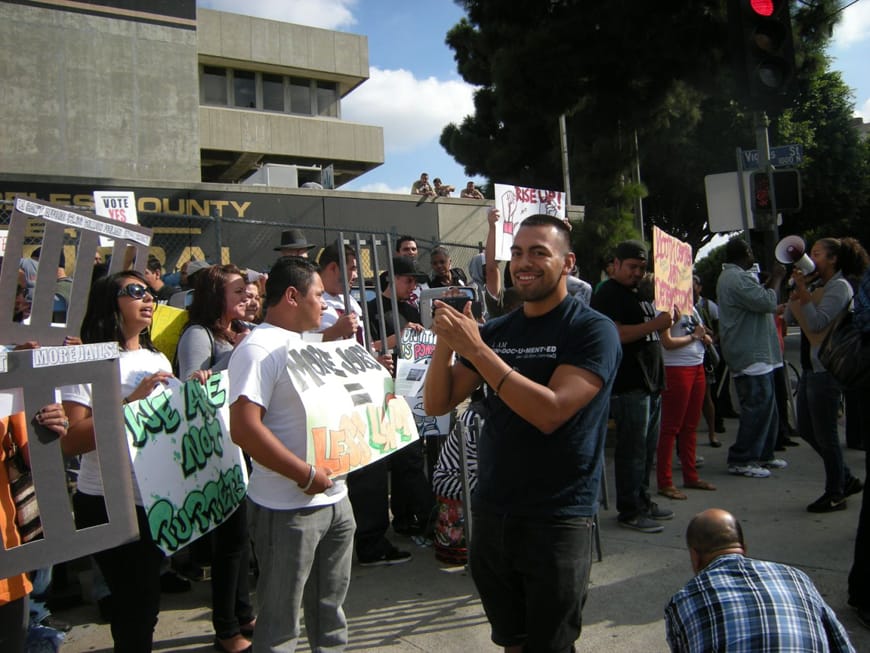

A large, enthusiastic crowd, including prisoners’ families and supporters as well as youth, turned out for the 10/10 rally in LA. – Photo: Virginia Gutierrez
California prisoners, who are prohibited from writing to each other, rely on phone calls, visits and letters from outside the walls and on the Bay View and a few other publications for the news that matters most to them. Most of the men in the Short Corridor Collective, however, are allowed no phone calls, and many are denied visits as well.

And rumors reached us that the Corrections Department might ban the October Bay View statewide for containing the call that would effectively disarm them. We don’t yet know whether subscribers have received their papers. What we have heard is that many prisoners’ letters to the Bay View are being confiscated.

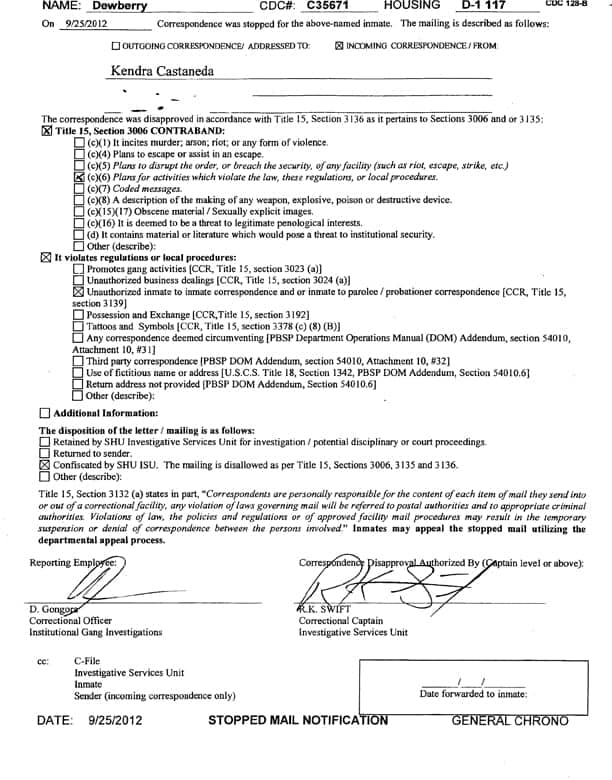
Of the 100 copies of the call to end hostilities that Kendra mailed, all appear to have been delivered except the 11 addressed to the very same men who wrote it. On Oct. 12, she received 11 “mail stops,” notices from the Pelican Bay gang unit claiming her letters violate California Code of Regulations Title 15 with “plans that violate the law” and facilitate prisoner-to-prisoner communication, even though she had deleted all the signers’ names and prison numbers.

Rumors have reached us that the Corrections Department might ban the October Bay View statewide for containing the call that would effectively disarm them.

Responses from prisoners who did receive her letters are beginning to reach Kendra, and here’s what they write:

This is one of 11 “mail stops” Kendra Casteneda received Oct. 12, barring her letters containing copies of the Bay View story announcing and including the “Agreement to end hostilities” from reaching the very prisoners who wrote the agreement. This mail stop names Ron Dewberry, better known as Sitawa Nantambu Jamaa. (Click to enlarge.)
From Gustavo Chavez: “The idea of this agreement going around is a positive start to a new beginning for all inmates. If we could maintain this valuable peace treaty within the prison system, why not work on spreading the word outside the prison walls so that we may put an end to the gang violence and work on becoming a bigger force?

“If we could maintain this valuable peace treaty within the prison system, why not work on spreading the word outside the prison walls so that we may put an end to the gang violence and work on becoming a bigger force?” – Gustavo Chavez

“Of course this movement will immediately be looked at as home grown terrorism. We can’t allow such propaganda to interfere with our progress to educate our youth. The whole system operates on scare tactics, tactics that we shouldn’t fear.

“The challenges that lie ahead must be supremacy over the entire system. We can’t allow our decisions to be uncertain, because uncertainty won’t take us far. We also must implement principal to our purpose so that we may understand the cause. When people lose focus, things get ugly, and we all know who benefits from that!

“Last but not least, we/I know that rumors have been going around about certain stuff, and supposedly everything is coming from the Short Corridor. It sounds like the guards are attempting to disrupt the agreement by spreading these rumors around. We all must be careful not to fall into the guards’ web.
“I’m always prepared for the worst, especially when knowing I’m being psychologically tortured day after day.” – In struggle, Gustavo Chavez, E-45117, PBSP SHU D-8-121, P.O. Box 7500, Crescent City, CA 95532, written Sept. 26, 2012

In a separate personal letter, Gustavo writes on Oct. 7: “Kendra, a lot of scandalous things are occurring up here. They have over 16 inmates from the main line on potty watch. I’m constantly being threatened by the coward pigs. Their tactics are aimed to disrupt what we are setting out to accomplish. You make sure to continue riding strong against the enemy regardless of the amount of times they try to bring you down.”

From Terrance E. White: “They’ve moved a lot of people over to Wasco State Prison Ad-Seg Unit, and they’re still validating people but have let non-serious incidents go back to the yard. That’s what I’ve witnessed.

“And they didn’t try to deter our Black August celebration this year. Here at North Kern State Prison, we had Southern Hispanics, Northern Hispanics and a few whites participate in our exercising routines on the yard (dog kennel) with us New Afrikkkans.



“We are all also aware of the peace treaty that’s to start Oct. 10, 2012, throughout the prison system and are all in agreement with it. It is about time to take back all that has been lost and continue to press forward in this struggle for liberation. They’ve had all us oppressed in these conditions for far too long.” – Comrade T, Terrance E. White 

AG8738, KVSP D6-241, P.O. Box 5005, Delano, CA 93216, written Oct. 5, 2012

From Heshima Denham: “We received the comments (from several different sources) on the 10/10 cessation of hostilities and are in FULL adherence/compliance with all three points. However, there does seem to be some confusion on aspects of point 3 as it relates to the 10/10/2012 date, and we were wondering could we get some clarity from the main reps at PB?” – Heshima Denham, J-38283, Cor-SHU 4BIL-46, P.O. Box 3481, Corcoran, CA 93212, written Oct. 3, 2012

Prisoners’ inability to communicate leads to confusion

The confusion Heshima mentions appears to be reflected in an Oct. 13 story in the Los Angeles Times. Prisoners apparently heard that a call had been put out by those who had called last year’s hunger strikes and assumed it was for another hunger strike. The Times reports:

“Corrections officials said they do not know why about 500 inmates started refusing food Wednesday, the same day a prison ‘end to hostilities’ was called by inmate activists who had orchestrated last year’s mass hunger strikes.

“The fasting began at opposite ends of the state. Several hundred inmates at Pelican Bay State Prison near the Oregon border refused meals from Wednesday through Friday, but began eating again Friday night, said Terry Thornton, spokeswoman for the state Department of Corrections and Rehabilitation. About 300 prisoners at California Correctional Institute in Tehachapi, north of Los Angeles, also began refusing meals Wednesday. About 200 of them continued to refuse food Saturday, Thornton said.”
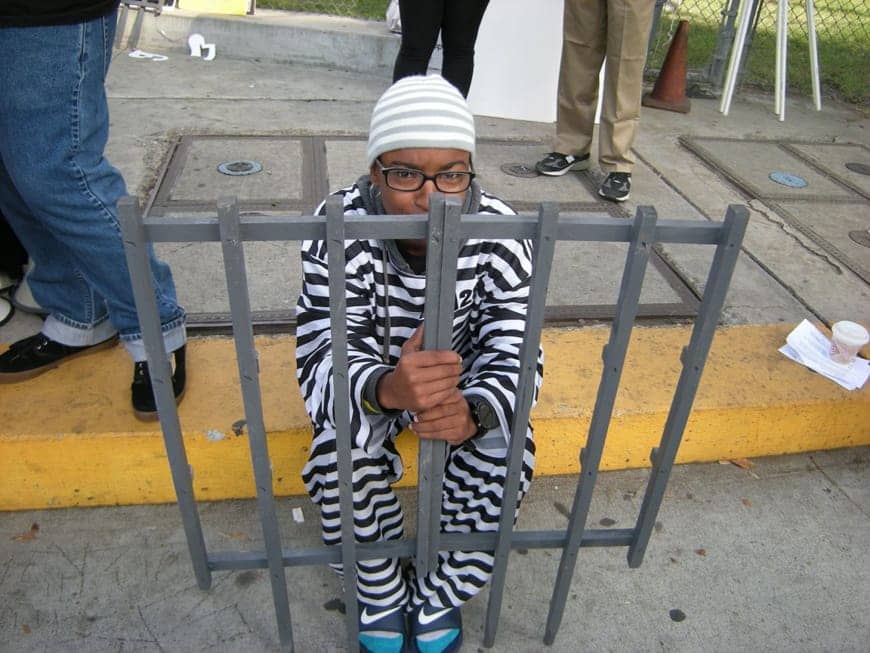

This youngster dressed in stereotypical prison garb behind bars dramatizes the encaging of human beings practiced on a mass scale in California and throughout the U.S. Prisoners in solitary confinement endure years and even decades of isolation in windowless “concrete coffins” the size of a parking space, deprived of sensory stimulation, human contact or a glimpse of the natural world – a bird, a tree or a blade of grass. Imagine the strength of character that takes! – Photo: Virginia Gutierrez
The Times’ story closes on an ominous note:

“Prison officials regard the reference to race [in the call to end hostilities] as a synonym for the race-based gangs active in California prisons, including the Mexican Mafia, Aryan Brotherhood and 415 KUMI.

“Molly Porzig with Prisoner Hunger Strike Solidarity said Pelican Bay prison officials responded to the ceasefire by asking the 16 Short Corridor inmates whose names appear on the statement to acknowledge gang activity. She attributed the claim to a family member visiting one of those inmates last week.”
This suggests that CDCR is trying to turn the call to end hostilities on its head and consider it evidence of gang activity.

It is imperative that the truth be communicated to prisoners all over California. We urge readers to print out this story and mail it to prisoners you know.

To nip in the bud these efforts to confuse and criminalize prisoners and stop their peaceful organizing, it is imperative that the truth be communicated to prisoners all over California. We urge readers to print out this story and mail it to prisoners you know. If you’re not currently corresponding with a prisoner, look for California prisoners from among the hundreds of pen pals listed in the Bay View.

The call to end hostilities is heard and heeded on the streets

Los Angeles’ Youth Justice Coalition (YJC) called for a “parallel cease fire in the streets” to correspond to the end of hostilities inside the prisons called by the Short Corridor Collective. Led by the youth, a large, diverse crowd rallied at 10 a.m. on 10/10 outside the LA County Men’s Jail.

In announcing their rally, YJC wrote: “Prisoners in Pelican Bay State Prison’s Security Housing Unit (SHU) have announced a push to end all hostilities between racial groups within California’s prisons and jails. The handwritten announcement was sent to prison advocacy organizations. It is signed by prisoners identifying themselves as the PBSP-SHU Short Corridor Collective. Pelican Bay’s SHU was the point of origin for last year’s hunger strikes which rocked California’s prison system, at one point including the participation or nearly 12,000 prisoners in over 11 prisons throughout the state.”
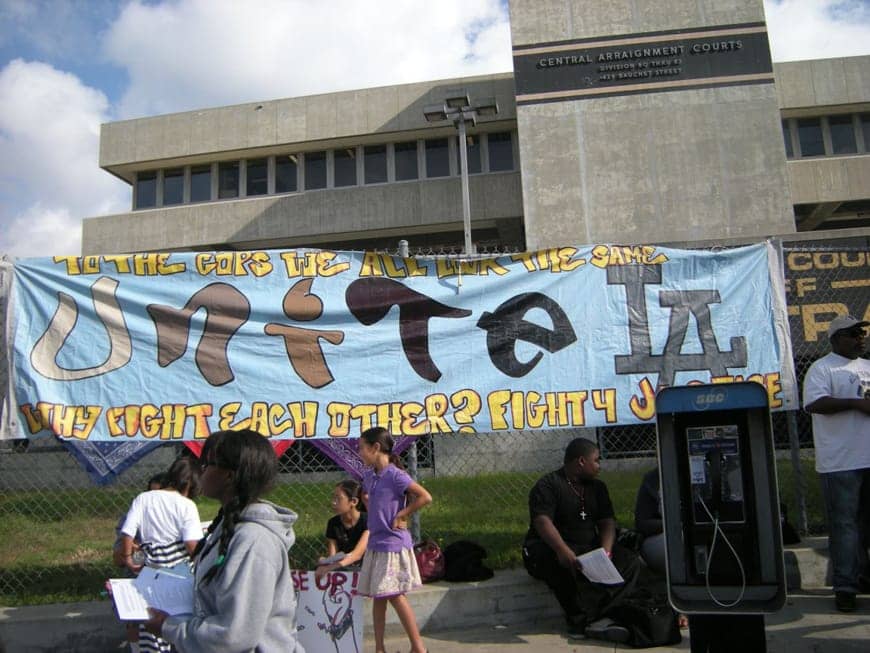

As the crowd gathered for the 10/10 rally, a big banner greeted them: “To the cops we all look the same! Unite LA! Why fight each other? Fight for justice!” – Photo: Virginia Gutierrez
“We have the duty to fight for our brothers and sisters who remain inside the walls of injustice and confined to a system that does NOT work for our community,” they declared.

Photos taken at the rally that illustrate this story exude solidarity and hope.

Sponsoring organizations included Youth Justice Coalition, Fair Chance Project, LA Community Action Network, FACTS (Families to Amend California Three Strikes), California Families to Abolish Solitary Confinement, Homies Unidos, California Faith Action, Coalition to Stop Sheriff Violence and Gender Justice LA. For more information or to add your organization as a supporter, email the Youth Justice Coalition at freelanow@yahoo.com or call them at (323) 235-4243.

The youth quote political exile Assata Shakur: “If unity happens inside the walls of prison, imagine the impacts it will have on our neighborhoods and youth!”

“If unity happens inside the walls of prison, imagine the impacts it will have on our neighborhoods and youth!” – Assata Shakur

Another rally was held in Riverside. The announcement on Facebook reads: “We are calling on all communities in Riverside County to stand in solidarity with all of our loved ones locked inside California’s prisons and county jails. This press conference and rally calls on the CDCR and local county sheriff’s departments to honor the call to end all hostilities between racial groups.”
In the Bay Area, a panel discussion on the call to end hostilities among other topics under the heading, “Alternatives to the Prison System,” is set for Saturday, Oct. 20, 2:30 p.m., at the Niebyl-Proctor Library, 6501 Telegraph Ave., Oakland. The topics are:
  • prisoners’ call for an end to hostilities, inside and in the communities
  • a critique of power’s criminality as revealed in the existence of prisons
  • real alternatives to the criminality of punishment
Panelists will include:
  • Steve Martinot, author of “The Need to Abolish the Prison System: an Ethical Indictment”
  • Joileen Richards, Campaign to End Mass Incarceration
  • Urszula Wislanka, Pelican Bay Hunger Strike Support Committee, and News and Letters
  • Melvin Dickson, The Commemorator: Commemoration Committee for the Black Panther Party
  • Dorsey Nunn, All of Us or None
Bay View editor Mary Ratcliff can be reached at editor@sfbayview.com or (415) 671-0789.