Retiring Arizona Prison Watch...


This site was originally started in July 2009 as an independent endeavor to monitor conditions in Arizona's criminal justice system, as well as offer some critical analysis of the prison industrial complex from a prison abolitionist/anarchist's perspective. It was begun in the aftermath of the death of Marcia Powell, a 48 year old AZ state prisoner who was left in an outdoor cage in the desert sun for over four hours while on a 10-minute suicide watch. That was at ASPC-Perryville, in Goodyear, AZ, in May 2009.

Marcia, a seriously mentally ill woman with a meth habit sentenced to the minimum mandatory 27 months in prison for prostitution was already deemed by society as disposable. She was therefore easily ignored by numerous prison officers as she pleaded for water and relief from the sun for four hours. She was ultimately found collapsed in her own feces, with second degree burns on her body, her organs failing, and her body exceeding the 108 degrees the thermometer would record. 16 officers and staff were disciplined for her death, but no one was ever prosecuted for her homicide. Her story is here.

Marcia's death and this blog compelled me to work for the next 5 1/2 years to document and challenge the prison industrial complex in AZ, most specifically as manifested in the Arizona Department of Corrections. I corresponded with over 1,000 prisoners in that time, as well as many of their loved ones, offering all what resources I could find for fighting the AZ DOC themselves - most regarding their health or matters of personal safety.

I also began to work with the survivors of prison violence, as I often heard from the loved ones of the dead, and learned their stories. During that time I memorialized the Ghosts of Jan Brewer - state prisoners under her regime who were lost to neglect, suicide or violence - across the city's sidewalks in large chalk murals. Some of that art is here.

In November 2014 I left Phoenix abruptly to care for my family. By early 2015 I was no longer keeping up this blog site, save occasional posts about a young prisoner in solitary confinement in Arpaio's jail. I'm deeply grateful to the prisoners who educated, confided in, and encouraged me throughout the years I did this work. My life has been made all the more rich and meaningful by their engagement.

I've linked to some posts about advocating for state prisoner health and safety to the right, as well as other resources for families and friends.

until all are free -

MARGARET J PLEWS (June 1, 2015)
arizonaprisonwatch@gmail.com


INDIGENOUS ACTION MEDIA

INDIGENOUS ACTION MEDIA
ANTICOLONIAL zines, stickers, actions, power

Taala Hooghan Infoshop

Kinlani/Flagstaff Mutual AID

MASS LIBERATION AZ

MASS LIBERATION AZ
The group for direct action against the prison state!

Black Lives Matter PHOENIX METRO

Black Lives Matter PHOENIX METRO
(accept no substitutions)

BLACK PHX ORGANIZING COLLECTIVE

BLACK PEOPLE's JUSTICE FUND

PHOENIX: Trans Queer Pueblo

COVID Mutual AID PHOENIX

AZ Prison Watch BLOG POSTS:


Showing posts with label direct action. Show all posts

Tuesday, May 20, 2014

#NOYOUTHINPRISON 2014 Week of Action!


 look what I saw over the I-10 today...
it reminded me this is a special week.
 

There are very few blogs out there about prison abolition - this has got to be one of the best in the US, authored by Mariame Kaba. Go there all week for more focus on liberating criminalized youth.

Sorry I wasn't more organized for this week - it caught me by surprise. Families, take a lesson from these folks in Chicago: Don't settle for crumbs when you fight for change. Don't just try to make the system "better" - that is, stronger. Insist on making our communities smarter on crime instead, so we can end the violence and despair of incarceration altogether.


#NO YOUTHINPRISON week of action


----------from Prison Culture------------

#NoYouthInPrison: Kicking Off National Week of Action Against Incarcerating Youth

May 19 2014
 

If you’ve read this blog even once, you know that I am against prisons. I am particularly against incarcerating children. Today kicks off the National Week of Action Against Incarcerating Youth.
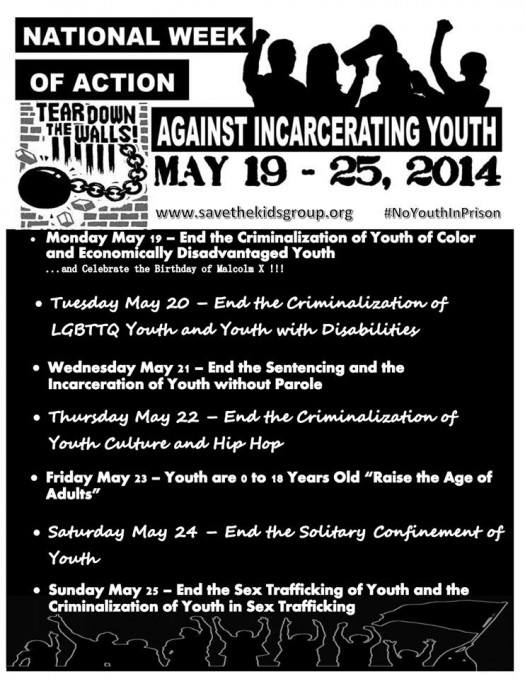
nationalweekofaction
I write a lot about the prison industrial complex (including the juvenile punishment system) and last year I published a paper with my friend Dr. Michelle VanNatta about alternatives to youth incarceration in Chicago. In the paper, we provided a brief literature review about juvenile detention and incarceration. I am republishing that part here to buttress the case against incarcerating young people.

“There is an urgent need to find constructive ways to respond to young people in conflict with the law. Research compellingly demonstrates that youth placed in juvenile detention centers compared to alternative interventions are much more likely to later spend significant time in prison (Aizer and Doyle, 2013). Juvenile and adult incarceration both create exorbitant financial and social costs (Petteruti, Velázquez, and Walsh, 2009).

Incarceration of juveniles is harmful to young peoples’ development, education, families, communities, and their current and future socioeconomic status (Majd, 2011; Bickel, 2010). Furthermore, incarcerating youth is not effective at enhancing public safety (Butts & Evans, 2011; Petteruti, Velázquez, & Walsh, 2009). Conditions of detention, even when monitored and regulated, often involve serious violations of human rights, such as solitary confinement and sexual violence perpetrated by staff (Beck, Cantor, Hartge, & Smith, 2013; Kysel, 2012; Krisberg, 2009). These abuses harm youths’ physical health, mental health, and social well-being (McCarty, Stoep, Kuo, & McCauley, 2006; Mendel, 2011). Destructive conditions that create lasting damage are even more extreme for youth confined to adult jails and prisons (Arya, 2007; Sarri and Shook, forthcoming; Wood, 2012). The detention process disconnects youth from family and supportive relationships, interrupts education, and makes it difficult for youth to get adequate exercise, healthcare, nutrition, and support.

Incarceration is extravagantly expensive. In 2012, Illinois taxpayers paid an average of $86,861 per year for each youth incarcerated in state prison (Illinois Department of Human Services, 2012). Taxpayers paid an astounding $219,000 per year for each youth confined to the Cook County Juvenile Temporary Detention Center (Civic Federation, 2013). These numbers do not include associated costs, such as government monies used to pay police, investigators, prosecutors, public defenders, judges, court personnel, and others for the arrest, investigation, and adjudication of youth’s criminal cases. Illinois (and the rest of the United States) has made a staggering investment in the criminalization of youth.

Incarceration is traumatic for youth, as evidenced by young peoples’ suicides, suicide attempts, self-harm, and the worsening of mental health symptoms while inside (Hayes, 2009; Ford, Chapman, Hawke, & Albert 2007). The stigma of incarceration follows youth for a lifetime, interfering with education housing, jobs, economic wellbeing, and stable community relationships (Houchins et al, 2009). Disproportionate arrest, prosecution, conviction, and sentencing of youth of color perpetuate and intensify racist injustice throughout the United States (Jones, 2012; US Department of Justice, 2012; Cahn, Nash, and Robbins, 2011). Incarceration can be particularly horrific for gender non-conforming youth, who may be assigned to facilities on the basis physical examinations or identification documents rather than based on the youth’s own gender identity and presentation. Thus, someone who lives in the world as a young woman may be incarcerated at a men’s prison. This exposes the youth to significant danger and trauma (Estrada & Marksamer, 2006).

Finally, there is no conclusive evidence that incarceration in juvenile detention centers safeguards our communities, improves pro-social behavior among those currently or formerly incarcerated, or rehabilitates youth who have engaged in harmful behavior (National Juvenile Justice Network, 2011). Because incarceration is expensive, traumatic, disruptive, and ineffective (Mendel, 2011), exploring alternative strategies for working with youth in conflict with the law offers rich opportunities to promote community well-being while saving money. Carefully implemented, alternatives to detention/incarceration can reduce harm in communities, promote youth development, contain costs, enhance safety, protect human rights, and build a stronger society.”
In short, juvenile detention and incarceration is costly, harmful, and doesn’t improve public safety. We need to STOP LOCKING UP CHILDREN IN JAILS AND PRISONS TODAY.

For our part in Chicago, today we will be kicking off the week of action against incarcerating youth with a march at 5 p.m. Details are HERE. If you are in the city, I hope that you will join us.
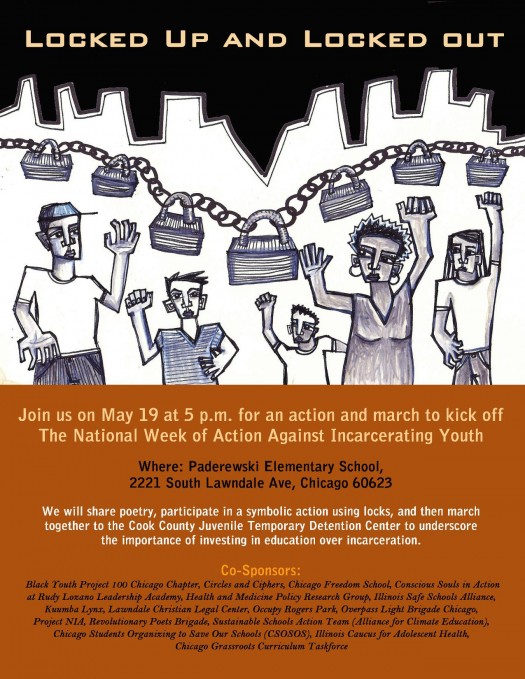
by Billy Dee
by Billy Dee

For those in Illinois who are interested in the numbers behind juvenile detention and incarceration, my organization published an updated version of “The Conscious Chicagoan’s Guide to Youth Detention and Incarceration” last week.

Finally, I am always asked for “solutions” as though this is the provenance of a single person. In fact, WE have a collective responsibility of solving our problems TOGETHER. One person didn’t create these problems and they have a long history. It’s going to take ALL OF US to address them properly. Regardless for those in Chicago, I have compiled a list of some ways that you can personally resist the criminalization of young people in our city. Feel free to add your own ideas to the list.


Friday, March 18, 2011

86 the Violence Against Sex Workers!


Take direct action to support sex worker rights today!


Stop the Violence. Stop the Fear.

See us Here.

Mothers and daughters and
Teachers and lawyers and
Songs within our souls.

Brothers with dreams, and
Trans with means,
And a light inside us that grows.


Each have a story

With sadness and glory
Trying to make our way through

When the judgment fades,

And the hate abates,
We'll be standing right beside you.
Will you be standing beside us too?

Stop the Violence. Stop the Fear.

See us Here.


WHAT IS 86 THE VIOLENCE ALL ABOUT AND WHY ARE WE DOING IT?


This year, the United States participated in a Universal Periodic Review (UPR) – a process set up by the Human Rights Council at the United Nations to assess the level of human rights in each country. The U.S. received more than 200 recommendations and must now decide to accept or reject each recommendation. Recommendation 86 called on the Obama Administration to “…ensure access to public services paying attention to the special vulnerability of sexual workers to violence and human rights abuses.” This is the first time the US has been internationally called upon to address its insensitivity to the long-neglected issues faced by sex workers.


To capitalize on this momentous opportunity, sex worker support and advocacy organizations from all across the country have organized to move government officials to agree to accept the recommendation. As a part of our organizing efforts we have reached out to sex worker groups, academics, policy makers, community organizations, funders and NGO’s around the globe and received unprecendented levels of support. (See the amazing list of folks who have signed our call to action below.)


On March 18th, the U.S. will go to Geneva to announce to the U.N. which recommendations they will accept and which they will reject. "86 THE VIOLENCE," a multi-city performance art action represents the culmination of sex worker advocacy efforts. We believe we have an opportunity to achieve high levels of media attention, which opens the door for us to let the world know in one solid, united voice, that violence and human rights abuses will no longer be tolerated in our community.


If the government accepts the recommendation, this action will serve as a celebration for having our nation’s first major political promise to address the needs of sex workers. If they do not accept the recommendation, then this action will serve to spark a fire of outrage that will be fueled by media and all of the supporters that have come out to champion the cause. Either way, we believe the more sex workers and allies we can motivate to participate in this action, the more media attention we will receive, and the greater the likelihood that we can alter the conversation and public perception about sex worki in this country.


HOW CAN I GET INVOLVED?

Join us in this public action performance on March 18th!


SWOP, Sex workers and allied organizations all over the country will be standing up and stripping down for recommendation 86!

Here's what you do:


1. Check if there is already a key organizer in your city. If there is no key organizer, email us, and we'll list YOU as the key organizer!

Key organizers will be contacted by our media team to help you identify media outlets in your area, and follow up.

If you are a key organizer, pick a location for the action that we can list on the website, and a contact name, number, and email address

"86 the violence" will take place at noon PST, 1pm MST, 2pm CST, and 3pm EST on March 18th, 2011 for 86 minutes!

2. Enact "86 the violence."

-You need AT LEAST one person to be a TARGET and one person to be SUPPORT/ INFORMATION. More people are better, 3 TARGETS and a few SUPPORTS are best to protect everyone involved.

-TARGETS dress up as shown in the video here . Draw a red bullseye somewhere on your body. Be as close to naked as is legally allowed on the street in your city, or that you are comfortable with. Tie red fabric around your eyes, your mouth or your hands. These three ties are symbolic and can mean many things about lack of access, silence, and invisibility. Infuse them with your own meaning.

Install the TARGETS on the street, in a park, or in any public place. TARGETS symbolically or verbally ask passerby to help us “86 the violence.” this can be done by silently holding out a cloth that passerby can use to wipe the target off your body, or verbally asking.

-SUPPORT may dress in any manner classic to the sex worker rights movement. Wear red, carry red umbrellas, and have at least one or 2 umbrellas with the number 86 painted on the top. Print out the information we have HERE: literature to hand out to passersby and lyrics to our song. Perhaps keep the information to hand out in an upturned red umbrella.

3. The final action of the performance is to remove or cut off the red cloth, wipe off the targets, and leave the red cloth in the shape of the number 86 on the ground.

4. Take photos. Document the hell out of it, and send your documentation to us. We'll be making a montage of videos and photos to take to press as well.


notes: if staying installed in one place becomes and issue (a cop tells you to leave, or threatens you) make sure your group knows what it wants to do. We recommend taking the whole production on a walk. You can simply walk down the street slowly, to avoid loitering. The 86 minutes need not be in one place. We recommend wearing the smallest amount of legally allowed clothing (in many places, this is a thong, underwear or T-Strap and nipple covering). We recommend that ALL TARGETS wear the same amount of clothing/covering for continuity and gender alliance.

--------------------


Organizations that have come out in support of accepting the recommendation:


Action pour la lutte Contre L'ignorance du SIDA (Democratic Republic of Congo)
AIDS Action Baltimore
AIDS Foundation of Chicago
AIDS Project Los Angeles
American Medical Students Association
Americans for Informed Democracy
Amnesty for Women
American Jewish World Service
Aniz, Inc.
Asocijacija za Borbu Protiv Side (Association against AIDS, JAZAS, Yugoslavia)
Association of Nurses in AIDS Care
Bay Area Sex Worker Advocacy Network
Best Practices Policy Project
Black Communities' Process (PCN)
Center for Anti-Violence Education
Center for Constitutional Rights (CCR)
Center for Health and Gender Equity (CHANGE)
Civil Liberties and Public Policy Program (CLPP), Hampshire College
Collectif pour le Developpement Economique, Social et Culturel Integre (Democratic Republic of Congo)
Desiree Alliance
Different Avenues
Erotic Service Providers’ Legal, Education and Research Project
Four Freedoms Forum
Harm Reduction Coalition
Helping Individual Prostitutes Survive (HIPS)
HIV Prevention Justice Alliance
HIVictorious, Inc.
Housing Works
Human Rights Watch
International Community of Women Living with HIV and AIDS Global (ICW Global)
International Committee for the Rights of Sex Workers in Europe
International Rectal Microbicide Advocates
International Women’s Health Coalition
Ipas
JJJ Association (Hong Kong)
Madonna e.V. (Germany)
MADRE
Malcolm X Center for Self Determination
Nashville CARES
National Minority AIDS Council
Nigerian Diversity Network
Paso del Norte Civil Rights Project
Public Interest Project, US Human Rights Fund
Population & Development Program, Hampshire College
Religious Institute
Sexuality Information and Education Council of the U.S. (SIECUS)
Scarlet Alliance (Austraila)
Sex Worker Forum (Botswana)
Sex Workers Action New York (SWANK)
Sex Workers Outreach Project (Chicago Chapter)
Sex Workers Outreach Project (Las Vegas Chapter)
Sex Workers Outreach Project (SWOP National)
Sex Workers Outreach Project (NYC Chapter),
Sex Workers Outreach Project (Seattle Chapter)
Sex Workers Outreach Project (Tucson Chapter)
Sex Workers Project, at the Urban Justice Center
Sexuality and Gender Working Group, Human Rights Network
SisterLove
St. James’ Infirmary
Syndicat du Travail Sexuel (STRASS) (France)
Tais Plus (Kirgizstan)
TAMPEP (European Network for HIV/STI Prevention & Health Promotion among Migrant Sex Workers)
U.S. Positive Women's Network (PWN) a project of WORLD (Women Organized to Respond to Life-threatening Disease)
Women of Color United
Women’s Network for Unity
Women’s Network for Unity (Cambodia)
Women's Organization Network for Human Rights Advocacy
Women’s Re-Entry Network
Women with a Vision
x:talk (London)

Academics who have come out in support of the recommendation:

*Laura Augustin, Ph.D.; Author, Sex at the Margins
*M. Jocelyn Elders, M.D.; 15th U.S. Surgeon General
*Elizabeth Bernstein, Ph.D.; Assistant Professor, Womens’ Studies & Sociology, Barnard College, New York, New York
*Barb Brents, Ph.D.; Professor of Sociology, University of Las Vegas, Nevada
*Wendy Chapkis, Ph.D.; Professor of Sociology, Director of Women and Gender Studies, University of Southern Maine
*Deborah Cohan, MD, MPH; Associate Professor
Department of Obstetrics, Gynecology and Reproductive Sciences, University of California, San Francisco; Medical Director, Bay Area Perinatal AIDS Center; Associate Director, National Perinatal HIV Hotline
*Melissa Ditmore, Ph.D.; Consultant, Research and Rights-Based Programming
*Shari L. Dworkin, Ph.D., M.S.; Associate Professor, Dept. of Social & Behavioral Sciences; Director, Sociology Doctoral Studies Program; Affiliated Faculty, Center for AIDS Prevention Studies (CAPS); Affiliated Faculty, Global Health Sciences, University of California, San Francisco
*Smarajit Jana, MD; Principal, Sonagachi Research and Training Institute, Kolkata, India
*Jessica Fields, Ph.D.; Associate Professor, Sociology,Research Faculty, Center for Research on Gender and Sexuality
*Valerie Jenness, Ph.D.; Dean, School of Social Ecology, Professor, Department of Criminology, Law and Society, Professor, Department of Sociology, University of California, Irvine
*Kamala Kempadoo, Ph.D.; Professor, Department of Social Science, York University, Toronto, Canada
*Gail Kligman, Ph.D.; Professor of Sociology, UCLA, Director, Center for European and Eurasian Studies
*Kari Lerum, Ph.D.; Associate Professor, Interdisciplinary Arts & Sciences, Adjunct Professor, Women Studies, University of Washington, Bothell
*Jill McCracken, Ph.D.; Assistant Professor, Rhetoric, Department of Languages, Literature, and Writing, University of South Florida St. Petersburg
*Alice M. Miller, J.D; Visiting Senior Research Scholar, Robina Foundation Fellow, Yale Law School
*Penelope Saunders, Ph.D.; Director, Best Practices Policy Project
*Svati P. Shah, Ph.D., MPH; Assistant Professor, Women, Gender, Sexuality Studies, University of Massachusetts, Amherst
*Kate Shannon, Ph.D., MPH; Assistant Professor, Dept of Medicine, University of British Columbia; Director of Gender & Sexual Health Initiative, BC Centre for Excellence in HIV/AIDS, Vancouver, Canada
*Lara Stemple; Director, Graduate Studies, Director, Health and Human Rights Law Project, UCLA School of Law
*Dallas Swendeman, Ph.D., MPH; Department of Psychiatry and Biobehavioral Sciences, David Geffen School of Medicine at UCLA; Semel Institute for Neuroscience and Human Behavior; Center for Community Health; Global Center for Children and Families; Center for HIV Identification, Prevention & Treatment Services
*Juhu Thukral, Esq.; Co-Founder and Former Director, Sex Workers Project at the Urban Justice Center New York, New York
*Stephanie Wahab, Ph.D.; Associate Professor of Social Work, Portland State University, Portland, OR
*Carole S. Vance, PhD, MPH; Assoc. Clinical Professor, Mailman School of Public Health, Columbia University, New York, New York
*Ronald Weitzer, Ph.D.; Professor of Sociology, George Washington University, Washington, DC

Saturday, May 22, 2010

O'odham Solidarity Across Borders: Resisting militarization

Activists Lockdown & Occupy US Border Patrol Headquarters Demanding End to Border Militarization, Protesters Cited and Released

Saturday, May 22, 2010 


High resolution pictures and B-roll available at: www.oodhamsolidarity.blogspot.com

 
 Tucson, AZ – At approximately 1:00PM Friday, May 21, 2010 more than a dozen people occupied the Tucson Headquarters of the US Border Patrol to draw attention to impacts of border militarization in Indigenous Communities. Six people, including Alex Soto a member of the Tohono O'odham Nation and a volunteer with the group O’odham Solidarity Across Borders, locked themselves together for up to 3 and 1/2 hours. “Indigenous voices have been ignored. In our action today we say NO MORE!” Said Soto.

Banners were hung, including one placed over the reception window that read, “Stop Militarization of Indigenous Lands Now”, traditional songs were sung and the group chanted, “Border militarization destroys Indigenous communities!” and “No raids, no deportations! No SB1070, no racist laws!” Approximately 30 Border Patrol agents flooded the lobby of the headquarters and scrambled to react. Roads to the headquarters and adjacent air force base were shut down. Tucson City Police were eventually called and began preparing an extraction of the peaceful resisters.

A diverse crowd of up to 70 people quickly gathered outside the Border Patrol headquarters to support those locked down inside. Ofelia Rivas of O’odham Voices Against The Wall, an elder in support of the action stated, “It was a historical and powerful moment for people of all color to unite with O’odham to stand in solidarity for human rights and to see the next generation take a stand”.

At approximately 4 o’clock the peaceful resisters negotiated the conditions of their release on their terms. Their requests to consult with Tohono O’odham elders to negotiate terms of release were denied by Tucson Police. The protesters decided to unlock and were cited for two misdemeanors each of trespassing and disorderly conduct. The resisters were released just outside the premises to join supporters where they gathered in traditional prayer and rallied against border militarization for another hour. Community members including members of the Pasqual Yaqui, Tohono O'odham, and Dine' Nations reacted emotionally when two Wackenhut Corp. buses left the Border Patrol compound filled with undocumented people. The detainees responded with returning the symbol of resistance - a raised fist.

“This is just one action of many that makes visible the invisible crimes against humanity that occur every day on the colonial border,” stated one of the peaceful resisters. “We commit to honoring the prayers and call for support of the people most impacted by border militarization, the Indigenous Peoples who’s lands we are on and migrants who seek a better life for their families. We cannot not allow government agencies, border patrol, ICE or reformist agendas to further their suffering. We will continue our actions of peaceful resistance for human dignity and respect for all peoples.”

The action also denounced SB1070 and HB2281 as racist laws that are a part of an ongoing system of genocidal policies against Indigenous Peoples and migrant communities.

For previous Press Statement, please see attachment.

Note to editors, high resolution photos attached; Photo credits: O'odham Solidarity Across Borders Collective

Media Contacts:
Alex Soto (602) 881-6027
Leilani Clark (520) 982-5687

Thursday, April 8, 2010

ON DIRECT ACTIONS, CIVIL DISOBEDIENCE, ETC.

The timing for this seems appropriate, though I think I originally wrote it for the Friends of Marcia Powell and stuck it in a widget soon after the anarchists were accosted by the PPD...anyway, it's in quotes, but it's me, just at a different point in time than today...

If anything should happen to me, by the way, just keep up the “Free Marcia Powell” campaign. I can take care of myself - Marcia will cover everyone. We still need to have that memorial in May.

Anyway, before moving on, since I have everyone's attention: I understand that the former Deputy Warden from Lumley Yard at Perryville prison was the kind of person who often took the time to ask the women what they thought, how they were doing, what they needed – and responded. Bailey, I believe. She's retired now; she was one of the ones who cared, according to a few prisoners I've heard from in recent months.

I don't know what went down with all the ADC folks after Marcia died - I can only imagine what a weight some people still carry. It is not my intention to exploit that tragedy to trouble those who are already haunted. In fact, it is Marcia's Friends, not her ghost, that have been summoned to help us here. Anyone can still be her friend and help us change the world.

Anyone.

I don't know that Marcia will "rest in peace," regardless of whether or not anyone else makes theirs. I do believe she would be forgiving, that she would lend us her name and memory generously if we hadn't just taken it (though I did ask...), that her spirit dances at every direct action we plan and follow through on, and that from wherever she is she smiles at every sidewalk - from Phoenix to Amsterdam - bathed in the pastels of children's giant chalk and urging Arizona to Free Marcia Powell...

she's gotta love that photo we found of her in Phoenix, too. That was thanks to the Alaskan blogger at Frozen Justice. Kick ass up there, my friend. Blogging radical women rock!

Anyway, I don't think it was "God's mysterious ways" that led to Marcia's death even if we make good come from it somehow - they were all our ways, collectively, as a community, in the years leading up to her final hours in a cage. We neglect and abuse our sisters on the street and inside still daily.

But, I also know it's possible to exaggerate the personal sense of responsibility one may have when something like that ultimately happens. So, it seems worth mentioning that I also believe that Love's capacity for understanding and reconciliation is beyond our own imagining, and that She is fully capable of responding to anyone burdened by Marcia's death - or a similar such trauma - who asks for help.

I survived the suicide of a loved one nine years ago Easter Sunday. I know something of which I speak.

------------------on direct actions, etc...-------------------


"Taking a cue from the animal rights activists (who usually don't even put their names and faces on their sites), I thought I should clarify a few things here.

The Friends of Marcia Powell and freemarciapowell.blogspot.com are not very organized, nor are we affiliated or associated with any other group or organization. We all just crash each other's protests to show solidarity. Me (Peg) - I'm just winging this stuff.

The information and ideas provided on this website are not meant to incite illegal actions or activities, even if it looks like that may be what we're doing. That's not to say we frown on civil disobedience; there's an important place in history for diverse tactics of resistance. We are each only responsible for our own actions, though.

The point is for folks to get involved in the 2010 political campaigns and challenge the BS around the prison industrial complex, but please be creative enough that no one gets hurt or arrested (well, a few lawmen and makers need to be indicted and disarmed, still, but we don't want any more of our friends getting into trouble.)

Do be advised: these are not nice people we're picking fights with, they far outgun us, they make all the rules, the game is already rigged, and if you piss the wrong person off bad enough in this state, you don't even need to break a law to go to jail or prison.

In any case, make sure you have the number you'll need to call for help from jail written on your arm if you think you might get arrested. Live on the buddy system (keep an eye on each other for awhile and check the jail if anyone goes missing). Don't let things you're responsible for drag anyone else down; keep your loose ends neat.

If you do get in some kind of trouble, don't rat out your comrades, and don't automatically believe it if someone says that someone you trust ratted you out first. That's a classic tactic. So is trying to make you think that something perfectly legal you did is a crime. Just because it's secret doesn't mean it's criminal or shouldn't be protected.

Be true to yourself and the cause regardless.

If you have any questions about the legality of any direct action you are considering, we encourage everyone receiving this (or the) action alert(s) to check your local laws and ordinances and think about the possible consequences before proceeding to do anything. Not that you'd be on your own, but most of us are too poor to bail you out, and too politically disenfranchised to otherwise wrest you free."