Retiring Arizona Prison Watch...


This site was originally started in July 2009 as an independent endeavor to monitor conditions in Arizona's criminal justice system, as well as offer some critical analysis of the prison industrial complex from a prison abolitionist/anarchist's perspective. It was begun in the aftermath of the death of Marcia Powell, a 48 year old AZ state prisoner who was left in an outdoor cage in the desert sun for over four hours while on a 10-minute suicide watch. That was at ASPC-Perryville, in Goodyear, AZ, in May 2009.

Marcia, a seriously mentally ill woman with a meth habit sentenced to the minimum mandatory 27 months in prison for prostitution was already deemed by society as disposable. She was therefore easily ignored by numerous prison officers as she pleaded for water and relief from the sun for four hours. She was ultimately found collapsed in her own feces, with second degree burns on her body, her organs failing, and her body exceeding the 108 degrees the thermometer would record. 16 officers and staff were disciplined for her death, but no one was ever prosecuted for her homicide. Her story is here.

Marcia's death and this blog compelled me to work for the next 5 1/2 years to document and challenge the prison industrial complex in AZ, most specifically as manifested in the Arizona Department of Corrections. I corresponded with over 1,000 prisoners in that time, as well as many of their loved ones, offering all what resources I could find for fighting the AZ DOC themselves - most regarding their health or matters of personal safety.

I also began to work with the survivors of prison violence, as I often heard from the loved ones of the dead, and learned their stories. During that time I memorialized the Ghosts of Jan Brewer - state prisoners under her regime who were lost to neglect, suicide or violence - across the city's sidewalks in large chalk murals. Some of that art is here.

In November 2014 I left Phoenix abruptly to care for my family. By early 2015 I was no longer keeping up this blog site, save occasional posts about a young prisoner in solitary confinement in Arpaio's jail. I'm deeply grateful to the prisoners who educated, confided in, and encouraged me throughout the years I did this work. My life has been made all the more rich and meaningful by their engagement.

I've linked to some posts about advocating for state prisoner health and safety to the right, as well as other resources for families and friends.

until all are free -

MARGARET J PLEWS (June 1, 2015)
arizonaprisonwatch@gmail.com


INDIGENOUS ACTION MEDIA

INDIGENOUS ACTION MEDIA
ANTICOLONIAL zines, stickers, actions, power

Taala Hooghan Infoshop

Kinlani/Flagstaff Mutual AID

MASS LIBERATION AZ

MASS LIBERATION AZ
The group for direct action against the prison state!

Black Lives Matter PHOENIX METRO

Black Lives Matter PHOENIX METRO
(accept no substitutions)

BLACK PHX ORGANIZING COLLECTIVE

BLACK PEOPLE's JUSTICE FUND

PHOENIX: Trans Queer Pueblo

COVID Mutual AID PHOENIX

AZ Prison Watch BLOG POSTS:


Showing posts with label SB1070. Show all posts

Wednesday, November 13, 2013

ACLU-AZ on SB1070 "show me your papers" law: illegal enforcement must stop.

thank you, ACLU-AZ!


ACLU Challenges the Implementation of Section 2(B) of SB 1070 in Arizona
 
In first-of-its-kind legal action, the ACLU says the South Tucson Police Department is violating constitutional rights in use of the ‘show me your papers’ law

FOR IMMEDIATE RELEASE
En Español
Nov. 12, 2013

CONTACT:
Steve Kilar, ACLU of Arizona, (602) 492-8540, skilar@acluaz.org
Isabel Alegria, ACLU Immigrants’ Rights Project, 415-343-0785, 646-438-4146, media@aclu.org

TUCSON – The American Civil Liberties Union is putting law enforcement agencies across Arizona on notice that they will be held accountable for constitutional violations that result from the implementation of the state’s “show me your papers” law, Section 2(B) of SB 1070, an anti-immigrant statute enacted nearly three years ago.

The ACLU has initiated a legal claim against the South Tucson Police Department on behalf of Alex Valenzuela, a DREAMer who was unlawfully detained and taken to Border Patrol this summer by South Tucson officers.

The organization today sent a “notice of claim” letter to the police department, the first step in pursuing relief on Alex’s behalf. Last year, the U.S. Supreme Court declined to enjoin Section 2(B) because it found a “basic uncertainty” about what the provision actually requires of law enforcement officers. Alex’s situation, and numerous others around the state, demonstrate that—just as the ACLU and other civil rights groups have argued—the law unconstitutionally authorizes and encourages illegal police practices. This is the first challenge to Section 2(B) since it went into effect in September of 2012.

Alex, 23, was a passenger in a parked car on July 13 when South Tucson police officers detained him in order to question him about his citizenship. Even though he provided multiple forms of identification and had not committed any crime, the officers unlawfully arrested and drove Alex to Border Patrol’s Tucson Sector headquarters where he was detained for an additional five hours.

“It didn’t matter to the officers that I hadn’t committed a crime,” Alex said. “This is what happens when you let police act like immigration officials and it’s another example of why the police have lost the community’s trust.”

The South Tucson police detained Alex for no reason other than to investigate his citizenship and immigration status. Alex was not charged with a crime arising out of the incident at the time of the illegal detention nor has he been since. The notice of claim explains that the South Tucson police officers’ actions amounted to false arrest, violated Alex’s right to equal protection of the law and trampled his right to be free from unreasonable seizures.

“We’ve been informed of dozens of incidents where police have violated individuals’ rights because of the ‘show me your papers’ law,” said James Lyall, the ACLU of Arizona’s Tucson-based border litigation attorney. “Officers are routinely harassing people who have committed no crime by demanding identification. Without major improvements to police policies and practices, these rights violations will persist. As the ACLU’s recent victory against Maricopa County Sheriff Joe Arpaio shows, the courts will hold Arizona police departments accountable for continued constitutional violations.”

Other abuses documented by the ACLU that have occurred because of Section 2(B) include:
  • Mesa Police’s jailing of a 67-year-old Latino citizen after he picked a water bottle out of a trash can at a convenience store;
  • Casa Grande Police’s jailing and transporting to U.S. Immigration and Customs Enforcement a passenger of a car that was stopped for having a burnt-out taillight;
  • Tucson Police’s questioning of a woman about her immigration status after she called on them to assist her in a domestic violence situation; and
  • Phoenix Police’s unconstitutional search and detention of a legal resident who was questioned about his immigration status while picking up his car from an impound lot.
“Alex’s claim against South Tucson PD is representative of policing problems throughout Arizona that have arisen since the enactment of Section 2(B),” said Christine P. Sun, an attorney with the ACLU’s Immigrants’ Rights Project. “Law enforcement should be protecting the community and ensuring public safety, not engaging in practices that single people out for treatment that is unlawful under our Constitution.”

In addition to this legal claim, the ACLU and its partners have been talking with police departments and local governments across the state to inform them about the law’s basic failings, explaining that SB 1070 doesn’t trump the U.S. Constitution or provide an excuse for discriminatory policing.

Click here for a copy of the ACLU’s notice of claim on Alex’s behalf.

Friday, September 21, 2012

NO PAPERS, NO FEAR: SB1070 is here.


 Driving without an AZ license 
is apparently cause to suspect one is in the country illegally

Funny how mine just got lost.


---------this in today from my friends at PUENTE---------


Today, SB1070 goes into effect.  The courts have failed us, allowing racial profiling to be made law.  Here in Maricopa County, we already live 1070 every day under Arpaio.  According to the Department of Justice, he enacts the 'worst case of racial profiling' they have ever seen.  Judge Bolton's recent ruling, to allow section 2b to take effect today, will only expand the human rights crisis in Arizona.  The police can no longer protect and serve our communities, but only racially profile us.

Ahora la SB1070 entro en efecto. Las cortes nos han fallado, dejando que el perfil racial se haga ley. Aquí en el condado deMaricopa, ya vivimos con la SB1070 todo los días con Arpaio. Como el Departamento de Justicia a dicho ‘ Arpaio a cometido el peor caso de perfil racial’ que han visto. Hoy la juez Bolton a dejado que la sección 2b entre en efecto, esto solo incrementara la crisis de derechos humanos en Arizona. La policía ya no nos puede proteger y servir, solo detenernos por perfil racial.


We will remember today as not only the day that 1070 went into effect, threatening to separate our families and communities.  We will also remember today as the birth of a new era of the struggle for human rights, justice, and dignity in Arizona, a struggle that will not stop until we win.  We have seen that we can depend on no one but ourselves to turn the tide from hate to human rights.  We know that building our community's power is the way we will stop deportations and family separation.  We know that together we are strong and that together, we can overcome Arpaio, 1070, and police-ICE collaboration.  When we unite and take brave action, we are unstoppable.


Recordaremos este día no solo como el día que la SB1070 entro en efecto amenazando a separar nuestras familias ycomunidades. También recordaremos este día como el día que a nacido una nueva época de lucha por derechos humanos, justicia y dignidad en Arizona, una lucha que no parrara hasta que ganaremos. Hemos visto que no podemos depender en nadie mas que en nosotros para cambiar de odio a derechos humanos. Sabemos que construyendo el poder de nuestra comunidad es como pararemos las deportaciones y la separación de familias. Sabemos que juntos somos mas fuertes y podemos vencer a, SB1070, Arpaio, y la cooperación de policía e inmigración. Cuando nos unimos y tomamos acciones de valentía somos imparables.

So today, more than ever, we need you to join us in the struggle for human rights and dignity that is happening right now in Arizona.  As many before us have said, and as we know now is true, when injustice becomes law, resistance becomes duty.  This is the moment we fulfill our duty by organizing and growing the grassroots movement against hate, racism, and deportations.
Ahora mas que nunca necesitamos que nos acompañen en la lucha por los derechos humanos y la dignidad que esta pasando en Arizona. Como muchos antes de nosotros han dicho, y ahora sabemos que es verdad, cuando la injusticia se hace ley, la rebeldía se hace obligación. Este es el momento que efectuamos nuestra obligación en organizarnos y crecer el movimiento del pueblo contra el odio, racismo y las deportaciones.

Call to Struggle/Llamado a La Lucha:
1. WE FIGHT FEAR: We continue to organize our community  as we know that the way we will stop hate is by building a movement based on the power that already exists in our own families, neighborhoods, and communities.  As our members who travelled with the No Papers, No Fear Ride for Justice doing civil disobedience here and at the Democratic National Convention showed us, we are safer when we organize and come out of the shadows.  We have learned how to organize to stop deportations and family separation through know your rights trainings and by building peaceful neighborhood defense networks.   Send us an email at info@puenteaz.org to join our next Curso de Defensa, or to help us organize one in your neighborhood.
  
1. LUCHAMOS CONTRA EL MIEDO: Organizando a nuestra comunidad, ya sabemos que pararemos el odio creando un movimiento basado en el poder que ya existe en nuestras familias, barrios y comunidades, como los que han viajado en la caravana Sin Papeles Sin Miedo nos han mostrado hacienda desobediencia civil aquí y en Carolina del Norte, estamos mas seguros cuando nos organizamos y salimos de las sombras. Sabemos organizar para parrar deportaciones y la separación de familias, ensenando los derechos y creando bases de redes de protección. Mándenos un mensaje 
info@puenteaz.org para involucrarse en nuestro próximos curso de defensa.

2. WE FIGHT HATE:  SB1070 poses a moral dilemma that everyone must answer: will you comply with hate or will you side with the struggle for human rights and dignity?  We demand that every city, every police department, every school, and every institution in Arizona refuse to comply with SB1070 by not allowing their officers to racially profile.  To businesses, we ask your support in not complying with 1070 by becoming Human Rights Zones.  Those that do not we will boycott.
 2. LUCHAMOS CONTRA EL ODIO: La SB1070 crea un dilema moral que todos tendrán que contestar: cumplirás con el odio o estarás de el lado de los derechos humanos y la dignidad? Le pedimos a todas la ciudades, municipios, departamentos de policía, escuelas, o cualquier otra institución en Arizona que NO cumpla con la SB1070, no dejando que sus oficiales cometan violaciones de perfil racial a nuestra comunidad. A negocios les pedimos su apoyo al igual no cumplir con la ley y a negocios que estén al favor les haremos boicot.

3. WE FIGHT DEPORTATIONS: We know that Arizona cannot deport people on its own. President Obama can follow the brave example that undocumented people have set by taking immediate action to stop deporting Arpaio and 1070's victims by ending Secure Communities in Arizona.  Sign the petition at bit.ly/potus1070.
3. LUCHAMOS CONTRA LAS DEPORTACIONES: Sabemos que Arizona no puede deportar a personas solo. El presidente Obama puede seguir la valentía que la gente indocumentada a mostrado y tomar acción inmediata y parar las deportaciones de las victimas de la SB1070 y Arpaio, con solo terminar el programa de comunidades seguras en Arizona firma la petición aquí bit.ly/potus1070.
  

How you can get involved/Para involucrarte:
Tell your story: Share your experience of racial profiling.  The more we go public with what is happening to our community, the safer we are.  Contact us for support at info@puenteaz.org.
Cuenta tu historia: Comparte tu experiencia de perfil racial.  Lo mas que hablamos en publico sobre lo que pasa en nuestra comunidad, lo mas seguro estamos.  Escribenos por apoyo a info@puenteaz.org.
Stay informed: Follow us on Twitter @puenteaz and Like us on Facebook
Quedate informad@: Siguenos en Twitter @puenteaz y da nos Like en Facebook.
Share our updates: Spread the word on the human rights crisis happening in Arizona and the powerful ways we are fighting back
Comparte nuestros datos: Corre la voz sobre la crisis de derechos humanos pasando en Arizona, y las maneras poderosas que luchamos y resistimos.
Volunteer with the Puente Movement: There are so many ways to get involved in the struggle for human rights, from canvassing local businesses as part of our Human Rights Zone campaign, to fundraising, to teaching English classes, and so much more.  Email volunteer@puenteaz.org to get involved!
Ser Voluntari@ con el Movimiento Puente: Hay tantas maneras de involucrarte con la lucha por los derechos humanos, desde pedir negocios locales ser parte de nuestra campana de Zonas De Derechos Humanos, a recaudar fondos, a ensenar clases de Ingles, y mucho mas!  Mandanos un email a volunteer@puenteaz.ogr para involucrarte!
Donate: Help us sustain and grow our movement.  Donate at puenteaz.org.
In struggle, 
Puente Arizona
 

Tuesday, July 17, 2012

ACLU-AZ: SB1070 and the fight over Section 2B


No one will comply...


Independence Day, 2012 
Central Phoenix, Arizona 


-----from the ACLU of Arizona------


FOR IMMEDIATE RELEASE
July 17, 2012

CONTACT:

Alessandra Soler, ACLU of Arizona, (602) 773-6006 (office) or (602) 301-3705 (cell)
Adela de la Torre, NILC: 213-674-2832; delatorre@nilc.org
Steven Gosset, ACLU: 212-549-2666;  media@aclu.org
Laura Rodriguez, MALDEF: 310-956-2425; lrodriguez@rabengroup.com

PHOENIX — A coalition of civil rights organizations today asked a federal district court to block implementation of the “show me your papers” provision of SB 1070, Arizona’s racial profiling law, until the court has had time to consider additional legal claims that the law is unconstitutional.


The civil rights organizations’ lawsuit includes evidence and claims that are not present in the federal government’s separate challenge to SB 1070, on which the U.S. Supreme Court issued a decision last month. In its decision, the Supreme Court struck down three other provisions of SB 1070. The Court noted potential constitutional problems with section 2(B), the “show me your papers” provision, but did not strike it down based on the evidence and claims that the federal government brought in its case. The Court noted, however, that other challenges could be brought against the section.


In their motion today, the civil rights groups contend that section 2(B) unlawfully discriminates against Latinos and individuals of Mexican origin. The groups present evidence that legislators who supported the law routinely used false “facts” and discriminatory language and that they intended section 2(B) to impose statewide the racial profiling tactics used by Sheriff Joe Arpaio of Maricopa County. The groups also introduced new evidence demonstrating that, if it is allowed to go into effect, section 2(B) will violate the U.S. Constitution’s Fourth Amendment and the well established principle, which the Supreme Court reaffirmed in last month’s decision, that federal immigration law preempts state immigration enforcement laws. Finally, the groups ask the district court to block a separate provision of SB 1070 that creates a state crime for “harboring” undocumented individuals, which the Supreme Court’s recent decision makes clear is unconstitutional.


“Assertions from politicians and law enforcement officials in Arizona that nothing will change once section 2(b) goes into effect are simply false,” said Alessandra Soler, executive director of the ACLU of Arizona.  “‘This provision requires that local agencies shift priorities to aggressively seek federal immigration violators, sending a clear message to Latinos that they are not welcome in Arizona. “ 

The request was made on behalf of plaintiffs in Valle del Sol v. Whiting, et al. (formerly known as Friendly House v. Whiting, et al.), a class action lawsuit challenging SB 1070, which was filed in May 2010.


“Our Constitution protects us from state laws that intend to discriminate based on on the color of a person’s skin or her or his nationality,” said Karen Tumlin, managing attorney with the National Immigration Law Center. “The district court should block this hateful provision that threatens countless Arizonans’ basic right to live free from fear of harassment or prolonged detention.”

Police chiefs across the country have long concluded that section 2B could not be implemented in a race-neutral manner. Immigration experts agree that there is no way to determine immigration status based on external or physical characteristics and that police will end up using race and ethnicity to decide who could be in the country without authorization.


“In a state that’s more than 30 percent Latino, requiring police to act as immigration agents is an invitation to racial profiling on a massive scale” said Omar Jadwat, a senior staff attorney with the ACLU Immigrants’ Rights Project. “Police chiefs and communities know these laws don’t work, and we hope that the courts will continue to block them from going forward.”

“The ‘papers provision’ is unconstitutional and the people of Arizona should not be subject to this law for even a single day,” said Victor Viramontes, MALDEF National Senior Counsel. “This law would result in Latinos being illegally arrested and detained across Arizona.”

The coalition includes NILC, ACLU, MALDEF, the National Day Laborer Organizing Network, the ACLU of Arizona, the Asian Pacific American Legal Center and the Asian American Justice Center, both members of the Asian American Center for Advancing Justice, as well as the NAACP. The law firms of Munger, Tolles & Olson LLP, Altshuler Berzon LLP, and Roush, McCracken, Guerrero, Miller & Ortega are also acting as co-counsel in the case.


Thursday, June 21, 2012

Resisting SB1070, Tent City, and White History's Lies


Excellent reflection below by the director of Puente Arizona on the immigrant rights movement this eve of the decision about SB 1070 from the US Supreme Court. 

Signs of resistance by Peggy Plews. 

Please come out to this weekend's:

Saturday, April 23, 2012 at 8pm. 
2939 W. Durango Street
"Imagine no prisons..."

maricopa county jail: tent city
phoenix AZ april 2011


----------------as posted at POLITIC365.com----------------------

Arizona, Arpaio and SB1070 Spur Crusade for Immigrant Rights

BY CARLOS GARCIA

The migrant rights movement in this country is about to enter a new phase and every person, no matter their position, will have to decide how they will relate to it.

While many are waiting to see the decision of the Supreme Court related to the Department of Justice’s SB1070 case, a human rights crisis of epic proportions is already roiling in Arizona.

The status quo we face now and the results of even the best possible decision from the Supreme Court still represent a steady march toward anti-immigrant attrition that the state has constructed over years. First we faced efforts to restrict our ability to function in society: drivers’ license bans, denial of social services, and English only rules. Then they built ways to humiliate and dehumanize us through Sheriff Arpaio’s outdoor jails and Florence’s expanding penal colonies.

From 2007 to 2010, even before SB1070 was introduced, our community faced checkpoints, bore witness to women forced to give birth in shackles, and traveled to work and school on a daily basis already wondering if we would reunite with our families and loved ones at the end of each day. In 2010, Arizona sought to erase us from history with a ban on ethnic studies and remove us altogether through SB1070.

In what amounts to a state of war by attrition on our community, it could get worse this summer as we expect that the injunction will be lifted on some of the remaining portions of SB1070. Further criminalization and tools demanding all law enforcement to investigate and deport in massive numbers is set to become law.

But that will not be our future. We are on the move, and we’re not going anywhere. We’re not running away as the authors of SB1070 had hoped, we’re moving our communities forward, and we will not let the last violent gasps of a dying generation’s prejudice stop us.

This struggle has both destroyed parts of our community and made us stronger. In the past years, we have learned important lessons and developed new ways to fight. The name ‘Arizona’ currently is a mark of embarrassment that makes people think of bigotry. But in the not too distant future, people will think of the birthplace of a new human rights movement when they hear talk about the state.

For more than a decade, we petitioned Congress for immigration reform only to be kicked around as a political football by both parties. We hoped things would change with President Obama but instead of feeling our pain, he caused more of it. Instead of executive action to grant us relief, he gave us record deportations and unprecedented quotas. When all else failed, we looked at the courts but even they seem ready to deny us our humanity.

Since Governor Brewer signed the bill meant to send us running, migrant communities have responded by losing our fear and peacefully defending ourselves. By learning our rights and more importantly, how to defend them when law enforcement tries to ignore them, we have created networks of protection that are prepared for the raids and the wrongful arrests. We have deepened our culture and celebrated our vision for a world without hate. People who before hid in our homes for fear of being picked up by police now are leading marches and supporting neighbors in efforts to keep our families together.

If Arpaio wants to find us, we will instead find him because we have learned that we are safer coming out of the shadows than living in them. When undocumented people confront the system, it crumbles and it becomes clear that they are more afraid of us than we are of them.
If undocumented people are willing to risk everything by confronting Sheriff Joe Arpaio, what are other supporters, allies, and family members willing to do?

As more of SB1070 is poised to go into effect and federal policies spread the same nation-wide, what will you do as we learn to defend our neighborhoods?

We have declared that we will not comply with hate. Every single person and institution must make the same evaluation. Will the federal government willingly deport Sheriff Arpaio’s victims when he hands over those caught in his raids? Will school districts agree to ask kindergarteners for the documents? Will neighbors draw the shades when checkpoints go up on their block?

Or will we refuse to comply and as a result prevent SB1070’s strategy from working?
 

In Solidarity with Tucson's Ethnic Studies students and teachers
Arizona's Centennial Day (February 14, 2012)
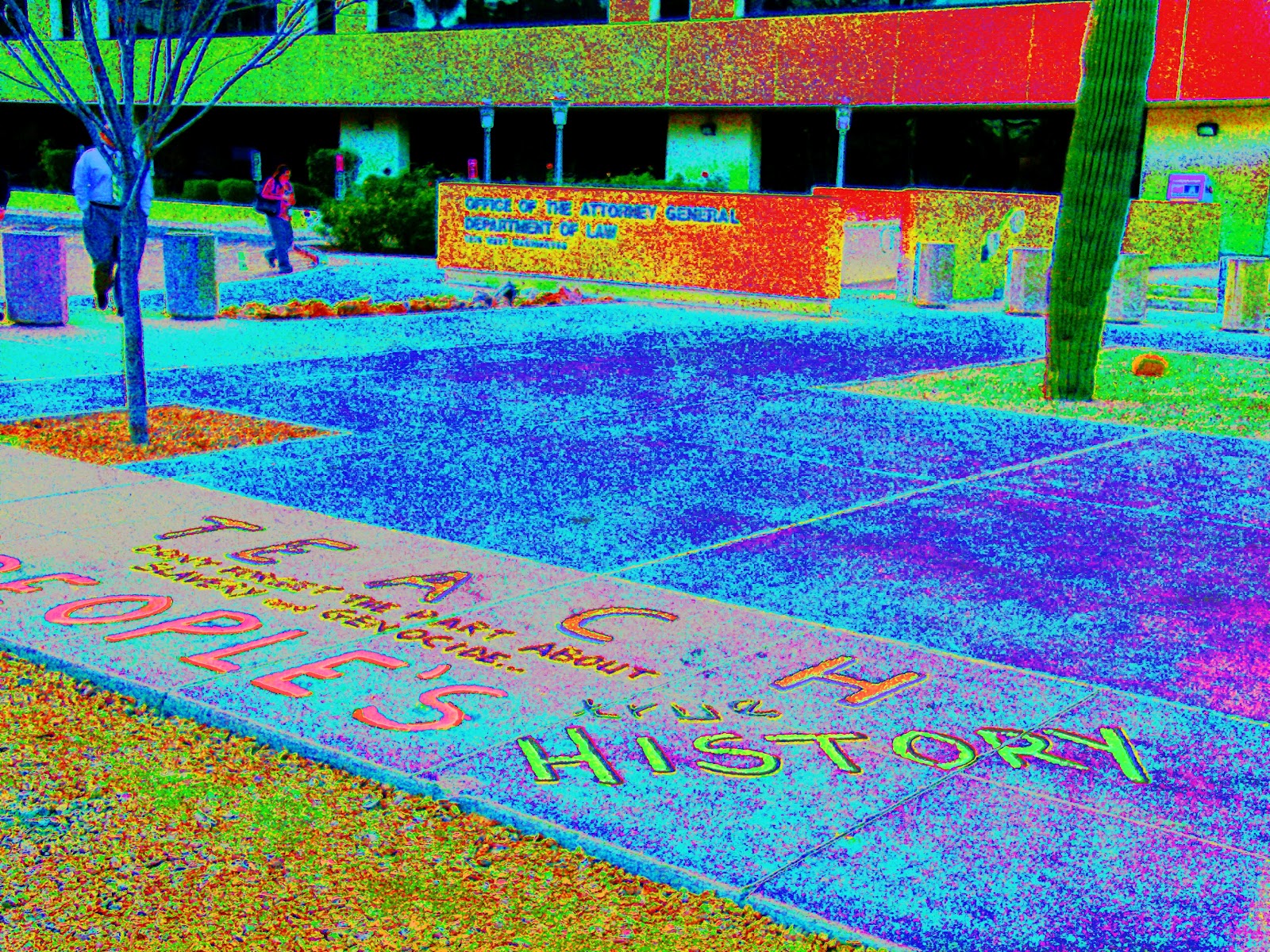
Attorney General Horne's Office

If they are coming for us now, they will be coming for you next. Immigrants are today’s scapegoats but there will be someone next to blame and fill the private prisons.

As undocumented people fill the vacuum of leadership on these issues and demonstrate real courage, all of us are called to follow their example.

The truth is that the suffering in Arizona isn’t caused by the cold hearts and bigoted minds of our adversaries. It is the apathetic souls of those who look upon Arizona and stand idly by. Perhaps people hear ‘immigrant’ and believe it does not apply to them or that we somehow deserve the treatment we receive.

White fear of the re-browning of this continent and general worry over unemployment and economic security has turned many against migrants as an easy scapegoat. But if we look deeply enough, we see that we hold in common both the cause of our troubles and the solution to our suffering. Around the world, people are toppling those who have ruled by broken promises and brutal policies. Arizona and the US will be no exception.

Change has always come when people challenged and broke unjust laws. Nonviolent civil disobedience has been used to historically to challenge racism and inequality from factory floors to lunch counters and buses.

And so, this is a call to action whether you are a community member directly affected, consider yourself an ally, or someone who up until now has been a bystander in the immigration battles. The undocumented youth movement has set an example of what it is to be unafraid, and the bravery they display far outweighs the courage elected officials lack. They have proven that the safest place for anyone targeted by these laws is out, proud, and part of an organized community.

As the migrant rights movement steps into this new phase, we do not do it alone. Allies can harbor anyone targeted, hire anyone fired, and refuse to allow Arizona or Arpaio to become the new normal. At the end of June, we will rally together in Phoenix at Sheriff Arpaio’s self-described ‘concentration camp,’ tent city and begin a summer of resistance in the state and across the country where these laws and their champions are calling for a challenge.

The present may feel heavy but the future is bright. Because love always overcomes hate. Our numbers are on our side. The truth is on our side. With or without those in power, history is on our side. We just have to put our shoulders to the gears of history and push.

Carlos Garcia is the director of Puente Arizona, a Phoenix-based human rights organization dedicated to empowering migrant communities.
 -----------------

Freewayblogging the SB1070 Resistance
Phoenix, AZ (July 28, 2010)

Tuesday, December 13, 2011

SB1070 and the US Supreme Court

This is not a supreme court I have much confidence in, seeing as how they let Troy Davis get lynched, among other things...


-----------------from the New York Times-------------

Court to Weigh Arizona Statute on Immigration

NEW YORK TIMES

WASHINGTON — In the space of a month, the Supreme Court has thrust itself into the center of American political life, agreeing to hear three major cases that could help determine which party controls the House of Representatives and whether President Obama wins a second term.

The court announced Monday that it would decide whether Arizona was entitled to impose tough anti-immigration measures over the Obama administration’s objections. The case joined a crowded docket that already included challenges to Mr. Obama’s signature legislative achievement, the 2010 health care overhaul law, and a momentous case on how Texas will conduct its elections.

The Texas case, which on Friday the court agreed to hear, could cause as many as four seats in the United States House of Representatives to change party control.

“It’s not just that these are big cases, but these are big cases that echo in the political arena,” said Nathaniel Persily, a professor of law and political science at Columbia University. “There is now a judicial forum for airing these political disputes.”

Arizona enacted its immigration law last year, and the Obama administration promptly sued to block four parts of it, saying they could not be reconciled with federal laws and policies.

The challenged provisions include a requirement that state law enforcement officials determine the immigration status of anyone they stop or arrest if officials have reason to believe that the individual might be an illegal immigrant. That provision also requires that the immigration status of people who are arrested be determined before they are released.

The law also makes it a crime under state law for immigrants to fail to register under a federal law and for illegal immigrants to work or to try find work. In addition, it allows the police to arrest people without warrants if they have probable cause to believe that they have done things that would make them deportable under federal law.

The United States Court of Appeals for the Ninth Circuit, in San Francisco, blocked all four provisions.

Applauding the Supreme Court’s decision to review that ruling, Gov. Jan Brewer, a Republican, was harshly critical of the administration.

“I was stunned at the audacity of the Obama administration to file suit against an individual state seeking to safeguard its people,” Ms. Brewer said in a statement. “That shock turned to outrage as the federal government proceeded to file suit against three more states — South Carolina, Alabama and now Utah — that followed Arizona’s lead.”

The health care and immigration decisions are likely to land in June, in the heat of the presidential campaign.

The court must act much faster in the Texas case, where its decision on Friday to stay the use of a set of election maps, created by federal judges, has thrown election planning there into disarray. Political observers believe that the new maps would increase the influence of Hispanic voters and thereby increase the number of Democrats in the House.

The court’s precedents point both ways in the health care case, and it is hard to say what the outcome will be. In the Arizona and Texas cases, recent decisions suggest that a majority of justices may look favorably on the positions of state officials, which would entail upholding the Arizona immigration law and rejecting at least a part of the court-drawn maps in Texas.

In May, the court upheld a different Arizona law, one that imposed harsh penalties on businesses that employed illegal immigrants. In a 2009 decision, Chief Justice John G. Roberts Jr., writing for the majority, expressed skepticism about the continuing vitality of a part of the Voting Rights Act of 1965 that the court in Texas relied on in substituting its own maps for ones drawn by the Legislature.

Legal scholars and court historians struggled to think of another recent Supreme Court term in a presidential election year with a similar pileup of cases with sharp political and societal consequences. The political impact of the term’s rulings may, moreover, be amplified by the court’s decision last year in Citizens United, which unleashed unlimited campaign spending by corporations and unions.

Some experts pointed to 1992, which featured a major abortion ruling and other big decisions. But the current term may be most reminiscent of the showdown between the Supreme Court and President Franklin D. Roosevelt in 1936, when the court struck down major pieces of New Deal legislation as well as a New York law establishing a minimum wage for women and children.

“There was a whole series of blockbuster cases, each with massive political implications and economic consequences for the country,” said Jeff Shesol, the author of “Supreme Power: Franklin Roosevelt vs. the Supreme Court.” That description sounds rather like the current term.

There is a great deal of happenstance in the shaping of a Supreme Court docket, and the fact that several cases arrived at the court at once does not necessarily suggest an agenda. The last term was lackluster; this one is lively.

“In most of these cases, it’s a coincidence of timing,” said Justin Driver, a law professor at the University of Texas.

The justices had little choice, for instance, in agreeing to hear a challenge to the health care law, as federal appeals courts were divided over its constitutionality and the Obama administration joined its opponents in urging the court to act quickly. But the Supreme Court did not have to signal that the case was a once-in-a-generation blockbuster by scheduling an extraordinary five and half hours of arguments.

The court had more options in deciding how to act on a request from officials in Texas in the redistricting dispute. The court could have stayed out of the matter, effectively endorsing the maps that favored Democrats, which were drawn by a special three-judge court in San Antonio that ignored a separate set of maps drawn by the Republican-dominated Legislature.

The Supreme Court could have sent the case back to the special court, directing it to give more deference to the Legislature’s maps. Or the justices could have jumped in feet first. They took the boldest route.

It was, similarly, not a sure thing that the justices would accept the Arizona case, which was one of several cases in the federal pipeline involving tough state anti-immigration laws. Lower courts had not issued a final ruling on the Arizona law, giving the justices plausible reasons to wait. Instead, they chose to weigh in on one of the most combustible issues in American politics.

Supreme Court decisions routinely have political consequences, of course, sometimes quite direct ones. In 2000, 11 years to the day before the court agreed to hear the Arizona case, the court effectively decided a presidential election, in Bush v. Gore.

Putting that case to one side (as the court has, never citing it), court watchers have to go back two decades, at least, to think of Supreme Court terms as politically consequential as the current one.

Eric J. Segall, a law professor at Georgia State University, pointed to the term that ended in June 1992, which included major cases raising fundamental issues of abortion, freedom of speech, freedom of religion and school desegregation. The most important of those decisions was Planned Parenthood v. Casey, which reaffirmed the core of the right to abortion established by Roe v. Wade.

In the new crop of cases, too, the court may yet avoid creating political earthquakes.

“I would not be surprised at all if they are looking at Solomonic ways to avoid trouble in an election year,” Barry Friedman, a law professor at New York University, said of the justices.

Monday, July 4, 2011

Arizona's tax base eroded by anti-immigrant legislation.

Even the cookie monster says: "STOP SB1070"
Resistance Alley, Phoenix (June 4, 2011)


Apparently, America's undocumented immigrants paid $11 billion in taxes last year, while the multinational GE paid NOTHING. No wonder Arizona's economy is still in the gutter - we chased away all the honest, hard-working taxpayers, while cutting extra breaks to freeloading, exploitative corporations...So, thanks a lot SB1070, ALEC, Russ Pearce, and Jan Brewer - and all the idiots who voted for the right wing last election thinking they were protecting their own interests. You screwed us all.

-------------------------


Unauthorized Immigrants pay taxes too.

Immigration Policy Center

April 18, 2011

Estimates of the State and Local Taxes Paid by Unauthorized Immigrant Households


Tax Day is an appropriate time to underscore the often-overlooked fact that unauthorized immigrants pay taxes. The unauthorized, like everyone else in the United States, pay sales taxes. They also pay property taxes—even if they rent. At least half of unauthorized immigrants pay income taxes. Add this all up and it amounts to billions in revenue to state and local governments. The Institute for Taxation and Economic Policy (ITEP) has estimated the state and local taxes paid in 2010 by households that are headed by unauthorized immigrants.


These households may include members who are U.S. citizens or legal immigrants. Collectively, these households paid $11.2 billion in state and local taxes. That included $1.2 billion in personal income taxes, $1.6 billion in property taxes, and $8.4 billion in sales taxes. The states receiving the most tax revenue from households headed by unauthorized immigrants were California ($2.7 billion), Texas ($1.6 billion), Florida ($806.8 million), New York ($662.4 million), and Illinois ($499.2 million) {See Figure 1 and Table 1}. These figures should be kept in mind as politicians and commentators continue with the seemingly endless debate over what to do with unauthorized immigrants already living in the United States. In spite of the fact that they lack legal status, these immigrants—and their family members—are adding value to the U.S. economy; not only as taxpayers, but as workers, consumers, and entrepreneurs as well.


Saturday, July 2, 2011

Private Prisons: Race, Criminalization, Cooptation and the Profit Motive

This well-researched video was produced by a comrade ("sally darity"), who blogs at Chaparral Respects No Borders - she's a brilliant, thoughtful area activist and artist. Any community considering building a prison in their hometown should first give some thought to what you learn here...

-----------------------


Sunday, June 5, 2011

Resistance Alley & the PHX Graffiti Police


I met the Graffiti Detectives Friday evening in my back alley, which is along the main drag for the Phoenix Artwalk on the First Friday of every month. A few friends and comrades showed to cop-watch from the sidelines; most of my friends are on probation or parole, however, and couldn't afford the risk involved in being as criminally disobedient as I have been in recent days, so they were excused from showing for the action.

A few folks have rightfully asked me to explain what I'm doing and why a little better. Among other things, I've been trying to force a more animated and engaging public dialogue about the prison deaths, free expression and resistance, and Arizona's tendency to prioritize property rights over human rights in our legislative practices. There are a host of intersecting issues affecting human rights in this state, beginning with a flawed value system. Here it's "criminal damage" to block access for livestock to water supplies - a felony - and yet guaranteeing access to water in the desert for people is prosecuted criminally as littering.

As a manifestation of our collective social values in Phoenix, the city's response to my solicitation to resist the status quo through possible criminal activity turned out a whole squad of cops to protect an alley from art, but no one in this state will initiate an investigation into all the suicides and homicides at the AZ Department of Corrections. What gives? I can't even count how many cops I've reported the state's crimes too, but no one seems to feel responsible for intervening themselves, or even calling in the feds.

An argument can be made that my chalk - and now paint - on the ground invites graffiti on the walls and "blight"; there was some new artwork done the night before they arrived Friday, specifically a message to them:


The images that bug me the most, frankly, are not graffiti per se, but from the advertising I can't avoid looking at everywhere I go - especially those faded, aging political signs like the ones outside of Tom Horne's old campaign office on 7th Ave and McDowell - boy that place is looking trashy. Bottom line is that if you have money you can ram your politics down everyone's throat with fear, racism, sexism, homophobia - the list of ugly manipulative strategies we're subjected to each political season goes on.

Then we must respect the "rights" of people who just want to make a buck from us to advertise their garbage - from fast food joints to casinos to strip clubs and the state's lottery system, as long as they have the money to buy or rent space they can push their products and messaging all over our everyday landscape. But if an impoverished citizen objects to the way our government is being run and puts up their own highway signage to express objection to the wars, for example, it's considered a crime.

Only property-holders and lawmakers can color and abuse our public horizon that way, it appears. All public space should be safe for free (unpaid) political expression, but none is really protected by our laws in meaningful places, quantities, or ways - if anything, it's discouraged by the privatization of so much community space (done to give police departments and businesses the leverage to criminalize homelessness and hassle the poor riff raff busking on "their" sidewalks).

I can only guess who made those kinds of laws, and who they serve most today - I'm fairly sure they weren't designed to empower The People, though. Law is mainly made to maintain the social order, after all - which is inherently heirarchical, capitalist, racist, misogynistic, and anti-democratic in America - especially Arizona...

Anyway, as I said, I met the Graffiti Detectives (Diane Rowe and her partner, whose name I keep forgetting) in my back alley Friday in time for my planned protest. It quickly became clear that they wouldn't be arresting me - I think they mainly just didn't want to become players in my street theater any more than they already had to be.


Detective Rowe took issue with my characterization of cops picking on teenage taggers - they feel as if they try to help the kids they arrest, in particular. They also argued that there really aren't that many youth being charged as adults or even sent off to child prison for graffiti alone. They see writing as being like a "gateway" drug, so the youth getting into real trouble may face burglary and other charges by the time they get busted for tagging...


So, the Graffiti Detectives are really here to help wayward youth, not control and punish budding revolutionaries. Right. Regardless, we never would have had the conversation we did if I was a teenage Latino male chalking the public walks in the middle of the
night instead of a middle class white woman calling my vandalism "politics" and "art"...

which is what this protest was really about - my own privilege. In a year and a half of chalking the walks of Power, how is it that I've never been arrested, assaulted, or shot by a cop in this town? Not that I WANT any of those things to happen, mind you - but I see them happening to people of color and those in poverty all around me, and can't help but wonder why I get a pass, if not for the intersections of my gender, age, race and class...

That I am particularly privileged by the status quo in Arizona today is fairly disturbing - and the cost of accommodating my comfort, and that of my class, compels me to resist with everything I have. I may not be the most brilliant organizer or political strategist - some folks really doubt my sanity given my engagement of the police in confrontations - but I have yet to hear one good reason why not to tackle this head-on, at every level of law enforcement.


Anyway, I talk to cops more than real anarchists
do because I want them engaged in the struggle of prisoners - they're the ones doing them the "favor" of arrest and confinement to get them off the streets, give them "3 hots and a cot" (which are really two bag lunches and a "boat" on the floor) - like everyone did to help Marcia Powell and Shannon Palmer, lucky them. That's a reminder that even the best intentions can still hurt a lot of people, especially if the police are brought into the mix as partners or "helpers". Their primary job is to maintain the order of the state, not promote the liberties and rights of the people - no matter how friendly they may seem.

But the cops didn't come to chat about my politics. Detective Rowe and I talked about all those issues for half an hour or so before I finally threw my red paint down and slapped my palm print up on the side of one of the dumpsters in our alley, irritated by the show of police force to discourage such activity. In the end I was yelling, I think, about how property rights trump human rights in this town as they all showed up to fight "vandalism" but I can't get anyone to follow up on serious abuse complaints against cops.


That's bullshit, frankly. So I've asked the Phoenix Graffiti Detectives to help me get the DOJ out here - we'll see if they bother to do that much. That might be too much like ratting out their own to internal affairs - that's how creeps like Gerster, Keesee and Chrisman stay in positions of power, though.

As for my criminal damage - I was the only one to handle the paint Friday night, since my friends don't need to be harassed any more than they already are - I can expect them to catch up to me with criminal charges and a bill for restitution and clean-up, on their own schedule. They aren't about to accommodate mine. I'll keep you all posted on how that unfolds; I expect it will give me plenty to write about, if nothing else of value.


Thanks for all your support, by the way, folks. You all rock!


Saturday, April 23, 2011

APRIL 23, 2011: Chavez Plaza to the Capitol: NO SB1070!

From my good friend, Dennis:

------------------------------------


On Fri, Apr 22, 2011 at 8:53 PM, Dennis Gilman wrote:


Tomorrow, April 23, is a big day for Arizona. It has been one year since Gov. Brewer signed SB1070. We are not the same and never will be.


It has created confusion and given law enforcement carte blanche to harass and intimidate our friends, families and neighbors even as not one official arrest has been made under the law.


It is now common knowledge that the 1070 Boycotts have had such a powerful impact on the business community that it stopped the republicans from passing 5 bills even worse then 1070.


The business community made it very clear by their own testimonies before congress. Yet we cannot forget that under the Obama administration, deportations of non-criminals have increased. Children continue to lose their parents who should've been given legal status years ago. Much of this could've been done administratively despite the lack of republican support.


Young adults raised here are denied education or even the right to work. Those DREAM-ACT students risked so much and fought so hard. What kind of a society would reject them? What kind of world is this where they are Legally considered less then human?


This Wednesday, ICE arrested 40 people working at Chuys restaurant chain. Their crime? Trying to survive. How many children lost their parents because of what was supposed to be an IRS raid? Does the Obama administration really need ICE to be involved in a 400,000 dollar tax debt? Arpaio misused 100 million in tax dollars yet I see no federal action toward him. He is still free to destroy families and our economy with heartless raids designed for self-promotion.


So tomorrow, at 10:00AM we meet, greet and rally. Why? One reason is we forget we are part of a larger community or family. God knows we sometimes fight with each other just like family.


Lets all meet as a family tomorrow. Lets break bread, walk, talk , shout and sing together. Lets stick up for each other. Lets listen to one another.


We need each other. I know I need all of you to teach, forgive and love me. I am so grateful for all of you. Those that decided to get arrested standing up for justice and dignity last summer are my heros. Others who have been arrested simply because of who they are and what they do are also heros. I want to be the kind of person that always has your back.


You are all in my prayers or thoughts-all of you. From students and teachers in Tucson who continue to fight for the Ethnic Studies program that brought us so many remarkable people and saved many from what was referred to as "at risk" youth become amazing successes to the people of Flagstaff brave enough to say unapologetically that EVERY HUMAN has the right to live, love and work wherever they wish.


From the Anarchists who refused to give up our streets to neo-Nazis to the republicans from Mesa supporting the recall of Russell Pearce. From the Barrio committees organizing their neighborhoods to those teaching one another english. From those helping the victims of Arpaio's raids helping children find their parents and put together their lives to those that simply send money to the many lawyers that have given freely.


From the rock stars who give up money, time and even fame to help, to the medical professionals on the streets for us...even willing to offer assistance to those that wish us harm.

From those that have stood ground in front of Wells Fargo for over 3 years to those that stayed at the Capitol every day last summer and those who confronted the hatred this legislative session at a cost to there own careers only to be accused by racist politicians of being paid. From the wonderful churches and atheists who stand on the side of love....together. And, of course, my brothers and sisters who made me stand and film in the pouring, freezing rain in Washington DC as they protested in front of the DOJ making it clear they will not back off until Arpaio is somewhere he cannot hurt anyone anymore.

It's no secret we don't all get along. Sometimes it seems like we fight with each other more then the evil we are supposed to be opposing. But thanks to all of you-I know what it means when they say "It takes a village."


You are all amazing and I am so very grateful for all of you-even the ones that piss me off. We are all more connected then we are able to see sometimes.


Two short videos:
One shows an arrest of a brave, non-violent protester who was brutally detained and arrested last week while Arpaio was bragging about the 100 million he stole from the Tax Payers at the Tea Party.


The other shows Russell Pearce as an "Illegal". Pearce decided to make out a check for 225 dollars to the Fiesta Bowl. But he said he would show us receipts. Show us your papers Mr. Pearce. Illegal is illegal.


SEE YOU ALL SATURDAY! LETS DO THIS!
Start: Cesar Chavez Memorial Plaza
200 W. Washington
10am
End: Arizona State Capitol
1700 W. Washington


Monday, November 8, 2010

Private prison industry exploits greed and fear with SB 1070

Seems I missed posting the excellent NPR report on immigration and private prisons when it came out before the elections, so here's a synopsis and the link.

That's Arizona's favorite son, Russ Pearce again, to the left. He has a lot to do with all this. He's done our state - our nation -more damage than Brewer, I'd say. Follow the link below for part II of the NPR story for more on his role.


-----------from Imagine 2050------------------

Cross-post: Prison Economics Help Drive Ariz. Immigration Law

October 30, 2010 by Imagine 2050 Editors

NPR broke an incredible story this week that is sure to continue unearthing the shady dealings behind the creation and passage of SB 1070 in Arizona. The following article was published on Oct. 28, 2010 by NPR reporter Laura Sullivan. To listen the podcast of this story click here.

"Last year, two men showed up in Benson, Ariz., a small desert town 60 miles from the Mexico border, offering a deal.

Glenn Nichols, the Benson city manager, remembers the pitch.

“The gentleman that’s the main thrust of this thing has a huge turquoise ring on his finger,” Nichols said. “He’s a great big huge guy and I equated him to a car salesman.”

What he was selling was a prison for women and children who were illegal immigrants.

“They talk [about] how positive this was going to be for the community,” Nichols said, “the amount of money that we would realize from each prisoner on a daily rate.”

But Nichols wasn’t buying. He asked them how would they possibly keep a prison full for years — decades even — with illegal immigrants?

“They talked like they didn’t have any doubt they could fill it,” Nichols said.

That’s because prison companies like this one had a plan — a new business model to lock up illegal immigrants. And the plan became Arizona’s immigration law..."

Continue reading the NPR article here.

Here's part II of the report:

Shaping State Laws With Little Scrutiny

Among hundreds of bills drafted by an alliance of business, lawmakers: Arizona's immigration law...

Monday, August 23, 2010

Prison privatization - no pros, all cons.

Nice job on this piece from the folks at the AZ Republic. The cost comparison report they refer to can be found at the Az Department of Corrections' website, here. The whole thing is very troubling. We spend an extraordinary amount of money incarcerating minimum security drug and alcohol offenders - and it doesn't go to treatment or rehab for more than a tiny fraction of them. Instead they are exposed to gangs, abuse, menial labor, and Hepatitis C before being released back to their communities to begin the cycle all over again...

----------------------------

Arizona inmate escape puts spotlight on state private prisons

Questions arise over safety standards, taxpayer savings

by Casey Newton, Ginger Rough and JJ Hensley - Aug. 22, 2010 12:00 AM

The Arizona Republic

.

Arizona puts more of its inmates into privately run prisons every year, even though the prisons may not be as secure as state-run facilities and may not save taxpayers money.

Lawmakers began using private prisons to ease overcrowding and have supported their use so aggressively that today, one in five Arizona inmates is housed in a private facility.

Many inmates from other states also are housed in private prisons in Arizona, but the state has little information about who they are and limited oversight of how they are secured.

The state has 11 privately operated prisons.

A high-profile escape of three Arizona inmates last month from a Kingman-area private prison, which spurred a nationwide manhunt and is believed to have resulted in two murders, raises questions about the industry's growth and the degree of state oversight.

The last fugitives in that escape were caught Thursday, and the state's prison director has promised changes to the private sites that house Arizona inmates.

State leaders in recent years have pushed for more privatization and have blocked efforts to regulate the industry, which has invested heavily in local lobbying and contributed to political campaigns.

Last year, officials approved a plan to hand over the operation of nearly every state prison to private companies. The plan was repealed only after no credible bidder came forward. This year, lawmakers approved 5,000 new private-prison beds for Arizona prisoners.

Data suggest that the facilities are less cost-effective than they claim to be. A cost study by the Arizona Department of Corrections this year found that it can often be more expensive to house inmates in private prisons than in their state-run counterparts.

A growing industry

Arizona's use of private prisons dates back to the early 1990s, when lawmakers, grappling with overcrowding in state facilities, authorized the construction of a 450-bed minimum-security prison in Marana to house drug and alcohol abusers.

The prison is owned and operated by Management & Training Corp., the Utah-based company that also operates the Kingman facility where the three inmates escaped.

Since then, Arizona has increasingly relied on for-profit operators to manage its own inmates. It also has allowed private companies to import prisoners from other states.

Rapid growth began in 2003 and the years immediately following, when Arizona was again wrestling with prison overcrowding.

To ease the shortage, Republican lawmakers agreed to build 2,000 new prison beds, compromising with a reluctant Gov. Janet Napolitano, a Democrat, to make half of them private.

Around the same time, nearly a dozen other states grappling with the same issues began shipping their inmates to private facilities elsewhere in the country.

Arizona, with cheap land and a receptive political climate, became a go-to destination for private-prison operators, who began accepting inmates from as far as Washington and Hawaii.

Today, Arizona houses 20.1 percent of its prisoners in private facilities, according to state data from July. Exactly how many inmates are here from other states is unclear.

Last year, lawmakers took the unprecedented step of exploring the privatization of almost the entire Arizona correctional system, passing a bill that would have turned over the state's prisons to private operators for an up-front payment of $100 million. The payment would have helped the state close a billion-dollar budget gap.

The bill, which also included a host of changes related to the state's budget, was signed by Gov. Jan Brewer, but the language relating to prison privatization was repealed in a later special session.

The state now has an open contract for the construction and operation of 5,000 new private-prison beds.

Arizona's reliance on private facilities coincides with operators' increasing national political activity in hiring lobbyists and donating to political campaigns.

The ties between the companies and Arizona elected officials - which go back nearly a decade - have become a campaign issue in this year's gubernatorial race.

Tennessee-based Corrections Corporation of America, the nation's largest operator of private prisons, runs six in Arizona, three of which house inmates for U.S. Immigration and Customs Enforcement.

Brewer's critics have suggested that she signed Senate Bill 1070, and has advocated for privatization of some prisons, in part to benefit CCA's bottom line.

Democrats have called on Brewer, a Republican, to fire "aides" associated with the prison company. That includes HighGround, a Phoenix consulting and lobbying firm managing Brewer's gubernatorial campaign. The firm counts CCA among its clients.

Brewer's official spokesman, Paul Senseman, also used to lobby for CCA.

Campaign finance reports filed earlier this year show that eight executives with CCA contributed $1,080 of the $51,193 in seed money Brewer received for her gubernatorial campaign.

CCA also gave $10,000 to the "Yes on 100" campaign, which backed a temporary, 1-cent-on-the-dollar increase in the state's sales tax. Brewer was the chief advocate for the tax, which was approved by voters in May.

In an interview with The Arizona Republic, Brewer said those connections have not influenced her policy decisions. She said she never felt pressured by any of her advisers.

"It's absolutely political posturing and rhetoric," Brewer said. "I find it very disappointing. We have a bed shortage here in Arizona, and we have to come up with some way to incarcerate (criminals). The best way, the least expensive way, is to do it with private prisons."

The industry's political connections have extended to other Arizona politicians.

According to a 2006 report from the National Institute on Money in State Politics, the private-prison industry gave to the campaigns of 29 of 42 Arizona lawmakers who heard a 2003 proposal to increase state private-prison beds.

Between 2001 and 2004, the industry contributed $77,267 to Arizona's legislative and gubernatorial candidates, the vast majority through lobbyists paid to represent their interests at the Legislature.

In most cases, donations ranged from a couple of hundred dollars to as much as $2,500.

Lax oversight

The state Department of Corrections has varying levels of oversight of Arizona's private-prison network.

Some prisons house criminals convicted in Arizona. The Corrections Department regulates those facilities, though private-prison critics question whether those facilities maintain the same safety standards as their state-run counterparts.

Other private prisons house inmates from other states or on behalf of the federal government. Arizona does not dictate what kinds of inmates they may accept, nor the manner in which they are secured.

In those situations, private-prison operators work with their outside-government partners on training specifications and other operational details.

They report to Arizona only the names, security classifications and number of inmates housed at their facilities. State statutes do not require private operators to provide Arizona officials details about the crimes the prisoners committed or escape data.

In 2007, two convicted killers sent from another state stole ladders from a maintenance building and climbed onto a roof at a private prison outside Florence. Brandishing a fake gun, they climbed over the prison walls and escaped to freedom.

One was caught within hours, but it was almost a month before the other was caught hundreds of miles away in his home state of Washington.

As with the Kingman breakout, the 2007 escape drew attention to the largely unregulated growth of private prisons in the state, particularly prisons that house other states' inmates.

To address security concerns, a bipartisan bill drafted by Napolitano's office in 2008 and introduced by Republican state Sen. Robert Blendu would have required private prisons to be built to the state's construction standards.

The proposal also would have ended the practice of private prisons importing murderers, rapists and other dangerous felons to Arizona. And it would have required the companies to share security and inmate information with state officials.

After an initial flurry of activity, the bill died.

"The private-prison industry lobbied heavily against that bill, and they were successful," said Michael Haener, Napolitano's lobbyist at the time.

Blendu later left the Legislature, and the bill was not reintroduced.

What little regulation private prisons have in Arizona stems from a series of escapes in the late 1990s.

In response, the Legislature passed a law requiring the reimbursement of law-enforcement costs from private-prison operators in the event of an escape.

Arizona laws also require companies to carry insurance to cover law-enforcement costs in cases of escape, to notify state officials when they bring new prisoners into the state and to return out-of-state prisoners to their home states to be released. But there are no penalties if the companies don't comply.

Costs questioned

Notwithstanding lawmakers' concerns about security, private prisons gained favor in part because of the promised savings they could deliver to a cash-strapped and overcrowded prison system. Yet studies have questioned whether those savings are real.

In making their pitches, private-prison companies played on the desire of many lawmakers to shift more state services to the private sector.

Direct cost comparisons between for-profit and public prisons can be difficult, however.

According to the National Institute of Justice, private prisons tend to make much lower estimates of their overhead costs to the state for oversight, inmate health care and staff background checks.

Officials at public prisons often argue that the state winds up paying a higher cost for those services than is advertised, mitigating savings that private prisons are built to deliver.

A study this year by the Arizona Department of Corrections found that when various costs are factored in, it can be more expensive to house an inmate in a private prison than it is to house one in a state-run prison.

The cost of housing a medium-security inmate is $3 to $8 more per day in a private prison, depending on what assumptions are made about overhead costs to the state, the study found.

Travis Pratt, a professor of criminology and criminal justice at Arizona State University, said there is no evidence that private prisons save government agencies money, even though they typically promise up-front savings.

To maintain profit margins, Pratt said, companies often cut back on staff training, wages and inmate services.

"Cost savings like that don't come without consequences," Pratt said. "And that can present a security risk that's elevated."

Odie Washington, a senior vice president at Management & Training Corp., acknowledged Thursday that the Kingman prison employed an inexperienced staff.

"We have a lot of very young staff that have not integrated into very strong security practices," Washington said.

Private-prison operators disagree with Pratt's assessment, contending that they can deliver services efficiently and safely.

"That's one of the more frustrating misconceptions out there for us that we have to repeatedly respond to," said Steve Owen, director of public affairs for Corrections Corporation of America.

Owen said it is CCA's "general experience" that private prisons can save states and the federal government 5 to 15 percent on operational costs. The company also can build facilities more cheaply, he said.

CCA is contractually required to meet or exceed training requirements that states they work for set for themselves, Owen said. In addition, the company has made sure its prisons in Arizona comply with accreditation standards put in place by the American Correctional Association, a Virginia-based trade group.

Many communities, meanwhile, eagerly welcome private prisons because the facilities generate jobs and economic activity. CCA prisons in Florence and Eloy, for example, employ 2,700 people. Last year, the company paid $26 million in property taxes, Owen said.

What's next

Lawmakers from both parties have called for hearings into what went wrong in Kingman. Presumptive Democratic gubernatorial nominee Terry Goddard has said he would push to bring back the 2008 private-prison bill.

Goddard also is calling for an immediate re-evaluation of the system used to classify and place inmates in facilities.

The five-tiered system, which allows some violent criminals to migrate to lower-security facilities for good behavior, met with bipartisan criticism in the wake of the escapes.

Two of the three inmates who escaped from the medium-security Kingman prison had been convicted of murder.

Goddard said the three recent escapees never should have been in a medium-security prison.

Charles Ryan, director of the Department of Corrections, announced Thursday that the state would slow its bidding process for the 5,000 new private-prison beds pending additional review.

Brewer has said little publicly about the escape but told The Republic last week that she is committed to holding prison operators responsible for mistakes they made. She said she has ordered Ryan to conduct a "complete review to make sure that inmates are appropriately secured and in the right kinds of facilities."

While Brewer remains confident that private prisons are well suited to house less-violent offenders, she said: "What has happened is unacceptable, and I am absolutely pushing for more accountability."