Retiring Arizona Prison Watch...


This site was originally started in July 2009 as an independent endeavor to monitor conditions in Arizona's criminal justice system, as well as offer some critical analysis of the prison industrial complex from a prison abolitionist/anarchist's perspective. It was begun in the aftermath of the death of Marcia Powell, a 48 year old AZ state prisoner who was left in an outdoor cage in the desert sun for over four hours while on a 10-minute suicide watch. That was at ASPC-Perryville, in Goodyear, AZ, in May 2009.

Marcia, a seriously mentally ill woman with a meth habit sentenced to the minimum mandatory 27 months in prison for prostitution was already deemed by society as disposable. She was therefore easily ignored by numerous prison officers as she pleaded for water and relief from the sun for four hours. She was ultimately found collapsed in her own feces, with second degree burns on her body, her organs failing, and her body exceeding the 108 degrees the thermometer would record. 16 officers and staff were disciplined for her death, but no one was ever prosecuted for her homicide. Her story is here.

Marcia's death and this blog compelled me to work for the next 5 1/2 years to document and challenge the prison industrial complex in AZ, most specifically as manifested in the Arizona Department of Corrections. I corresponded with over 1,000 prisoners in that time, as well as many of their loved ones, offering all what resources I could find for fighting the AZ DOC themselves - most regarding their health or matters of personal safety.

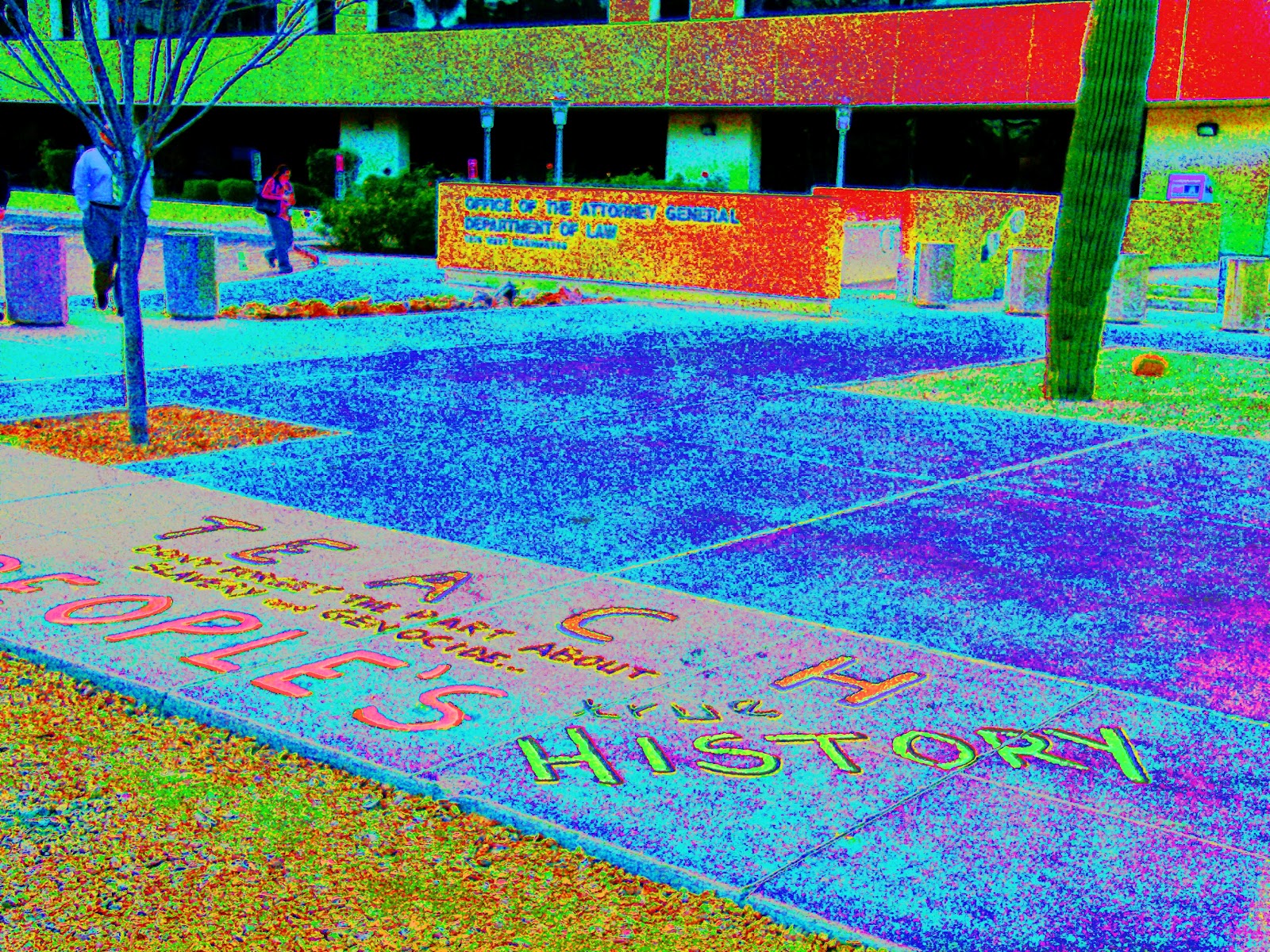
I also began to work with the survivors of prison violence, as I often heard from the loved ones of the dead, and learned their stories. During that time I memorialized the Ghosts of Jan Brewer - state prisoners under her regime who were lost to neglect, suicide or violence - across the city's sidewalks in large chalk murals. Some of that art is here.

In November 2014 I left Phoenix abruptly to care for my family. By early 2015 I was no longer keeping up this blog site, save occasional posts about a young prisoner in solitary confinement in Arpaio's jail. I'm deeply grateful to the prisoners who educated, confided in, and encouraged me throughout the years I did this work. My life has been made all the more rich and meaningful by their engagement.

I've linked to some posts about advocating for state prisoner health and safety to the right, as well as other resources for families and friends.

until all are free -

MARGARET J PLEWS (June 1, 2015)
arizonaprisonwatch@gmail.com


INDIGENOUS ACTION MEDIA

INDIGENOUS ACTION MEDIA
ANTICOLONIAL zines, stickers, actions, power

Taala Hooghan Infoshop

Kinlani/Flagstaff Mutual AID

MASS LIBERATION AZ

MASS LIBERATION AZ
The group for direct action against the prison state!

Black Lives Matter PHOENIX METRO

Black Lives Matter PHOENIX METRO
(accept no substitutions)

BLACK PHX ORGANIZING COLLECTIVE

BLACK PEOPLE's JUSTICE FUND

PHOENIX: Trans Queer Pueblo

COVID Mutual AID PHOENIX

AZ Prison Watch BLOG POSTS:


Showing posts with label tent city. Show all posts

Tuesday, January 27, 2015

Johann Hari: Why addicts' lives matter...

Don't miss Johann's book on the Drug War!


Thanks, friend, for remembering Marcia Powell...


-----------------from the Huffington Post-----------------

Addicts' Lives Matter: Here's Why We Need a Hashtag -- and a Total Change of Attitude

Author of 'Chasing The Scream: The First and Last Days of the War on Drugs'
Posted: Updated:

For the past few months, I have been watching the hashtag #BlackLivesMatter as it exposes the unpunished killings of African-Americans -- Trayvon and Michael and Eric, and all the other names that never make the news, because there are so many, and it never seems to stop. I had a very personal reason for watching it so closely. For most of my adult life, and for the past three years especially, I have been spending a lot of time with another minority group. All over the world, they are being killed or left to die, with nobody being punished, and nobody being called to account. There have even been government officials who suggest their deaths are a good thing
.
There will be some people reading this who shrug when members of this minority die, and say they brought it on themselves. I am talking about addicts, who I spent a lot of time with for my new book, Chasing The Scream: The First and Last Days of the War on Drugs. I would like to propose today the hashtag #AddictsLivesMatter, because we need to change how we think about them.

Here's a story I stumbled across that, to me, distills the darkest attitude we have fostered towards addicts in our culture -- the one that has been created by the drug war, and has been in place for a century this year.
In Phoenix, Arizona, I went to a prison called Tent City. It is a slew of tents in the desert behind barbed wire, and I went out in the sweaty Arizona sun with the prison's female chain gang, who are forced to wear t-shirts saying "I Was A Drug Addict" and dig graves. The guards force these women to chant rhymes that state they will be electrocuted if they show any "lip." It's not an idle threat: I met the father of a man who was killed with a taser in this prison, on camera, when he was offering no resistance.

I talked with the women about their lives as they wiped the sweat from their brows. One of them, Karen, was in her early forties and had a quiet, girlish voice as she stuttered her story about being violently abused by men all her life, and how the only thing that had ever made her feel any relief was drugs.

I also spoke with the women who work on prisoners' rights in Arizona, and I asked them one of my stock journalistic questions: What have you seen over the years that shocked you? One of them, Donna Leone Hamm of the excellent organization Middle Ground Prison Reform, started to reel off a long list, and a while into her list she mentioned the time they put a woman in a cage and cooked her, and then carried on. I asked her to stop, and go back a second. What did they do?

When Prisoner Number 109416 woke up in her cell in Perryville State Prison on May 19th 2009 she was suicidal. The prison doctor said she was just trying to get out of her cell. They took 109416 and put her in an uncovered outdoor cage. And they left her there. According to witnesses, she begged for water. She shat herself. She started to scream deliriously. And then she collapsed. By the time the ambulance arrived, her internal organs had been cooked, as if in an oven.

And here's the thing. Nobody was ever criminally punished.

Because she was an addict. Because she didn't matter.

Almost nothing was known about Prisoner Number 109416 except that she was in and out of prison either for having meth, or for prostituting herself to get it, so I set off on a journey across the US to find out who she really was. The story -- which you can find in the book -- tells us a lot about the drug war. Her real name was Marcia Powell and, as I learned from the father of her son, there were moments in her life when she got clean and recovered, only to be busted for old drug charges and to spiral back onto the road that ended in a desert cage.

This story is extreme, but as I learned on my long journey from Mexico to Vietnam, it is only the sharpest tip of the spear that is jabbed at addicts every day, across most of the world. It has been there since the start of the drug war. This war was launched in the 1930s by a man called Harry Anslinger, the head of the Federal Bureau of Narcotics, who was driven by an obsessive hatred of addicts. He treasured a poem that said he could only retire when "the last addicts died."

One of the people he took his rage out on was Billie Holiday. He had her stalked by his agents and sent to prison. He had her stripped of her ability to perform anywhere that alcohol was served. When she collapsed with liver cancer, his agents arrested her on her hospital bed. They handcuffed her to the bed. They confiscated her record player. They banned her friends from seeing her. People protested outside with signs saying "Let Lady Live." When her methadone was cut off, she went into withdrawal and died.

And here's where #BlackLivesMatter and #AddictsLivesMatter meet. When Anslinger found out Judy Garland was a heroin addict, he didn't have her stalked and killed. He told her to take longer vacations, and reassured her studio she'd be fine. Can you spot the difference between Billie and Judy? Can you spot the difference today between the addicts in Beverley Hills who get compassionate rehab, and the addicts in South Central who get cold jail cells?

Nobody wishes the drug war on people they love -- white people, in Harry Anslinger's case. Yet when it comes to the addicts we don't know, we have chosen -- as a society -- a policy of mass caging instead of a policy of compassion. Why? I interviewed Eric Sterling, the lawyer who wrote the drug laws from the United States throughout the 1980s, and who now bitterly regrets it and campaigns for sensible policies. He told me about one meeting, at the height of the AIDS crisis, where he and a group of senators were being briefed on how it was essential to distribute clean needles, or all the addicts would die. Eric didn't write down the words at the time, but he recalled that one of the senator suggested a mass die-off of addicts would be a good thing. After all, who wants addicts to survive?

It's important to stress that most people who support the drug war don't think this way. They don't want to kill addicts. They tell themselves that they are being harsh in order to be kind -- that you have to threaten punishment in order to encourage current addicts to stop, and to prevent other people from falling down that dark well. I don't judge anyone for believing this -- it is based on compassion, and it has been backed with an enormous amount of government propaganda for a hundred years.

But I would urge anyone who sincerely believes this to look at the evidence. There are places that have tried the punishment approach and addicts keep dying in huge numbers. And there are places that have tried the compassionate approach and addicts start to survive and recover in much greater numbers. I have seen this all over the world, from Switzerland to the North of England. To give just one example, in Portugal, after they decriminalized all drugs and chose to spend the money on caring for addicts instead, the rate of injecting drug use has fallen by 50 percent, and overdose and HIV transmission among addicts have come crashing down.

To choose this better path, we have to undo a lot of the assumptions that have been drilled into our heads. As Harry Anslinger was stalking Billie Holiday, he was helping to invent a whole new way of thinking about addicts -- as vampires, or zombies, or predators. We have dehumanized people who get addicted to banned drugs in a way we (thankfully) don't dehumanize people who get addicted to legal drugs, like alcohol. We have to recover the ability to see the humanity of addicts -- that they are people like us, with feelings and dreams and the capacity to be heroic.

I learned about this from many people -- but nobody taught it to me more than a man called Bud Osborn.
In the year 2000 Bud was a homeless street addict on the streets of the Downtown Eastside of Vancouver. His neighborhood had the highest concentration of addicts anywhere in North America. It was the place at the end of the line in the city at the end of the line of the American continent, and all around him, Bud's friends were dying. They would shoot up behind dumpsters so the police wouldn't see them -- but if the police can't see you, nor can anyone else, so if you start to OD, you will be found days later, dead.

Bud decided he had to do something. But he also thought, What can I do? I am just a homeless junkie.
Then he had an idea. He gathered some addicts and proposed something simple. He asked them, Why don't we arrange a schedule, and patrol the alleyways ourselves? If we see one of us ODing, we can call an ambulance.

The addicts started to do it and their death rates began to tumble. That was great in itself, but it also meant they began to think about themselves differently -- maybe we're not pieces of shit. Maybe we are people who can achieve things. They started to turn up at public meetings to discuss The Menace Of The Addicts, and they would sit at the back, and after a while, they would put up their hands and explain they were The Addicts, and ask what they could do differently. People complained they left needles lying around, so the patrols were extended to collect discarded needles.

Bud learned that in Frankfurt, Germany, they had opened safe injecting rooms where people could use their drugs monitored by doctors, and that it had massively reduced the death toll. So Bud and hundreds of other addicts began to stalk Philip Owen, the right-wing mayor of Vancouver, everywhere he went, carrying a coffin, asking how long it would be before he ended the deaths.

Nobody had much optimism. Philip Owen was a right-wing businessman from a rich family who had said that addicts should be carted off to the local military base.

But then, after protesting for years, something nobody expected happened. Philip Owen wondered who the hell these people were, and he went to the Downtown Eastside incognito, and he spent night after night talking with addicts. And he was blown away. He had had no idea what their lives were like.

So Philip Owen made an announcement. He held a press conference with the police chief, the coroner, and the addicts, and he announced they were opening the first injecting room in North America. It opened, and Philip Owen's right-wing party was so appalled they eventually deselected him, and his political career ended. He was replaced by a left-wing candidate who kept the injecting room open.

But the taboo was broken. And now the results are in. Ten years on, the average life expectancy on the Downtown Eastside has improved by ten years, and overdose is down by 80 percent. Philip Owen told me he would do it all again in a heart beat.

Bud died last year. He was only in his early sixties, but life as a homeless addict during a drug war, before there was any help, had wrecked his body. For his memorial service they sealed off the streets of the Downtown Eastside, where he had once lived on the pavements, and enormous crowds gathered. There were a lot of people in that crowd who knew they were alive because of the uprising Bud began all those years before.

I learned so much from my friendship with Bud, but here's what I learned more than anything else: You never write anyone off. You never dismiss a human being. You never can assume anyone is worthless. It's hard to think of somebody with less power or respect than a homeless street addict -- but Bud saved thousands of lives, and he changed his city forever.

If you are reading this and thinking, Yes, the abuse of addicts is wrong, but what can we do? We all feel powerless. We all feel sometimes like we can't make a difference. Then think of Bud. If we band together, we have so much more power than we realize.

Every human has the capacity to be a hero -- including addicts. Every life matters. Every addict's life matters. Marcia Powell deserved better than being cooked in a cage. Billie Holiday deserved better than being handcuffed on her deathbed. Bud deserved better than years on the streets. In the twentieth century, we chose policies that kill addicts over policies that save addicts. As year 101 of the drug war begins, we have a chance to save the next Marcia, and Billie, and Bud. There is a better way waiting for us -- if only we are ready to seize it.


Please share your stories of addicts you have known, or addicts who have been killed by our wrong approach, with the hashtag #AddictsLivesMatter.

Johann Hari's book 'Chasing The Scream: The First and Last Days of the War on Drugs' is published by Bloomsbury as a hardback, ebook and audiobook. To find out where to buy it, or for more information, click here.

To be kept up to date on this issue, you can like the book's Facebook page and follow Johann on Twitter.

The sources for this article can be found in the book.

You can watch the video of Johann Hari's recent speech about #AddictsLivesMatter

Johann will be speaking and signing books at Politics and Prose in Washington DC on the evening of the 29th Jan, the 92nd Street Y in NYC on the lunchtime of the 30th Jan, Red Emma's in Baltimore on the 4th Feb, and at Ben McNally bookstore in Toronto (with Naomi Klein) on the 11th Feb.

Thursday, June 21, 2012

Resisting SB1070, Tent City, and White History's Lies


Excellent reflection below by the director of Puente Arizona on the immigrant rights movement this eve of the decision about SB 1070 from the US Supreme Court. 

Signs of resistance by Peggy Plews. 

Please come out to this weekend's:

Saturday, April 23, 2012 at 8pm. 
2939 W. Durango Street
"Imagine no prisons..."

maricopa county jail: tent city
phoenix AZ april 2011


----------------as posted at POLITIC365.com----------------------

Arizona, Arpaio and SB1070 Spur Crusade for Immigrant Rights

BY CARLOS GARCIA

The migrant rights movement in this country is about to enter a new phase and every person, no matter their position, will have to decide how they will relate to it.

While many are waiting to see the decision of the Supreme Court related to the Department of Justice’s SB1070 case, a human rights crisis of epic proportions is already roiling in Arizona.

The status quo we face now and the results of even the best possible decision from the Supreme Court still represent a steady march toward anti-immigrant attrition that the state has constructed over years. First we faced efforts to restrict our ability to function in society: drivers’ license bans, denial of social services, and English only rules. Then they built ways to humiliate and dehumanize us through Sheriff Arpaio’s outdoor jails and Florence’s expanding penal colonies.

From 2007 to 2010, even before SB1070 was introduced, our community faced checkpoints, bore witness to women forced to give birth in shackles, and traveled to work and school on a daily basis already wondering if we would reunite with our families and loved ones at the end of each day. In 2010, Arizona sought to erase us from history with a ban on ethnic studies and remove us altogether through SB1070.

In what amounts to a state of war by attrition on our community, it could get worse this summer as we expect that the injunction will be lifted on some of the remaining portions of SB1070. Further criminalization and tools demanding all law enforcement to investigate and deport in massive numbers is set to become law.

But that will not be our future. We are on the move, and we’re not going anywhere. We’re not running away as the authors of SB1070 had hoped, we’re moving our communities forward, and we will not let the last violent gasps of a dying generation’s prejudice stop us.

This struggle has both destroyed parts of our community and made us stronger. In the past years, we have learned important lessons and developed new ways to fight. The name ‘Arizona’ currently is a mark of embarrassment that makes people think of bigotry. But in the not too distant future, people will think of the birthplace of a new human rights movement when they hear talk about the state.

For more than a decade, we petitioned Congress for immigration reform only to be kicked around as a political football by both parties. We hoped things would change with President Obama but instead of feeling our pain, he caused more of it. Instead of executive action to grant us relief, he gave us record deportations and unprecedented quotas. When all else failed, we looked at the courts but even they seem ready to deny us our humanity.

Since Governor Brewer signed the bill meant to send us running, migrant communities have responded by losing our fear and peacefully defending ourselves. By learning our rights and more importantly, how to defend them when law enforcement tries to ignore them, we have created networks of protection that are prepared for the raids and the wrongful arrests. We have deepened our culture and celebrated our vision for a world without hate. People who before hid in our homes for fear of being picked up by police now are leading marches and supporting neighbors in efforts to keep our families together.

If Arpaio wants to find us, we will instead find him because we have learned that we are safer coming out of the shadows than living in them. When undocumented people confront the system, it crumbles and it becomes clear that they are more afraid of us than we are of them.
If undocumented people are willing to risk everything by confronting Sheriff Joe Arpaio, what are other supporters, allies, and family members willing to do?

As more of SB1070 is poised to go into effect and federal policies spread the same nation-wide, what will you do as we learn to defend our neighborhoods?

We have declared that we will not comply with hate. Every single person and institution must make the same evaluation. Will the federal government willingly deport Sheriff Arpaio’s victims when he hands over those caught in his raids? Will school districts agree to ask kindergarteners for the documents? Will neighbors draw the shades when checkpoints go up on their block?

Or will we refuse to comply and as a result prevent SB1070’s strategy from working?
 

In Solidarity with Tucson's Ethnic Studies students and teachers
Arizona's Centennial Day (February 14, 2012)
Attorney General Horne's Office

If they are coming for us now, they will be coming for you next. Immigrants are today’s scapegoats but there will be someone next to blame and fill the private prisons.

As undocumented people fill the vacuum of leadership on these issues and demonstrate real courage, all of us are called to follow their example.

The truth is that the suffering in Arizona isn’t caused by the cold hearts and bigoted minds of our adversaries. It is the apathetic souls of those who look upon Arizona and stand idly by. Perhaps people hear ‘immigrant’ and believe it does not apply to them or that we somehow deserve the treatment we receive.

White fear of the re-browning of this continent and general worry over unemployment and economic security has turned many against migrants as an easy scapegoat. But if we look deeply enough, we see that we hold in common both the cause of our troubles and the solution to our suffering. Around the world, people are toppling those who have ruled by broken promises and brutal policies. Arizona and the US will be no exception.

Change has always come when people challenged and broke unjust laws. Nonviolent civil disobedience has been used to historically to challenge racism and inequality from factory floors to lunch counters and buses.

And so, this is a call to action whether you are a community member directly affected, consider yourself an ally, or someone who up until now has been a bystander in the immigration battles. The undocumented youth movement has set an example of what it is to be unafraid, and the bravery they display far outweighs the courage elected officials lack. They have proven that the safest place for anyone targeted by these laws is out, proud, and part of an organized community.

As the migrant rights movement steps into this new phase, we do not do it alone. Allies can harbor anyone targeted, hire anyone fired, and refuse to allow Arizona or Arpaio to become the new normal. At the end of June, we will rally together in Phoenix at Sheriff Arpaio’s self-described ‘concentration camp,’ tent city and begin a summer of resistance in the state and across the country where these laws and their champions are calling for a challenge.

The present may feel heavy but the future is bright. Because love always overcomes hate. Our numbers are on our side. The truth is on our side. With or without those in power, history is on our side. We just have to put our shoulders to the gears of history and push.

Carlos Garcia is the director of Puente Arizona, a Phoenix-based human rights organization dedicated to empowering migrant communities.
 -----------------

Freewayblogging the SB1070 Resistance
Phoenix, AZ (July 28, 2010)

Sunday, September 18, 2011

Coconino jail crowding may bring a tent city

Or it may bring a detox/treatment center, which would be far better for the community and long-term outcomes with drug/alcohol offenders. I really hope your sheriff doesn't follow Joe Arpaio's idiotic footsteps. He's just a clown, as far as law enforcement officers go - even other cops here think so. Arpaio just happens to be a very powerful, twisted and dangerous clown.

In any case, he and his policies are not to be emulated by more intelligent people.
He's actually investigating the legitimacy of Barak Obama's birth certificate - a priority for his office, even though his people are brutalizing prisoners in the psychiatric wing of his jail, and the MCSO can't solve major crimes like murder because they're so busy chasing down immigrants who smuggled themselves over the border (and got jobs which are paying into - not stealing from - our social security accounts for us...).


So, good luck, Coconino County. Hope your sheriff is a smart man interested in evidence- based practice and goes for the detox center instead of a tent city.

---------------------------------

Crowding at jail hits crisis level


AZ Daily Sun
ERIC BETZ Sun Staff Reporter
Sunday, September 18, 2011 5:25 am

This week, the inmate population at the Coconino County Jail Detention Facility reached "crisis" levels for the third time in three years, according to jail managers.

The Coconino County Sheriff's Office says the surge in prisoners is making it harder to manage various groups of inmates in a way that prevents conflict and is reducing how much money the jail can make from renting beds to state and federal agencies.

And if the problem persists, the jail might have to erect a "tent city" next summer to handle the overflow, especially if it must house more state prisoners for free.

MORE CITE AND RELEASE

The sheriff's office sent a memo to local law enforcement, prosecutors and judges this week asking them to do whatever they can to help alleviate the problem.

That means citing and releasing offenders when safe to do so and expediting the judicial process.

The problem started earlier this summer as the local transient population rose with warming temperatures in Phoenix. Most of the increase in inmates has come from misdemeanor offenders booked on charges like disorderly conduct or simple assaults. Felony bookings have not increased.

"This is the first time we've seen a spike in population to this extent," said Coconino County Sheriff Bill Pribil. "In summer we usually see population increases because we have a lot more transients coming to Flagstaff, but we've seen an unusually high increase this summer."

INCOMPATIBLE POPULATIONS

The jail typically classifies inmates and separates them by gender, criminal sophistication, past history, mental illness and other characteristics. Mixing potentially incompatible populations can increase the risk of an assault on officers and other inmates.

To manage populations safely, the jail tries to maintain an 80 percent occupancy. It's currently above 90 percent.

The jail has been fortunate there hasn't been an increase in assaults so far, Pribil said. And the number of misdemeanor bookings usually falls off significantly as the winter approaches.

But the surge has implications for the jail's future, with legislation taking effect next summer that will require the county to house state inmates sentenced to less than a year behind bars.

$2 MILLION IN RENTALS AT RISK

Rather than pay the county to house these inmates, the state can force the county accept the inmates for free or force it to pay the state an unspecified daily fee not to take them.

The jail currently generates about $2 million annually by renting beds to agencies like U.S. Immigration and Customs Enforcement, the U.S. Marshals Office and the Arizona Department of Corrections.

On a typical night, the jail will rent about 100 of its nearly 600 beds. This summer they've only been able to rent around 75 beds per night.

"Right now the (jail) district is solvent and looks to be so for the near future," Pribil said. "This could be a double whammy. At this point we have the capacity to absorb the increase, but that ability has come at the expense of lost rental bed revenue."

TENT CITY EXAMINED

The sheriff's office is trying to stay ahead of the curve by brainstorming ways they can continue to make money and properly manage inmates even if the population continues to swell, or if the situation is exacerbated next summer.

Among the fixes being considered is a tent city similar to the one used by Maricopa County Sheriff Joe Arpaio.

Pribil says his officers have visited the facilities in the valley and they think it could work here if they needed it. The tent structures have already been picked out, as has a place to put them, but things like restrooms, showers and meal delivery would still have to be arranged. Managing such a facility would also require additional staff for the sheriff's office.

The tent housing could be operational within three weeks, if required, Pribil said.

But a tent city would only be possible here during the summer months.

Adding a full-service detention center in Page could alleviate some of the problem too, so that the county doesn't have to frequently transport short-term inmates.

REGIONAL DETOX CENTER MULLED

A more comprehensive solution might be a regional detox, treatment and rehabilitation center. Pribil recently visited a facility in the Gallup, N.M., area that he thinks might work well in northern Arizona.

That New Mexico center is a partnership between counties, the state and the Navajo Nation, and Pribil says there is discussion about trying to get state funding and a possible partnership with the Navajo Nation for a facility here too.

If they can build a consensus, legislation on such a center could come as soon as the next session.

"As managers we need to look forward and see what might happen and see what might be our response," Pribil said. "We have quite the braintrust here. Our people are students of this profession."

Eric Betz can be reached at ebetz@azdailysun.com or 556-2250.

Sunday, August 21, 2011

Joe's Jail health care audit: Arpaio fails.


Many thanks to the AZ Republic for this report... Maybe if that $100 million of inmate programs' funds that Arpaio "misspent" had gone into improving services all along, some of the folks who have died there would have made it.


tent city, phoenix (April 5, 2011)

----------------------------

County's jails still falling short on health care, audit finds
Millions already spent improving inmate services

by JJ Hensley and Yvonne Wingett Sanchez - Aug. 20, 2011 12:00 AM
The Arizona Republic


Despite spending millions of dollars trying to rectify long-recognized problems, Maricopa County still falls short of its constitutionally mandated obligation to provide adequate health care to jail inmates, a court-appointed expert says.

Her report, filed earlier this month as part of a long-standing lawsuit over jail conditions, is a setback for the county Board of Supervisors and the Sheriff's Office. For years, they have pledged to improve a taxpayer-funded health-care system used in county jails, where about 7,500 inmates are housed.

For years, the county has paid millions of dollars in legal fees, settlements and jury verdicts to inmates and their families for death and injury claims.

With a budget of $55 million, the county's Correctional Health Services oversees the delivery of care to inmates housed in the county's five jails and Tent City.

Jail-reform advocates first sued the county in 1977 to force changes, claiming inmates received substandard care. The court in 1981 issued guidelines for the county to follow, and the court has revisited the matter several times.

The 33-page audit by Kathryn Burns concluded that although the CHS has made substantial advances in a number of areas, serious issues persist, particularly within the Mental Health Unit through which thousands of inmates move annually.

An estimated one-third of inmates are on psychotropic medications, which treat mental disorders, said Dawn Noggle, CHS director of mental health.

The county received positive marks for its investments and improvements in staff training, inmate-health assessments and follow-up appointments.

It has increased the number of mental-health employees at Fourth Avenue Jail. Portions of health screenings during bookings are now electronic to better manage patient information. More group treatment is offered.

However, the audit also found continuing problems with inadequate or incomplete admission assessments on medical charts; premature inmate releases from treatment; discharges of detainees without discussion among staff; lack of continuity of care with outpatient providers; and inconsistent and poor quality of treatment within the Mental Health Unit.

In another related audit, a separate court-appointed expert recently reviewed the CHS' medical services.

Lambert King's 34-page audit cited similar improvements and deficiencies, indicated the agency is understaffed and said that technical problems pose a "significant setback" in implementing a long-awaited electronic-records system to better track patient care.

The system is now "indefinitely delayed" because the county needs time to solve the technical problems involving integration of two separate technologies.

Some of those same problems were cited as reasons for the CHS' loss of accreditation in 2008, and a few even were noted as far back as 1977, when the lawsuit was first filed.

Experts say the loss of accreditation makes Maricopa County vulnerable in its defense of legal claims by current and former inmates and their families.

The accreditation comes from the National Commission on Correctional Health Care, an independent agency that assesses medical and mental-health care in jails and prisons.
Shield against suits

That accreditation gives jails and prisons a national seal of approval that can help defend them against lawsuits over inadequate care.

Noggle acknowledged that problems persist but said correctional-health staffers are "making good progress" in screening detainees for health problems.

But the strengthened screening, she said, has led to a rise in the number of inmates deemed mentally ill, and that has increased demand on staff and resources. Noggle said the Mental Health Unit now admits 200 to 300 inmates a month.

"When you think about what we're doing on a daily basis, it's extraordinary," Noggle said. "We still have a ways to go, there's no doubt about it. It is an enormous challenge."

Burns' audit noted certain cases to highlight problems within the system. For example, it cited:

- Inadequate screening. An inmate previously had been booked into county jail nine times, and his records contained notes about his suicidal tendencies. The report alleges that staff did not notice those notes when the man was booked again last October. He committed suicide in jail in early December.

- Questionable treatment of inmates withdrawing from drugs and alcohol.

One Friday night last April, a pregnant woman who later tested positive for methamphetamine was booked into jail. Two days later, she demanded to go to the hospital. A nurse ordered Tylenol and sent the woman back to her housing unit. She gave birth to a baby boy in a bathroom of the Estrella Jail.

An inmate in the woman's housing unit said the woman "was in labor for several hours, but detention staff attributed her behavior to withdrawal and/or minimized her pain and discomfort and did not call or send her to medical (care) promptly."

Another inmate wrote that the woman was "in extreme pain and howling in the bathroom but not checked by detention staff."

- Unsanitary conditions. Despite periodic cleaning, cells in the Mental Health Unit had "floors, walls and windows appear grimy and stained with what appears to be dirt, feces and/or blood in some instances."

One mentally ill inmate refused to leave his cell for weeks. "When taken out for emergency treatment, his hair and feet were described as being matted with feces."

Members of the Board of Supervisors, ultimately charged with overseeing health care for inmates, said they were unaware of Burns' findings until contacted by a reporter. Staffers said they likely will be briefed on it next week.

Jim Bloom, chief of staff for Supervisor Andy Kunasek, concluded after reading the audit: "I think it's not so bad. In the past, I think we probably had a D. This report, I think, gets us closer to a C+ or a B-. We certainly have a ways to go, but we're committed to going there."

An Arizona Republic series in 2008 found the Board of Supervisors had failed to adequately respond to problems in the jail system despite having been told time and again through court documents, consultant reports and interviews that the CHS was providing inadequate care.

The CHS lost its accreditation as a result of the problems, and the county has paid millions of dollars in legal fees, settlements and jury verdicts to inmates and their families for death and injury claims against the county.

Burns' report was filed as part of the county's ongoing effort to get the Sheriff's Office and CHS out from under court-ordered oversight that began in 2008 after Judge Neil Wake ruled that conditions in the jails violated constitutional protections.

Since then, county lawyers and attorneys for the plaintiffs, who are affiliated with the American Civil Liberties Union's National Prison Project, have tried to develop a plan that would allow the jails to comply with Wake's ruling without the ongoing oversight.

Burns' audit tour was the first since that plan was put in place, and it was intended to gauge how far along the jails were on the path to compliance, said Eric Balaban, an attorney with the National Prison Project.

The plaintiffs' attorneys weren't expecting wholesale changes to be reflected in the jail system immediately, but they were hoping for fewer references to the same problems that have plagued the jails for decades, Balaban said.

"It's not unusual to take years to turn around a system that was essentially non-existent (at the time of Wake's ruling)," he said.

"We're concerned overall with the provision of health care. We're not going to get into ascribing bad motives to anyone involved here. We will continue to push the defendants as quickly as we possibly can to reach compliance with those markers."

The challenges are significant, Noggle said.

Budget-cutting at all levels of government has affected the CHS' funding.

Still, Noggle said, the CHS within the past year has added nine mental-health professionals, a mental-health supervisor, several psychiatric providers, two psychiatric nurses and six administrative workers dedicated to mental health.

And even as the county's jail population has declined in recent years, the number of inmates who are mentally ill or experiencing substance-abuse problems has increased, she said.

Many of those inmates have never, or only intermittently, sought medical help, making it more difficult to diagnose and treat them.

Dr. Jeffrey Metzner, a Colorado psychiatrist who evaluates mental-health systems across the nation, said local jails have become de facto mental-treatment centers.

"The number of mentally ill in jails has skyrocketed . . . and the courts have made it very clear that if you're going to incarcerate people, you've got to provide the treatment," he said.

Wednesday, July 21, 2010

Phoenix New Times dissed by Sheriff Joe.

In my book, that means they're doing something right, and everyone else is colluding.


---------------------------------

‘Section 1070′ tent city expansion to unveil July 21

Capitol Times
July 20th, 2010

Maricopa County Sheriff Joe Arpaio announced July 20 that he will be opening a new section of his tent city jail, just for those convicted under Arizona’s new immigration law. The new section of the outdoor jail will be called “section 1070,” according to a Sheriff’s Office spokeswoman.

The new section will be arranged inside the existing tent city area in south Phoenix, since expanding the boundaries of tent city would require approval from the Maricopa County Board of Supervisors, with which the sheriff has had high-profile public fights involving budget issues.

But the board of supervisors told the Arizona Capitol Times before Arpaio’s announcement that any changes to tent city would need to meet safety and liability requirements, and that despite his assertion that he gets the final say on what happens at his jail, the board needs to provide the proper checks on his practices.

Arpaio will hold a press conference to formally announce and display his tent city addition at 3 p.m. July 21. The announcement coincides with the 17-year anniversary of the opening of tent city. The sheriff’s office will be giving “hot chocolate cake” to all the inmates to celebrate the anniversary. A spokeswoman for the sheriff’s office said all media except the Phoenix New Times is welcome.