Retiring Arizona Prison Watch...


This site was originally started in July 2009 as an independent endeavor to monitor conditions in Arizona's criminal justice system, as well as offer some critical analysis of the prison industrial complex from a prison abolitionist/anarchist's perspective. It was begun in the aftermath of the death of Marcia Powell, a 48 year old AZ state prisoner who was left in an outdoor cage in the desert sun for over four hours while on a 10-minute suicide watch. That was at ASPC-Perryville, in Goodyear, AZ, in May 2009.

Marcia, a seriously mentally ill woman with a meth habit sentenced to the minimum mandatory 27 months in prison for prostitution was already deemed by society as disposable. She was therefore easily ignored by numerous prison officers as she pleaded for water and relief from the sun for four hours. She was ultimately found collapsed in her own feces, with second degree burns on her body, her organs failing, and her body exceeding the 108 degrees the thermometer would record. 16 officers and staff were disciplined for her death, but no one was ever prosecuted for her homicide. Her story is here.

Marcia's death and this blog compelled me to work for the next 5 1/2 years to document and challenge the prison industrial complex in AZ, most specifically as manifested in the Arizona Department of Corrections. I corresponded with over 1,000 prisoners in that time, as well as many of their loved ones, offering all what resources I could find for fighting the AZ DOC themselves - most regarding their health or matters of personal safety.

I also began to work with the survivors of prison violence, as I often heard from the loved ones of the dead, and learned their stories. During that time I memorialized the Ghosts of Jan Brewer - state prisoners under her regime who were lost to neglect, suicide or violence - across the city's sidewalks in large chalk murals. Some of that art is here.

In November 2014 I left Phoenix abruptly to care for my family. By early 2015 I was no longer keeping up this blog site, save occasional posts about a young prisoner in solitary confinement in Arpaio's jail. I'm deeply grateful to the prisoners who educated, confided in, and encouraged me throughout the years I did this work. My life has been made all the more rich and meaningful by their engagement.

I've linked to some posts about advocating for state prisoner health and safety to the right, as well as other resources for families and friends.

until all are free -

MARGARET J PLEWS (June 1, 2015)
arizonaprisonwatch@gmail.com


INDIGENOUS ACTION MEDIA

INDIGENOUS ACTION MEDIA
ANTICOLONIAL zines, stickers, actions, power

Taala Hooghan Infoshop

Kinlani/Flagstaff Mutual AID

MASS LIBERATION AZ

MASS LIBERATION AZ
The group for direct action against the prison state!

Black Lives Matter PHOENIX METRO

Black Lives Matter PHOENIX METRO
(accept no substitutions)

BLACK PHX ORGANIZING COLLECTIVE

BLACK PEOPLE's JUSTICE FUND

PHOENIX: Trans Queer Pueblo

COVID Mutual AID PHOENIX

AZ Prison Watch BLOG POSTS:


Showing posts with label phoenix police. Show all posts

Thursday, March 20, 2014

Calls for PHX Police SGT Schweikert's firing in wake of hunger strike encampment raid.

for a refresher on what happened during the Phoenix Police raid on the PUENTE Hunger Striker encampment last month, see:  

PUENTE hunger strikers undeterred by Phoenix Police violence and arrests.

Below is an excerpt from a press release about the following letter: the SGT Mark Schweikert they refer to supervises the Phoenix Police Department's "protest police" unit, AKA The Red Squad (see this link for more on them).  The reality is that under their cheery "community liason" veneers, their real job is not to protect protesters from traffic or counter-protesters, as they suggest. Their mission is to assure that progressive social movements in the valley don't ever meaningfully disrupt "business as usual"; that's how they "keep the peace" in the community. 

Schweikert and the Red Squad were also behind the repeated arrests of Occupy Phoenix protesters and demolition of our encampments, and divisiveness being spread between groups of activists by maliciously identifying anarchists at one protest as "troublemakers" to the event organizers. Community organizations who think they need the Red Squad's protection and guidance in order to have a "safe protest experience" would be well advised not to trust them, lest they simply become tools in the PHX PD's efforts to protect the status quo.

Sorry this isn't the best copy of this letter:

 Press release from Puente (March 19, 2014):

...Activists arrested at the Not1More Hunger Strike in front of the Phoenix ICE Field Office on February 28 are facing a judge today.  Protestors were supporting hunger strikers with loved ones in detention and facing deportation, when at least 40 Phoenix police officers raided the camp, violently retaliating against a peaceful demonstration for human rights.  This police raid happened at the same time that Jaime Valdez, who was hunger striking from inside Eloy Detention Center, was deported as punishment for fighting back against his deportation. 

In addition to requesting that their charges be dropped, those arrested highlight the continual violations of trust between the migrant community and local law enforcement.  A recent study showed that 50% of Latinos in Maricopa County are less likely to report being a crime victim and that 43% feel less safe because of police-ICE collaboration.  To combat this mistrust, the demonstrators are demanding a meeting with Chief of Police Daniel Garcia, the immediate firing of Community Police Liason Mark Schweikert who led the aggressive police raid against protestors after assuring them they would not be evicted that night, and an end to local police-ICE collaboration....


Tuesday, March 4, 2014

Call to action: March 14 - Stand with Monica Jones.

Monica Jones should not have to go to court to fight wrongful charges resulting from a discriminatory and arbitrary arrest stemming from a department in which she studies.

to have the charges against Monica dropped.

In case she does go to court, though, we plan to stand with her. 
Her trial begins March 14, 2014 at 8:30 in courtroom 607. 
 Meet outside the Phoenix Municipal Courthouse at 7:45am if you can.
 
If you want a T-shirt, need a ride, or have a question, feel free to contact Peggy at arizonaprisonwatch@gmail.com or 480-580-6807


this is MOnica Jones

JOIN MONICA JONES ON MARCH 14: TAKE ACTION FOR THE RIGHTS OF TRANS PEOPLE AND SEX WORKERS

The Best Practices Policy Project, the Desiree Alliance and Global Action for Trans* Equality are calling for US-wide and international action on March 14, 2014 to support Monica Jones’ campaign for the rights of transgender people and sex workers.

Monica Jones, a human rights defender in Arizona and an advocate for the rights of transgender people and sex workers, was profiled and wrongfully arrested for “manifestation of prostitution” by a police sting operation and anti-prostitution diversion program known as “Project ROSE”. Ms Jones had been a speaker at a rally protesting Project ROSE—which is run by Phoenix police and Arizona State University’s School of Social Work—the day before. At the time of her arrest, she was not engaging in sex work, but was in fact walking down her street to the local bar.

On March 14 at 8.30 am (US Mountain Standard Time) Monica’s case will go to trial at Phoenix Municipal Court. She will plead not guilty and an action is planned outside the court to show the City of Phoenix Prosecutor that we won’t tolerate the systematic profiling and criminalization of transgender people of color and sex workers. Simultaneously on March 14, two sex worker rights advocates will be at the United Nations in Geneva to bring international attention to Monica’s trial and the ongoing human rights violations occurring in Phoenix and across the United States.

We call on people and organizations across the United States, in the region and internationally to show your support for Monica Jones and the issues she cares about. We encourage individuals, organizations, and communities to acknowledge the day in whatever way they feel safe in doing to raise awareness, to learn and share about the issues (it could be by viewing online coverage from the United Nations, it could be through social media action, by sharing a meal, organizing a public action, writing a letter to the press, through art and so on).

Please email us at bestpracticespolicyproject @ gmail.com and director@desireealliance.org to tell us about the action you plan and if you would like us to highlight your action on our websites. If you wish to add your organization’s name to this call, email us and we would be happy to do so.

More information about the case, Monica’s trial and the UN action can be found at:

https://www.facebook.com/events/477216822384806/

http://www.bestpracticespolicy.org/2014/01/10/phoenix-calling-the-united-nations-new-iccpr-report/

http://www.swopphoenix.org/monica/

The hashtags #standwithMonica and #notyourrescueproject are being used for social media.

Update on ongoing harassment of Monica: Since refusing to plead guilty to the charges she is innocent of, Ms. Jones has been targeted four additional times by police officers while walking around her neighborhood carrying out everyday activities such as bringing groceries home or heading to her local bar. Each time, the police use insulting and transphobic language and threaten her with arrest, despite the fact that she is doing nothing more than simply walking outdoors. Across the U.S. and in Phoenix, transgender people of color are routinely targeted for harassment and hate-motivated violence, by both police and the public, and are frequently profiled as sex workers by police. Transgender people are also targeted for cruel treatment in prisons, including by guards.

Ms. Jones states, “I believe I was profiled as a sex worker because I am a transgender woman of color, and an activist. I am a student at ASU, and fear that these wrongful charges will affect my educational path. I am also afraid that if am sentenced, I will be placed in a men’s jail as a transgender woman, which would be very unsafe for me. Prison is an unsafe place for everyone, and especially trans people.

Monica Jones should not have to go to court to fight wrongful charges resulting from a discriminatory and arbitrary arrest stemming from a department in which she studies. Sign the petition to have the charges against Monica dropped.

Monday, February 10, 2014

SWOP-PHX petitions the UN High Commissioner for Human Rights.


The following petition is posted on the website of the UN's Office of the High Commissioner for Human Rights. SWOP-PHX and Best Practices Policy Project are challenging the US' commitment to human rights in light of the harsh and broad anti-prostitution laws in Phoenix, as well as the "arrest-and-rescue" model of outreach and service like that employed by ASU School of Social Work's prostitution-diversion program,  Project ROSE.


Thursday, November 14, 2013

Project Rose: AZ waging war on sex-traffickers, or just a War on Sex?

 great video on Project ROSE, which Al Jazeera refused to air. Their version is a propaganda piece for the Phoenix Police.


Sex Work In Phoenix (October 2013)


The folks with Project Rose articulate well enough below themselves why this program is so damaging...its all about rounding up prostitutes, not fighting human traffickers. Note that only 30% of those scooped up in these stings even complete Project Rose services - the rest were promised prosecution and  jail time if they wouldn't or couldn't get with the program, which involves being interviewed by the cops about your "victimization" (sounds like extracting confessions from those "victims" who are hardly entering into that conversation willingly, yet get no Miranda Warning or access to a defense attorney beofre they have to decide what to do).

Apart from the obvious violation of ones' right not to incriminate onesself in that whole process, I'm concerned that the information the cops are gathering and analyzing loses credibility and validity because of the coercive methods employed in extracting it. It's also tainted by the expectation that the prisoner is actually a "victim" - that's clearly the only way to get out of jail free: they have every reason to give them what they want to hear, not necessarily the truth. Phoenix Vice is just banking on this project bringing in all sorts of extra goodies - this is the anti-trafficking decade, and the money is flowing for the cause. I think they just have to declare War on Sex again because the War on Drugs is wearing pretty thin.

Whether they were taken to jail the night they got picked up, or sent a summons if they failed to be good candidates for indoctination, as in the case of our friend Monica Jones, these "victims" not served successfully by Project Rose are people who end up being hurt and violated by the experience instead. Project Rose amplifies only the voices of those they "rescue": we need to find some way to make sure the voices and stories of all those victimized by them get heard, too...

If you're in Phoenix this month, come to our sex positive party at the Firehouse Gallery, 9pm Nov 22! Support SWOP-PHX and sex worker rights' activists. Sounds like we'll even have a spanking booth (I get to spank the cops! We suspect PHX Vice will be dropping in, those bad boys..). Geez -  I hope spanking for a good cause isn't against the law here too...these people really do know how to twist things.


-----------------------

Arizona's tenacious laws against sex workers

US state's initiative that aimed to improve prostitutes' lives has brought "no real reform" as harsh penalties persist. 

Jordan Flaherty 11/14/13

Arizona has some of the harshest penalties for prostitution in the US. Even the Phoenix Police Department and District Attorney’s office see a need for change.

Project ROSE (Reaching Out on Sexual Exploitation) is a new collaboration between police, prosecutors and Arizona State University’s School of Social Work that is hailed as an effort at offering an alternative.
However, after spending two days with Project ROSE, I found many of those affected by these laws felt that this high-profile reform made little difference.

Arizona is one of a handful of states that dictates mandatory minimums and felony upgrades for selling sex. Those convicted for the first time serve 15 days in jail with no possibility of probation or parole. The fourth conviction rises to the level of an automatic felony and a minimum of 180 days.

“I've worked on these issues for more than 20 years,” said Penelope Saunders, an advocate for reform of policies related to sex work and director of Best Practices Policy Project. “I've been a harm reductionist, I've been a service provider, I've been a researcher, and even I was not aware of the degree to which people are being incarcerated here in Arizona for prostitution related offenses.”

However, the city of Phoenix has had a diversion program on the books since 1997. On their first prostitution conviction, people are offered the choice to take classes through a programme offered by Catholic Charities instead of jail. If they complete the programme, they will not have a conviction on their record.

Project ROSE, which started in 2011, brings a new innovation: Those arrested are brought straight to a donated space in a church rather than taken to jail or seeing a judge. Once there, they meet with representatives from the police and prosecutors and if they agree to stay, they meet with social service agencies and are asked to take a several-month-long diversion programme offered by Catholic Charities.
About 10 percent of those arrested and brought to Project ROSE do not qualify for any assistance, generally because they have an outstanding warrant or too many convictions. Those people are led out in handcuffs and taken to jail.

'No real reform'
Of those that remain and choose to take the diversion programme, about 30 percent complete it, and overall about 10 percent are re-arrested within the first year. These percentages of completion and of re-arrest are nearly the same as without Project ROSE, fueling complaints from advocates that it does not offer real reform.

For many, the injustice of Arizona’s system was crystallised by the death of a 48-year-old woman named Marcia Powell.

Powell was an indigent woman with mental health issues who had been convicted multiple times for drug possession and prostitution. In 2008, offering oral sex to a police officer for $20 got her a 27-month felony sentence in maximum security at Perryville prison, just outside Phoenix.

Once inside, she got placed on suicide watch. But instead of keeping an eye on her, corrections officers placed her in a cage in the blazing sun for nearly four hours on a 107 degree day.

Powell died, and sixteen corrections employees were eventually fired or disciplined. A report from the Arizona Department of Corrections recommended negligent homicide charges against at least seven of the officers, but the district attorney declined to pursue charges.

“If one person faced what Marcia Powell faced, then many, many other people who are incarcerated in Arizona are also at risk,” says Saunders, who points out that Powell, like many women on the fringes of society, would not have qualified for the help offered at Project ROSE.

“Prison is not a safe place for women. Your health will get worse while you're in prison. You are not kept safe. Violence can be perpetuated against you. You can lose your life. Marcia Powell was sentenced to 27 months in Perryville Prison for prostitution. But really it was a death sentence.”

Lawyer consultations prohibited
Another issue that has legal advocates concerned: Those arrested and taken to Project ROSE are not allowed to consult with a lawyer. Monica Jones, a former sex worker who was arrested and brought to Project ROSE, told officers she was innocent and asked to see a lawyer. She says she was told the only lawyer she could talk to was the prosecutor.

I asked John Tutelman, charging bureau chief with the Phoenix prosecutor’s office, why defense attorneys were not allowed.

“We have considered that,” he told me. “But this is not a legal process. You are entitled to an attorney to defend you when it’s a legal process.” Tutelman added: “The women are not under arrest. They go in and they talk to police officers in the police room here. And they give them a lot of information. And it’s not because they are under arrest or they are in any way compelled to do it at that juncture, just like we’re not compelling them as prosecutors.”

Tutelman’s stance that the women are not under arrest did not seem to match the reality I saw around me of women in handcuffs. I asked him about what happens when police put these women in a car and tell them they are coming to Project ROSE. If the woman asks if she is under arrest, what will police officers say? “They are under arrest,” admitted Tutelman.

“But when a police officer arrests someone, they don’t have to book them into jail. And basically, that’s what they’re doing.” Advocates I spoke with questioned if those arrested and denied attorney are really not “compelled” to speak with officers and prosecutors.

'Traumatic police force'
Project ROSE involves 100 officers or more engaging in two days of mass arrests. For founders, the large amount of officers involved is part of the appeal. But advocates say this is part of the problem. A recent editorial in a social work journal questioned the ethics of Project ROSE because of this collaboration.

“Social workers should be deeply troubled by social work interventions that target individuals for arrest as a means of providing services,” write Stéphanie Wahab and Meg Panichelli. “We believe that targeting people for arrest under the guise of helping them violates numerous ethical standards as well as the humanity of people engaged in the sex industry.”

“Project Rose seems to be blurring the lines between linking people to social services and arresting them,” agrees Saunders. “And as a harm reductionist, that is worrisome to me. When we link people to services, they should be given freely. No one should be forced to engage in the program. There's a justification to say even if we help only one person, or 10 people, the rights violations of all the other people are worth it. And I would say that that's a false dichotomy.”

Activists from Sex Workers Outreach Project of PHOENIX have protested against Project ROSE, and done public outreach in the days leading up to the raids, offering supplies for both safe sex and drug use. The group also warned people about the raids.

“By viewing all sex workers as victims, and then going out and revictimizing them through using police force, which is violent and traumatic, it just seems very counterintuitive,” says Jaclyn Moskal-Dairman, a volunteer with the organization.  “The way they're going about it completely lacks a nuanced analysis of these women's lives. For example, if I was working and taken off the street and told I couldn't work, then I wouldn't be able to afford basics or I wouldn't be able to go to school, or take care of my children, or have child care.”

Dominique Roe-Sepowitz, Associate Professor at the University of Arizona’s School of Social Work and co-founder of the program, strongly defends Project ROSE. She says that almost all of the people she sees in this work are victims in need of rescue.

“Once you've prostituted, you can never not have prostituted.  You are always identified, even by yourself that way,” she says. “Having that many body parts in your body parts, having that many body fluids near you and doing things that are freaky and weird really messes up your ideas of what a relationship looks like, and intimacy.”

'Enforcing morals'
Monica Jones, who has been through the programme and is also a member of SWOP, finds this attitude overly judgemental.

They're forcing their morals on you,” she says. “It doesn't help the women that are single mothers and trying to make money. It doesn't help a runaway teen. It doesn't help a person out there making money for themself.” 

When Jones went through the prostitution diversion programme offered at Project ROSE, she says she was kicked out because of her views. SWOP activists believe that in her most recent arrest Jones was targeted because she is a transgender woman. The fact that she was arrested just hours after she was protesting Project ROSE has also drawn suspicion about the motivations behind her arrest.

Jones is being charged with “manifesting” prostitution. Phoenix city law allows officers to arrest people they suspect of prostitution, even if they don’t offer sex for money. Evidence can include what they are wearing, what neighborhood they are in, and even asking someone if they are a police officer or attempting to “engage passerby in conversation.”

'The push to treat sex workers as victims'

Nationally, there has been a shift towards seeing women involved in the sex trade as victims, rather than criminals. Public relations campaigns by celebrities like Ashton Kutcher, and increased federal funding that encourages law enforcement to go after “sex traffickers” has fueled the push for reforms.

But activists say the result has been to treat all women in the trade as victims. Organistions like Sex Workers Outreach Project, which are mostly made up of current and former sex workers, say that the victimisation framework ignores the experiences of women who make the choice to sell sex and robs them of their free agency.

A study of sex workers by Young Women’s Empowerment Project in Chicago found that violence and harassment by police was the biggest danger reported by those in the business. About 32% of respondents reported violence or harassment from police, including sexual assault, while only 4% reported violence from pimps.

They concluded that the biggest threat was not the work itself, but the atmosphere created by making it illegal.

This data makes clear why advocates are distrustful of programs like Project ROSE that rely on police. In two days at Project ROSE, I watched dozens of handcuffed women led in by police. It seemed like a traumatic experience.

“This is hostile.  I'm the one being kidnapped,” said one woman I observed during her intake into Project ROSE.

'Victims of trafficking'
Lieutenant Gallagher, an 18-year veteran of the Phoenix police department sees every sex worker as a victim of trafficking.

“What we have found through our investigations, through interviews and our contacts with the victims of this problem is that everybody's trafficked by something,” he says. “Most often they're trafficked by a pimp.  Other times they're trafficked by an economic need or, you know, a need for socialisation, or they've got a kid that they have to feed.”

While seeing the women as victims, Gallagher also believes that arrest is an important tool. “You have to break down these barriers that traffickers put on these women, to get them to give up their normal.  They've come to normalise the abnormal.”

Not surprisingly, Saunders disagrees. “Trafficking in humans is not the same as sex work,” she says. 
“Trafficking is an egregious human rights violation that can occur in any sector. It can occur in agriculture, it can occur in domestic work, it can occur in restaurants. I think that Project Rose miscommunicates this by saying that arresting people who are engaged in sex work on any level is an initiative against human trafficking. No, arresting people engaging in sex work is arresting people engaged in sex work.”

Another woman I met after her arrest, Cacee (she asked me not to reveal her real name), was arrested three times this year. In the spring, she completed the diversion programme offered through Project ROSE, so she is not eligible again. This means this arrest will likely bring her jail time. She thought the diversion program was a positive experience, but the allure of the money makes sex work hard for her to leave.

“If someone offers you 200 bucks and says ‘let's go have some sex,’ you're just like, oh wow. You know what you can do in 10, 15 minutes to bust a nut with somebody, you can get 200 bucks. It's like wow, I've been doing it all my life for free. It's so easy to make somebody come. Somebody can look at your breasts and just come, and you'll get 200 bucks.”

Cacee has tried other jobs, and was good at them. “I was the assistant manager to Denny's for all the servers, and I was the trainer for all the servers,” she says. “I even worked at McDonalds. I did CNA work, I've been in pretty much every field that you can be in. But as a single mother, I just never wanted to struggle, ever.”

But Cacee found sex work offered stability she couldn’t find in other work. “When I was going through the Project Rose, I was getting kicked out, evicted from a lot of places,” Cacee explained. “I didn't have money for rent because I was doing so much to, you know, trying to be good and have a job and stay out.”

The experience of going through Project ROSE made Cacee want to start her own programme, one that would offer free housing to women that needed support, and be less judgmental than shelters and other services that exist now.

“Any place like that should be open to anyone,” she said. “You accept all people for who they are, no matter what they've done, they should all be able to have a home.”

Wednesday, November 13, 2013

From Tits and Sass: SWOP Phoenix and Project Rose.

Thanks to Caty at  titsandsass.com for checking in with SWOP-Phoenix organizers about our local struggle over Project Rose. SWOP-Phoenix (go like their page) is fighting back with a sex positive dance party November 22  at 9pm at the Firehouse Gallery in Phoenix - come one and all!

----------------------

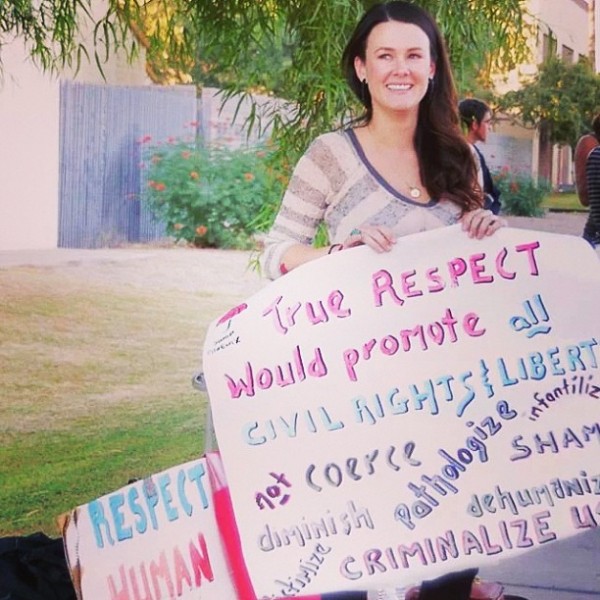
Monica Jones with other SWOP-Phoenix members (Photo by Peggy Plews, courtesy of SWOP-Phoenix)
Monica Jones with other SWOP-Phoenix members (Photo by Margie Diddams, courtesy of SWOP-Phoenix)

SWOP-Phoenix, a new branch of national sex workers’ rights organization Sex Workers Outreach Project, mounted a campaign this year against the Project ROSE (Reaching Out To The Sexually Exploited) Prostitution Diversion Initiative, in which Phoenix police and students from the Arizona State University School of Social Work team up twice a year to arrest local sex workers who then face criminal charges or a six-month diversion program. After SWOP-Phoenix protested against Project ROSE in May, one of the protest participants was picked up by an undercover officer the following night and taken to the Project ROSE site. The SWOP member, Monica Jones, an accomplished activist and a student who takes courses at the ASU School of Social Work herself, was deemed ineligible for diversion, and now faces up to six months in jail. Fellow Phoenix activists started an indiegogo fundraiser for Jones’ legal defense. I interviewed SWOP-Phoenix member Jaclyn Moskal-Dairman over the course of a week. The following is modified from the Google doc shared between us as an outgrowth of an email interview.

One of your members, Monica Jones, was arrested for “manifestation of prostitution” after participating in the protests against Project Rose. Jones was in the diversion program before, and spoke eloquently about her experience being mistreated there as a trans woman and a student sex worker. Can you tell me more about her case?

We believe Monica was targeted by the Phoenix police department. The evening after she spoke at the protest she was walking to a bar in her neighborhood. She accepted a ride from what turned out to be an undercover cop. He began to solicit her and she warned him he that he should be careful because of the Project ROSE stings that were going on that evening. He kept propositioning her and she asked to be let out of his vehicle. He did not let her out and actually changed lanes so she couldn’t exit the car. She was frightened and thought she was being kidnapped (which she was). She asked him if he was a cop, because she didn’t want to assault an officer. They were pulled over for a “routine traffic stop” and she was placed under arrest for the intent to manifest prostitution.

What was SWOP-Phoenix’s response when you first heard about Project ROSE? What would you say to those who claim that diversion is at least an improvement over wholesale incarceration?

When I heard about Project ROSE through an activist friend I set out to interview the professor at the ASU School of Social Work who spearheaded the initiative, Dr. Dominique Roe-Sepowitz. As a researcher, I tried my best to go into the interview unbiased until I had all of the details. Upon completing the interview I confronted Dr. Roe-Sepowitz about what I felt was wrong with Project ROSE, particularly the inherent contradiction of fighting coercion with coercion. Dr. Roe-Sepowitz explained that the initiative is completely police-driven. The School of Social Work has community organizations meet the apprehended community members at the initiative’s command post at Bethany Bible Church. The arrestees are met with prosecutors, as well as “tour guides,” who are ex-sex workers, and are told that they can have access to hygiene products, a hot meal, clothing, detox, mental healthcare, healthcare, safe housing and more, if they meet the eligibility criteria. After the interview, I compiled the research and met with a couple of activists from the Phoenix Harm Reduction Organization to discuss what we should do about it. They knew some folks from SWOP Tucson (who are incredible and have been supportive and essential in the creation of the Phoenix chapter) and SWOP PHX was formed as an emergency response. We immediately reached out to other activists and organizations, such as members of  [immigrant rights organization] Puente and Arizona Prison Watch, and began to strategize. We found out the exact dates of the next stings and began street and internet outreach to inform workers of the impending raids, handing out pamphlets and Know Your Rights information. We also protested outside of the Project ROSE command post, Bethany Bible Church.


Diversion is not an “improvement” in any way. Research states that there is little, if any, evidence of diversion initiatives helping sex workers or reducing prostitution rates. Those involved in creating diversion initiatives want people to believe that they are an improvement because they benefit from it due to special interests. Social workers and non profit organizations stand to benefit from diversion projects through the creation of jobs, grants, other funding and publication. The Project creates good publicity for the police department, and offers the police more billable hours in the form of opportunities to travel to train other police departments in the treatment of sex workers as victims. Project ROSE actually widens the net of the prison industrial complex by pushing individuals into the system. The police department organizes more stings and raids, and since most of those arrested are ineligible for diversion or do not complete it successfully, they are then funneled back into the criminal justice system. The organizations involved should be ashamed because they scare away the oppressed and marginalized populations they seek to serve by using police force. This creates fear within these communities and exacerbates danger because individuals cannot trust their local resources and so sex work is driven further underground.

Diversion programs and criminalization mainly target street based sex workers and trans sex workers. These community members are already targeted, marginalized and oppressed. Profiling laws like the manifestation statute only seek to reinforce and justify this discrimination. Diversion and criminalization perpetuate the stigma against street sex workers and trans sex workers as well as reinforce racism, sexism, and transphobia.

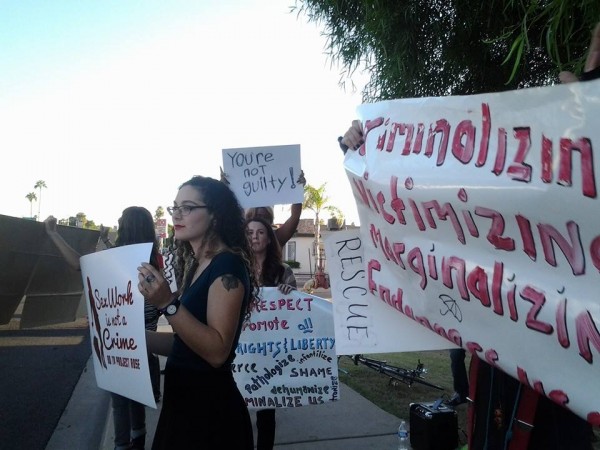
Jaclyn Dairman at a SWOP Phoenix protest (Photo by Peggy Plews, courtesy of SWOP-Phoenix)
Jaclyn Moskal-Dairman at a SWOP Phoenix protest (Photo by Margie Diddams, courtesy of SWOP-Phoenix)

Jones was deemed “ineligible” for diversion. What does that mean—does that translate into not being repentant enough about being a sex worker? She was arrested for “manifestation of prostitution”—what does that legally mean?

Ineligibility for this particular diversion initiative means that the apprehended community member has had prior arrests for prostitution, a warrant out for their arrest, or had illegal substances on them at the time of arrest.

Monica was “ineligible” for diversion because she had already been through a similar diversion program titled DIGNITY House through Catholic Social Services. She was told to not come back to that particular program after only a few days because she was very outspoken about how they treated her as a victim and she told the people in charge as well as other individuals in the program that she has the right to her own body.

The Phoenix manifestation law is a municipal statute which states that “[a] person is guilty of a misdemeanor (prostitution, soliciting an act of prostitution and related offenses) [if they are] in a public place, a place open to public view or in a motor vehicle on a public roadway and manifests an intent to commit or solicit an act of prostitution. Among the circumstances that may be considered in determining whether such an intent is manifested are: that the person repeatedly beckons to, stops or attempts to stop or engage passersby in conversation or repeatedly, stops or attempts to stop, motor vehicle operators by hailing, waiving of arms or any other bodily gesture; that the person inquires whether a potential patron, procurer or prostitute is a police officer or searches for articles that would identify a police officer; or that the person requests the touching or exposure of genitals or female breast.”

We feel that this statute clearly violates rights to free speech and is unconstitutionally vague. It gives the police permission to profile sex workers.

Can you explain how the ASU School of Social Work’s spearheading this diversion program goes against the ethical guidelines of social work?

Using police force as an impetus to coerce and force individuals into services strips them of their autonomy. By disregarding the principle of self-determination, Project ROSE violates many standards of social work practice 1 The Project reiterates the ideal that marginalized groups need constant surveillance. It perpetuates the “this is for your own good” ideology which, in the social work field, has historically created oppressive consequences.

Some sex workers found fault with the wording of SWOP-Phoenix’s statement that diversion programs “ignore the fact that many people who work in the sex industry are not victims in need of rescue, but consenting adults who should not be arrested, coerced into diversion, or incarcerated for working,” saying that trafficking victims shouldn’t be arrested or coerced into diversion either. Monica Jones was quoted saying, “I’m not on drugs. I’m not like one of these crazy people.” Surely SWOP-Phoenix doesn’t believe that sex workers who are drug users, sex workers with mental illness diagnoses, and sex workers who are in coercive situations deserve to be criminalized or forced into Project Rose?

In May we had only just begun to come together as a community to organize and we were placed under tremendous pressure by the impending citywide stings that we knew would lead to a very large number of people being incarcerated. And here in Arizona, when people are incarcerated their very lives are at stake. In a fast-moving situation like this sometimes messages are not as clear as they should be, and lessons are learned every time communities stand up for rights. All of the activists in Phoenix working on this issue would like to say here and now that we don’t agree with ANYONE being arrested and coerced in order to be “helped,” whether they identify as sex workers or trafficked persons.

As to the second part of your question, the comment you quote Monica making was from her speaking off the cuff at the protest in May. I feel as if her comments are being taken out of context. She was speaking about her experience in solitary confinement where because of her gender she was stigmatized as a “crazy person who needed to be isolated.” And to be clear, I am not implying that all individuals in solitary confinement are crazy, and I acknowledge that solitary confinement can wreak havoc upon one’s psychological and physical health. Monica’s comment also referred to how she was treated in diversion (she is not struggling with substance abuse issues, so why was she forced into drug counseling?) I think closer consideration of Monica’s real intent actually highlights the inherent problem with diversion initiatives: these programs completely lack a nuanced analysis of our community members’ individual lives. By treating ALL sex workers as victims and generalizing their personal needs, the Project perpetuates stigma and stereotypes which convey that all sex workers are helpless victims in need of forced detox, forced drug counseling, forced mental healthcare, etc. Diversion programs like Project ROSE stand in direct opposition to powerful harm reduction based and rights affirming substance abuse and mental health approaches, the kind that actually help make a difference.

Marcia Powell, RIP (Photo by Gary Millard, 2008, courtesy of SWOP Phoenix)
Marcia Powell RIP (Photo by Gary Millard, 2008, courtesy of SWOP Phoenix)

Some of the press coverage on SWOP-Phoenix mentioned the death of Marcia Powell, a local sex worker. How did prison abuse and negligence contribute to Powell’s death, and how has this influenced SWOP-Phoenix in working against violence against sex workers?

According to Peggy Plews, an Arizona Prison Watch member, Marcia was a 48-year-old sex worker diagnosed with mental illness, with a long history of drug and prostitution convictions and no family willing to claim her body once she was gone. She got 27 months for offering a cop a $20 blow job, serving much of it on the maximum security yard at Perryville. Marcia was supposed to be on a ten minute suicide watch when she was left in an uncovered cage, largely ignored, for nearly four hours in the mid-day sun. It was at least one hundred and seven degrees out that day. By the time someone noticed her unconscious on the ground, Marcia had defecated on herself, her organs were overheated and failing, and she had second degree burns all over her body. She went into a coma and passed away that night after the director of the Arizona Department of Corrections removed her from life support.

In the wake of Marcia’s death, sixteen ADC employees were disciplined, seven of whom were referred for criminal prosecution. No one ended up being charged, unfortunately; they all got their jobs back, except for the deputy warden, who was allowed to retire. Conflicting testimony was one reason no one was prosecuted. All the prisoners said the guards ignored Marcia’s pleas for water and relief from the sun; the guards had another story, of course. 10,000 pages of ADC investigative material, and the county attorney couldn’t make a single case out of it to hold anyone responsible—not even on a misdemeanor.

Marcia Powell’s death has deeply influenced SWOP-PHX to try our hardest to keep our sex workers safe in every possible way, especially from criminalization. A prison sentence in Arizona, along with many other states, can mean a death sentence. This is evidenced in many other cases besides Marcia Powell’s.

Marginalized and oppressed populations that are incarcerated are often already targeted by discrimination and stigma. The laws the police enforce only seek to justify the targeting. It’s total bullshit. Through harm reduction, handing out Know Your Rights information, attorney assistance (to the best of our ability), creating awareness about stings (those of which are already public information), and through fighting profiling and shitty laws, we are trying to create a safer community and build back trust that the system has completely annihilated through police force and brutality, redirecting it to community organizations. (This distrust also stems from social workers and community organizations teaming up with the police.) We understand that the resources we have are minimal but we can only work with what we have at this point.

SWOP-Phoenix members protesting Project Rose (Photo by Peggy Plews, courtesy of SWOP-Phoenix)
SWOP-Phoenix members protesting Project Rose (Photo byMargie Diddams, courtesy of SWOP-Phoenix)

What can the sex worker community as a whole do to support your campaign? Now that Monica Jones faces incarceration again, what can the national sex workers’ rights movement do to help her besides donating towards her legal defense?

Please speak out against Project ROSE and similar diversion initiatives by contacting your representatives and those who are involved with spearheading these projects. Know your rights as well as your local laws and speak out against ambiguous legislation that justifies profiling sex workers like the manifestation statute. Speak out against the Phoenix municipal manifestation statute and speak out against activists being targeted by the state!

We feel that the national sex workers’ rights movement can help Monica by bringing awareness to ambiguous and unconstitutional laws that profile workers, like the manifestation statute Monica is being charged with. The movement can also further highlight the ways in which our trans community members are mistreated and profiled by the police. Social workers should speak out against Project ROSE and similar diversion initiatives initiated by their colleagues. If Monica is found guilty, than writing to her to show your support would help boost her morale. Write to your local university’s school of social work and ask them to speak out against social workers using police force as an impetus to “rescue” sex workers and provide services. On Nov. 27th, Monica’s pre-trial date, the national movement can come together and rally at local courthouses to protest diversion initiatives, unconstitutional laws that profile sex workers, and Monica’s targeting by the police as a trans woman of color and an activist.

If you’d like to do more, you can call the city of Phoenix prosecutor’s office and demand that they drop charges against Monica Jones immediately: City Prosecutor’s Office Phoenix, Municipal Courthouse, 300 West Washington St., Phoenix, Arizona 85003, 602-262-6461. Jones is a student of the ASU School of Social Work so SWOP-PHX urges you to write to the director of the school, Steve Anderson, tell him that he’s criminalizing his own students, and demand that Project ROSE be shut down: 602-496-0058/ steven.anderson.2@asu.edu. You can also  check out SWOP-PHX’S Facebook page, like it, and advertise the events posted.  SWOP-PHX is planning a benefit for Monica in the form of a sex positive dance party on Nov. 22nd, at the Firehouse Gallery in Phoenix.

1. According to the National Association of Social Workers [NASW] Code of Ethics [Standards 1 and 6], Council on Social Work Education [CSWE], Educational Policy and Accreditation Standards (Policies 2.1.2 and 2.1.5), and the International Federation of Social Work [IFSW] Ethical Principles (Principles 4.1 [1 and 2] and 4.2 [3–5] [Wahab and Panichelli, Ethical and Human Rights Issues in Coercive Interventions With Sex Workers])

Saturday, November 2, 2013

STAND WITH MONICA JONES: Project Rose is Violence!


(Edited November 10, 2013) 

When I first put up this blog post, I didn't realize how toxic the environment was in which the debate between sex worker rights activists and anti-traffickers has been taking place these past several years. It was not my intent to polarize local parties even further by focusing so much on the person who developed and implemented Project Rose, as opposed to simply critiquing the methods the program employs to rescue people. The edits made in this post account for that concern.

I also didn't intend to diminish the reality that there are many lives torn apart by human trafficking, whether or not the labor exploited and stolen is sexual in nature. There are enough in the business who would choose a diferent line of work, given the option, that I don't want to minimize that reality, either. In a truly healthy economy, people would have more choice and mobility.

Sex work really isn't for everyone - but those who do work in the field deserve respect, safety and protection from exploitation and violence. I don't see how Project Rose does anything for them but expose them to even more state violence than they otherwise would be...and it seems as if Social Work should be very much concerned with the principle of "first do no harm" when professional interventions are designed for public policy and private lives. I was a social work student for many years myself, and Project Rose runs counter to so much I learned about social work ethics.

I still adamantly object to a program design which casts a large net to round everyone up in handcuffs and sorts through who gets to be free and who goes to jail later. It "liberates" some at the expense of others, and does immeasurable harm to those arrested in the end.  That said, I hope readers who take issue with Project Rose - particularly those of you who are ASU students, will still raise your concerns with Professor Roe, but please do so in a respectful  way which allows the dialogue to continue. I don't think her ultimate objective is to hurt anyone, by any means, and I hope there is at least some common ground we can agree on...like the principle that consensual sex workers and their allies also deserve to be free of violence, and thus Project Rose should offer everyone assistance, regardless of priors or other factors, and arrest no one (especially not those of us protesting it). If the people behind Project Rose could at least agree to that much, we will have made progress.


Peggy Plews


 SWOP-Phoenix Activist Monica Jones


Last May I joined the  Phoenix Sex Workers Outreach Project (SWOP-Phoenix) in a protest of Project Rose, a Phoenix Police prostitution sting operation that purports to rescue victims of sex trafficking, and claimed not to arrest those voluntary sex workers swept up in its net (See: Cracking down on sex trafficking by not arresting prostitutes). My friends and I were not terribly well-received, and the day after our protest - which was the second day Project Rose was operating - one of our transgender friends who was out there with us, Monica Jones, was even arrested for "manifestation" of the intent to commit prostitution for accepting a ride to the bar in her own neighborhood.


Specifically, the Phoenix Police say that under the Phoenix Municipal Code, she is guilty of this:

23-52 Prostitution, soliciting an act of prostitution and related offenses.

A.    A person is guilty of a misdemeanor who: 


3. Is in a public place, a place open to public view or in a motor vehicle on a public roadway and manifests an intent to commit or solicit an act of prostitution. Among the circumstances that may be considered in determining whether such an intent is manifested are: that the person repeatedly beckons to, stops or attempts to stop or engage passersby in conversation or repeatedly, stops or attempts to stop, motor vehicle operators by hailing, waiving of arms or any other bodily gesture; that the person inquires whether a potential patron, procurer or prostitute is a police officer or searches for articles that would identify a police officer; or that the person requests the touching or exposure of genitals or female breast;  


The first time I put this post up, I did some speculating about the mindset of the Phoenix Police when they decided to arrest Monica. My comments were kind of inflammatory and probably unfair to the arresting officer, so I've taken them down. The truth is, I don't know what the PPD was thinking - maybe they weren't thinking at all. I can't believe they thought we would all quietly go away after this. 

It's possible the cop who did the dirty work is the one who made the call to target her while he was driving through her neighborhood, and thought she was really out hooking. I'm skeptical of the arresting officer's veracity and his bias about transgender people, though, having read the report. For one thing, even though Monica's driver's license identifies her as female, the cop identified her using male pronouns throughout the entire police report - he really felt she should be clearly identified as a man, not a woman. And there are a few variations between his version (or interpretation of events) and hers.


I'm more inclined to think that the commander made the decision the day before after they identified her at the protest and saw that she had a prior - which is what makes her so vulnerable to that "manifestation" charge: they apparently use a prior offense as evidence that you intended to commit that crime again. I guess it's possible that her neighborhood was on their map of areas to target, but it seems awfully coincidental that the Project Rose officers were lurking around there.


  In any case, here's pretty much what went down: The day after our protest, Monica got dressed up and decided to go to the bar.  She's on her way, by foot (through her own neighborhood, mind you), when this guy pulls up in front of her, literally blocking her path, and offers her a ride. She has a mile yet to walk to the bar and was bothered by another dude in the area, so she figures "either this guy is a cop and I've got a safe ride, or he's someone who might buy me a drink when we get there", and she gets in.


Almost immediately the guy starts propositioning her, asking how much she wants for a sex act. Monica wasn't working, though - besides, she knew full well what was going down with Project Rose; he must have been disappointed that she wouldn't take his bait. This guy kept being really pushy, too, so she asked him "look are you a cop? Because there's this sting going down and you really need to be more careful about asking those kinds of things..." He was obviously a cop.

The guy insists several times that he's not a cop, though, as he passes by Monica's bar, and keeps going when she says "turn here!" "stop!" "I want to get out!". So what was she supposed to think? If he wasn't a cop, then he was in the process of abducting her, so she grabs his..umm..male organ,  having every reason to be concerned for her safety now (what would you do if you thought you were being kidnapped? That's better than going for the jugular...). Of course, in his report Officer John made that moment sound like a sex act. At that point he gave his buddies the signal to pull him over, and they arrested
her for trying to solicit him.

The cops took Monica (in cuffs) to Project Rose's HQ at the Bethany Home Bible Church, where she asked for an attorney, and was introduced to the prosecutor, who threatened to send her to jail that night if she didn't agree to participate in their program. She was not entitled to consult an attorney before deciding whether or not to sign away her rights and enter the diversion program (which is an implied admission of guilt). 


Monica had already been through a diversion program, though, which they soon discovered - that disqualifies you from ever being diverted from the criminal system again (that's how they sort out the "victims" from the "repeat offenders"  - the  "real prostitutes" who they apparently do feel belong in jail). She also would have been disqualified from the program if she had so much as a baggie they thought once held pot in it. After detaining and processing Monica that night, though, they released her without charges...that is, until this fall, when they sent her a summons to answer the charge of "manifestation".

This is no small thing. Monica is facing up to 6 months in jail and a $2,500 fine - with a minimum mandatory of 30 days in jail.  Even if the judge doesn't think imprisonment is appropriate, with a conviction she would lose not only her freedom, but also her student loans and class standing, as well as her safe, affordable housing. Now, I ask the perpetrators of Project Rose: just how are you "saving" trafficking victims with this program again? Are you sure it isn't inadvertently hurting anyone?

As a transgender woman who would be locked up in a male facility, Monica faces infinitely higher levels of violence, abuse and exploitation from both prisoners and officers than cisgender people are when incarcerated. She would be forced to remain in solitary confinement for her own safety through the course of her imprisonment - which still doesn't protect prisoners from lecherous guards and the jail trustees. She would have to endure the special "care" of Joe Arpaio's gracious deputies, who are known for beating up some of thier mentally ill prisoners in restraints, and killing others through overt violence or deliberate indifference, among other things.

The law that Monica is being prosecuted under assumes that certain things she did that day: walking in a "high-vice area", accepting a ride from a stranger, asking the man who was propositioning her repeatedly for sex if he was a cop, and making physical contact with his, um, sex organ - were motivated by the
intent to trade sex for money. Now, how do they prove criminal intent? They'll point to her prior conviction for a prostitution charge as evidence of that intent: after all, "Once a whore always a whore". They may even use her statement from the protest the day before - she, like myself - believes sex work should be legalized. Does that mean she was out hooking the next day herself? C'mon, guys - you know she wasn't.

If anything, the fact that this arrest went down during Project Rose - the day after she publicly criticized the sting - should have been evidence enough to the cops that Monica WASN'T attempting to solicit anyone  - she knew full well what they were up to. They should have been wary that SHE might be stinging them when they went after her - none of us would be so stupid, though, as to deliberately bait a Vice operation.


Even if the cops who picked Monica up were totally oblivious to her role in the protest the day before, Daniel Garcia, the Chief of Police and Aarón J. Carreón-Aínsa, the Phoenix City Prosecutor, are well aware of the back-story to this arrest now - and yet these charges still stand. What does that tell you about the overall "intent" and integrity of  Project Rose?


 Can't miss Monica standing tall, even in this one...
(May 2013: Protesting Project Rose)

Interestingly, given that some of these Project Rose arrests are being based on assumptions about the target's "intent" behind non-criminal behaviors and their response to having someone aggressively proposition them for a sex act, the Phoenix Police department apparently decided not to record any of their cops in the act of setting these people up - or any of these people actually committing their crime. I guess they know that in court their testimony alone always wins against some streetwalker's version of events - and a recording might contradict the good officer's word, so they made sure not to have any way for these women to defend themselves if they alleged the officers version ws inaccurate. That alone brings the validity and credibility of Project Rose arrests into question.


I recently wrote to the professor at the Arizona State University School of Social Work who is supervising the academic/research side of Project Rose about my concerns for Monica and the charges she's facing. She never responded to it, though. ASU insists that Project Rose first does no harm...of course, we can see from Monica's prosecution that this assertion isn't true at all - they appear to be going out of their way at the Phx PD to do my friend as much harm as possible for challenging them.


Project Rose is also embraced by a host of non-profit organizations in the valley, most of which serve populations at high risk of victimization by state violence. They're all collaborating with the cops in the worst kind of way, encouraging violence against sex workers by lining up to have the police deliver their prospective clients to them in a church basement in handcuffs and tears, so they're more receptive to the great services those kind people have to offer them. I think those agencies are being paid from anti-trafficking funds for the time they give to Project Rose, by the way, but don't quote me on that.


Shame on all of those organizations (including ASU, Catholic Charities, EMPACT, Community Bridges, and HealthCare for the Homeless , StreetlightUSA, and ALERT) - beginning with the biggest provider of services to homeless youth in the valley, Tumbleweed. Most of these agencies appear to have a bunch of cops, prosecutors, and big business CEOs on their boards of directors - no wonder they don't know what they're doing. And they all seem to be quite happy to be in bed with the Phoenix Police - how can they really be serving the vulnerable populations that are most violated by the police, then? Word must be out on the street that these places can't be trusted by now.


Anyway, if you're hungry and homeless and you call Tumbleweed for a crisis outreach team to take you to a homeless shelter, you better make sure you don't have a warrant out for your arrest: before they come to your aid those nice people at Tumbleweed are going to call the cops to see where you stand with them - and to tell them where to grab you if you're wanted. I was floored. I had to drag it out of them, but they really told me that when I called them about a homeless 18 year old kid getting out of prison the other day.  They said "well, we can't have people up in here who have warrants out for them." That doesn't mean you have to call the cops on them yourself, though! What a violation of trust.


Now, why should homeless and runaway youth ever ask these people for help?  They seem far more interested in their corporate image than the safety and survival of their clientele, and clearly lack a meaningful, critical analysis of how state violence plays out against the youth they serve.  They certainly don't seem to understand the basics of street outreach and harm-reduction, with these kinds of policies and their cozy "partnerships" with the police. Far too often the people who are there to help those kids only do them harm by involving the police. Good intentions can even kill.

Project Rose has already been roundly criticized in a well-respected professional journal, AFFILIA - and I expect more to hit the presses soon. Please read that article if you still believe programs like this "help" more people than they hurt, or that the harm they do to some is worth the good they do for others. There are far more effective outreach programs to help people who are really being trafficked against their will, and the
best jail "diversion" program for sex workers would be to simply legalize prostitution altogether. It would certainly undermine those who are trafficking others by bringing the entire sex work industry out of the shadows, making it safer for victims to ask for help.


The City of Phoenix needs to drop these charges against Monica now, before it takes any more of a toll on her. The intent of prosecuting her seems not only to punish her, but to silence anyone who would publicly call this project what it is - a conspiracy between cops and social workers to lock up people they think are "willing whores". They had to charge Monica for "manifesting" her "intent" because she wasn't actually doing anything criminal - they know full well she wasn't out there prostituting during their sting, and that she had every reason to think their buddy was indeed a cop.  This prosecution is malicious - and when she beats it, she's going to have one hell of a good wrongful arrest suit on her hands.

Monica's next court date (we thought it would be her trial, but it's a pre-trial) is November 27, 2013 at the Phoenix Municipal Court. Tune into SWOP-PHX to keep up on what's happening, and visit our INDIEGOGO page to support Monica's defense - though I'm going to be really pissed off if the city makes us spend all that money on a lawyer just to motion to dismiss this garbage...


(note: I made prior reference to Monica being Dr. Roe-Sepowitz' student - she never was. She's an ASU student planning to major in social work, and had simply spoken to Professor Roe before about Project Rose).

Sunday, October 20, 2013

Social work values, state violence, and Project Rose.

The following post from the Best Practices Policy Project references a great article in AFFILIA: Journal of Women and Social Work that sums up my own major concerns about Project Rose being supported by the ASU School of Social Work program.

Download the PDF and read on...


protesting Project Rose 
October 17, 2013

-------------------------------

Questionable Practices: Arresting people “for their own good” violates social work ethics

Stephanie Wahab and Meg Panichelli provide a succinct analysis of the ethical considerations associated with diversion programs that arrest people in the sex trade in order to force them to accept services. Their commentary which appears in a 2013 edition of AFFILIA, a peer reviewed social work journal addressing the concerns of social workers and their clients from a feminist point of view, challenges the “assumption that arresting (or participating in the arrest of) people ‘for their own good’ constitutes good or ethical social work practice.” The authors conclude that, “targeting people for arrest under the guise of helping them violates numerous ethical standards as well as the humanity of people engaged in the sex industry” and express concerns that such an approach “constitutes an act of structural violence against individuals who already frequently report negative, discriminatory, and often violent encounters with law enforcement including people with precarious migratory or citizenship status, poor, youth, transgender, and people of color.”

The example that sparked the writing of the AFFILIA editorial is Project ROSE, a program in which social workers from Arizona State University  School of Social Work and some service providers collaborate with city wide raids orchestrated by the Phoenix Police Department. Project ROSE is found to violate ethical standards described in the National Association of Social Workers (NASW) Code of Ethics, the Council on Social Work Education Educational Policy and Accreditation Standards, and the International Federation of Social Work Ethical Principles. Informed consent–an essential element of social work practice and the standard in many other professions–is violated because the services provided rely on recruitment via ”massive police (in this case 125 officers) sting operations.” The authors explain that, ‘if targeted sex workers (and people profiled as sex workers) reject the ‘offer’ to enter the diversion program and/or if they fail to successfully complete a diversion program… they face criminal prosecution.”

Wahab and Panichelli provide the reader with clear guidance on how to avoid unethical practice from the perspectives of social workers. “Whether you believe that sex work = sex trafficking or whether you believe that there is no universal sex work experience and that sex workers can make their own decisions about what they need and when they need it,” they write. “Schools of Social Work and social work in general should not be in the business of arresting people for their own good.”

The full text for the commentary is available at: Ethical and Human Rights Issues in Coercive Interventions With Sex Workers Stéphanie Wahab and Meg Panichelli, Affilia 2013 28: 344.