Retiring Arizona Prison Watch...


This site was originally started in July 2009 as an independent endeavor to monitor conditions in Arizona's criminal justice system, as well as offer some critical analysis of the prison industrial complex from a prison abolitionist/anarchist's perspective. It was begun in the aftermath of the death of Marcia Powell, a 48 year old AZ state prisoner who was left in an outdoor cage in the desert sun for over four hours while on a 10-minute suicide watch. That was at ASPC-Perryville, in Goodyear, AZ, in May 2009.

Marcia, a seriously mentally ill woman with a meth habit sentenced to the minimum mandatory 27 months in prison for prostitution was already deemed by society as disposable. She was therefore easily ignored by numerous prison officers as she pleaded for water and relief from the sun for four hours. She was ultimately found collapsed in her own feces, with second degree burns on her body, her organs failing, and her body exceeding the 108 degrees the thermometer would record. 16 officers and staff were disciplined for her death, but no one was ever prosecuted for her homicide. Her story is here.

Marcia's death and this blog compelled me to work for the next 5 1/2 years to document and challenge the prison industrial complex in AZ, most specifically as manifested in the Arizona Department of Corrections. I corresponded with over 1,000 prisoners in that time, as well as many of their loved ones, offering all what resources I could find for fighting the AZ DOC themselves - most regarding their health or matters of personal safety.

I also began to work with the survivors of prison violence, as I often heard from the loved ones of the dead, and learned their stories. During that time I memorialized the Ghosts of Jan Brewer - state prisoners under her regime who were lost to neglect, suicide or violence - across the city's sidewalks in large chalk murals. Some of that art is here.

In November 2014 I left Phoenix abruptly to care for my family. By early 2015 I was no longer keeping up this blog site, save occasional posts about a young prisoner in solitary confinement in Arpaio's jail. I'm deeply grateful to the prisoners who educated, confided in, and encouraged me throughout the years I did this work. My life has been made all the more rich and meaningful by their engagement.

I've linked to some posts about advocating for state prisoner health and safety to the right, as well as other resources for families and friends.

until all are free -

MARGARET J PLEWS (June 1, 2015)
arizonaprisonwatch@gmail.com


INDIGENOUS ACTION MEDIA

INDIGENOUS ACTION MEDIA
ANTICOLONIAL zines, stickers, actions, power

Taala Hooghan Infoshop

Kinlani/Flagstaff Mutual AID

MASS LIBERATION AZ

MASS LIBERATION AZ
The group for direct action against the prison state!

Black Lives Matter PHOENIX METRO

Black Lives Matter PHOENIX METRO
(accept no substitutions)

BLACK PHX ORGANIZING COLLECTIVE

BLACK PEOPLE's JUSTICE FUND

PHOENIX: Trans Queer Pueblo

COVID Mutual AID PHOENIX

AZ Prison Watch BLOG POSTS:


Showing posts with label terminally ill. Show all posts

Friday, September 10, 2010

Perryville SOS: Critical conditions for the seriously ill.

The following comment was posted to my earlier piece about conditions out at Perryville - this is specifically referencing San Pedro, which is supposed to be the "medical yard". The concerns enumerated by her are serious and chronic. There are elderly and frail women there, including women with AIDS, cancer, and a host of other illnesses and disabilities.


I can say with confidence that this woman's complaints aren't an exaggeration, nor are they unique to San Pedro (or even to Arizona). I also doubt that any of these issues were addressed when the women of Santa Cruz protested the recent lock-down. I've heard all these things from other women who were/are prisoners at Perryville - including two breast cancer survivors and one woman seeking a compassionate release who's now losing a battle with colon cancer (ironically, given the horrid conditions of her confinement, she was actually written up once for a "grooming violation").


Even the healthy women are at risk in that environment. The notion that people are "well taken care of" behind bars is a popular myth rooted in ignorance and self-serving politics that costs many vulnerable prisoners their lives. And no, they don't all "deserve" to be there in the first place - they certainly don't all need to be there for the sake of public safety - despite the absurd claim in the Fischer report that almost all of the ADC's prisoners are a danger to the rest of us (if you look at that link, check out Professor Mona Lynch's testimony in response, and note how Fischer doesn't differentiate between violent and repeat offenders for the legislature - they're just staving off budget cuts by preventing the early release of ANY prisoners, save a handful of "criminal aliens" the state had deported). My terminally ill friend is an example - she got 5 years from a Pinal County judge as a first time, non-violent offender on a controlled substances charge (she's an addict, of course). Hence the outrage of the author below about "bullshit charges" women are imprisoned for these days - our rate of incarceration has skyrocketed.


San Pedro is a minimum custody level yard - those are women who are low risk enough that they can move freely about the prison, share large dorm areas, and work in the community. When escorted outside of Perryville, they only need one guard to accompany them. So why do they need to be locked up at such an exorbitant expense at all? The average amount we pay per state prisoner in minimum custody in Arizona is about $21,500/year. That's more than twice what our federal government will afford for an elderly or disabled person in the community who is solely dependent on Supplemental Security Income (the state doesn't even supplement that).


Health care costs for prisoners are outrageous, but the quality of health care that prisoners get (if they get it at all) is worse than folks get on AHCCCS, believe it or not. Given that San Pedro is a "medical yard", the author's estimate of the cost of incarceration there may well be accurate, though - for some prisoners it's much higher. Once they finish doing their time (if they survive the experience), we're more than willing to leave them homeless, too, no matter how sick they may be. If they stay homeless too long on parole, they can get violated and thrown back in. That seems awfully twisted to me...


Thank you, to the former prisoner who took the time to send out this SOS for her sisters. She's absolutely right about women getting the worst deal in prison (most of the prisons are fire traps, but I don't hear nearly as much from the men about health hazards as I do from Perryville). Results will be hard to come by - God knows Middle Ground has been working on this for years - but if we can get some key legislators invested and build even a modicum of human rights' protections into Marcia's Law, it might help some of these conditions.


Please feel free to contact me - you or any other family members or former prisoners out there - if you want to work on these concerns with us. We need all the help and eyewitness testimony that we can get.
My number is 480-580-6807; call anytime.

--------------------------------

September 10, 2010 12:41 PM

Anonymous said...

I want someone to fight for the women who are serving time in Perryville Prison. I just did a nine month stint on San Pedro Yard. The place is disgusting, none of the swamp coolers work, its 120 degrees in our cells. The K-9 dogs stays in cages in the air conditioning. We are treated like animals (worse than animals). The sewer systems on both yards over flow, right in front of the kitchens, YUCK! The swamp coolers are filled with pigeon poop, and we breathe that into our lungs. Every bathroom is covered with mold, the walls , the floors, the shower curtains. One of the kitchens on 8 yard has been condemed, and the prison is not supposed to house inmates in there. BUT THEY DO! As soon as the health inspectors come to check stuff out, they leave and they start housing girls back in there AGAIN!.

The medical services on San Pedro is a joke, more than one time I was told to take advil and drink alot of water, and I have blood clots, and fibromyalgia!!!! Ive Heard them tell the same exact thing to the girls right after they have a seizure! The prison is so over full that we are living in squaller, The smoking section is full of fleas, bugs, ROACHES. The Deputy Warden MUSE is useless, Im surprised she even has a job. IF we get lucky to have a community meeting, and ask her a question, she always puts it off on someone else, she is extremely rude, and inconsiderate. AND LLAAZZYY!!

San Pedro is supposed to be a medical yard and i have NEVER seen living conditions like that before.!, and Im not just taking someone elses word for it, I lived there. The prison is so broke , why do we continue to hold so many girls that they cant afford to take care of them. ITS your Tax money to hold girl in disgusting conditions, Why dont you let alot of them go home to there kids. Come on drug charges for there own personal use (GIVE ME A BREAK). It cost tax payers 30-40 thousand dollars a year to hold mothers, daughters, wifes sisters.... FOR SOME BULLSHIT CHARGES...... Dont any of you have better things to do with your money?

Push for the senate bill to lower the 85%, to the 65%, and Fire Deputy Muse, shes not doing one bit of good anyway. Illegal Immigrants had their 85% dropped down to 50%..... The Prison is condemned, and its filthy, if we were the men at the mens prison, wed riot for what we want, but because were women and were more passive , and we dont riot....WE GET THE SHITTY END OF THE DEAL!!!!!!!! HELP!!!!!HEALTH INSPECTORS ARE ALWAYS SHUTTING THINGS DOWN ON OUR YARD! we EAT DAYS OLD LUNCH MEAT EVERY SINGLE DAY FOR LUNCH! food poisoning is common!~


Wednesday, August 11, 2010

Hospice for dying prisoners.

This is the first time I recall seeing in ADC death notices that terminally ill prisoners are dying in hospice...I hope this represents a trend towards more hospice placements and compassionate releases being granted for prisoners not expected to outlive their sentences. Whatever the nature of a person's crime may be, knowing you will die of a terminal illness in prison before your sentence expires must be a frightening, isolating experience - especially when it occurs at a young age.


I hope the short bit of time these prisoners had in hospice helped facilitate some measure of comfort at a time of great suffering, spiritual healing as they came to terms with the end of life, and a path to making peace with themselves and amends to victims wherever it may have been needed and possible.


Thank you, Hospice of the Valley, for your gracious embrace. That seems to be a politically courageous move. Thank you, as well, to whomever at the AZ Department of Corrections facilitated their placement there. I've given the ADC nothing but grief on this issue, about which I clearly know very little.


Condolences to Lopez' and Davenport's surviving loved ones.

--------------------------------

ARIZONA DEPARTMENT OF CORRECTIONS
JANICE K. BREWER GOVERNOR
1601 W. JEFFERSON PHOENIX, ARIZONA 85007 (602) 542-3133
CHARLES L. RYAN DIRECTOR

For more information contact:

Barrett Marson
www.bmarson@azcorrections.gov

Bill Lamoreaux
www.blamorea@azcorrections.gov

August 9, 2010
Inmate Death Notification


Florence, Ariz. – Inmate Angel Lopez, 23, ADC #214893, died Saturday at Hospice of the Valley from apparent natural causes. Lopez was transported to the hospice on May 27.

Lopez, sentenced out of Maricopa County, was serving 10.5 years for a drive by shooting. He came to ADC March 6, 2007, and was housed at the Central Unit of ASPC-Florence.

###


August 9, 2010
Inmate Death Notification


Goodyear, Ariz. – Inmate Dora Davenport, 47, ADC #88860, died Friday at Hospice of the Valley from apparent natural causes. Davenport was transported to the hospice on Aug. 3.

Davenport, sentenced out of Maricopa County, was serving 20 years for child prostitution. She came to ADC Jan. 3, 1992, and was housed at ASPC-Perryville.

###

Thursday, July 15, 2010

Brewer's sick, dying, and innocent prisoners: Letter to the Governor.

My note to the Governor today via her website; posting it here, too, just to make sure it isn't lost:

First Name: * Margaret J
Last Name: * Plews
Phone: 480-580-6807
Email: * arizonaprisonwatch@gmail.com
Street: PO Box 20494
City: Phoenix
County: Maricopa
State: AZ
Zip: * 85036
Subject: legal/law *
Topic: Sick, dying, and innocent prisoners, and the Board of Executive Clemency

My friends and I at Arizona Prison Watch are gravely concerned about the number of state prisoners who are dying inside from medical neglect, from homicide, and from their own hand due to the despair of mental illness and incarceration - as well as those succumbing to terminal illness while awaiting compassionate release petitions which we suspect she has no intention of approving, just as Janet didn't. We find that totally unacceptable.

We are particularly concerned right now about the fates of prisoners William Macumber and Davon Acklin. The Board of Executive Clemency recommended Macumber for immediate release last year because they believed him to be innocent: the governor denied his petition, giving no reason. This is incomprehensible, and we'll be initiating a public campaign for his freedom if the governor doesn't take responsibility for acting on the Board of Clemency's recommendations in his case.

You may already be quite familiar with Davon Acklin's mom Julie, who has been trying to save her son's life - also going through the Board of Executive Clemency now. He's sick from hepatitis C and the ADC is refusing to treat him, we believe largely because of his serious mental illness, which appears to be the standard MO. This despite the stipulations of the Americans With Disabilities Act, which we intend to file a complaint about if appropriate care isn't provided to that child, or if he isn't sent home so his mother can get it for him.

We will also be seeking a new CRIPA investigation into the ADC - and possibly the AZDJC - if the other concerns we've raised aren't promptly addressed, and prisoners continue to die at present rates from neglect, abuse, and despair. The one poor child at Adobe Mountain appears to have been bullied to death; there's no excuse for that. Director Branham has, however, been quite gracious in trying to work with us given the limitations of confidentiality laws, so he may have bought some time. The ADC is out of time, however. As far as we're concerned, all of Chuck Ryan's prisoners are her prisoners too, and she bears a great deal of responsibility for their welfare. Criminalized or not, they are still real human beings with loved ones, hopes, and dreams. The state has a duty to protect them while they are in your care.

I do expect a response on these matters by Friday afternoon - our campaign to address them with the community and media will otherwise begin first thing Monday morning. We hear from these families and prisoners all the time - often we receive copies of letters sent to Governor Brewer pleading for assistance. We'll have them crying on the news every night and we'll be coming to her campaign events until the governor either steps in and steps up, or gets voted out. We can be extremely creative about these kinds of things, as can our friends - thousands of whom are already pretty outraged by SB 1070.

I will be looking forward to a reply from your office.

Thank you.


Margaret J Plews,
Arizona Prison Watch
Arizona Juvenile Prison Watch
Hard Time Alliance (Hep C in AZ Prisons)

Sunday, June 27, 2010

The dying, prison, and Adam Montoya.

For those who still think that prisoners get great medical care, think again. This is not an unusual story...sounds like Marcia Powell's.

If you wish you could have helped this guy - or Marcia Powell, for that matter - and want to know how to make a difference here: please take a minute and help someone still living. Free Davon Acklin. That will take you straight to the petition his mom has going supporting her request that he be pardoned by Governor Brewer so she can bring him home for medical care.

He's only
23, and he has hep C and needs a liver biopsy. He's not getting treatment at the ADC, either, so your time and good name for the cause would be appreciated.

------------------from Salon.com-----------------------

Ill. inmate died in agony while pleading for help

For days before he died in a federal prison, Adam Montoya pleaded with guards to be taken to a doctor, pressing a panic button in his cell over and over to summon help that never came.

An autopsy concluded that the 36-year-old inmate suffered from no fewer than three serious illnesses -- cancer, hepatitis and HIV. The cancer ultimately killed him, causing his spleen to burst. Montoya bled to death internally.

But the coroner and a pathologist were more stunned by another finding: The only medication in his system was a trace of over-the-counter pain reliever.

That means Montoya, imprisoned for a passing counterfeit checks, had been given nothing to ease the excruciating pain that no doubt wracked his body for days or weeks before death.

"He shouldn't have died in agony like that," Coroner Dennis Conover said. "He had been out there long enough that he should have at least died in the hospital."

The FBI recently completed an investigation into Montoya's death and gave its findings to the Justice Department, which is reviewing the case. If federal prosecutors conclude that Montoya's civil rights were violated, they could take action against the prison, its guards, or both. A Justice Department spokesman declined to comment, saying that the matter was still being investigated.

The coroner said guards should have been aware that something was seriously wrong with the inmate. And outside experts agree that the symptoms of cancer and hepatitis would have been hard to miss: dramatic weight loss, a swollen abdomen, yellow eyes.

During Montoya's final days, he "consistently made requests to the prison for medical attention, and they wouldn't give it to him," said his father, Juan Montoya, who described how his son repeatedly punched the panic button. Three inmates corroborated that account in interviews with The Associated Press.

The younger Montoya was taken to the prison clinic one day for "maybe five, 10 minutes," his father said. "And they gave him Tylenol, and that was it. He suffered a lot."

The federal prison in Pekin will not discuss Montoya's death. Prison spokesman Jay Henderson referred questions to the Bureau of Prisons, which denied an AP request for information on Montoya's medical condition, citing privacy laws.

It isn't clear whether the prison system, relatives or even Montoya himself knew the full extent of his illness. Montoya's father had no idea his son had cancer or hepatitis. Inmates who knew him said he told them he had cancer, but they knew nothing of his HIV.

According to its website, the Bureau of Prisons tries to screen the health of new inmates within 24 hours of their arrival. A closer examination within two weeks is required for prisoners with serious, long-term illnesses. But officials have not said whether Montoya was given any kind of exam or whether his medical records made it to Pekin.

Montoya pleaded guilty in May 2009 to counterfeiting commercial checks, credit cards and gift cards. Prosecutors will not say how much money was involved in the scheme, but Montoya was ordered to pay a little over $2,000 in restitution.

Montoya, who had a history of methamphetamine abuse, was released while awaiting sentencing and was ordered not to use drugs. At the time, he was living with his father and working for his father's process-serving business, which delivers legal documents. His father said he was paying Montoya's bills and paying him about $300 a week.

Then in mid-June, Adam Montoya was diagnosed with HIV.

"It hit him like a ton of bricks," his father said.

After the diagnosis, Montoya retreated back into methamphetamine. Following a urine test, he admitted using the drug three times in a month, and he was locked up.

Montoya began taking antiviral drugs, so his father still had hope and tried to give his son a sense of the same. "I thought, 'You'll get out. You'll get your probation, and you'll have years of life," the elder Montoya said.

In mid-October, Montoya was sentenced to two years and three months in prison. When he arrived at a federal prison transfer center in Oklahoma City, his medication was waiting for him. His father took that to mean that the prison system knew Montoya suffered from HIV.

Montoya arrived at the Pekin prison on Oct. 26. He lived just 18 more days. The inmates around him say he spent much of that time pleading for help from his cell.

Prison staff told Montoya he had the flu, according to Randy Rader, an inmate in the next cell who wrote letters to his mother about Montoya and discussed him in an e-mail interview with the AP.

"That man begged these people for nine days locked behind these doors," Rader wrote to his mother on Nov. 14. The letter was first obtained by The Pekin Daily Times, which wrote about Montoya's death earlier this year.

Rader has since been moved to a prison in California -- far from his family in Michigan. He suspects the move was retaliation for speaking out about Montoya.

The last time a staff member visited Montoya, about 10 p.m. on Nov. 12, he reported having trouble breathing and complained that he could no longer feel his fingers, Rader said in the e-mail interview. The staff member told Montoya that he would try to get help the next day.

Around 6:30 a.m., prison officials found Montoya's body in his cell.

The autopsy showed that Montoya's spleen was almost 10 times the normal weight because it had been engulfed by a cancerous tumor, which was on its way to doing the same with his liver.

The pathologist who examined Montoya's body said his eyes were also yellow -- an unmistakable sign of hepatitis. Dr. John Ralston is reluctant to speculate whether treatment could have saved Montoya's life by the time he reached Pekin. The doctor suspects he would have needed a liver transplant to have a chance.

That said, "You would think that he would have been feeling bad enough and complaining enough that somebody should have tried to get to the bottom of this," Ralston said.

The AP sought opinions about Montoya's condition from other doctors who did not examine him but were familiar with his diseases. They agreed he probably displayed obvious signs of distress.

Montoya would have had a swollen abdomen because of his spleen. At the same time, he probably was losing weight rapidly because the large tumor would have left little room in his belly for food, according to Dr. Krishna Rao, an assistant professor of oncology at Southern Illinois University Medical School in Springfield.

Someone in Montoya's condition should have been taking heavy doses of chemotherapy for his cancer or receiving stem cell transplants, if he were healthy enough, said Dr. James Egner, an oncologist with the Carle Foundation Hospital in Champaign.

If the cancer was too advanced, Montoya should have at least been treated for pain with powerful drugs, possibly in a hospice, Egner said.

The president of the American Civil Liberties Union's National Prison Project said it isn't uncommon for medical records not to arrive with a federal inmate.

"Sometimes it arrives late, and sometimes it doesn't happen at all," said David Fathi, who has spent 15 years studying prison conditions. "That's why it's so critical that the new facilities do a medical screening" of new inmates.

Fahti said Montoya's death "is really an egregious failure, of the kind that you wouldn't expect from even a small county jail, let alone the largest prison system in the United States."

After his son's death, Juan Montoya wrote to the prison complaining about its medical care. Warden Richard Rios wrote back to defend his institution.

"I must respectfully disagree with your characterization of the medical care Adam received and want to assure you that we carefully monitored you son's medical condition," wrote Rios, who was not hired for the job until months after the death. He did not elaborate, writing that privacy laws limited what he could say.

The elder Montoya is now waiting for his son's medical records, but he doubts they will offer many clues. The family has hired lawyers but has not decided whether to file a lawsuit.

Montoya thinks a lot now about the assurances he offered his son as he headed for prison.

"Your time will go by fast, and you'll get out, and we'll get you a job and be part of the family," Montoya recalls telling his son. "It never happened."

Thursday, June 24, 2010

The politics of compassion, death, and prison: TX to AZ

Kudos to this reporter for caring about this story. We have some compassionate release hang-ups in Arizona that need some journalistic help, too...maybe there's even a student out there who would want to make it an investigative journalism or research project? Let us know. Time is running out for Davon and his fellow prisoners; even he suggests that there are men far more ill than him who need to be going home before they die. Terminal illness was not included in their sentencing; perhaps sentencing judges should be reviewing such things when people apply for compassionate release.

So, keep hounding the governor - we need to let these folks find decent treatment in order to survive their sentences, or release them so they can die at home. Let her know that more than just a few of us care about this - she doesn't strike me much as the "compassionate" type, after all this with SB 1070.

But if she's really into helping the people of Arizona, then this is one small way she can make a huge difference in the lives of folks who have otherwise been disposed of and forgotten by all but their families - if they even still have connections with them, then the suffering generated by denying medical releases to terminally or chronically, severely ill prisoners is exponentially magnified. Everyone, including the state and our communities, hurts from our inability to embrace our own humanity, and find within ourselves the qualities of Mercy and Grace.


And the effects of the ease with which we detach from the pain of our fellow beings trickle down to the next generation...it is not a kind thing to bestow on them, or much of a gift to leave the world: a callous heart.

And it's all politics. Challenge Brewer to have the courage to step up to this issue and do it right. Word is that too many people since Janet have been approved by the Board of Executive Clemency only to die while sitting on the Governor's desk. Is this governor any less a coward than Napolitano was? I hope so.

- Peg

----------------------

Few Texas Inmates Get Released on Medical Parole
by Emily Ramshaw
Texas Tribune
June 3, 2010

A gaunt old man, thick with whiskers and stricken with dementia, writhes under the covers of his bed. Down the hall, doctors monitor elderly diabetics with recently amputated limbs, medicate terminal cancer patients shuffling by with walkers and tether shivering dialysis patients to blood-cleaning machines.


Despite the pacing guards, the handcuffs and the bars on the windows, the geriatric and medical wing at the Estelle Unit in Huntsville looks more like a nursing home than a maximum-security prison.


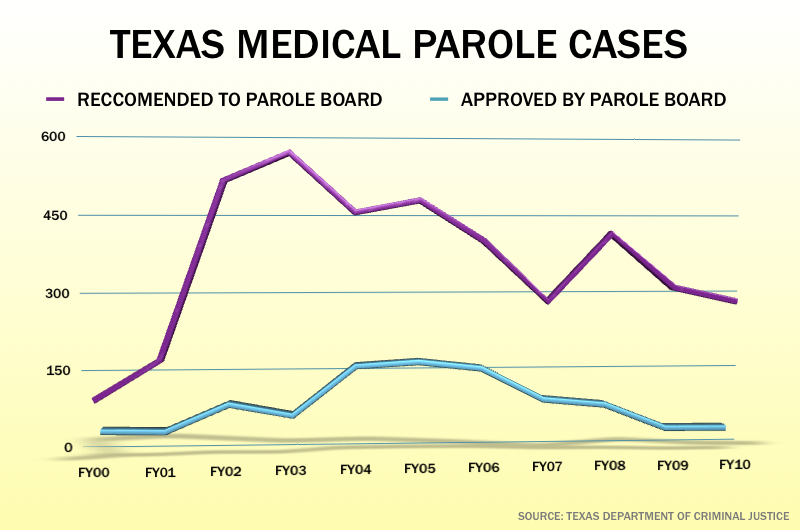
Prison doctors routinely offer up the oldest and sickest of these inmates for medical parole, a way to get those who are too incapacitated to be a public threat and have just months to live out of medical beds that Texas’ quickly aging prison population needs. They’ve recommended parole for 4,000 such inmates within the last decade. But the state parole board, which makes the final decision on “medically recommended intensive supervision,” has only agreed in a quarter of these cases, leaving the others to die in prison — and on the state’s dime.


Texas’ “geriatric” inmates, classified as those 55 and older, make up just 7.3 percent of Texas’ 160,000-offender prison population. But they account for nearly a third of the system’s hospital costs and make three times as many visits to prison medical departments as younger inmates. Elderly inmates have average annual hospitalization costs of $4,700, compared to $765 for inmates under 55. In total, providing inmate medical care costs the state correctional health care system — already facing hundreds of employee layoffs amid a budget shortfall — nearly half a billion dollars a year.


Parole board members say they’re faced with the difficult task of determining whether an inmate is still dangerous and must err on the side of public safety. “You can be sick, have an illness or a disease, and still be a threat,” said board chair Rissie Owens. “Our decisions aren’t based on numbers, on quotas. And we feel like we’re making good decisions.”


But criminal justice and prison funding experts say leaving elderly, terminally ill inmates to waste away behind bars is often unnecessary and exorbitantly expensive. Those costs would be shared with the federal government if the offenders weren’t in state custody.


“These are totally incapacitated inmates, terminally ill inmates, inmates on respirators, who are not paroled at a huge expense to the state and hardship to the inmate’s family because of the nature of a crime they may have committed 20 or 30 years ago,” said Sen. John Whitmire, D-Houston, who chairs the state Senate’s Criminal Justice Committee. “I think it’s largely for political reasons.”


The cost of care


While the total prison population in Texas isn’t growing, it’s quickly aging. The ranks of geriatric inmates are rising by about 6 percent every year, frightening the budget writers who have to figure out how to pay for them. Health care costs are rising too: The average daily medical bill for Texas inmates grows about 4 percent every year — which is low, compared to some states.


The sickest inmates can each cost the state up to $1 million a year in health care costs. If these same inmates were living in nursing homes or hospice facilities, the federal government — through Medicaid — would pay two-thirds of the cost and save Texas taxpayers up to $50 million a year, according to state projections. If the offenders are eligible for Medicare, the feds would pick up the full tab. “We could be transitioning them to some other facility where state taxpayers wouldn’t have to bear the full health care cost,” said Marc Levin, the director of the Texas Public Policy Foundation’s Center For Effective Justice Director, who suggested special nursing homes or hospice centers monitored by parole officers. “It’s a real opportunity to identify some savings without doing anything to endanger public safety.”


But despite the fact that the national one-year recidivism rate for older offenders is miniscule compared to that of younger offenders — 3.2 percent for inmates over 55, compared to 45 percent for inmates between 18 and 29 — an April report by the VERA Institute of Justice, a nonprofit criminal justice policy group, found that the 15 states that allow medical release rarely use it. What stands in the way? Political repercussions, complicated review processes and limited eligibility, the researchers found.


Getting Texas inmates released on medical parole is no easy task. To be eligible for it, an offender can’t be on death row or be serving life without parole, and must be either terminally ill (six months or less to live) or require intensive long-term care, said Dee Wilson, director of the Texas Correctional Office on Offenders with Medical or Mental Impairments. Sex offenders must effectively be in a vegetative state for consideration.


If inmates qualify, the office, in conjunction with the Correctional Managed Health Care Committee, recommends them for medical parole, then submits them to the seven-member Board of Pardons and Paroles for a decision. “It’s all about how long you have to live, and what your prognosis is,” Wilson said. “You can have a terminal illness but still be fully functioning.”


Dying behind bars


The parole board, in turn, relies on a pre-existing condition threshold of sorts. If an inmate with a particular illness commits a crime, Owens said, it’s unlikely he or she will get medical release for that same diagnosis. Some inmates with multiple amputated limbs may look incapacitated, Owens said, but managed to commit their crimes that way. Of the roughly 4,000 inmates prison health officials recommended for medical release in the last decade, the parole board turned down nearly 3,000.


In the last fiscal year alone, more than 440 Texas inmates died in prison. Thirty-one inmates who’d been recommended by medical staff for release died while awaiting the parole board to take up their case; another 26 died after the parole board rejected them for release. Twelve inmates were approved for medical parole but died before they could be sent home.


“There are documented cases where individuals had days or weeks left to live” and were rejected for medical parole, Whitmire said. “I saw no reason why they shouldn’t be paroled so the family could make plans for their funeral.”


Texas is not the only state struggling with skyrocketing prison health care costs and concerns around medical release. Between 1999 and 2007, the number of inmates 55 or older in state and federal prisons grew by more than 75 percent, to 76,000. To date, more than a dozen states have units set aside for elderly inmates; eight have dedicated hospice facilities. Estelle has an impressive medical facility, with a bustling emergency room, high-tech telemedicine equipment and a team of nephrologists that perform 1,800 dialysis treatments a month — sometimes on aggressive or unstable inmates.


“From a medical perspective, I’m comforted that [offenders are] getting a level of care they may not be getting on the street. On the other hand, we’re about to un-employ 363 people,” said Dr. Owen Murray, the chief physician for the University of Texas Medical Branch’s correctional managed care program, which oversees health care for the majority of Texas’ prisoners — and is facing layoffs this summer. “Are there other strategies to reduce our costs? And how do we prevent having to build more expensive units in the future?”


Charles Dill, a 71-year-old offender who started a 20-year sentence in 2000, has been hospitalized multiple times himself for costly heart problems, including getting stents for his carotid arteries. He’s befriended several elderly inmates in Estelle’s geriatric unit, only to watch them die on the ward.


“I’ve seen several of these guys drop over dead,” Dill said, gesturing across a prison dorm room of prosthetic limbs and wheelchairs, adult incontinence products and white-haired men in Coke-bottle glasses. “I guess they completed their sentence.”


Monday, June 21, 2010

Called to Care: Hospice of the Valley.

Hey all,

Called to Care is one of the main ministries addressing the needs of people with disabilities that has been supporting the efforts of the Hard Time Alliance, which is organizing Arizona's Hepatitis C + prisoners/ex-prisoners and their families. They had us give a little presentation at their coordinating meeting a month ago (where they had an awesome main speaker), and were on hand for the Candlelight Vigil last month at the ADC. Robert's also been a real support to my friend and comrade, Julie, who's trying to get either treatment for her son in prison or a pardon / compassionate release so he can get care in the community before the disease progresses further.

Anyway, I don't think these folks would mind if a few of us crashed this meeting in order to address concerns about the terminally ill in prison: is there even hospice space available to release dying prisoners to? Do hospice workers go into Arizona's prisons or jails? Does Hospice of the Valley deal at all with the prisons (like training other prisoners to be end-of-life caregivers, for example)? Are they a resource for the families of elderly and terminally ill prisoners?

I'm sure the rest of you can think of more questions to ask. Do just that - ask questions that concern these issues - wherever you go. In fact, if you can, make a point of going to things like this specifically to engage the rest of the community in a relationship with people dying behind bars: we have to do something about the hang-up on compassionate release (word is, there have been none/few signed by the governor since the Baseline Killer - that means Janet let a lot of sick people die in there who the ADC found eligible and the Arizona Board of Executive Clemency recommended for release).

So, if you have a chance to talk with someone from the American Cancer Society or other patient education/support/advocacy groups, please speak to the issues of compassionate release and hospice care for dying prisoners. If they hear it from several sources, maybe they'll jump in and help.

Thanks again, Robert, for your kindness and solidarity.

------------------from Called to Care---------------------

Dear Friends:
This is a reminder for the Called to Care Coordinating Council meeting, Sunday, June 27, 2010, 12 noon, Anthony Lounge, First Congregational United Church of Christ,1407 N. 2nd Street, Phoenix, potluck, carry-in meal. All are welcome. Sue Bartz, First Church member and Hospice of the valley Patient Insurance Department Coordinator, organized this speaker meeting. She invited Heather Chapple, Community Liaison, Hospice of the Valley, to speak on "The Hospice of the Valley's Senior Placement Service" that helps families find appropriate care for their loved ones at no cost to the family. Check attachment for details. For more information, contact Robert Koth by telephone at: 602-284-4159 or by email at: RobertKoth1@cox.net.


Our speaker, Heather Chapple, is a long-time Valley resident, moving to Arizona from Colorado in 1988, Heather served in the U.S. Navy for four years as an executive assistant at a submarine base in San Diego. She joined Hospice of the Valley in July 2009. She works as a community liaison, giving educational presentations about end-of-life care. Heather graduated from the University of Phoenix in 2008 with a bachelor's degree in education. I hope that you can join us to hear this exceptional speaker.

Blessings,

Robert Koth

Saturday, August 29, 2009

Send them home.

Dear UNSHACKLE friends,

I came across this article on a bill recently signed into law that amends Maine's policies around jails and state prisons to allow early release for people who are terminally ill.

I know that many of you on this list have done tremendous work around compassionate release guidelines and petitions in various states. Please let us know if there is any further update on this policy, particularly how 'those who might pose a risk of reoffending' is being defined/is traditionally defined.

All my best,
Laura


--------
New Law Allows Some Terminally Ill Inmates to Leave Prison Early
http://www.mpbn.net/News/MaineNews/tabid/181/ctl/ViewItem/mid/3475/ItemId/8669/Default.aspx
August 14, 2009 Reported By: Anne Ravana

Today Gov. John Baldacci signed into law a bill that amends a few correctional programs. LD 1224, "An Act Regarding the Operation of County Jails and the State Board of Corrections," will allow terminally ill inmates to leave prison early if they do not pose a threat to public safety. And the law also expands domestic violence and sexual assualt victim notification requirements.

Originally Aired: 8/14/2009 5:30 PM Listen (Duration: 3:29)

Only about seven percent of Maine's jail and prison inmates are over the age of 55, but corrections officials say most of those older inmates are not in good health.

"We see every type of sickness coming through, I think known, to man and that's why our pharmaceutical bill runs about $15,000 a month," says Penobscot County Sheriff Glenn Ross. "Hepatitis C is very common, alcohol problems, AIDS due to needle use, we have lots of problems with pharmaceutical abuse where people are coming in on many different types of drugs, and that combined with alcoholism, we have to try to get that person stabilized and off medicines that they're not supposed to be on."

Ross says he supports a new law that amends the state's home release program provisions, and allows some inmates to be released early into nursing homes or hospice care.

"There are those times when we have older individuals that have severe diseases that may succumb to those diseases, and the cost of keeping them in the jail or in the hospitals being guarded is astronomical," Ross says. "So there's no real good answer to this. I do support the new law if it's applied in a way that protects public safety, and you have people that are monitoring to make sure that the decisions are not purely financial and the risk to the community is the number one priority."

Under the law, which was amended in the last session of the Legislature, the home release program would not apply to inmates sentenced to life in prison or those who might pose a risk of reoffending, Ross says.

Many of the bill's provisions were recommended by the Board of Corrections, and Denise Lord, Associate Commissioner for the state Department of Corrections, says the bill brings more flexibility to the home release program.

"The early release programs that currently exist require prisoners to have served a certain portion of their sentence and to have a minimal amount of time left on their sentence before they're eligible for early release," she says. "For those prisoners who are severely medically incapacitated, those requirements go away."

Medically incapacitated, Lord says, means physically ill, not mentally ill. She says standards for release will be the same at all county jails and state prisons, and the new law leaves that decision to the sheriffs.

Sheriff Ross says there's always the question of how and where terminally ill inmates will be cared for after release, but the Volunteers of America, he says, have been a help.

"Here in Penobscot County we have a contract with Volunteers of America for release of inmates back into the community," he says. "And so that's a supervised community confinement program, basically, where we have somebody checking in on them. But we can set up conditions on inmates that are released to hospitals, or to homes and have them checked on by our VOA staff."

The Maine Department of Corrections says the state expects the percentage of inmates over 55 to grow in the coming years, and it's already higher than most states. Also in the new law is an expansion of the state's victim notification requirements. Now victims of Class D, or misdemeanor crimes, of domestic violence, sexual assault or stalking may request notification when the offender is released from jail or prison.


--
Laura McTighe
Director of Project UNSHACKLE
Community HIV/AIDS Mobilization Project (CHAMP)
80-A Fourth Avenue
Brooklyn, New York 11217
llmctighe@champnetwork.org
Office: (212) 937–7955, Ext. 20
Cell: (215) 380-5556
Fax: (401) 633-7793

www.champnetwork.org/unshackle

Monday, August 24, 2009

Free the Sick and Dying.

Plan to free state prison inmates moves ahead
Friday, August 21, 2009
Sacramento - The state Senate on Thursday narrowly approved a prison bill brokered by Gov. Arnold Schwarzenegger and Democratic lawmakers that would save the state $525 million this year by reducing the prison population by 27,000 inmates.


The legislation includes controversial plans such as allowing nonviolent elderly and sick inmates to finish their sentences outside prison walls in homes or community hospitals, where they would be monitored with GPS devices. The bill also includes the creation of a sentencing commission that would revamp the state's punishment and parole rules.


Republicans argued strongly against the bill.


"If this becomes law, the people of California will become less safe, pure and simple," said Sen. Tony Strickland, R-Thousand Oaks (Ventura County).


GOP lawmakers also warned that the sentencing commission, which would include a nonvoting former inmate, would weaken the state's tough-on-crime laws.


"You have the gall to put a felon on there?" Senate Republican leader Dennis Hollingsworth of Murrieta (Riverside County) asked Democrats during the spirited and contentious debate.

Close vote

After more than four hours, the Senate voted 21-19 to approve the bill, barely clearing the simple-majority hurdle.


The Assembly adjourned at midnight Thursday without debating the bill and will return Monday.


Speaker Karen Bass, D-Baldwin Vista (Los Angeles County), said the Assembly bill would differ from the version passed by the Senate. Those changes include eliminating so-called "wobbler" crimes that would reduce some felonies to misdemeanors and eliminating alternative sentencing, such as moving old and sick inmates out of prisons and into hospitals or nursing homes.


The changes would mean a loss of about $200 million in savings and Bass said she did not know how the Legislature would make that up.


There also would be changes to the sentencing commission, including eliminating a nonvoting seat for a former inmate. The changes would reduce the prison population by about 10,000 fewer inmates than the Senate plan would over two years.


Bass said she is concerned that waiting until Monday could be a political risk, but she said she thought it ultimately would not derail the plan.


"I just wasn't going to hold people here for three more hours ... and know there would still be members uncomfortable because their constituents hadn't had a chance to see it," Bass said.


Earlier, Senate President Pro Tem Darrell Steinberg, D-Sacramento, said he agreed with Republicans that public safety should be the No. 1 concern, but argued that the bill would result in greater public safety because it would allow authorities to focus more of their resources on violent criminals.


For example, the Senate bill would lower the ratio between parole agents and parolees from the current 70 to 1 to 45 to 1.


"Does this plan do more to protect people from more violent predators?" he said. "I would argue ... that it does."


Sen. Roderick Wright, D-Inglewood (Los Angeles County), said it makes sense to move old and seriously ill inmates out of prison into home detention or community hospitals with GPS tracking devices because the state would save money without endangering citizens.


"We have guys sitting in the joint who've had strokes," he said. "If you're blind and have one leg ... I won't worry about you anyway."


The bill was part of a plan to cut prison spending by $1.2 billion this year to help reduce the state's $24 billion deficit.

Administrative cuts

Besides the $525 million in savings in the bill, another $665 million would be saved by Schwarzenegger's actions. For example, the governor plans to use his authority to commute the sentences of some nonviolent illegal immigrant inmates and hand them over to federal authorities for deportation.


The governor also plans to cut costs by eliminating vacant administrative positions at the corrections department's Sacramento headquarters and reduce funding for rehabilitation programs.


The provisions of the bill that the Senate approved are:


-- $42 million saved by allowing the early release of inmates who complete certain rehabilitation programs, such as by earning GEDs and taking vocational training classes.


-- $134 million saved by reducing the influx of new prisoners by changing some property crimes that now qualify as felonies to misdemeanors. Petty thefts, writing bad checks and receiving stolen property would no longer be charged as felonies. Stealing cars valued at $2,500 or less could be charged as misdemeanors instead of an automatic felony.


-- $120.5 million saved by allowing certain inmates to finish their sentences at homes or hospitals under GPS monitoring. Qualifying inmates would need to be at least 60 years old or severely ill and have less than one year to serve.


-- $30 million saved by allowing certain felons who violate probation to serve time in county jails instead of having them sent back to prisons.


-- $198.5 million saved by changing the state's parole system so that some low- and moderate-risk offenders would not be subject to parole revocation. Also, certain serious offenders would be eligible for early parole discharge if they successfully complete drug treatment.


http://sfgate.com/cgi-bin/article.cgi?f=/c/a/2009/08/21/MNQS19BFR3.DTL