Retiring Arizona Prison Watch...


This site was originally started in July 2009 as an independent endeavor to monitor conditions in Arizona's criminal justice system, as well as offer some critical analysis of the prison industrial complex from a prison abolitionist/anarchist's perspective. It was begun in the aftermath of the death of Marcia Powell, a 48 year old AZ state prisoner who was left in an outdoor cage in the desert sun for over four hours while on a 10-minute suicide watch. That was at ASPC-Perryville, in Goodyear, AZ, in May 2009.

Marcia, a seriously mentally ill woman with a meth habit sentenced to the minimum mandatory 27 months in prison for prostitution was already deemed by society as disposable. She was therefore easily ignored by numerous prison officers as she pleaded for water and relief from the sun for four hours. She was ultimately found collapsed in her own feces, with second degree burns on her body, her organs failing, and her body exceeding the 108 degrees the thermometer would record. 16 officers and staff were disciplined for her death, but no one was ever prosecuted for her homicide. Her story is here.

Marcia's death and this blog compelled me to work for the next 5 1/2 years to document and challenge the prison industrial complex in AZ, most specifically as manifested in the Arizona Department of Corrections. I corresponded with over 1,000 prisoners in that time, as well as many of their loved ones, offering all what resources I could find for fighting the AZ DOC themselves - most regarding their health or matters of personal safety.

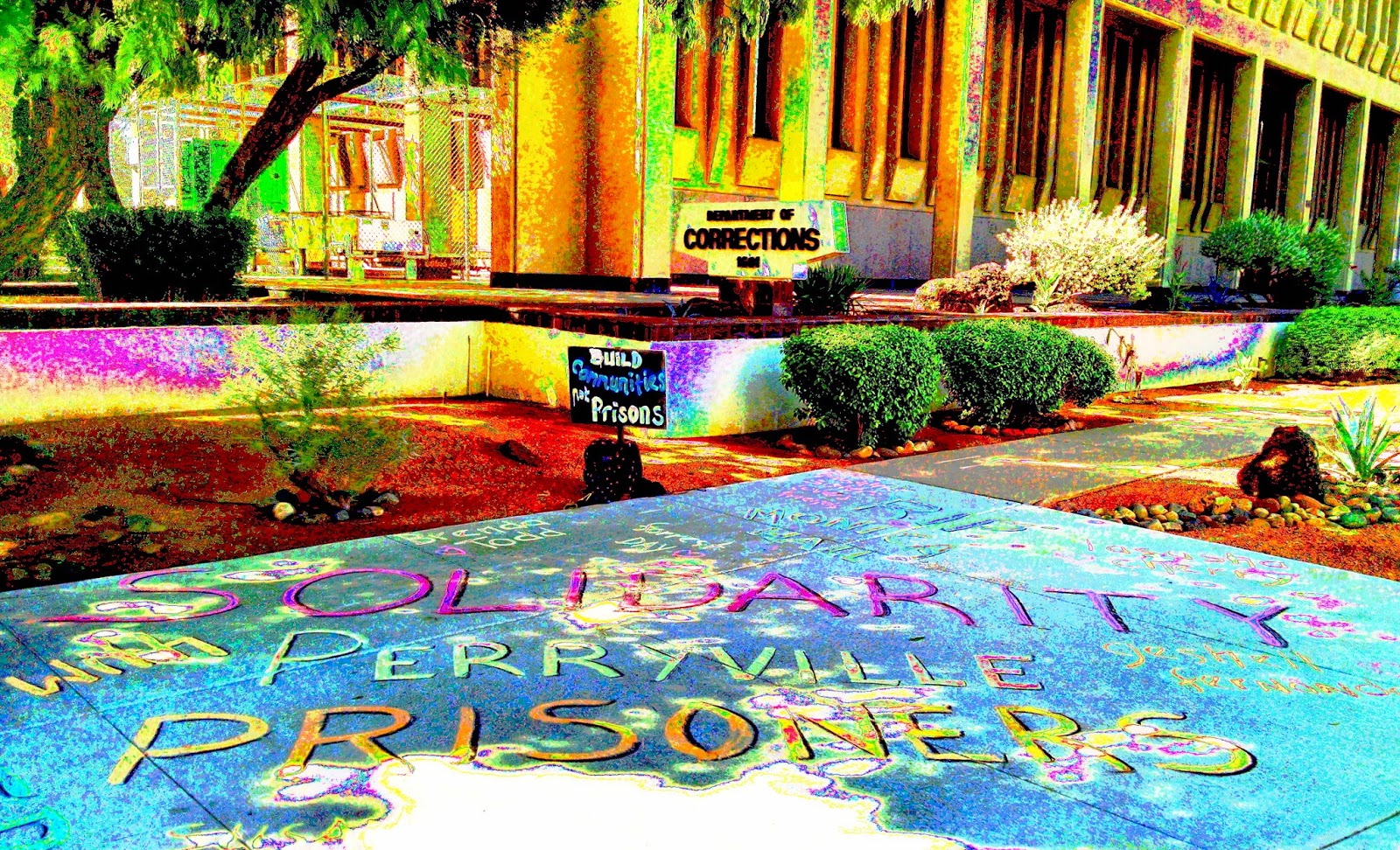
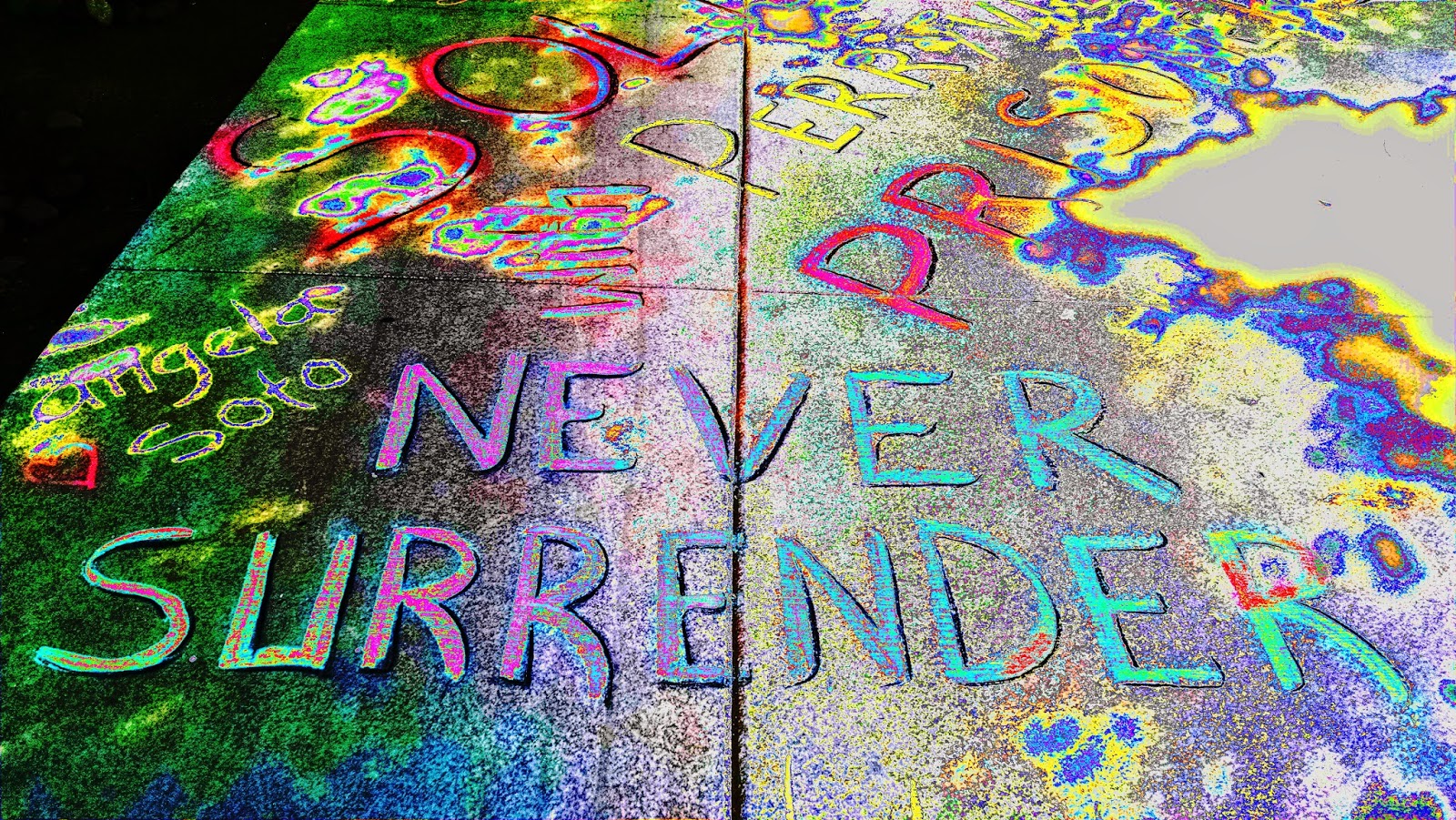
I also began to work with the survivors of prison violence, as I often heard from the loved ones of the dead, and learned their stories. During that time I memorialized the Ghosts of Jan Brewer - state prisoners under her regime who were lost to neglect, suicide or violence - across the city's sidewalks in large chalk murals. Some of that art is here.

In November 2014 I left Phoenix abruptly to care for my family. By early 2015 I was no longer keeping up this blog site, save occasional posts about a young prisoner in solitary confinement in Arpaio's jail. I'm deeply grateful to the prisoners who educated, confided in, and encouraged me throughout the years I did this work. My life has been made all the more rich and meaningful by their engagement.

I've linked to some posts about advocating for state prisoner health and safety to the right, as well as other resources for families and friends.

until all are free -

MARGARET J PLEWS (June 1, 2015)
arizonaprisonwatch@gmail.com


INDIGENOUS ACTION MEDIA

INDIGENOUS ACTION MEDIA
ANTICOLONIAL zines, stickers, actions, power

Taala Hooghan Infoshop

Kinlani/Flagstaff Mutual AID

MASS LIBERATION AZ

MASS LIBERATION AZ
The group for direct action against the prison state!

Black Lives Matter PHOENIX METRO

Black Lives Matter PHOENIX METRO
(accept no substitutions)

BLACK PHX ORGANIZING COLLECTIVE

BLACK PEOPLE's JUSTICE FUND

PHOENIX: Trans Queer Pueblo

COVID Mutual AID PHOENIX

AZ Prison Watch BLOG POSTS:


Showing posts with label Perryville. Show all posts

Tuesday, September 30, 2014

Solidarity with the women of Perryville: Never Surrender.

PRINT PRISONER COPY HERE

(EDITED/UPDATED OCTOBER 16, 2014): Thanks for your prayers, people - the prisoner whose suicide attempt prompted this post survived and has recovered enough to return to Perryville's Special Needs unit, as of Oct 14th.


Last week, a dear friend of a dear friend was reported to have ended her life on Santa Cruz yard in Perryville prison. Over the weekend I learned a little about the kind of blessing this woman has been in the lives of  her friends and fellow prisoners, and determined to do something special to help remember her by.  As of 9/29 the DOC still hadn't posted her death notice, and her record on line only showed that she was sent out  to the hospital on  9/25. Sometimes the DOC is pretty slow on those, though, and I was pretty sure of my sources. So, first thing Monday morning I hit Central Office to build a memorial for her and the other women who have died by suicide or gross neglect under the Brewer/Ryan administration. There are quite a few, some whose names and stories I don't even know. Some stories  I am all too familiar with, though, like that of the beloved Gloria Rogers, whose suffering I'll write about more in due time...


Apparently none of this woman’s friends saw a suicide attempt coming, by the way - she had just been returned to prison in August, having relapsed since her parole last year. She had just done a decade behind bars, and was now looking a six more years in prison, away from her family, as was her partner in crime. But she was tough, and seemed like she could handle it. She was certainly plagued by her addictions, but those who contacted me about her didn't know of any serious mental health history that would suggest she was at risk for this. They felt completely blindsided, and devastated. Many successful suicides occur without clear warning, though.

Out of respect for her privacy and that of her family's, I'll defer naming this good soul until she recovers enough from this trauma to give her permission or tell her story herself - or until the DOC posts a death notice, if it turns out she passes away. Until then, those of you searching for what happened to your friend on Santa Cruz last week should just keep good thoughts in your hearts for her - she may yet be holding on. And be sure to take advantage of this time of uncertainty about her fate to tell those you love how much they mean to you - especially if they are struggling now, or in exile. You never know if you'll have the opportunity to do so tomorrow.

Finally, those of you who are  struggling yourselves with thoughts of ending your life because you're in or are facing prison: chances are, there are people in your life who need you nonetheless - they need you to make it through this, or your death will haunt them forever. And there may be others down the road you can help if you can figure out how to survive your ordeal now.  So, please don't take yourself out - study your rights, and become a thorn in the DOC's side instead. Whatever you do, don't do their dirty work for them.

My apologies to the working women from Perryville who received misinformation and probably had to clean up after me. I pray I never have cause to write that name on the sidewalk again. The Ghosts of Jan Brewer number far too many already…

 
MONIdeliberateindiff2.JPG

NEW PRISONER SUPPORT RESOURCE:

Carpe Locus Collective  PO Box 7241 Tempe, AZ 85281

Helping prisoners assert their civil rights in custody, and survive their incarceration with self-help tips, copies of DOC policies and Jailhouse Lawyer Handbooks, and whatever else they can afford to mail. They meet every two weeks to answer letters.

“FREE VERSE” PO BOX 7241  Tempe, AZ 85281

The Carpe Locus Collective is also putting together a zine for distribution among prisoners, and are looking for art, poetry, essays, letters, etc. Right now they’re helping  transcribe a guide for new LGBT prisoners, written by my own correspondents as they were battling the DOC for their own survival. So think about what kind of collaboration you might want to have with these folks, and help them amplify the prisoner’s voice!


PS - TO PERRYVILLE PRISONERS: No matter who you are, or what kind of hell you’re going through, you don’t have to do it completely alone. If you need help dealing with feelings of worthlessness, hopelessness, and the thought that the world would be better off without you - or you without the rest of us, don’t surrender to your shame or your fear. Talk to someone who loves you to anchor you here, before you even think about leaving them that way.


Now, if you think you’re unloved or unlovable and have no one who cares if you live or die, go out and find someone who needs to be loved more than you do and love them as if your own life depends on it. They are probably in your life already. In short time, if you treat the rest of the people around you the same way - looking for ways to be a blessing in their lives, however small -  you’ll find that you have become a valued member of your community whose presence heals. Then, even if you expect to be buried in an orange jumpsuit someday, those feelings that nearly drove you to leave your children or sister or cellie grieving your suicide for a lifetime will no longer have room to dwell…


I promise you, that’s a much better way to be free.  

Take care of eachother, please.
                                                                                                              
   Peggy Plews
   ------------------------


If you need help dealing with your own mental health crisis or that of a loved one, THE NATIONAL SUICIDE PREVENTION LIFELINE is a free, 24/7 service that can provide suicidal persons or those around them with support, information and local resources.

800-273-TALK (8255)

Thursday, July 11, 2013

Heroes in Custody: Prisoner Wildland Firefighters.

gisela creek riverbank, AZ (march 2013)


This story below was just recently published at the Big Round Table, a worthy site for new works. "Burn" goes up here in partial tribute to those 19 Hot Shot Crew members lost by Prescott in the Yarnell Hill fire not long ago - as well as all the brothers and sisters who risk their lives fighting fires and disaster still, wading through the violence and grief of some of the worst moments of our lives. Wherever you lay your head at night, and whatever color you wear under your suit, thank you and blessings to you all. You should all be honored for your service. Here is the only remembrance the DOC has on their website...

http://www.azcorrections.gov/Memorial/History_Remembrance_Bachman.aspx

What follows is just a few excerpts of BURN - hit the Big Roundtable for the whole thing. This blogger here also has some interesting remarks about the writing of the story, from the author herself. 

Thanks for remembering these deaths in custody, Jaime, and for helping their survivors tell their stories...


------------------------------


Burn

The Big Roundtable

June 23, 2013 


"...At 12:30 in the afternoon on Monday, June 25, 1990, lightning flashed above the Tonto National Forest near Payson, Arizona, about 100 miles northeast of Phoenix. It started a fire just south of the Mogollon Rim. Within an hour, the fire had spread over five acres. By 4:15 p.m., more than 100 acres of manzanita brush, scrub oak, and old-growth ponderosa pine had been consumed in what was by then called the Dude Fire, named for Dude Creek, where the lightning had touched down and ignited the blaze. Propelled by brisk winds, the flames moved fast. Initial attack crews were called in. Helicopters dangled collapsible canvas buckets from sturdy cords and dipped them into nearby lakes and ponds to gather thousands of gallons of water and dump it on the fire. Air tankers dropped bright red slurry, a fire retardant. Neither had much effect. At 6 p.m., the U.S. Forest Service called in 18 wildland fire crews, each made up of 20 team members, from across the state and beyond, to help suppress the Dude Fire. One was a crew of inmate firefighters from the Arizona State Prison at Perryville.

Seventeen inmates from Perryville’s minimum-security San Pedro unit served on the fire crew. The men ranged in age from 22 to 39. Among them were Joseph Chacon, 25, and Curtis Springfield, 24, who had both been convicted of aggravated assault; Geoff Hatch, 27, who had been in prison since 1984, charged with theft and burglary; and James Ellis, who was 34 and serving a 20-year sentence for manslaughter. Their bosses were correctional officers Larry Terra, 30, and Sandra Bachman, 43. A third crew boss, Dave LaTour, would later arrive separately.

The inmates and staff were certified Type II wildland firefighters. Type II crews have less experience than Type I Interagency Hotshot crews, which are made up of career and part-time firefighters who live and work together throughout the fire season. The Perryville crew was trained according to standards established by the National Wildfire Coordinating Group, no differently than the civilian crews that battled forest fires throughout the West. But civilian Type II firefighters at the time earned between $7 and $8 an hour and, with overtime included, could make enough money in six months to spend the rest of the year on the beach, as some of the younger ones did.

In contrast, Perryville crew members earned between 40 and 50 cents an hour. The pay didn’t matter to them. Neither did the inherent risks of the job. Wildland firefighting is brutal, sometimes dangerous, work. Heart attacks and burnover—in which fire overcomes a crew, forcing them to take cover in portable fire shelters until the flames pass—are among the most common causes of death, the former brought on by extreme physical exertion. But the inmates weren’t focused on that. They considered it a privilege to fight fire, and a spot on the crew was coveted. Good behavior inside the prison had earned them the opportunity to get past the razor wire and the gates and the floodlights that loomed above the Perryville complex, way out there in the middle of the Sonoran Desert northwest of Phoenix.

For sure, the job beat doing other people’s laundry or slapping together bologna sandwiches in an institutional kitchen. Plus, it offered the chance to spend weeks at a time camped out in sleeping bags under the stars, with steak and pork chops for supper at the campsite. But there was something else that made the work special, as good for the soul as it was for the stomach: In prison, the men had to wear all orange, all the time. Yet dressed in the firefighting uniform—yellow flame-resistant Nomex jackets, olive green pants, lace-up leather boots, and hard hats—no one could tell that the men were prisoners. And to the people whose homes or land or lives the men saved, they weren’t felons. They were firefighters. Heroes. They commanded respect...


...“Get out!” yelled firefighter Edison Notah, of the Navajo crew.

Positioned just south of Perryville, Notah was able to see through the tree canopy. The fire was blowing up. A column of superheated clouds mixed with smoke and burning debris towered above the forest. The column was later estimated to be 40,000 feet tall and six miles wide. It collapsed when colder air suddenly burst downward, pushing the fire through the dry, dense undergrowth that choked the forest floor. Arizona was in its third year of drought, so the fuels were bone-dry. Sixty-mile-per-hour winds moved the fire over and down the ridge from the west to the east side of Walk Moore Canyon. The Perryville crew was directly in its path...


....The Navajo crew made it out. But when the fire jumped the line meant to keep it at bay, the Perryville crew was separated into two groups. Nine crew members made it to Control Road, where they climbed onto the back of a pickup truck that was waiting to get them out. The rest of them were trapped.

Eleven crew members—10 men and Bachman—turned around and ran back up the canyon, about three-tenths of a mile, away from Control Road, and deeper into the forest. A black, rolling fireball of dense smoke and superheated air barreled downhill. It looked like a monster, or a demon, some thought, and was unlike anything they’d ever seen. The fire was otherworldly. Its size and sound were terrifying. A 100-foot wall of flame rose behind the crew. It roared like a steam engine. There was nowhere to escape.

LaTour ordered the crew to deploy their fire shelters. Made of aluminum foil bonded to fiberglass cloth, these individual-size tarps are designed to both reflect and absorb high heat. Breathable air is trapped inside. The crew members had no choice but to lie beneath the shelters facedown on the forest floor. They’d been trained to slip their arms and legs into straps sewn into the corners of the tarps to hold them securely against the ground. They knew to position their feet toward the fire. They would let the flames roll over the shelters, then wait there until it was safe to come out.

Donald Love, 30, deployed his shelter first, near the dozer line. To the left of Love was Curtis Springfield. Below Love and to his right was William Davenport. One of the youngest men on the crew, Springfield also had the shortest sentence, seven and a half years on a conviction for aggravated assault, which he began serving in 1986, just two months shy of his 20th birthday.

James Denney and Bachman kept running. As they ran, Denney helped Bachman pull her shelter from her pack. It was hard to get to with leather gloves on. Denney then got into his shelter alongside Davenport and LaTour. Bachman was on the ground and in her shelter soon after, next to James Ellis, Geoff Hatch, and Alex Contreras.

About 60 feet downhill from the group, Joseph Chacon lay underneath his shelter. Greg Hoke waited out the firestorm in his shelter, 400 feet from Chacon. He’d made it the closest to Control Road. The wind was so fierce his shelter flipped over.

“We’re going to make it,” LaTour told the crew members near him. “Stay calm. Stay in your shelters. Stay on the ground.” He reminded them to keep talking to one another. “We’re Perryville. We’re tough. We’re gonna make this. We’re gonna be okay,” he heard those close to him say. During a deployment, talking is supposed to ease anxiety. But it was hard for crew members to hear one another as the fire ripped through the canyon. The flame front came in three waves, each just a few minutes apart. From inside the shelters, bright orange flames were visible through pinholes in the seams. When hot wind from one of the flame fronts lifted LaTour’s shelter, smoke and debris rushed in, and he was burned.

LaTour soon heard screams mixed with the sound of rushing wind and flame. The fire was so fast and conditions so extreme that some of the crew members weren’t secure inside the tents. When they had first spotted the fire, it was 75 feet away, at best, and that gave them just one minute to get inside their shelters before being overcome by the flames.

A hot, flaming branch fell onto Davenport’s shelter and burned his legs. Denney abandoned his shelter and ran toward Chacon, near the dozer line. Chacon pulled Denney into his shelter and tried to protect him by lying on top of him. Both were later found dead.

Ellis left his shelter. He walked to the creek bed, near Hoke, who was still tucked safely inside his tent. “I’m hurt bad,” Ellis said. “My shelter didn’t work.”

Meanwhile, Springfield’s lungs burned from inhaling hot gases and smoke. He, too, got out of his shelter. “I can’t take it anymore,” he said. He stumbled toward Love’s shelter then back to the dozer line, which is where he died..."

read the whole story here....

http://www.thebigroundtable.com/stories/burn/


Saturday, January 28, 2012

Perryville Prison Deaths in Custody: Forrest Day, 19.

 
UPDATED 2/2/2012:  

The answers to those of my questions below which can be derived from criminal and court records are in this new article by the Arizona Republic. I'm choosing not to re-print it here because the article positions Forrest's behavior problems in a way that seems to justify her being sent to prison in the first place...like she was just a "bad girl". I don't accept that premise. She acted out the way children do when troubled...and troubled children, in my book, do not belong in adult prison.

So, if you plan to contact either the judge or prosecutor in this case, do check out the AZ Republic article linked to above to see just the surface of what they were looking at, through the eyes of the criminal justice system. Before you make up your mind what to write, though, read the note below from this friend of Forrest's family as well...


  Forrest Day, at 16.


UPDATED (9/31/12): 

At the age of 16, despite being too young to be trusted to drink, drive, smoke, vote, or even get away with skipping school, Forrest Day was prosecuted as an adult for the death of her 8 month old baby. As recounted in the article below, she put her son in the bathtub then got distracted elsewhere in the house by writing poetry - behavior characteristic of a child. It's not even as if she went out partying and left him home alone, beat or shook him, or even filled up the tub.

It doesn't appear that Forrest was even accused of intending to hurt her child. You don't have to will a person harm in order to be charged with negligent homicide, of course, though I suspect they hit her so hard to begin with in order to coerce her into a plea deal on the felony child abuse charges - which I also think were a stretch in this circumstance. 

This case may not be entirely a matter of Andrew Thomas' office overreaching again, though. It looks like the state law requires prosecutors to file charges in adult court when certain felonies and violent crimes are involved - when that happens, though, it appears as if that court then has discretion over where the case is heard.

In any event, Forrest's prosecutor was Suzanne E. Cohen. Her office with the Maricopa County Attorney is at: 301 W. Jefferson St., Phoenix, AZ 85003. She's just applied to be nominated as a judge, so this would be a good time to write to her about her take on charging children like Forrest as adults (according to the DOJ's research, it doesn't reduce crime). She just helped prosecute the Baseline Killer and got a few death sentences, so there's a good chance she could end up on the Superior Court bench in the next couple of years. 


Forrest was sentenced to probation, and then to prison, by Michael Kemp, a judge from Juvenile Court. I can't tell from the records who actually made the decision to let the state prosecute her as an adult, though. If you have questions about why he did what he did and what he thinks about charging children like her as adults - kids with no criminal record or intent - direct them to him. He can be reached at:
 
Northwest Regional Center (NW)
14264 W. Tierra Buena Lane
Surprise, AZ. 85374
(602) 372-9400


Within less than 6 months of being charged, facing decades in prison if convicted on both counts, Forrest pled guilty to class 3 felony child abuse. Here's the news article on her plea. In return, the state dropped the homicide charges and she was sentenced to 7 years of probation; upon entering her plea she was sent home with her parents and essentially ordered, ironically, to resume the life of a "normal" teenager. 


For those of you who have never been on probation or parole, it's not as easy as you may think to abide by. Forrest violated hers within a year, just before her 18th birthday. I don't know what she did to get into trouble with the court - she apparently wasn't charged with a new crime. She did get pregnant again, though, and wanted to keep her unborn daughter - forbidden by the judge. She was only allowed to see her at the hospital once she was born.

Forrest was committed to the custody of the AZ Department of Corrections on November 10, 2010, soon after having her second child. For breaking her probation, Kemp gave her 3 1/2 years in state prison on the original child abuse conviction. For neglecting her child at the age of 16, the rest of us condemned her to live - and die - with the guilt and stigma of killing her son as if she had intended to. We just can't seem to dole out enough punishment in Arizona to satisfy the electorate here, and it looks like we're letting the legislature get away with refusing to address sentencing reform again this session, so we do share some responsibility here...


Sadly, Forrest committed suicide on January 27, 2012 at Perryville Prison on the maximum security yard, Lumley. She was only 19 years old. Hers was one of three prison suicides last week, in fact; she was the youngest. Our condolences go out to Forrest's parents and other loved ones. I can't think of anything more devastating than surviving the loss of one's child.

This weekend a friend of Forrest's family left a comment at the bottom of another post, speaking to the beautiful soul she knew her to be, that is better placed here: 


-------------from Arizona Prison Watch--------------


Tina Schwindt has left a new comment on your post "Criminal Damage and Deaths in Custody: Letter to t...":

"I am a close personal friend of the Day family and I want to thank you for trying to bring this tragedy to the people's attention. Forrest wasn't a bad person, she had a lapse in judgement, just like millions of other 16 year old kids do every day. She was funny, kind, loving, artistic and so much more. I believe that the state wanted to use her as an example to other young mothers and it backfired horribly. This young girl never should have been put behind bars in an adult prison with the women who actually committed murder freely and willingly. She did not take her babies life intentionally, it was just a horrible accident. 

Accidents happen every day to a multitude of people, for instance the mother whose 2 year old baby got out of the house 4 years ago and tumble onto Thomas road and was hit and killed by a car. The mother had several children and didn't notice the baby gone until it was too late, but she never got charged for any crime. 

I want people everywhere to know that Forrest was an amazing young woman who wanted to go to culinary school to make her life better, but she will never get that opportunity now. I also wanted to say that Forrest gave birth to a beautiful baby girl right before she was incarcerated and the baby is the spitting image of her mommy. The family has custody of the baby, and I can only imagine that they feel very blessed by this wonder born from tragedy. Thank you so much for letting me speak my mind. You are doing a wonderful thing here!"


----------from the Arizona Republic archives (2009)--------
 

Police: Teen mom was writing poem when baby drowned


A 16-year-old Avondale girl facing felony child abuse and negligent homicide charges was distracted by writing poetry while her 8-month-old son drowned in the bathtub, according to a police report.


Forrest Day, pleaded not guilty at her arraignment Wednesday, following her indictment on April 23. Day will be tried as an adult and is due back in court June 18.


Day's son, Elijah James Day, drowned about 3:30 p.m. Feb. 21 after she set him down in the bathtub, turned the water on with the drain unplugged and left the room, according to the Avondale police report.


Day told investigators she was looking for a towel but got sidetracked with poems she was writing, the report states. After checking on Elijah after about five minutes, she said she went into her bedroom, saw her poetry book and started reading some old poems. She said she was gone for about 20 minutes this time.


Day said she went from her room to the living room, to her sister's room, and then outside on the back porch trying to find a quiet place to write. She eventually went into her parents' bedroom and closed the door behind her, according to police documents.


Day's 9-year-old brother and his friend were playing video games in the living room when the friend heard the water running in the bathroom and told her brother. Her brother went to the bathroom and found Elijah floating face down in the water.


He pulled him out of the water and yelled for his sister, the report says. Day tried CPR but when it didn't work, she took him across the street to a neighbor's house. The neighbor called police and administered CPR until police arrived.


Elijah was unresponsive to attempts to revive him, according to the report. He was airlifted to St. Joseph's Hospital and Medical Center in Phoenix, where he was pronounced dead at 4:36 p.m.


Day was "hysterical and crying," the report states. She told police she gave Elijah a bath almost daily but this was the first time she left him alone in the bathtub.


She faces one count of Class 2 felony child abuse, a dangerous crime against children; and one count of negligent homicide, a Class 4 felony.


Sunday, August 21, 2011

AZ Republic: GEO Group Goodyear Public Hearing

---------from the Arizona Republic--------


Prison proposal for Goodyear draws fire
Geo Group Inc.'s plan to construct a private facility spurs opposition

Bob Ortega
Arizona Republic
August 11, 2011


Geo Group Inc.'s proposal to build a 2,000- to 5,000-bed private prison in Goodyear ran into fierce public opposition Wednesday, with much of the anger at a public hearing coming from residents who said the state has broken a promise made at the time the nearby Perryville state prison was built.

Geo tried to head off criticism, saying its prison would be built to far higher security standards than the state requires, with several extra layers of fencing and security devices and with more staff.

Company CEO George Zoley also stressed the economic benefits of adding up to 1,000 construction jobs and up to 1,100 permanent jobs if the largest alternative were selected.

But despite giving a far more detailed presentation than rival bidder Corrections Corp. of America provided at a hearing in Eloy one night before, Geo Group ran into a buzz saw.

Litchfield Park Mayor Thomas Schoaf, in a statement read by City Manager Darryl Crossman, called the proposal "a slap in the face to our residents," a direct threat to the public safety of the area "and a threat to the public welfare of our communities."

Schoaf, in an argument echoed by others, said that when the state built the Perryville prison in 1980, the Legislature overcame local opposition by promising to limit the facility to 1,400 minimum-security women prisoners.

But by 1989, the state began sending male, higher-security inmates there. Perryville now houses just under 3,500 inmates.

Schoaf called a further prison expansion preposterous.

"I'm the guy who founded this company in 1984 . . . and I'm accountable to you," Zoley promised at the hearing.

But when he declined to answer a question about the ratio of correctional officers to prisoners, Dianne Post, the NAACP's Maricopa County representative, argued, "He says, 'I'm accountable to you.' How? He won't tell us his staff ratio. They're not accountable."

Other speakers alternated between those in construction - "We all need jobs, we need jobs in this area," said John Coffman - and those peppering the company with questions, criticizing its record and political donations, or arguing, as Goodyear resident Barb Julien said, "If this area had a Scottsdale ZIP code, we wouldn't be holding this meeting tonight."

Geo., based in Boca Raton, Fla., is a publicly traded company with about 78,000 beds in 116 corrections and treatment facilities in the U.S. and three other countries. It recently bought a company that uses ankle-bracelet tracking devices to monitor about 60,000 probationers and parolees.

Geo operates three prisons under contract with the Arizona Department of Corrections: Phoenix West, a minimum-custody prison that can hold 495 inmates; Florence West, which can hold 750 inmates; and the Central Arizona Correctional Facility, also in Florence, which can hold 1,280 sex offenders.

In addition to the Goodyear proposal, Geo is proposing an alternative plan to provide 2,000 or 3,000 beds in San Luis, southwest of Yuma.

Wednesday's hearing was the second of five being held this week and next over proposals by Geo, CCA, Management and Training Corp. and LaSalle Southwest Corrections. The hearings continue today in Winslow and next week in San Luis and Coolidge.


Wednesday, June 29, 2011

Wal Mart, Women's Resistance, and Martori Farms


I've posted here and there already about Martori Farms and the news I was receiving from Perryville prisoners regarding the work conditions, but Vikki Law managed to unpack it, put it all into the larger context of women's resistance, and make sense of the women's complaints in a way I hadn't quite been able to. So, for those of you interested in the Martori Farms prison labor situation here in Aguila, Arizona, this is the best summary we have of it.

If you're interested in doing some organizing around these issues, please contact Vikki Law, as she's picking up the slack on this while I'm out with family matters. Vikki compiles the zine Tenacious for women prisoners, and can be reached at:


Victoria Law

PO Box 20388
Tompkins Square Station
New York, NY 10009

or e-mail: vikkimL@yahoo.com

She's on-line at her blog: Resistance Behind Bars, and you can order her book about women's resistance to the prison industrial complex through PM Press. Thanks again for this, Vikki...and to Truth-out for putting it up there.

------------------------

Martori Farms: Abusive Conditions at a Key Wal-Mart Supplier

Friday 24 June 2011
by: Victoria Law
Truthout | News Analysis

(Photo: Walmart / Flickr)

In 1954, an 18-year-old black woman named Eleanor Rush was incarcerated at the state women's prison. She was placed in solitary confinement for six days.

On the seventh day, Rush was not fed for over 16 hours. After 16 hours, she began yelling that she was hungry and wanted food. In response, the guards bound and gagged her, dislocating her neck in the process.

Half an hour later, Rush was dead.

The next morning, when the other women in the prison gathered in the yard, another woman in the solitary confinement unit yelled the news about Rush's death from her window. The women in the yard surrounded the staff members supervising their activities and demanded answers about Rush's death. When they didn't get them, the women - both the black and the white women - rioted.

The riot lasted three and a half hours, not stopping until Raleigh, North Carolina, police and guards from the men's Central Prison arrived.

The women's riot brought outside attention to Rush's death. As a result:

  • The State Bureau of Investigation ordered a probe into Rush's death rather than believing the prison's explanation that Rush had dislocated her own neck and committed suicide.
  • Until that point, nothing in the prison rules explicitly prohibited the use of improvised gags. After the riot and probe, the State Prisons director explicitly banned the use of gags and iron claws (metal handcuffs that can squeeze tightly).
  • The prison administration was required to pay $3,000 to Rush's mother. At that time, $3,000 was more than half the yearly salary of the prison warden.
  • The prison warden, who had allowed Rush to be bound and gagged, was replaced by Elizabeth McCubbin, the executive director of the Family and Children's Service Agency. Her hiring indicated a shift from a punitive model toward a more social service/social work orientation.

The women themselves testified that they had rioted to ensure that Rush's death was not dismissed and that the circumstances would not be repeated.

Fifty-five years after Rush was killed in solitary confinement, Marcia Powell, a mentally ill 48-year-old woman incarcerated at the Perryville Unit in Arizona, died. The Arizona Department of Corrections (ADC) has more than 600 of these outdoor cages where prisoners are placed to confine or restrict their movement or to hold them while awaiting medical appointments, work, education, or treatment programs. On May 20, 2009, the temperature was 107 degrees. Powell was placed in an unshaded cage in the prison yard. Although prison policy states that "water shall be continuously available" to caged prisoners and that they should be in the cage for "no more than two consecutive hours," guards continually denied her water and kept her in the cage for four hours. Powell collapsed of heat stroke, was sent to West Valley Hospital where ADC Director Charles Ryan took her off life support hours later.

The ensuing media attention over Powell's death caused the ADC to temporarily suspend using these cages. Once the media attention faded, the ADC lifted the suspension.(1)


Abuses at Perryville have continued. The ADC has sent its prisoners to work for private agricultural businesses for almost 20 years.(2) The farm pays its imprisoned laborers two dollars per hour, not including the travel time to and from the farm. Women on the Perryville Unit are assigned to Martori Farms, an Arizona farm corporation that supplies fresh fruits and vegetables to vendors across the United States (Martori is the exclusive supplier to Wal-Mart's 2,470 Supercenter and Neighborhood Market stores).(3) According to one woman who worked on the farm crews:

They wake us up between 2:30 and three AM and KICK US OUT of our housing unit by 3:30AM. We get fed at four AM. Our work supervisors show up between 5AM and 8AM. Then it's an hour to a one and a half hour drive to the job site. Then we work eight hours regardless of conditions .... We work in the fields hoeing weeds and thinning plants ... Currently we are forced to work in the blazing sun for eight hours. We run out of water several times a day. We ran out of sunscreen several times a week. They don't check medical backgrounds or ages before they pull women for these jobs. Many of us cannot do it! If we stop working and sit on the bus or even just take an unauthorized break we get a MAJOR ticket which takes away our "good time"!!!

We are told we get "two" 15 min breaks and a half hour lunch like a normal job but it's more like 10 minutes and 20 minutes. They constantly yell at us we are too slow and to speed up because we are costing $150 an acre in labor and that's not acceptable.

The place is infested with spiders of all types, scorpions, snakes and blood suckers. And bees because they harvest them. On my crew alone, there are four women with bee allergies, but they don't care!! There are NO epinephrine pens on site to SAVE them if stung.

There's no anti venom available for snake bites and they want us to use Windex (yes glass cleaner) for scorpion stings!! INSANITY!!! They are denying us medical care here.(4)

Although Martori Farms contracts with the local fire departments to provide medical attention for injuries on the farm, farm supervisors do not always allow women to stop work when they need medical care. When "N" complained of chest pains, the farm representative refused to allow her to stop working. The next day, an hour after returning to work, she began experiencing chest pains. The farm representative told her, "Come on, the big bosses are here. You'll be in trouble if you stop. It's not break time. Work, work, work." "N" complied, working while in pain, until the break. She resumed working for another half hour before she experienced even more severe pains: "I have a steady deep dull pain with sharp stabbing pains periodically ... Then all of a sudden, I can't even lift the hoe in the air. My arms are no longer strong enough. By now, the chest pains are so bad it's knocking the wind out of me. I'm straight seeing stars. I tell our substitute boss officer Sanders I can't do it no more. I'm having really bad chest pains. I can't even lift the hoe anymore." The man accused her of faking these pains, but allowed her to stop working. While the woman was receiving medical attention, another farm representative stated, "Oh, so now they're gonna start faking fucking heart attacks to not work. Great."(5)

In addition, the prison has sent women to work on the farms regardless of their medical conditions. "N" was sent to West Valley Hospital where an emergency room doctor ordered that she be exempt from the farm work crew and any other physical exertion for three to four days. However, when "N" was returned to the prison, the nurse told her that they could not honor the doctor's order and ordered her back to work.

Another woman concurs. "There was one woman that is on oxygen, in a wheelchair, has an IV line and cancer that they sent to the gate to work on the farm ... The captain asked if she could stand. She said yes. His reply was if you can stand, you can farm. She told him no and was issued a disciplinary ticket."(6)

The women have not accepted these abuses quietly. They have launched complaints to prison administrators:

"Women have made their complaints on inmate letters and verbally to the lieutenant, sergeant, captains, deputy warden, counselors, supervisors and the major. Their solution was to give us an extra sack lunch and agree to feed us breakfast Saturday mornings. UGH!! Really ... food is not what we were asking for. Though being fed on Saturdays is nice. Yah! They were not feeding us Saturdays because that's a day Kitchen opens late because they give brunch on weekends. No lunch, so we were getting screwed! But as of this past Saturday they said they would feed us before work! Let's see how long it lasts."

Women have also stood up to unfair demands from the bosses at the farm. One woman recounted:

On Wednesday I go to work ... it's the second day in a row we are doing weeds. [I'm] up to my chest trying to weed to save a minimal amount of watermelon plants. Needless to say, the work was excessively hard - to put it mildly. So I must confess the day before I was "on one," so to speak. My haunted mind was lost in the past and so I was just trucking through the weeds, plowing them down, not even connecting with my physical exertion and pain. So the next day I was completely exhausted and physically broke down!! I was in so much pain because the day before I did like double the work everyone else did. So anyways, the M Farm representative was pushing me so hard trying to get me to produce the same results as the day before ... [He] has everyone at minimum teamed up helping each other plow through these weeds. Well everyone but me that is. I repeatedly asked him to give me a partner. I kept telling him that I was in pain. I also went as far as to tell him that I don't think I can do this anymore, to PLEASE give me a partner also. His response was "No. You're strong. You can do it by yourself." I told him not true; I over-exerted myself yesterday because I was going through some things. Now I'm hurt and need help.... He thought my pleas were funny. I hated to degrade myself and plea so I stopped and continued.

After "N" had finished her assigned row, the farm representative demanded that she finish weeding two other rows that had been abandoned. When she again requested a weeding partner, stating that she was in pain, the representative replied, "When you get to the end, I'll think about it."

By this time, all the girls are finishing their rows because they're all teamed up with 2 or three girls per row. Except me. So there are only two whole rows left on the field by now and he already placed six girls per row. That's twelve women on two rows. And I can't even get one helper. That's RIDICULOUS ... I tell him "Mariano all joking aside, all the others are finishing. Can I please get a helper?" He tells me "Seriously, no joking. When you get to the end, I'll think about it." At that point I'm pretty upset and broke down. I looked at him and said "Is that right?" I paused staring at him waiting for him to stop his male chauvinist domination games or whatever he's playing. When he didn't say anything, but just stared. I told him, "Fine Mariano I'm done. I can't do this anymore. I'm hurt and struggling through this. After what happened to me before I would think you would provide me help when I need it. Since you won't look out for my health and well-being, I will. Someone has to. I'm done for today. I'm going to sit on the bus."

The supervisor demanded that she return to work, threatening to call the prison to have disciplinary tickets written up. She refused.

At this point I'm so angry that this jerk would make me lose everything because I'm not submissive and I don't obey him like the women back in Mexico do that I admit I blew up and acted unprofessional. I told him "Mariano, Fuck you and your tickets. Go write them if you want. In fact I'll write them for you to make sure you get the facts straight."...

At this point the two women who were on the bus got all riled up and were yelling, "That's not fair. She's your best worker and you're going to punish her with tickets!!!" "She's hurt I heard her asking for help all day!" "We've been sitting on the bus for over an hour and we're not getting tickets, why is she the only one getting a ticket?"(7)

Not only did "N" stand up for herself, but the other women defended her actions at the risk of being ticketed as well. Their combined efforts ensured that "N" was not issued a ticket in retaliation for standing up for herself.

Women have also alerted outside advocates and activists about these inhumane conditions, again at great risk to themselves. If not for their courage in speaking out, the outside world would remain unaware of the exploitation and abuse on the farm.

While the women both endure and challenge these abuses, those outside prison gates remain largely unaware of their struggles. Those involved in social justice organizing need to recognize that prisons and prison injustices are exacerbations of the same social issues in the outside world and recognize that these struggles intersect. Safe from the retaliation of prison authorities, outside organizers and activists can and should raise their voices and take action to help the women inside challenge and ultimately stop these abuses.

Footnotes:

1. As of April 15, 2010, these cages (or "temporary holding enclosures") remain in use. Arizona Department of Corrections, Department Order Manual, Department Order 704: Inmate Regulations.

2. Nicole Hill, "With Fewer Migrant Workers, Farmers Turn to Prison Labor," Christian Science Monitor, August 22, 2007. Reprinted here.

3. Press release, "16-Year Relationship Between Wal-Mart and Arizona Business Grows, Thrives," September 7, 2007. The 2470 figure is as of August 1, 2007.

4. Letter from "N," dated April 24, 2011.

5. Letter from "N," dated April 24, 2011

6. Letter from "H," dated May 22, 2011.

7. Letter from "N," dated May 7, 2011.

Wednesday, June 22, 2011

Sad Solstice: Remembering Brenda Todd

Six months ago this week, on January 21, 2011, Brenda Todd died in Perryville state prison begging for medical attention that never came. That's part of a twisted pattern of neglect and gross indifference to human life at the AZ Department of Corrections - particularly at the AZ state women's prison.

Urged on by prisoners who were there when she died, we tracked down Brenda's father to make sure that her family members know to file suit because of the circumstances, though I don't know if he's in time to file a Notice of Claim against the state - there's generally a six-month deadline for grieving families to be on top of (and no one ever tells them that). I referred him to a good attorney who will find out, no doubt.

Brenda's dad isn't on-line and the family never saw the Phoenix New Times story or my blog posts about how she died - or all the letters we received from the other women about what happened - and the State only notified him last week that the death certificate is ready, so I think the courts should grant him an extens
ion to file. He had no way of knowing that her death was wrongful until now. It goes beyond simple negligence.

The family can still file suit in federal court, however, I believe under civil rights law. There's a two-year deadline for prisoners to file Section 1983 CR suits, at least, so survivors of prison violence who have missed filing deadlines for the state should still speak to an attorney as soon as possible. Do NOT wait for or trust the AZ Department of Corrections or the AZ Attorney General's office to give you timely, accurate information about your loved one's death - they're just trying to avoid your lawsuits. Unfortunately, it seems the only way they change is when someone wins in court - and we need to stop them from killing these women now, so please exercise all your rights to fight back.

Our condolences go out to all of Brenda's loved ones. Feel free to contact me (Peggy at 480-580-6807) if there's anything I might be able to do. If nothing else, I can put you in touch with other families who share your struggle - just let me know.


June 23, 2011: CORRECTION:

It's only been five months since Brenda died. That means that - thanks to my friend Matt's work - we're in time to help her family with a claim against the state. Unfortunately, litigation seems to be the only thing that makes them clean up the prisons, and Brenda's family has one hell of a suit...she could end up sparing a lot of other women from the hell she went through. From what I've been told, she'd probably give her blessings to that struggle
...


Thursday, March 31, 2011

Wrongful Deaths in Custody: Susan Lopez (ADC)

(UPDATED from March 29, 2011 post.)

As noted in the last post, a prisoner at ASPC-Perryville killed herself last week. Below is the notice of
35 year-old Susan Lopez' death from the AZ Department of Corrections. What follows is what some of the other prisoners had to say about her suicide. If you are a loved one of Susan's, please brace yourself. I'm sorry if this post is painful, but the public needs to know what's happening behind bars in this state, or more vulnerable people will die needlessly.

Susan was a mother of four children,
and was apparently a Certified Nurses' Aide. By the number of people landing on my site Googling her this week, I'd say she was probably well-loved by people in her community, even though she was ignored by her caretakers in prison, where she was sent for non-violent crimes. Her history suggests that her criminal activity may have been related to the disease of addiction. Most addicts in America never acquire a record for it; many get medical treatment for their illness or join a 12-step program and give a tremendous amount back to their communities. The ones who get criminalized before they get well are less fortunate, not less worthy of recovery, and their lives are often shredded by the excess branding, shaming, exiling, and impoverishment that results from initiating criminal prosecution. It can be completely devastating.

A few extraordinary souls pick themselves up after prison and make good anyway - we like to use them as proof that incarceration itself can "help" people get back on their feet. They are the exception to the rule, however, and it's what they already have within them - not some magic instilled by going to prison itself - that gets them through hell and back in one piece, if they make it. Once caught up in the machinery of "justice", though, too many just never break free. The criminal justice system is designed to extort us and exploit our troubles, not assist us, if we're in the shoes of the accused - guilty or not. Once law enforcement is on the scene we have no control over how it plays out from there; cops have been known to kill people who are suicidal, and courts here routinely hold mentally incompetent defendants criminally culpable for the symptoms of their mental illness.

There are no easy answers for addiction, of course; the ones out there are really as diverse as the population of addicts. I've seen courts be far too quick to take a one-size-fits-all approach and send people off to prison because AA didn't fit them and they screwed up their probation or couldn't pay off their restitution in time. A lot of folks think that the state is actually benevolent and calling the police on a loved one who's addicted might help speed along their recovery process by raising the bottom they have to hit before committing themselves to breaking the cycle, but that's especially misguided because of what I just described. I would only resort to such drastic action today if it was the only way to protect someone's life or limb in a crisis.

Most addicts who land in prison are admittedly there for crimes supporting their habits, too, like theft or fraud. That doesn't make them dangerous, though, or justify the violence of imposing imprisonment on them at outrageous public expense - especially while simultaneously refusing to cover treatment services for them to get well. Once you're a criminal, however, every relapse - which is "part of recovery" for the rest of us - is a potential parole violation or a new charge as a "repeat offender", and as your record gets longer judges get less sympathetic...

All of which appears to have happened to Susan.

Susan's guilty plea is on the internet; the sentencing minutes should be updated and posted soon. Her Graham County sentence is what's in question; that's the one that hasn't been posted as of yet. You can check current court records by searching her name with her month and year of birth (June 1975). She had a whole lot of petty stuff pile up on her in several different counties at once - apparently accumulating over several years then catching up to her once she was in custody.

I think if all her charges were in one county, she would have had more dismissed in a plea agreement; the poor woman was just pounded by court appearances this winter. By the looks of it, the respective county attorneys filed every single charge they possibly could to intimidate her into the deals she entered: she could have been facing the rest of her life in prison for forgery-related crimes if she lost at trial. They really do hurt people who resist them: I know one fellow doing 52 years for fraudulent schemes (largely because he accused the prosecution and judiciary of racism then lost in court).

I find it astounding that the judges who sent this mother off to prison were prepared to expend anywhere from $60,000 to over $120,000 in public funds just to punish her - that's what really seems criminal. Our legislature is equally as complicit. It's unbelievable that given such an investment no one could even bother to sit down to help Susan figure out how long she would be locked up and away from her family. There are sources of possible confusion evident in Susan's posted ADC records - her death notice lists her as being 40 though she was born in 1975, and her obituary indicates a different middle name than her court and ADC records. All the court documents indicate it's the same Susan, though. How hard could it have been to help her sort this out and cope with it? A little bit of attention could have saved her life.

Unfortunately, the nightmare that unfolded for Susan immediately prior to her suicide seems to be the standard MO at the Arizona Department of Corrections, though I've had some good experiences with at least one CO at ASPC-Tucson, and I know there are other exceptions - like former ASPC-Eyman DW Carl Toersbijns. It's not the individual CO's so much anyway - it's the staffing schedules, inadequate training, and an abusive institutional culture that results in deaths like Marcia Powell's, Brenda Todd's, and Susan's. There isn't the expectation that officers respond with compassion to prisoners, of course - they're all just criminals trying to manipulate them because that's what they do best.

If ADC policies and culture reflected a fundamental value for human rights, there would be less abusive and negligent conduct by employees. The leadership makes their disdain for their prisoners clear to all, however, and throws criminals on the legislature's alter for live sacrifices to offer their constituents without thought for the consequences of new fees and restrictions for prisoners and their families - who are also taxpaying constituents, I might add. The description of the main officer who ignored Susan's pleas for help is consistent with what I would expect from the current ADC, sadly.

At most the officer(s) involved might get written up - unless this becomes a politically charged case, and the ADC decides to sacrifice the officer to minimize the appearance of institutional negligence, as was alleged by CO's over the death of Marcia Powell. The pattern and practice of ignoring women begging for help in AZ state prisons is unlikely to change any time soon, then - not without serious litigation, anyway. The state is far more concerned with avoiding liability than it is with taking responsibility, despite the moralistic garbage it shoves down prisoners' throats about why they must be brutalized the rest of their lives for the smallest of crimes.


To Susan's family, on that note: take your time grieving, but file a notice of claim against the state within six months for each survivor, or you'll be precluded from suing in state court in the future. The ADC needs to be held responsible for their neglect; so many women out there are still suffering, and have no other hope for relief. I'll do what I can to put survivors in touch with attorneys who can help file claims for wrongful deaths - there are far too many happening like this. I'll also do what I can to help you compile evidence; that's what I've been doing in these blogs for nearly two years now.

My number is 480-580-6807; my email is prisonabolitionist@gmail.com; my name is Peggy. My office is at 1009 N. 1st St. #8, Phoenix, next to the Firehouse Gallery. Contact me anytime.


Anyone can contact the US Department of Justice to complain about all the prison suicides under Brewer, by the way. Ask for a CRIPA Investigation into the AZ Department of Corrections.


The address is:

Jonathan Smith, Chief

US DOJ Civil Rights Division,
Special Litigation Section


950 Pennsylvania Ave. NW, PHB

Washington, DC 20530


SOS DOJ: CRIPA Arizona.

Dodge Theater, Phoenix, AZ.

Halloween Night, 2010.


-------from the AZ Department of Corrections' website (posted 3/30/2011)-----


ARIZONA DEPARTMENT OF CORRECTIONS
1601 W. JEFFERSON
PHOENIX, ARIZONA 85007
(602) 542-3133
www.azcorrections.gov


JANICE K. BREWER, GOVERNOR CHARLES L. RYAN, DIRECTOR


NEWS RELEASE
For Immediate Release


For more information contact:
Barrett Marson
bmarson@azcorrections.gov
Bill Lamoreaux
blamorea@azcorrections.gov

March 28, 2011 Inmate Death Notification

Phoenix, Az. – Inmate Susan Lopez, 40, ADC #184221, died Friday night from an apparent suicide.

Lopez, sentenced out of Cochise and Graham County, was serving 6 years for forgery. She came to ADC Dec. 2, 2010 and was held at the Santa Cruz Unit, ASPC-Perryville.

The death is under investigation by the department.


-----via personal email, March 26, 2011 re: suicide on Santa Cruz-----


"Perryville - 16 yard: Inmate 184221 LOPEZ Susan died last night by hanging. Was told she was a low risk inmate who was put in 16 yard after returning from going to court.

She had just been brought back to from court where she was sentenced to 3 years concurrent on a charge but the counselor told her the computer said she got 6 years-consecutive. She begged for help and was ignored. Her counselor did nothing to try to get that corrected and would not allow her to talk to anyone about it.

She had been seeking help for several days and begged for help. The counselor did nothing. She asked for help from other officers.

Her husband called to say their daughter was having surgery in the hospital - a family emergency. She tried to get the counselor to let her call home on this emergency. He would not help her."


----received from ASPC-Perryville/Santa Cruz via US Mail on March 30, 2011 (dated 3/28/2011)-----


We must do everything we can to keep this from happening again.


Tuesday, March 29, 2011

Perryville prisoner suicide: March 2011.

SOS DOJ: CRIPA AZ.
Sandra Day O'Connor Federal Court House.
November 14, 2010.


***UPDATED MARCH, 2011 at:

http://arizonaprisonwatch.blogspot.com/2011/03/deaths-in-custody-susan-lopez-adc.html


Another prisoner hung herself out at Perryville last Friday. The department has yet to put up the notice that she even died, for some reason, so I'll wait for them to release her name. I'm guessing they're either still notifying next-of-kin or trying to do some kind of damage control. A lot of people have been Googling her name and poking around my site for news of her, though, so I hope the state puts out the information soon. Once they do, I'll post the notice and fill in the blanks with what little I've been told; it was another case of people just not listening to the distress of prisoners.


I hope the ADC has learned that they need to do critical incident debriefing with affected prisoners or there'll be another suicide out there within a short time; their policies just suggest that they offer counseling to prisoners who ask for it; staff get the debriefing. There have been at least two suicides in the past seven months that were precipitated by another prisoner killing themselves on the same yard: Lasasha Cherry was preceded by Geshell Fernandez at Perryville/Lumley, and Duron Cunningham killed himself at Florence/Central just a week after Rosario Rodriguez-Bojorquez. Both might have been prevented by an intervention after the first suicide.

Just so folks know, if you have a loved one who has killed themselves or been murdered in Arizona's prisons, the best thing you can do to reduce the risk of it happening to the next person's loved one is to hold the state responsible in civil court. Sue them. Survivors must file a notice of claim within six months to take action in state court; don't wait until the last minute.

Contact me at 480-580-6807 if you need help finding an attorney.