Retiring Arizona Prison Watch...


This site was originally started in July 2009 as an independent endeavor to monitor conditions in Arizona's criminal justice system, as well as offer some critical analysis of the prison industrial complex from a prison abolitionist/anarchist's perspective. It was begun in the aftermath of the death of Marcia Powell, a 48 year old AZ state prisoner who was left in an outdoor cage in the desert sun for over four hours while on a 10-minute suicide watch. That was at ASPC-Perryville, in Goodyear, AZ, in May 2009.

Marcia, a seriously mentally ill woman with a meth habit sentenced to the minimum mandatory 27 months in prison for prostitution was already deemed by society as disposable. She was therefore easily ignored by numerous prison officers as she pleaded for water and relief from the sun for four hours. She was ultimately found collapsed in her own feces, with second degree burns on her body, her organs failing, and her body exceeding the 108 degrees the thermometer would record. 16 officers and staff were disciplined for her death, but no one was ever prosecuted for her homicide. Her story is here.

Marcia's death and this blog compelled me to work for the next 5 1/2 years to document and challenge the prison industrial complex in AZ, most specifically as manifested in the Arizona Department of Corrections. I corresponded with over 1,000 prisoners in that time, as well as many of their loved ones, offering all what resources I could find for fighting the AZ DOC themselves - most regarding their health or matters of personal safety.

I also began to work with the survivors of prison violence, as I often heard from the loved ones of the dead, and learned their stories. During that time I memorialized the Ghosts of Jan Brewer - state prisoners under her regime who were lost to neglect, suicide or violence - across the city's sidewalks in large chalk murals. Some of that art is here.

In November 2014 I left Phoenix abruptly to care for my family. By early 2015 I was no longer keeping up this blog site, save occasional posts about a young prisoner in solitary confinement in Arpaio's jail. I'm deeply grateful to the prisoners who educated, confided in, and encouraged me throughout the years I did this work. My life has been made all the more rich and meaningful by their engagement.

I've linked to some posts about advocating for state prisoner health and safety to the right, as well as other resources for families and friends.

until all are free -

MARGARET J PLEWS (June 1, 2015)
arizonaprisonwatch@gmail.com


INDIGENOUS ACTION MEDIA

INDIGENOUS ACTION MEDIA
ANTICOLONIAL zines, stickers, actions, power

Taala Hooghan Infoshop

Kinlani/Flagstaff Mutual AID

MASS LIBERATION AZ

MASS LIBERATION AZ
The group for direct action against the prison state!

Black Lives Matter PHOENIX METRO

Black Lives Matter PHOENIX METRO
(accept no substitutions)

BLACK PHX ORGANIZING COLLECTIVE

BLACK PEOPLE's JUSTICE FUND

PHOENIX: Trans Queer Pueblo

COVID Mutual AID PHOENIX

AZ Prison Watch BLOG POSTS:


Showing posts with label medical release. Show all posts

Thursday, June 24, 2010

Captives of an Industry of Pain: Terminally ill in California prisons.

If corrections officers in Arizona find some of this offensive, my apologies. I found many parallels in this editorial between Arizona and California, and felt some of her points were worth making. I am mindful that officers have it a little better in CALI prisons than here...but really, do they need two of you to guard a dying old woman already in shackles every time she goes to the hospital? And do we need to lock up young men for burglary and property crime who have since developed neurological disease and become quadraplegic?

I think these prisoners' judges and juries would have ordered something different from the hell they landed in, in most cases, if they knew the social, economic, and human costs of abandoning people to die in prison. Unless the court ordered death, life or its equivalent in years, they expected these prisoners to end up home one day...that should be honored, too - the right of judges to know the truth about their sentencing, and to re-do it when chronic or terminal illness strikes someone they locked away...


---------------------------

CA: Enforcing prisoner compassionate release law would save a billion...
Sacramento Prison Reform Examiner
Editorial - B. Cayenne Bird
June 19, 2009

Senator Mark Leno explained during Monday's online Senate Town Hall Meeting that the lawmakers can sometimes jump the 2/3 vote requirement hurdle and actually pass reform bills. However, due to a lack of oversight, it can take years for the changes in laws to be enforced. Then, Senator Steinberg described the financial consequences brought about as a result of harsh laws such as Three Strikes and Jessica's Law. These are but two laws foisted upon us by special interests via the initiative process which had no funding source, meaning that they are paid for from education, human services or some other existing program.

Implementation of Three Strikes and Jessica's Law and now Prop 9 are certainly not for free and have already driven up the cost of corrections from 5.4% to 11% in just seven years, which doubled the percentage of spending in the General Fund alone. Add to these costs the millions that will be required to bring California into compliance with the hysterical federal Adam Walsh Act and it is no surprise that this $10 billion expense is still growing. Senator Steinberg is correct when he points out that such extravagant laws have contributed greatly to our meltdown. Leno says that the cost of incarcerating a prisoner under 50 years old is $49,000, but the cost doubles after the age of 50 and triples after the age of 60, which means that many elderly prisoners cost upward of $150,000 a year. Leno says that 70% of this outlay is in employment costs alone.

Imagine, an entire industry built for the purpose of punishing sick people. I. for one, am ashamed and outraged that this is being done in my name,with my precious tax dollars. I am appalled that my legislature is in total gridlock due to the malicious will of the minority party who caused the prison overcrowding crisis and refuses to remedy it other than possibly agreeing to a miniscule 12% - 15% cut which will be decided this week. There should be at least a 50% cut to Corrections, a black hole of waste that is providing few valuable services and has devolved into more of a criminal college where nobody is coming out "corrected."

See this important, eye-opening webcast about the budget crisis here.

http://media.senate.ca.gov/townhall090615.

Around the 1 hour 20 minute mark (1:20), the two senators address one of the questions I submitted to them during the broadcast, but they don't really directly answer it. I asked, "When will prisoner releases begin and why haven't they already started considering there are about 80,000 non violent people incarcerated for minor technical parole violations?"

After all, the elderly and disabled have already received an 8.5% cut in income and had all their dental services eliminated, as if teeth aren't necessary to good health or frail people being able to chew their food. It is common sense that cuts to the poor, which make bad situations worse, almost always result in a rise in crime. But common sense doesn't rule governments, organized groups and the people they put into office make the decisions for everyone. The weakest voting groups are taking the most serious cuts. After all, the elderly and disabled aren't organized well enough to elect or recall a politician, so they can take away their food and utility money, cause them to go homeless, and there won't be much of a public outcry about such unwise public safety endangerment at all.

But any move that would interfere with the job security and a salary of a prison guard has yet to be implemented. This supremacy is because the guards' union, CCPOA, can elect or recall politicians and have already put many of the lawmakers into power to serve their wants and needs. The teachers and nurses are far bigger voting lobbies, but they aren't as agressive, or generous to the politicians, so the bullies rule the day with very little public outcry from those who should be out posting at the news sites voicing opposition.

Today's prison guards are paid more than university-level professors with years of education. About $40 million per month in overtime pay alone is being spent for guards to stand over sick prisoners who can't swat a fly off their noses. This is in addition to their regular pay to just sit or stand at the door for 24 hours a day on four shifts . Very little of these billions are actually going to benefit or heal the prisoners, which would be a wise thing to do since they are almost all going to be eventually released into our neighborhoods. The goal should be to return them better off instead of broken in mind, body and spirit but that is far from the reality of what is actually taking place.

This dysfunction that Senator Leno mentions of a years-long delay in actually enforcing changed policies, even when they would remedy crisis situations, has certainly been true in the case of AB 1539, This urgent bill was passed into law in 2007 for the compassionate release of terminally ill and permanently medically incapacitated prisoners. It took 15 years of painful struggle to get both parties to agree upon and a Governor to sign this desperately needed bill which would reduce prison overcrowding and medical costs. People died and are still dying cruel deaths in overcrowded prisons long past the time when they could be sent home to spend their final days with their families or to skilled nursing facilities which would cost far less than having them die in prison under costly heavy guard.

Additionally, our prisons are full of quadriplegics such as Steven Martinez (see his parent's side of the story and statement of his attorney at the links to the right of this article) and of terminally ill prisoners such as Mark Grangetto, whose torture case I have been writing about for years as it travels through the back-logged and corrupt courts. There are prisoners who cannot care for themselves dying from cancer, AIDS and every disease known to man. I have witnessed guards just standing there with their batons and pepper spray in readiness for the unlikely event that one of these dying, pathetic people might make any move at all. It's revolting and beyond ludicrous for our education and human services dollars to be wasted in this manner.

From $1-$2 billion of taxpayer dollars have been unnecessarily spent since 2007 alone to continue to punish people who meet the standards for a compassionate release or more technically, a recall of sentence. Arrogant attitudes, political posturing and unbearable incompetence by individuals in CDCr and the Board of Prison Terms, which lawyers say exceed their authority, are forcing taxpayers to pay an extravagant price for public safety services that we're not even getting. The bungling of physicians who couldn't get a job anywhere else actually caused permanent harm to many of the inmates, which is why more than 100 doctors were fired. The violence in the mismanaged prisons and the state's failure to protect the inmates in over-crowded environments have also resulted in many life-long disabilities. Hundreds of millions of dollars have been spent in lawsuit settlements which were preventable if only the state had been following and enforcing their own laws. Still, many of these problems continue today. Why?

Attorney General Jerry Brown fights the reforms and healing programs as well as defying court orders mandated by the three judge panel and almost never prosecutes those whose deliberate indifference resulted in a death or permanent disability. The careless double celling policy, continual lockdowns in cells the size of a small bathroom where they put two men 23 hours a day, one of whom might be severely mentally ill, has caused untold maiming and deaths to occur. Some of this carnage would be stopped if the new law AB1539 were being enforced because it would reduce the over-crowding and free up space for healthier inmates.

The lawmakers from both parties passed AB 1539 for good reasons, to remedy the present crisis, and yet two years later state employees still think that they have the jurisdiction to deny compassionate releases when it is now up to the judges. CDCr administrators are doing everything in their power to stop such releases for the purpose of maintaining the human bondage industry and no one is calling them on these unlawful practices.

Steven Martinez' mother, Norma, says that "the decision to deny a compassionate release to my paralyzed son was made by Suzane Hubbard. She says she was acting on behalf of Matthew Cate." The law clearly states that only a judge can make the final determination of whether or not an inmate should be released. Both Hubbard and Cate have no jurisdiction to deny release. Martinez fits the criteria of AB1539 by being totally unable to care for himself. Both state administrators are violating the law by making such a denial which is out of their purview. Even in the Martinez case, where it is so clearly evident with him being paralyzed, the administrators continue their unlawful arrogance and still ignore that AB 1539 was passed just to remedy such an expensive and inhumane situation. How can they sleep at night?

Martinez' father is a retired fireman and he comes from a solid, loving home. Even the victim in his case has joined his release campaign. Martinez has three small children who are being disallowed regular visits with their father, a cruel practice taking place in all the prison hospitals. These three children would benefit from having him in the home because he still has his voice and they love him. There are medical providers who will care for Martinez, saving the taxpayers the expense of upwards of a million dollars just for this one prisoner. The same is true in the Grangetto case, yet the state officials refuse to obey the law and many physicians are being threatened for making compassionate release recommendations.

Taxpayers should demand that every recall of sentence denied since 2007 is immediately reviewed and that the Director of the Department of Corrections and the Secretary of the Agency, Matthew Cate, be informed and held accountable for implementing the changes that this law brought into effect. AB 1539 is still being ignored at great fiscal and humanitarian expense for political reasons which all concerned, should find unacceptable.

The solution to these problems is not to build more prisons but to release those who shouldn't be there in the first place. We as taxpayers are being sold a "security service" which we can't afford and which provides no security. And we're paying for it with actual crime prevention dollars because that's why we have human services and education, to reduce crime. No matter how hard anyone tries, a sick person cannot be punished into being well. It is very clear that the purpose of prisons is to punish sick people. Where is the public outcry about laws not being followed by those we put into power?

The politics of compassion, death, and prison: TX to AZ

Kudos to this reporter for caring about this story. We have some compassionate release hang-ups in Arizona that need some journalistic help, too...maybe there's even a student out there who would want to make it an investigative journalism or research project? Let us know. Time is running out for Davon and his fellow prisoners; even he suggests that there are men far more ill than him who need to be going home before they die. Terminal illness was not included in their sentencing; perhaps sentencing judges should be reviewing such things when people apply for compassionate release.

So, keep hounding the governor - we need to let these folks find decent treatment in order to survive their sentences, or release them so they can die at home. Let her know that more than just a few of us care about this - she doesn't strike me much as the "compassionate" type, after all this with SB 1070.

But if she's really into helping the people of Arizona, then this is one small way she can make a huge difference in the lives of folks who have otherwise been disposed of and forgotten by all but their families - if they even still have connections with them, then the suffering generated by denying medical releases to terminally or chronically, severely ill prisoners is exponentially magnified. Everyone, including the state and our communities, hurts from our inability to embrace our own humanity, and find within ourselves the qualities of Mercy and Grace.


And the effects of the ease with which we detach from the pain of our fellow beings trickle down to the next generation...it is not a kind thing to bestow on them, or much of a gift to leave the world: a callous heart.

And it's all politics. Challenge Brewer to have the courage to step up to this issue and do it right. Word is that too many people since Janet have been approved by the Board of Executive Clemency only to die while sitting on the Governor's desk. Is this governor any less a coward than Napolitano was? I hope so.

- Peg

----------------------

Few Texas Inmates Get Released on Medical Parole
by Emily Ramshaw
Texas Tribune
June 3, 2010

A gaunt old man, thick with whiskers and stricken with dementia, writhes under the covers of his bed. Down the hall, doctors monitor elderly diabetics with recently amputated limbs, medicate terminal cancer patients shuffling by with walkers and tether shivering dialysis patients to blood-cleaning machines.


Despite the pacing guards, the handcuffs and the bars on the windows, the geriatric and medical wing at the Estelle Unit in Huntsville looks more like a nursing home than a maximum-security prison.


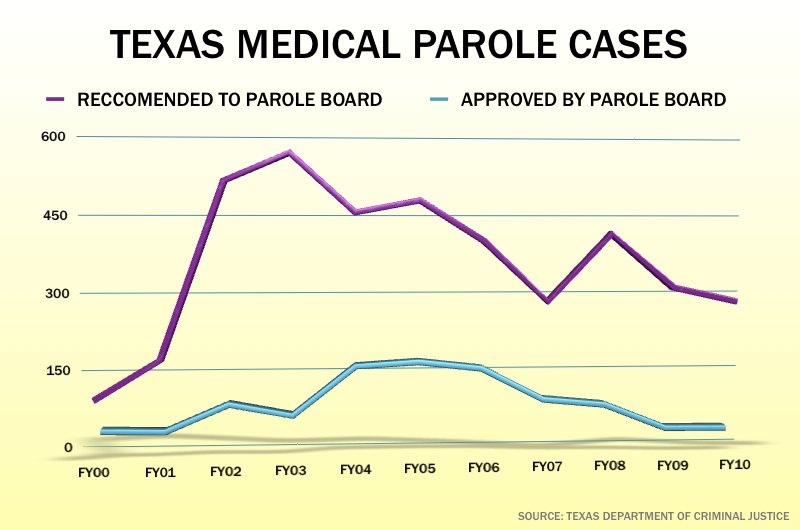
Prison doctors routinely offer up the oldest and sickest of these inmates for medical parole, a way to get those who are too incapacitated to be a public threat and have just months to live out of medical beds that Texas’ quickly aging prison population needs. They’ve recommended parole for 4,000 such inmates within the last decade. But the state parole board, which makes the final decision on “medically recommended intensive supervision,” has only agreed in a quarter of these cases, leaving the others to die in prison — and on the state’s dime.


Texas’ “geriatric” inmates, classified as those 55 and older, make up just 7.3 percent of Texas’ 160,000-offender prison population. But they account for nearly a third of the system’s hospital costs and make three times as many visits to prison medical departments as younger inmates. Elderly inmates have average annual hospitalization costs of $4,700, compared to $765 for inmates under 55. In total, providing inmate medical care costs the state correctional health care system — already facing hundreds of employee layoffs amid a budget shortfall — nearly half a billion dollars a year.


Parole board members say they’re faced with the difficult task of determining whether an inmate is still dangerous and must err on the side of public safety. “You can be sick, have an illness or a disease, and still be a threat,” said board chair Rissie Owens. “Our decisions aren’t based on numbers, on quotas. And we feel like we’re making good decisions.”


But criminal justice and prison funding experts say leaving elderly, terminally ill inmates to waste away behind bars is often unnecessary and exorbitantly expensive. Those costs would be shared with the federal government if the offenders weren’t in state custody.


“These are totally incapacitated inmates, terminally ill inmates, inmates on respirators, who are not paroled at a huge expense to the state and hardship to the inmate’s family because of the nature of a crime they may have committed 20 or 30 years ago,” said Sen. John Whitmire, D-Houston, who chairs the state Senate’s Criminal Justice Committee. “I think it’s largely for political reasons.”


The cost of care


While the total prison population in Texas isn’t growing, it’s quickly aging. The ranks of geriatric inmates are rising by about 6 percent every year, frightening the budget writers who have to figure out how to pay for them. Health care costs are rising too: The average daily medical bill for Texas inmates grows about 4 percent every year — which is low, compared to some states.


The sickest inmates can each cost the state up to $1 million a year in health care costs. If these same inmates were living in nursing homes or hospice facilities, the federal government — through Medicaid — would pay two-thirds of the cost and save Texas taxpayers up to $50 million a year, according to state projections. If the offenders are eligible for Medicare, the feds would pick up the full tab. “We could be transitioning them to some other facility where state taxpayers wouldn’t have to bear the full health care cost,” said Marc Levin, the director of the Texas Public Policy Foundation’s Center For Effective Justice Director, who suggested special nursing homes or hospice centers monitored by parole officers. “It’s a real opportunity to identify some savings without doing anything to endanger public safety.”


But despite the fact that the national one-year recidivism rate for older offenders is miniscule compared to that of younger offenders — 3.2 percent for inmates over 55, compared to 45 percent for inmates between 18 and 29 — an April report by the VERA Institute of Justice, a nonprofit criminal justice policy group, found that the 15 states that allow medical release rarely use it. What stands in the way? Political repercussions, complicated review processes and limited eligibility, the researchers found.


Getting Texas inmates released on medical parole is no easy task. To be eligible for it, an offender can’t be on death row or be serving life without parole, and must be either terminally ill (six months or less to live) or require intensive long-term care, said Dee Wilson, director of the Texas Correctional Office on Offenders with Medical or Mental Impairments. Sex offenders must effectively be in a vegetative state for consideration.


If inmates qualify, the office, in conjunction with the Correctional Managed Health Care Committee, recommends them for medical parole, then submits them to the seven-member Board of Pardons and Paroles for a decision. “It’s all about how long you have to live, and what your prognosis is,” Wilson said. “You can have a terminal illness but still be fully functioning.”


Dying behind bars


The parole board, in turn, relies on a pre-existing condition threshold of sorts. If an inmate with a particular illness commits a crime, Owens said, it’s unlikely he or she will get medical release for that same diagnosis. Some inmates with multiple amputated limbs may look incapacitated, Owens said, but managed to commit their crimes that way. Of the roughly 4,000 inmates prison health officials recommended for medical release in the last decade, the parole board turned down nearly 3,000.


In the last fiscal year alone, more than 440 Texas inmates died in prison. Thirty-one inmates who’d been recommended by medical staff for release died while awaiting the parole board to take up their case; another 26 died after the parole board rejected them for release. Twelve inmates were approved for medical parole but died before they could be sent home.


“There are documented cases where individuals had days or weeks left to live” and were rejected for medical parole, Whitmire said. “I saw no reason why they shouldn’t be paroled so the family could make plans for their funeral.”


Texas is not the only state struggling with skyrocketing prison health care costs and concerns around medical release. Between 1999 and 2007, the number of inmates 55 or older in state and federal prisons grew by more than 75 percent, to 76,000. To date, more than a dozen states have units set aside for elderly inmates; eight have dedicated hospice facilities. Estelle has an impressive medical facility, with a bustling emergency room, high-tech telemedicine equipment and a team of nephrologists that perform 1,800 dialysis treatments a month — sometimes on aggressive or unstable inmates.


“From a medical perspective, I’m comforted that [offenders are] getting a level of care they may not be getting on the street. On the other hand, we’re about to un-employ 363 people,” said Dr. Owen Murray, the chief physician for the University of Texas Medical Branch’s correctional managed care program, which oversees health care for the majority of Texas’ prisoners — and is facing layoffs this summer. “Are there other strategies to reduce our costs? And how do we prevent having to build more expensive units in the future?”


Charles Dill, a 71-year-old offender who started a 20-year sentence in 2000, has been hospitalized multiple times himself for costly heart problems, including getting stents for his carotid arteries. He’s befriended several elderly inmates in Estelle’s geriatric unit, only to watch them die on the ward.


“I’ve seen several of these guys drop over dead,” Dill said, gesturing across a prison dorm room of prosthetic limbs and wheelchairs, adult incontinence products and white-haired men in Coke-bottle glasses. “I guess they completed their sentence.”


Monday, April 19, 2010

The Quality of Mercy: Compassionate Release in America


Medical Parole: Politics vs. Compassion

By Nina Quinn

Dostoevsky reminds us that society can be measured by how it treats its prisoners. And part of that measure must surely be the degree of compassion we show toward the dying. Yet compassionate release, or medical parole, is an under-used and too rarely granted option for terminally ill inmates in our U.S. prisons. 


While some form of medical parole legislation is in place in federal and state jurisdictions, it is often overly restrictive, narrowly interpreted, and muddied by political interests. Unfortunately, a lack of political will affects bureaucratic will and ultimately the number of dying released from prison.

Barry Holman of the National Center for Institutions and Alternatives sardonically states, "There is not much of a constituency for criminals in the United States." With overtones of Dostoevsky, he adds, "There is a lack of political and bureaucratic will to see dying in prison as a negative marker for what a prison system should be and society as a whole,"

Jack Beck; who has done a careful study of medical parole in New York State reports that not only are few people getting out, there is a downward trend. Both applications and releases are dropping. In 2000, out of 170 New York state prison deaths – most from medical reasons – 81 applied for compassionate release and only 12 were granted.

In New York, the current administration is against parole generally and this spills over to medical parole. This negative influence in not confined to New York. California and other states are facing the same antagonism and similar low release numbers.

Apart from negative political influence, there are other related obstacles. The eligibility criteria can be overly restrictive eliminating, people who are clearly terminally ill. The process can be convoluted and delayed resulting in many inmates dying in prison before their review is completed. In New York, the 2000 statistics show more than twice as many inmates died during the review process than were granted release.

When these three barriers of politics, criteria and process come together they virtually guarantee a fourth: lack of incentive to initiate applications.

While there can be various factors contributing to this, Beck points to a common theme of frustration and futility. The paper burden on the medical providers can be both excessive and judged a waste of medical time when so few are granted parole. Similarly, many prison staff with compassion for the dying, do not want to raise the inmates hopes and put them through the stress of a long waiting period only to have them die in the process or be refused.

Also, the establishing of Regional Medical Units (RMUs) and hospice programs make for a simpler alternative – transfer the inmate. The RMUs run on a fixed DOC's budget and there is incentive to keep the beds full. Plus it is quicker, less complicated, and does not require the additional work involved in a discharge plan.

Another obstacle Beck articulates is the failure to educate the staff and inmates about the program and the process. This is particularly important in states like New York where correctional staff can initiate but the prime responsibility is placed on the inmate. Beck notes that there are prisons and infirmaries within the state that do not, for whatever reasons; file any applications for their terminally ill inmates.

Other than holding our politicians to a higher standard, what else is required for effective compassionate release policy?

A first requirement is clear legislation that is free from murky political bias, compromise, and overly restrictive criteria. A clearly defined medical prognosis is required. One that includes all terminally ill inmates. It should be clear and factual enough that inmates and their doctors know if they meet the criteria. And it should be fair. 

In New York, where an incapacitation standard is used, some terminally ill are excluded because they can walk-they may die tomorrow but they are excluded because of the legislative restriction on self-ambulation.

Rather than an incapacitation model where the prime emphasis is on risk, Beck makes the case for a terminal illness diagnosis with a one-year life expectancy. Studies show that when a six months diagnosis is used, the median length of stay in hospice is roughly 30 days. One year would increase the possibility of the review process being completed before the applicant dies. Also, it would allow time for the patient to adjust and relate to his family or new surroundings.

Another requirement is that there be a clear separation between the medical prognosis and the assessment of risk upon, release. Medical staff should not be asked to assess risk but solely address the medical status and prognosis of the inmate. Risk assessment is the pervue of the criminal justice system.

It is at this stage that the process generally gets cumbersome and protracted. So many arms and voices within the criminal justice system are included that the inmate may be dead before a decision is reached. The political temptation to spread the risk and decision-making as broadly as possible needs to be reined in and the process streamlined. Maryland has a process that appears to run smoothly. What makes it particularly efficient is not only that they have kept steps to the necessary minimum, they have also mandated short timelines at each stage of the process. Any inmate applying for compassionate release knows that he or she will receive a decision no later than 30 days from the start of the process. In urgent cases, decisions have been made as quickly as one day.

Maryland also meets another requirement by mandating discharge planning as soon as the inmate is given a terminal diagnosis. This ensures that when the decision is made, everything is in place for the inmate's release.

Communication is also important. The system could benefit from staff being well educated on all aspects of the process and this information should be made available to inmates and their families, including language translation when necessary.

Finally, a key and critical requirement, is that when a doctor makes a terminal diagnosis a mandatory application for release is submitted and the process is started including discharge planning. This standardized application should be as simple and straightforward as possible.
accessed january 29, 2010