Retiring Arizona Prison Watch...


This site was originally started in July 2009 as an independent endeavor to monitor conditions in Arizona's criminal justice system, as well as offer some critical analysis of the prison industrial complex from a prison abolitionist/anarchist's perspective. It was begun in the aftermath of the death of Marcia Powell, a 48 year old AZ state prisoner who was left in an outdoor cage in the desert sun for over four hours while on a 10-minute suicide watch. That was at ASPC-Perryville, in Goodyear, AZ, in May 2009.

Marcia, a seriously mentally ill woman with a meth habit sentenced to the minimum mandatory 27 months in prison for prostitution was already deemed by society as disposable. She was therefore easily ignored by numerous prison officers as she pleaded for water and relief from the sun for four hours. She was ultimately found collapsed in her own feces, with second degree burns on her body, her organs failing, and her body exceeding the 108 degrees the thermometer would record. 16 officers and staff were disciplined for her death, but no one was ever prosecuted for her homicide. Her story is here.

Marcia's death and this blog compelled me to work for the next 5 1/2 years to document and challenge the prison industrial complex in AZ, most specifically as manifested in the Arizona Department of Corrections. I corresponded with over 1,000 prisoners in that time, as well as many of their loved ones, offering all what resources I could find for fighting the AZ DOC themselves - most regarding their health or matters of personal safety.

I also began to work with the survivors of prison violence, as I often heard from the loved ones of the dead, and learned their stories. During that time I memorialized the Ghosts of Jan Brewer - state prisoners under her regime who were lost to neglect, suicide or violence - across the city's sidewalks in large chalk murals. Some of that art is here.

In November 2014 I left Phoenix abruptly to care for my family. By early 2015 I was no longer keeping up this blog site, save occasional posts about a young prisoner in solitary confinement in Arpaio's jail. I'm deeply grateful to the prisoners who educated, confided in, and encouraged me throughout the years I did this work. My life has been made all the more rich and meaningful by their engagement.

I've linked to some posts about advocating for state prisoner health and safety to the right, as well as other resources for families and friends.

until all are free -

MARGARET J PLEWS (June 1, 2015)
arizonaprisonwatch@gmail.com


INDIGENOUS ACTION MEDIA

INDIGENOUS ACTION MEDIA
ANTICOLONIAL zines, stickers, actions, power

Taala Hooghan Infoshop

Kinlani/Flagstaff Mutual AID

MASS LIBERATION AZ

MASS LIBERATION AZ
The group for direct action against the prison state!

Black Lives Matter PHOENIX METRO

Black Lives Matter PHOENIX METRO
(accept no substitutions)

BLACK PHX ORGANIZING COLLECTIVE

BLACK PEOPLE's JUSTICE FUND

PHOENIX: Trans Queer Pueblo

COVID Mutual AID PHOENIX

AZ Prison Watch BLOG POSTS:


Showing posts with label dying in prison. Show all posts

Tuesday, April 3, 2012

AZ DOC: Nobly, heroically, protecting us from the dying...

I find this kind of thing particularly disturbing because the AZ DOC blames the tripling of the assault rate and the doubling of the homicide and suicide rates on staff shortages. No one watched Dana Seawright's back - or Shannon Palmer's, or Duron Cunningham's, or Tony Lester's, or Susan Lopez', or Marcia Powell's - when they were alive in their care, but the state always has plenty guards and chains at the bedsides of the helpless and dying...


Immigrant Mother Asks Arizona to Let Her Son Die in Peace

Published April 03, 2012  | EFE

An immigrant mother is asking Arizona authorities to let her son die in peace since he is in the terminal phase of brain cancer and is kept cuffed to his hospital bed with two guards beside him.

"My son is dying, he cannot move and yet they're still keeping him handcuffed," Martha Elena Palomares, originally from the Mexican state of Sonora, told Efe on Tuesday.

Her son, Juan M. Corrales Palomares, 20, is hospitalized at Tucson's University Medical Center.

Corrales, a U.S. citizen, was serving a five-year sentence for possession of drugs and a firearm in Safford state prison when he began to experience severe headaches.

Palomares said she received letters in which her son complained of bad headaches, but she was still surprised when he called her last week from UMC to say he had undergone surgery on Feb. 29.

"He called me to tell me with his own mouth that he didn't know what was happening, that his head hurt him a lot. It was a nurse who told me that they had found some tumors and that it could be cancer," the mother said.

The doctors told her that her son, who is now unconscious, had terminal brain cancer, and they recommended that she disconnect him from life support when the time came, something that she refuses to do.

"What mortifies me is to see that they still have one of his legs cuffed to the bed and two guards are always with him. They don't allow more than one (visitor) in the room and they ask for identification to enter," she said.

"In the situation my son is in, I don't think he can escape, or that I can take him anywhere," she added.
Upon being contacted by Efe, spokesmen with the Arizona Department of Corrections explained that agency policy is to use handcuffs as a way to guarantee the safety of their personnel and of the prisoners.

Palomares also questioned the medical care her son received while he was in prison.

"I don't know what happened with him, someone told me that he had fallen inside there," she said.

Last month the American Civil Liberties Union of Arizona filed a lawsuit against the state corrections department arguing that prisoners are not receiving the medical and mental care they need.

The documents presented to the court by the ACLU indicate that sick prisoners who asked for medical attention were told things such as "be patient" and "it's all in your head," or urged to pray for a cure.

"We're asking for several things, among them an order prohibiting the Department of Corrections, for example, from putting people with mental problems in isolated cells," Alessandra Soler, the executive director of the ACLU in Arizona, told Efe on Tuesday.

Thursday, June 24, 2010

The politics of compassion, death, and prison: TX to AZ

Kudos to this reporter for caring about this story. We have some compassionate release hang-ups in Arizona that need some journalistic help, too...maybe there's even a student out there who would want to make it an investigative journalism or research project? Let us know. Time is running out for Davon and his fellow prisoners; even he suggests that there are men far more ill than him who need to be going home before they die. Terminal illness was not included in their sentencing; perhaps sentencing judges should be reviewing such things when people apply for compassionate release.

So, keep hounding the governor - we need to let these folks find decent treatment in order to survive their sentences, or release them so they can die at home. Let her know that more than just a few of us care about this - she doesn't strike me much as the "compassionate" type, after all this with SB 1070.

But if she's really into helping the people of Arizona, then this is one small way she can make a huge difference in the lives of folks who have otherwise been disposed of and forgotten by all but their families - if they even still have connections with them, then the suffering generated by denying medical releases to terminally or chronically, severely ill prisoners is exponentially magnified. Everyone, including the state and our communities, hurts from our inability to embrace our own humanity, and find within ourselves the qualities of Mercy and Grace.


And the effects of the ease with which we detach from the pain of our fellow beings trickle down to the next generation...it is not a kind thing to bestow on them, or much of a gift to leave the world: a callous heart.

And it's all politics. Challenge Brewer to have the courage to step up to this issue and do it right. Word is that too many people since Janet have been approved by the Board of Executive Clemency only to die while sitting on the Governor's desk. Is this governor any less a coward than Napolitano was? I hope so.

- Peg

----------------------

Few Texas Inmates Get Released on Medical Parole
by Emily Ramshaw
Texas Tribune
June 3, 2010

A gaunt old man, thick with whiskers and stricken with dementia, writhes under the covers of his bed. Down the hall, doctors monitor elderly diabetics with recently amputated limbs, medicate terminal cancer patients shuffling by with walkers and tether shivering dialysis patients to blood-cleaning machines.


Despite the pacing guards, the handcuffs and the bars on the windows, the geriatric and medical wing at the Estelle Unit in Huntsville looks more like a nursing home than a maximum-security prison.


Prison doctors routinely offer up the oldest and sickest of these inmates for medical parole, a way to get those who are too incapacitated to be a public threat and have just months to live out of medical beds that Texas’ quickly aging prison population needs. They’ve recommended parole for 4,000 such inmates within the last decade. But the state parole board, which makes the final decision on “medically recommended intensive supervision,” has only agreed in a quarter of these cases, leaving the others to die in prison — and on the state’s dime.


Texas’ “geriatric” inmates, classified as those 55 and older, make up just 7.3 percent of Texas’ 160,000-offender prison population. But they account for nearly a third of the system’s hospital costs and make three times as many visits to prison medical departments as younger inmates. Elderly inmates have average annual hospitalization costs of $4,700, compared to $765 for inmates under 55. In total, providing inmate medical care costs the state correctional health care system — already facing hundreds of employee layoffs amid a budget shortfall — nearly half a billion dollars a year.


Parole board members say they’re faced with the difficult task of determining whether an inmate is still dangerous and must err on the side of public safety. “You can be sick, have an illness or a disease, and still be a threat,” said board chair Rissie Owens. “Our decisions aren’t based on numbers, on quotas. And we feel like we’re making good decisions.”


But criminal justice and prison funding experts say leaving elderly, terminally ill inmates to waste away behind bars is often unnecessary and exorbitantly expensive. Those costs would be shared with the federal government if the offenders weren’t in state custody.


“These are totally incapacitated inmates, terminally ill inmates, inmates on respirators, who are not paroled at a huge expense to the state and hardship to the inmate’s family because of the nature of a crime they may have committed 20 or 30 years ago,” said Sen. John Whitmire, D-Houston, who chairs the state Senate’s Criminal Justice Committee. “I think it’s largely for political reasons.”


The cost of care


While the total prison population in Texas isn’t growing, it’s quickly aging. The ranks of geriatric inmates are rising by about 6 percent every year, frightening the budget writers who have to figure out how to pay for them. Health care costs are rising too: The average daily medical bill for Texas inmates grows about 4 percent every year — which is low, compared to some states.
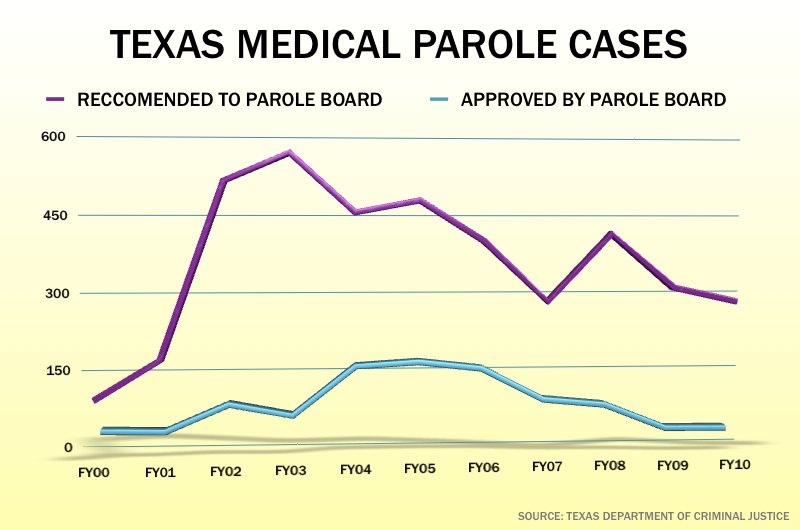

The sickest inmates can each cost the state up to $1 million a year in health care costs. If these same inmates were living in nursing homes or hospice facilities, the federal government — through Medicaid — would pay two-thirds of the cost and save Texas taxpayers up to $50 million a year, according to state projections. If the offenders are eligible for Medicare, the feds would pick up the full tab. “We could be transitioning them to some other facility where state taxpayers wouldn’t have to bear the full health care cost,” said Marc Levin, the director of the Texas Public Policy Foundation’s Center For Effective Justice Director, who suggested special nursing homes or hospice centers monitored by parole officers. “It’s a real opportunity to identify some savings without doing anything to endanger public safety.”


But despite the fact that the national one-year recidivism rate for older offenders is miniscule compared to that of younger offenders — 3.2 percent for inmates over 55, compared to 45 percent for inmates between 18 and 29 — an April report by the VERA Institute of Justice, a nonprofit criminal justice policy group, found that the 15 states that allow medical release rarely use it. What stands in the way? Political repercussions, complicated review processes and limited eligibility, the researchers found.


Getting Texas inmates released on medical parole is no easy task. To be eligible for it, an offender can’t be on death row or be serving life without parole, and must be either terminally ill (six months or less to live) or require intensive long-term care, said Dee Wilson, director of the Texas Correctional Office on Offenders with Medical or Mental Impairments. Sex offenders must effectively be in a vegetative state for consideration.


If inmates qualify, the office, in conjunction with the Correctional Managed Health Care Committee, recommends them for medical parole, then submits them to the seven-member Board of Pardons and Paroles for a decision. “It’s all about how long you have to live, and what your prognosis is,” Wilson said. “You can have a terminal illness but still be fully functioning.”


Dying behind bars


The parole board, in turn, relies on a pre-existing condition threshold of sorts. If an inmate with a particular illness commits a crime, Owens said, it’s unlikely he or she will get medical release for that same diagnosis. Some inmates with multiple amputated limbs may look incapacitated, Owens said, but managed to commit their crimes that way. Of the roughly 4,000 inmates prison health officials recommended for medical release in the last decade, the parole board turned down nearly 3,000.


In the last fiscal year alone, more than 440 Texas inmates died in prison. Thirty-one inmates who’d been recommended by medical staff for release died while awaiting the parole board to take up their case; another 26 died after the parole board rejected them for release. Twelve inmates were approved for medical parole but died before they could be sent home.


“There are documented cases where individuals had days or weeks left to live” and were rejected for medical parole, Whitmire said. “I saw no reason why they shouldn’t be paroled so the family could make plans for their funeral.”


Texas is not the only state struggling with skyrocketing prison health care costs and concerns around medical release. Between 1999 and 2007, the number of inmates 55 or older in state and federal prisons grew by more than 75 percent, to 76,000. To date, more than a dozen states have units set aside for elderly inmates; eight have dedicated hospice facilities. Estelle has an impressive medical facility, with a bustling emergency room, high-tech telemedicine equipment and a team of nephrologists that perform 1,800 dialysis treatments a month — sometimes on aggressive or unstable inmates.


“From a medical perspective, I’m comforted that [offenders are] getting a level of care they may not be getting on the street. On the other hand, we’re about to un-employ 363 people,” said Dr. Owen Murray, the chief physician for the University of Texas Medical Branch’s correctional managed care program, which oversees health care for the majority of Texas’ prisoners — and is facing layoffs this summer. “Are there other strategies to reduce our costs? And how do we prevent having to build more expensive units in the future?”


Charles Dill, a 71-year-old offender who started a 20-year sentence in 2000, has been hospitalized multiple times himself for costly heart problems, including getting stents for his carotid arteries. He’s befriended several elderly inmates in Estelle’s geriatric unit, only to watch them die on the ward.


“I’ve seen several of these guys drop over dead,” Dill said, gesturing across a prison dorm room of prosthetic limbs and wheelchairs, adult incontinence products and white-haired men in Coke-bottle glasses. “I guess they completed their sentence.”


Wednesday, June 16, 2010

Dying inside: The elderly in prison.

Plan to spend about 20 minutes weeping, if you tune into this documentary on aging in US prisons. Thank you, Jeremy Young and Al Jazeera.

----------------------from Al Jazeera----------------------------

Our program has aired and is finally up online—it is titled “Dying Inside: Elderly in Prison”. Here is the link to the show, please let me know your thoughts and feedback:


http://www.youtube.com/watch?v=Xvqj8hgxRfg


If you toggle the settings on you tube from 360 to 720 and you have a strong internet connection the quality of the video is very vivid. Please feel free to share the video with whomever.

Many thanks to all of those people that helped us out along the way….your contributions are greatly appreciated!

Jeremy Young

Al Jazeera English- The Americas

1627 K Street, 11th Floor

Washington, D.C. 20006

Work- 202.496.4543

Cell- 202.651.1632

Thursday, December 10, 2009

Truth in Sentencing and Human Rights.

Upcoming Events


December 10: International Human Rights Day.
December 15: 5th Special Legislative Session to screw the poor and working classes even further.

December 17: International Day to End Violence Against Sex Workers (Tucson Memorial).
December 18: Sex Workers Outreach Project Protest at the AZ DOC in Phoenix.


----------------------------


I appear to have stopped posting the inmate death notices in August sometime. It wasn't a conscious decison;  think it was just particularly heartbreaking, and I couldn't seem to keep up with them. But people often come back here again and again searching for links about their loved ones, sometimes posting final messages or explanations so that others might understand what happened to them, and know that they weren't a bad person just because they died in prison. 

I think we should be here for them, so even if it makes us all a little uncomfortable, so I'm going to start putting these folks back up on AZ Prison Watch when they die. We need to know what's killing them, and while they don't give us many clues in the press releases, we do get a little closer to the human suffering part of their experience. 

I always wonder how differently a judge might have sentenced someone if he or she knew that it could be the last few years of their life because prison is harder to survive when you're ill or your immune system is compromised...Maybe judges should have to include statistical probabilities with each sentence that they hand out which informs defendants of their likelihood of being raped in prison, contracting a deadly infectious disease, dying of an otherwise treatable cancer for a delay in diagnosis or inadequate medical intervention, or being otherwise terribly compromised or violated. That would be real "truth-in-sentencing".


Those odds could all,be calculated out - they probably already have been by risk management experts who determine whether or not it's cheaper to let someone get injured and try suing (fat chance if you're a prisoner suing for rights), to settle a case or fight it in court, or to fix the potential hazard in the first place (why bother if prisoners can't sue?). Having to speak aloud the atrocities they must know occur in American prisons may at least make judges think twice about the sentences they were handing out, and what they really expect to accomplish by incarcerating addicted survivors of trauma, for example, with those who would be their perpetrators. What kind of lesson does that teach to whom? 

Even if the judges don't learn from such disclosure of what prison really does to people, the public would. Most of us would not condemn a mentally ill teenager to being repeatedly raped or to endure a long slow death by Hepatitis C for pulling a pen knife out when he thought someone was trying to kill him during a manic episode. Most of us would probably wonder why he was in prison instead of  a psychiatric hospital. 

Most everyone in court when he was sentenced wondered that too. 

Some of us just don't have lives that seem worth saving, I think, or we are viewed as being so helpless and pathetic that we need to be protected from ourselves by being put in prison for awhile, which too many Americans actually think is a "safe" place for people like Marcia Powell (and myself, for that matter), someplace where we would get presumably good dental and health care, be fed three times a day, and been seen by mental health staff... I think that's mostly just fantasy in America, though. Many prisoners only get fed twice a day, small portions of empty calories full of sugars and cholesterol  - for which they may even have to pay from their fifteen-cents-an-hour job.


Social Workers who think they are doing their clients a "favor" by conspiring with courts and cops to help them "hit bottom" via the brutal path through jail or prison may just be setting them up to crash through their bottom and die.  If you're going to mess with people's lives like that, then remember  first, to do no harm.


Even those of you with the best intentions impose your own version of order on us as we try to navigate an increasingly insane world with minimal resources for survival, while you ignore our resistance and cause for protest, and blame us for "non-compliance" if we reject the promise your prescribed pharmaceutical solutions offer to make us nauseaus, give us uncontrollable tremors, numb us to our loved one's smile, touch, or words  of comfort, or silence us in a drugged stupor for months or years.  

We really don't need those kinds of favors, no matter how many recovering addicts swear by "tough love" saving their lives - it was the love part, not so much the tough, that saved most of the hardest cases I knew. For every one who was saved by 12-Step ways, many more were lost along the same road to recovery; their families left in the wake of suicides and drunk driving accidents interrogating themselves about whether or not they were tough enough, too tough, or loving enough.


If every social worker, lawyer, judge and cop had to do a stint as a prisoner or involuntary psychiatric patient, there'd be a lot more sensitivity coming from those directions, and probably more effective solutions to engage someone in treatment would be tried - coercion should be the absolute last resort to protect life and limb.


So, we're going to be looking at you, too, my friends on the bench - if you're up for re-election this year, we'll be taking notes in your courtroom and gathering data on your sentencing practices, finding out who among you has accepted the responsibility of weighing multiple and competing views of justice, tuning out political pressures, and come up with creative and meaningful responses to human crises more in the vein of restorative than retributive justice - especially those of you in juvenile justice. 

Prosecutors, be on notice too. And any court-appointed attorneys that give their indigent clients the short shrift - we'll catch you. And you well-meaning social workers. CourtWatch is coming to Phoenix soon. What you do will no longer be visible only by way of your own press releases - we'll have inside accounts of how you treat people, and just how some of these pleas are arrived at that result in so many people - including the innocent - giving up their rights to trial out of fear, just to put another notch in Thomas' belt of "convictions".  From what I hear, he's got an awful lot of innocent people tucked underneath that belt. The new Maricopa County Attorney, if they have any guts, will start opening innocence claims once Thomas is run out on a rail, if he doesn't take the responsibility to deal with them himself first. The latter would seem to be the more responsible and noble course of action.


Anyway, regardless of their crimes, convictions, or time, I think the folks dying in prison deserve to be at least noticed by us - we may be the only people to whom their passing matters - except perhaps their victim, if there was ever one other than themselves to begin with. So, with today being International Human Rights Day, I thought it was time to go back and catch up on the names of those who have died in state custody over the past few months. I'll be working on this one all day, I think.


I may take a lunch break to do something down at the AZ DOC - call me if anyone's interested in joining me - just want to make sure the prisoners know that they're being thought of today.

--------------