Retiring Arizona Prison Watch...


This site was originally started in July 2009 as an independent endeavor to monitor conditions in Arizona's criminal justice system, as well as offer some critical analysis of the prison industrial complex from a prison abolitionist/anarchist's perspective. It was begun in the aftermath of the death of Marcia Powell, a 48 year old AZ state prisoner who was left in an outdoor cage in the desert sun for over four hours while on a 10-minute suicide watch. That was at ASPC-Perryville, in Goodyear, AZ, in May 2009.

Marcia, a seriously mentally ill woman with a meth habit sentenced to the minimum mandatory 27 months in prison for prostitution was already deemed by society as disposable. She was therefore easily ignored by numerous prison officers as she pleaded for water and relief from the sun for four hours. She was ultimately found collapsed in her own feces, with second degree burns on her body, her organs failing, and her body exceeding the 108 degrees the thermometer would record. 16 officers and staff were disciplined for her death, but no one was ever prosecuted for her homicide. Her story is here.

Marcia's death and this blog compelled me to work for the next 5 1/2 years to document and challenge the prison industrial complex in AZ, most specifically as manifested in the Arizona Department of Corrections. I corresponded with over 1,000 prisoners in that time, as well as many of their loved ones, offering all what resources I could find for fighting the AZ DOC themselves - most regarding their health or matters of personal safety.

I also began to work with the survivors of prison violence, as I often heard from the loved ones of the dead, and learned their stories. During that time I memorialized the Ghosts of Jan Brewer - state prisoners under her regime who were lost to neglect, suicide or violence - across the city's sidewalks in large chalk murals. Some of that art is here.

In November 2014 I left Phoenix abruptly to care for my family. By early 2015 I was no longer keeping up this blog site, save occasional posts about a young prisoner in solitary confinement in Arpaio's jail. I'm deeply grateful to the prisoners who educated, confided in, and encouraged me throughout the years I did this work. My life has been made all the more rich and meaningful by their engagement.

I've linked to some posts about advocating for state prisoner health and safety to the right, as well as other resources for families and friends.

until all are free -

MARGARET J PLEWS (June 1, 2015)
arizonaprisonwatch@gmail.com


INDIGENOUS ACTION MEDIA

INDIGENOUS ACTION MEDIA
ANTICOLONIAL zines, stickers, actions, power

Taala Hooghan Infoshop

Kinlani/Flagstaff Mutual AID

MASS LIBERATION AZ

MASS LIBERATION AZ
The group for direct action against the prison state!

Black Lives Matter PHOENIX METRO

Black Lives Matter PHOENIX METRO
(accept no substitutions)

BLACK PHX ORGANIZING COLLECTIVE

BLACK PEOPLE's JUSTICE FUND

PHOENIX: Trans Queer Pueblo

COVID Mutual AID PHOENIX

AZ Prison Watch BLOG POSTS:


Showing posts with label brewercare. Show all posts

Tuesday, October 11, 2011

Transinstitutionalization continues under Brewercare


Mary K. Reinhart's been doing an awesome job of covering the effects of Brewercare on citizens with psychiatric disorders in Arizona: Access her archived Arizona Republic articles on this here. These budget and AHCCCS cuts will have consequences that extend to our prison crisis in Arizona, as seriously mentally ill adults continue to be denied treatment and medical coverage and end up diverted from the health care system to criminal justice...

-------------------------------

Here's what was lost in mental-health care

It took decades to build Arizona's mental-health system. It took weeks to downsize it.

In March 2010, attorneys for the state and the mentally ill agreed to a two-year stay in the class-action Arnold vs. Sarn lawsuit. The 30-year-old lawsuit was based on a state law requiring a wide range of community services for people diagnosed with a serious mental illness.

Weeks later, state lawmakers eliminated more than $50 million in state funding and most of the services for people with a serious mental illness who were ineligible for Medicaid.

The state now provides $40 million for generic medication and $16 million for a beefed-up statewide crisis-response system, which fields hotline calls and dispatches mobile teams of counselors when necessary. The medication benefit includes monthly checkups and lab work.

Here's what was lost:

Brand-name drugs

In Maricopa County, about 3,000 people taking brand-name psychotropic medications switched to generic drugs. The most commonly prescribed antipsychotics, including Seroquel, Geodon, Zyprexa and Risperdal, have no generic equivalents.

The generics may not be as effective, tend to be more sedative and have other side effects, such as involuntary tics and tremors, doctors say.

The medication benefit includes a monthly doctor's visit, lab work and a nurse if injections are required.

Case management

Everyone receiving state services for a serious mental illness had a case manager, but the budget cuts eliminated that benefit for people without Medicaid.

More than 300 case managers and support staff in Maricopa County, and hundreds more statewide, lost their jobs as the agencies and clinics adjusted to see fewer patients.

The case managers were a lifeline for many of Arizona's most fragile citizens. They helped navigate complex paperwork and provided a sounding board for daily aggravations. They met people upon their release from jail or psychiatric facilities. They tried to head off suicide attempts and psychotic episodes and made hospital visits.

Two case managers remain at each of the county's 18 clinics to make reminder calls and coordinate appointments for non-Medicaid patients.

Housing

The budget cuts put 255 people with serious mental illness in danger of losing their housing, which in some cases included 24-hour supervision and had been their home for decades. Most had to move.

DHS officials forbid Magellan Health Services and the other regional administrators from evicting anyone or moving people into shelters, hotels, halfway houses or other transitional housing, as well as unlicensed "board and care" or supervisory care homes.

Dozens moved into apartments or assisted- living facilities, while others moved in with family. Some who have since been hospitalized, jailed or evicted have ended up in shelters and boarding homes.

Transportation

If there was one benefit she would restore among those lost, Peggy Hoefling says it would be transportation.

Without free bus passes or cab rides, people miss appointments, fail to pick up their prescriptions and may stop going out in public, said Hoefling, a clinical social worker at Connections AZ, a psychiatric urgent-care center. Symptoms typically worsen when people stop taking their medication and isolate themselves, she said.

The heat makes the lack of transportation a particular challenge. Psychiatric medications put patients at increased risk of heat stroke and heat exhaustion.

Therapy

Thousands of people lost access to group and individual therapy, severing relationships they may have had for decades with counselors, group members and support staff.

Regular group therapy helped people such as Shawn Harris of Peoria better understand and cope with his illness and learn from others who cut or otherwise injure themselves.

This type of cognitive behavioral therapy, which research has shown to benefit self-injurers, helped Harris learn ways to relieve internal pain, cope with stress and anxiety, and express his emotions.

Drop-in centers and job training

Those without Medicaid also no longer have state-funded job training or access to community drop-in centers, along with the friendships, support and self-esteem that came with them.

Agencies like the Marc Center in Mesa train the seriously mentally ill to take jobs in hospitals and grocery stores or do assembly-line work at the center's warehouse. They learn computer and interview skills, as well as time management and budgeting. The center lost about 120 people to the budget cuts.

Peer-support groups at non-profit centers across the Valley offered outings, life-skills and support groups, and opportunities for social interaction.


Thursday, September 29, 2011

Transinstitutionalizing the mentally ill: still filling the prisons.


Nationally, 4 times as many mentally ill people are now in prisons than in hospitals.

Arizona ranks as one of the worst offenders...
(image from Correctionsone.com)


I've seen this journalist doing research in the field - excellent reporting. Between her and Bob Ortega, the prisons have been getting a close look at by the AZ Republic these days. What's about to happen here is catastrophic. The Arizona Department of Corrections is the last place we should be sending people with mental illness - and it's the next place many will be heading. Someone has to fill all those new private prison beds, after all...the good prisoners will go to them, and the mentally ill will be kept in the fire traps they call state prisons.

Paul Rubin's Phoenix New Times article about the murder of Shannon Palmer comes to mind when I think of people who never should have been in prison to begin with - and wouldn't have, if our mental health system wasn't already so damaged and our communities so gutted of basic resources. Phoenix is so certain that more police are the answer that they're taking it out of the food tax - thank God we have the resources to arrest the poor when they steal to feed their families now.

Anyway, if we don't spend our tax dollars in the community folks - BEFORE people feel the need to call the police - we'll be spending it keeping a lot of these folks in horrendous conditions behind bars. We already are, sadly - for every one mentally ill person we hospitalize in Arizona, we put over nine more in jail or prison. Only Nevada is more brutal to their mentally disabled.


Needless to say, our disability rights advocates in this state have a lot of catching up to do if they're going to protect these folks all the way to prison and back. Most seem to stop at the courtroom door, I'm afraid...


---------from the Arizona Republic-------

Mental-health cuts: Experts fear long-term costs


Arizona taxpayers are providing fewer services to fewer people with serious mental illnesses than they were last year, for annual savings of roughly $50 million.

But the short-term savings from state budget cuts threaten to have long-term consequences for patients, providers and the community, mental-health experts say.

The budget reductions eliminated services for about 12,000 Arizonans who don't qualify for Medicaid, removing the foundation of a system intended to keep the seriously mentally ill, healthy and out of emergency rooms, hospitals, jails and prisons.

State lawmakers instead provided money for generic medication and additional funding to beef up a statewide crisis-response system to help prevent people from falling through the cracks. But in the 15 months since this population lost case management, brand-name prescription drugs, therapy, transportation and other benefits, more than 2,000 people have stopped receiving any state-funded services and are unaccounted for.

Local and county jails, emergency responders and hospitals often shoulder the costs when people with untreated serious mental illness, such as schizophrenia and bipolar disorder, fall into crisis.

The precise financial costs to those entities are unknown, but health professionals do know that it's far more expensive to treat people who have spiraled into crisis than to keep them stable. And once in crisis, health professionals say, it's more difficult for people to rebound, which means those higher costs continue to recur.

"It's a penny-wise and pound-foolish approach," said Bill Kennard, former executive director of the National Alliance on Mental Illness' office in Phoenix. "More people in jail and prison with mental illness, more time that law enforcement spends dealing with a health issue as opposed to a public-safety issue."

The costs

The state has not conducted an analysis that compares ongoing treatment with crisis costs.

But a March 2011 study that examined proposed mental-health cuts in Texas put the average daily cost of services at $12 for adults, compared with $401 a day in the state's mental hospital, $137 a day for a jail inmate with mental illness and $986 for an emergency-room visit.

The study, by Health Management Associates for the Texas Conference of Urban Counties, also showed that gaps in services put those discharged from psychiatric hospitals and jail at greater risk of relapse, readmission and recidivism.

Janey Durham, who is in charge of a workshop program at Mesa's Marc Center, said she lost 120 people to the budget cuts, including a man diagnosed with schizophrenia who deteriorated almost before her eyes. The non-profit agency center provides job training and other services to the mentally ill and developmentally disabled.

Durham said the man, a former alcoholic in his 50s, worked hard at his job in the manufacturing warehouse, at maintaining his sobriety and in treating his mental illness. But soon after the budget cuts forced him to switch to a generic medication, Durham said, he stopped taking his medication, started drinking again and grew increasingly paranoid, plagued by voices in his head.

Over the past year his erratic, disruptive behavior led Marc Center employees to call Mesa police at least once. He is believed to be homeless, she said, but contact with him has been sporadic since last winter.

Clarke Romans, who runs the NAMI office in Tucson, said a once-eager volunteer has been reluctant to leave her house since last summer, when her anti-psychotic Seroquel was replaced with a generic drug. Many of the most commonly prescribed brand-name psychoactive medications have no generic equivalent. Generics in some cases are less effective or have side effects that deter people from taking them, health officials say.

"She's been suicidal. She has not been able to come in and volunteer. She kind of hides in her house," Romans said. "These are people who are suffering in silence."

Before the budget cuts last July, individuals with serious mental illness were entitled to a full array of community-based services, from supportive housing to intensive case management and in-patient hospitalization, regardless of their income.

Mental-health advocates argue that city and county law enforcement, hospitals, jails and homeless shelters have picked up some of the costs of caring for the seriously mentally ill who lost benefits. Over the past year, many of these venues have seen an increasing number of people with severe mental illness.

State lawmakers made the cuts to help close a $1 billion deficit in fiscal 2011. House Appropriations Committee Chairman John Kavanagh, R-Fountain Hills, said the state's financial crisis forced lawmakers to cut $3 billion over four budget cycles, and all of the cuts carried some consequences.

"The question is, are the consequences so dire that it shouldn't be done? We don't believe so," Kavanagh said. "The changes really were not dramatic. . . . We're still providing these people with treatment."

Treatment, recovery

Publicly funded mental-health treatment can be highly effective, and the vast majority of people can improve their quality of life and relieve symptoms, such as hallucinations or depression, with consistent therapy, medication and other support.

But experts say treatment and services must be comprehensive and consistent.

"I don't think these kinds of services are luxuries for people with mental illness. They are part and parcel of their treatment for an underlying disorder," said Dr. Paul S. Appelbaum, a Columbia University psychiatry professor and past president of the American Psychiatric Association. "Unless you provide a package of services, just throwing pills at them isn't going to do it."

Those who work closely with the mentally ill say that is the situation for thousands of Arizonans who are ineligible for Medicaid. And they worry that people who stopped showing up at their assigned clinics may have become incarcerated, homeless, hospitalized or homebound.

Dennis Culhane, a University of Pennsylvania professor and nationally known expert on homelessness, said studies show people with serious mental illness who are not receiving regular, supportive services are more likely to become homeless.

Culhane's own research has shown that it costs less to provide apartments and other permanent housing for people who are homeless than to provide emergency shelter and services. People with serious mental illness who become homeless, he said, "have significant secondary costs," including emergency, hospital and incarceration costs.

Once they have fallen into crisis, the road back to recovery can be much harder.

"Untreated psychiatric illness is just more difficult to treat," said Dr. Jason Caplan, chief of psychiatry at St. Joseph's Hospital and Medical Center. "You have an increased risk of relapse. It's just harder to get you back."

Repeat visitors

Case management was a key benefit lost to the non-Medicaid mentally ill. Among other things, caseworkers helped people who were jailed or hospitalized to transition back into society and tried to prevent their relapse.

People often lose their housing while they're locked up and, if they're on probation or court-ordered treatment, they have a list of rules to follow upon release.

Now, there is no one to meet people as they are released from jail or a psychiatric hospital.

In Maricopa County, 54 people with serious mental illness were released to the street or to a homeless shelter in the past year after being stabilized at one of the Valley's two urgent psychiatric care facilities, according to Magellan, the for-profit contractor that administers behavioral-health care in the county.

Dr. Dawn Noggle, mental-health director for Correctional Health Services, which provides health care at Maricopa County's jails, said the seriously mentally ill are staying in jail longer. And, she said, police have arrested some more than 30 times for a variety of crimes, mostly low-level non-violent offenses, such as trespassing or theft, or probation violations.

Incarceration and prosecution of the mentally ill doesn't just affect taxpayers who foot the bill, she says.

"What happens after they get felonies? And there is an incredible impact on families," she says. "It's not just the immediate financial costs. It's the social costs as well."

There also are repeat customers at the county's psychiatric hospital, where the budget cuts mean court-ordered evaluations must be completely redone for people discharged only weeks earlier. Staff at the county's Desert Vista Behavioral Health Center, which handles involuntary commitments, say it's a new phenomenon.

In the past, people were typically court-ordered to continue treatment for at least a year, long after they were discharged from the hospital. Since the budget cuts, judges have been dismissing court-ordered treatment for non-Medicaid patients upon their discharge, reluctant to require them to participate in services, such as therapy and job training, they no longer have. Within months, some of those people are brought back for a new evaluation, a costly legal and medical process that delays treatment for several days.

"It's taking an enormous amount of resources to redo something that's already been done," said Sherry Fraley, legal-services manager.

Reach the reporter at 602-444-8603.

Sunday, September 11, 2011

AZCPOA: Diaz v. Brewer: gender justice

From the Arizona Correctional Peace Officers Association. I seldom post the stuff they send out, but this was pretty intriguing. I don't care much for some of the people Binh defends, but more power to him on this if they can get health coverage for all couples - and all kinds of families. Brewercare is killing too many people in this state already...


---------------September 11, 2011---------------


Recently the 9th Circuit issued a ruling in Diaz v. Brewer recognizing that the Arizona Legislature discriminated against same sex partners of state employees in rescinding their health insurance coverage.


You will recall that in April 2008, under then Governor Napolitano, ADOA rules were modified so that health insurance coverage could be offered to both same-sex and different-sex domestic partners. But, November 2008, voters approved Prop 102 which amended the Arizona Constitution to outlaw gay marriage, by defining "marriage" as the union of "one man" and "one woman"

The following year, in 2009, the Arizona legislature enacted House Bill 2013 that limited health insurance coverage offered by the State to a "spouse under the laws of this State." This effectively eliminated health insurance coverage for all same-sex and different-sex domestic partners as of January 1, 2011.


The Diaz v. Brewer suit was filed by a number of gay State employees to challenge House Bill 2013 as discriminatory. The plaintiffs filed for a preliminary injunction which was granted by the Federal District Court in Phoenix. The District Court noted that House Bill 2013 was not discriminatory on its face, because it affected both same-sex and different-sex couples. However the court found that HB 2013 had a discriminatory effect. This is because, under Arizona law, different-sex couples could retain their health coverage by marrying, but same-sex couples could not.


The preliminary injunction stopped HB 2013 from going into effect for same-sex couples (and required the State to continue to provide health coverage for them) until a full trial could be held on the case. Before a full trial could be held, the State appealed to the Ninth Circuit.


While the appeal was pending the preliminary injunction allowed same-sex domestic partners of State employees to retain their health coverage. Opposite-sex couples, however, lost heath coverage as of January 1, 2011.


A three judge panel of the Ninth Circuit reviewed the Arizona District Court's ruling, found it to be correct, and upheld it. The State of Arizona had argued that the law was valid because it: (1) promoted marriage, and (2) was a cost savings measure. The court rejected the "promotion of marriage" argument because same-sex marriages are illegal under the Arizona Constitution. Next the court rejected the "cost savings" justification because the only "cost" evidence that the State submitted was the fact that 863 "same and opposite-sex domestic partners" being covered. This is a miniscule number compared to the 57,000 State employees who have health coverage for their spouses and families.


Once the State of Arizona's justifications for the law were entirely discredited, the Ninth Circuit had to uphold the injunction. The court noted:


"the district court correctly recognized that barring the state of Arizona from discriminating against same-sex couples in its distribution of employee health benefits does not constitute the recognition of a new constitutional right to such benefits. Rather, it is consistent with long standing equal protection jurisprudence holding that "some objectives, such as 'a bare . . . desire to harm a politically unpopular group,' are not legitimate state interests."


The big question is what happens now? The State has a number of options: (1) the State can ask for an en banc rehearing in front of all of the Ninth Circuit judges and hope they overturn the decision, (2) the State can appeal to the US Supreme Court which will take some time, or (3) the State can let the decision stand and bring the case back to the Arizona Federal District Court for a full trial on the merits.


We should know what direction the State will take in the next few weeks. In the meantime, same-sex domestic partners of State employees will continue to have health insurance. Opposite-sex domestic partners, who lost health coverage in 2011 are not impacted by this ruling.


We are working on possible legislation to fix this issue for our opposite-sex domestic partner members. However, a lot hinges on the ultimate outcome of the case. If same-sex domestic partners wind up winning, we feel we have a strong argument to push for health insurance for opposite-sex domestic partners. We will keep you posted.


Martin Bihn
AZCPOA Attorney

Sunday, March 6, 2011

Brewercare is killing us! DREAM of LIFE Walk!!!


Saturday's DREAM of LIFE Walk for the surviving patients on the AHCCCS transplant list was amazing - these are my photos with a brief news piece from ABC15.com at the bottom. Here are the video clips.

Along those same lines, here's the article from Russ Pearce's Me Party Senate Appropriations Committee this week, which voted 8-5 to eliminate the MEDICAID for Arizonans altogether, so our friends awaiting transplants will soon have much more company among the people the state has decided to allow to withhold life-saving medical care for.

Ironically, no matter how ill or disabled a person is in this state, we still end up paying the government a hell of a lot through the very sales taxes that are supposed to be spent on the welfare of the people....and I want my taxes to go to AHCCCS before anyone else needlessly dies. I'm sick of the legislature extorting me for their salaries while they kill my people by pissing away my money on suing the feds over immigration and setting up committees to pick and choose which federal laws Arizona wants to nullify because they give too many people rights and health care and other essential things.

No wonder people are talking about seceeding from the state. What ignorant, self-righteous dolts we have running this show. If I knew it was that easy to nullify laws, I would have written my own constitution and criminal code a long time ago and told the feds and state where to go myself.


'Dream of Life Walk' aimed to raise awareness about AHCCCS funding cuts

ABC15.com
Posted: 5:55 PM
March 5, 2011


* By: Mike Pelton

PHOENIX - A Valley man who needs a new liver, along with dozens of others, marched to the state capitol Saturday, in hopes of raising awareness about the importance of funding the state’s Medicaid program, Arizona Health Care Cost Containment System (AHCCCS).

Francisco Felix has cancer and needs a liver transplant. He is one of the 98 people who lost coverage when Governor Jan Brewer approved cuts to AHCCCS, a move that aimed to help solve the state’s massive budget deficit.

“We are asking for the funds for the transplants,” said Felix, whose cousin, Lulu translated for him.

People from all across the Valley gathered at a Phoenix church this morning for a ‘Dream of Life Walk’. They marched to the capitol in hopes of raising awareness about the issue. Governor Brewer, however, isn’t in Arizona. She sent out a message on Twitter late Friday night that said she is in Alaska on vacation.

The cuts to AHCCCS were made last year as part of the new budget. It left 98 people who needed transplants without funding from the program. Two have died since the cuts were made.

“By subtracting this funding from them, these 96 remaining people will die,” said Dr. Richard Darling, who attended Saturday’s march. “It won't be that long either because some of them are very, very ill.”

State leaders have said the cuts were necessary because of the dire budget issues.

But for Felix, he and his family have resorted to selling food at local events to help raise money. They sell hot dogs, chips and drinks, in hope of getting enough money to pay for the transplant. They said they need about $500,000 and including donations, have raised about $100,000.

“I’m going to be fighting, I’m not going to give up,” Felix said.

Thursday, January 13, 2011

AHCCCS Transplants: Dream a little dream for me...


New Coalition Seeks to Restore Arizona Medicaid Funding

98 Arizonans were promised then denied coverage for life saving organ transplants. New Coalition forms to pressure legislature and Governor to restore funding.


FOR IMMEDIATE RELEASE
Jan 13, 2011

For more information contact:
Bob Aronson
904-434-6512
Jacksonville, Florida
bob@baronson.org
http://bobsnewheart.wordpress.com

New Coalition Seeks to Restore Arizona Medicaid Transplant Funding

A powerful new organization has been formed to help restore Medicaid coverage for Arizona organ transplant patients and to prevent similar cuts in other states. The mission of “The Dream of Life Intervention Coalition” (DLIC) is to help patients with life-threatening health conditions get or keep Medicaid and/or Medicare insurance coverage.

The DLIC will emphasize four points in its campaign:

1. Denying Medicaid patients organ transplants is a death sentence. Transplants are their only option for living. (Two have already died in Arizona and 30 more could die this year. Many children will be left with one parent, others could become orphans).

2. If we don’t reverse the Arizona situation it could be seen by other states as permission to do the same thing and these death panels will begin to spread across the nation (If that happens, thousands if not millions could be sentenced to death and despair by budget slashing, heartless politicians. What’s next, banning chemo or radiation therapy for cancer patients? Is that what America is about?)

3. DLIC strongly believes that sending people to their death is no way to solve budget problems (doing so flies in the face of the constitutional guarantee that our government exists to protect its citizens and provide for their general welfare. The constitution does not say that killing citizens is permissible if it will save money.)

4. We do not want to allow these issues to go unaddressed and therefore encourage medical tourism or influence migration to other states or countries that have more accessible health benefits (that would shift the burden to regions that are unprepared to absorb the impact while maintaining the human and moral commitment to be socially responsible for our citizens).

Circumstances

On October 1, 2010 the state of Arizona told 98 of its legal citizens that Medicaid would not cover life saving organ transplants despite having promised them earlier that the procedures would be covered. Since that order, two of the 98 have died and another is said to be selling her belongings in order to move somewhere where Medicaid will cover her liver transplant. Governor Jan Brewer says the cuts were made to help reduce the state’s budget deficit. She remains opposed to restoring the funding.

Last Monday January 10, 2011, leaders of several advocacy groups joined in a conference call with Arizona senate Minority leader David Schapira and State Senator Kyrsten Sinema (D) to discuss the issue. Senator Sinema has introduced a bill she says would provide more than enough money to restore transplant funding and provide millions more to help reduce the state’s budget deficit.

The conference call revolved around ways in which DLIC could assist with the effort to restore funding. While the Governor’s office says the transplants would cost nearly $5 million, Jennifer Carusetta, legislative liaison for Arizona Medicaid, says cutting transplants would only save $800,000 in the current fiscal year, and only $1.4 million for a full year.
Participating in the call was William Remak Chair of the National Association of Hepatitis Task Forces (NAHTF), two time liver transplant recipient and cancer survivor; Julie Acklin, Arizona Director of the NAHTF; Bob Aronson, heart transplant recipient and founder of Save the Arizona 98 and Facebook’s Organ Transplant Initiative; Patricia Lupole, Director of the Hepatitis C Veterans group (thehvcvets.com) and Flor Felix representing her husband and some other Arizona citizens who have been denied Medicaid covered organ transplants. We will soon announce other members.

Senators Schapira and Sinema said that while Democratic support for the bill was strong, some in the Republican majority were willing to review it while others were less enthusiastic. As a result the new group, Dream of Life Intervention Coalition, decided unanimously to embark on a nationwide campaign to bring greater visibility to the Arizona situation and to rally public opinion to put increased pressure on Arizona officials to restore Medicaid covered organ transplant funding. Additionally DLIC will work to help ensure that Medicaid cuts throughout the country at state levels do not result in restricting life saving interventions for people in dire circumstances.

DLIC is working on a more detailed communication plan and will soon provide the public with steps they can take to begin the campaign to stop the dying by restoring funding.

***William (Bill) Remak, BSMT, BSPH, SGNA, AHCJ., has initiated coordinating this collaborative effort in response to the pleas and desperation demonstrated by the families of the chronically ill from the neighboring state of California where he sits on the steering committee of the California Chronic Care Coalition. Bill said.” No state public servant or elected official should sacrifice the lives of their constituents as a means to flex their political party muscle or power by using policy to destroy the fabric of our value as human beings. It defeats the core of our ability to thrive as a nation and can only lead to the devastation of mankind.”

-30-

“Character cannot be developed in ease and quiet. Only through experience of trial and suffering can the soul be strengthened, ambition inspired and success achieved.” -Helen Keller (1880 – 1968)

# # #

Dream of Life Intervention Coalition is an non profit advocacy group that seeks to help patients with life-threatening health conditions get or keep Medicaid and/or Medicare insurance coverage. Our first project is to restore Arizona Medicaid funding for the 98 people who were denied organ transplatns. Bob Aronson is the founder of Save the Arizona 98 www.savethearizona98.com and Facebook's Organ Transplant Initiative.

Saturday, December 18, 2010

Have a Heart 4 AHCCCS Transplant Patients


FRANCISCO FELIX: Father of 4 beautiful girls.
Hepatitis C AHCCCS Patient on Liver Transplant Waiting List.
Needs $500,000.
Car Wash today and Tomorrow.

--------------------

My friend
Julie Acklin and I spent a few hours today with the friends and family of Francisco Felix, a Hepatitis C patient in need of a liver transplant. He actually had a match donated to him by a family friend who passed away in November, but he couldn't afford the $200,000 tab - and the state refused to step up to pay it.


Francisco is one of 98 patients in our state (now 97, I believe, with Mark Price's death) who lost funding this fall for their desperately needed organ and tissue transplants through the Arizona Health Care Cost Containment System (AHCCCS - Arizona's name for Medicaid, which is less and less accessible under our compassionate conservatives). Several of the links I've embedded in this post will help you find out who voted for and against the cuts, but I can tell you it was pretty much a party-line thing. A week or so ago I protested at the Capitol and blogged on this issue, too (see "Bury My Heart in An AHCCCS Patient").


13-year old Carlos Olivas, Jr
. (above, with Jessica Felix) also hit the Capitol to protest and has been everywhere fund-raising recently. I met him at the car wash today, and he's an amazing kid. Read the CNBC story about him if you need some inspiration to stop talking and take action for these folks. He's pretty humble about it, but as I understand it, he's single-handedly raised nearly $2,000 for the cause so far. Really, all those kids out there today were heroes; just a few (including Francisco's daughters) are pictured here.


The AZ Senate Democrats have filed a bill to restore the transplant funding, but they aren't the ones in control of the state legislature - the Republicans are, so lobby the Governor and your lawmaker for it hard, reminding them that it's our money they're depriving Arizona's families of, not theirs.


Anyway, the occasion today was a yard sale and car wash being held to raise money for Francisco, who will now need about $500,000 for his transplant and related expenses. A lot of people turned out, but I don't think we raised enough. In fact, I'm sure we didn't.


There will be another fundraiser for him tomorrow as well, so please bring your dirty cars, a little cash, and some rich friends or Republican legislators to support the cause.


It's being held from 7am-3pm at the entrance to Acclaim Charter School at 7624 W. Indian School Rd., on the West side of Phoenix between 76th and 77th Ave.


The easiest way I found to get there from my place on Central and Roosevelt was to hop on the I-10 going West, take the 75th Ave exit North, and head up to Indian School Road, where you'll make a left, going West again. About 1/4 mile down the road you'll see a ton of eager children on your right (probably waving hot pink signs) imploring you to wash your car. Turn in it even if it's already clean.


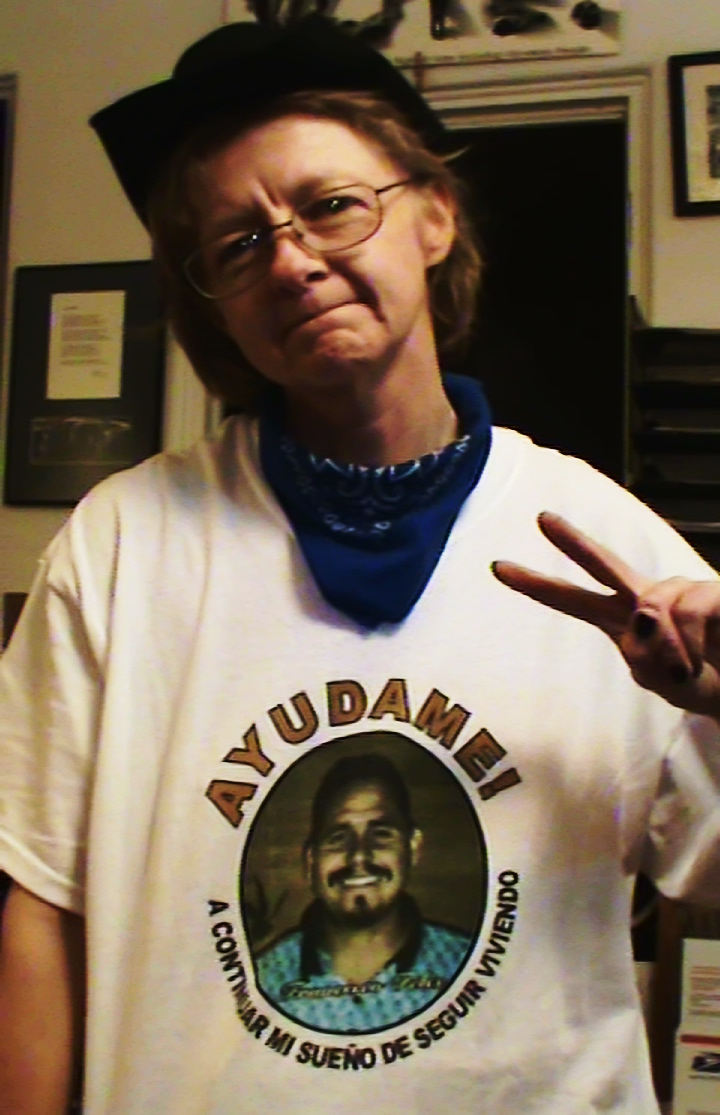
While you're waiting for your vehicle shop at NAPA Auto Parts (the guy there threw his support behind this whole thing), hit the yard sale for things you might (or might not) need, buy a Francisco Felix t-shirt, or mosey on to the back of the lot to pick up a couple of tacos. If you're really brave, turn your clean car over to me and the kids to have your back window painted. The photos throughout this post should give you an idea of what I mean.


If you can't make it tomorrow, don 't worry - you can still give to Francisco's fund. In fact, that's all I really want for Christmas, so if you really love me, go to the NTAF and donate today.


Thank you in advance for your support.


Feliz Navidad, mis amigos y amigas.


(hope I got that right... Love to all.)

Friday, December 10, 2010

Bury my Heart in an AHCCCS Patient


I felt strong enough for the first time in weeks to go out chalking today, so headed up to the Capitol Complex and Wes Bolin Park, one of my favorite spots to practice my free speech (That's 17th Ave I'm on, between W. Washington and W. Jefferson, right across the street from the legislators and governor's office buildings. The media and visitors and legislative aides all cross that sidewalk from the parking lot to get over there).


Kids were all over the place singing Christmas
Carols, and naturally curious about what I was writing about. So I told them about the people who are so sick that their insurance plans wouldn't cover their most critical medical treatment, and how they needed the state to pay their medical bills through the AHCCCS program - which the Arizona republican governor and legislature, the ultimate compassionate conservatives, decided isn't going to pay for their organ transplants anymore.


Then I told the kids that if Governor Brewer doesn't restore that funding, those people will die. I even named some of them:
Coach Tiffany Tate, a cystic fibrosis patient who needs a double lung transplant, Randy Shepherd, a father of 3 who needs a heart transplant, and Francisco Felix, a survivor - so far - of the deadly damage of Hepatitis C. His dying family friend even tried to give him her liver, but AHCCCS still wouldn't pay for the transplant.


I didn't mention "Death Panels" to the kids, though - I thought what I told them was heavy enough already.


In the meantime, someone called the Capitol Police on me ( they always do), assuming that what I was doing was a crime. They all know my name now, but wanted to see some ID anyway - and tried to convince me that my conduct was, in fact, against the law - they just weren't going to arrest me because I was technically in the territory of the Phoenix Police.


One of the guys was actually pretty nice about trying to intimidate me in to leaving (not this one above - he was really hostile to me when I was caught alone by him on Halloween night). I was actually pretty much done for the day, but stayed long enough to argue with the cops that not only was my mode of expression not criminal (I keep it on the ground and on city sidewalks), but that the vigor with which the state solicits the poor to harvest our organs upon our death, while justifying why we or our loved ones aren't deserving of receiving transplants in life is truly criminal.


They didn't put up much of a fight on that one.


Here's the finished product - not the greatest picture, but you get the gist...


I signed it "future organ donor against Brewercare."


Happy World Human Rights Day


Future Organ Donor Against Brewercare

Today is International Human Rights Day. This would be the perfect time for Brewer to call a special session of the legislature to pass a bill that would restore the cuts to AHCCCS funding for transplant patients - including liver transplants for people with Hepatitis C.

I find it deeply disturbing that as an Arizona citizen living in poverty, my own organs would be harvested by this state only to be doled out to the privileged few. Clearly the poor are still good enough to be preyed upon, but not worthy enough to be saved...


Is that really what Republicans stand for here?

On that note,
I'm dropping this $7 check off at the Capitol Executive Building for the Governor today. Read the article below for an explanation...


--------------from myfoxphoenix.com----------


Patients Desperately Needing Transplants Share Stories

They call on governor to restore AHCCCS cuts

Published : Tuesday, 07 Dec 2010, 5:16 PM MST

PHOENIX - Doctors, transplant patients and Democratic lawmakers blasted what they refer to as "BrewerCare" Tuesday, calling for Governor Jan Brewer to restore the money slashed from the state's Medicaid program AHCCCS.

A news conference was held at the state Capital. Among those in attendance were four people waiting for transplants for themselves or their loved ones, and called for Brewer to do something now before its too late.

Four Arizona families in need of transplants issued an emotional plea. A woman with cystic fibrosis, a father of 3 who needs a heart transplant, a man with hepatitis C and cancer, and another man who needs a heart transplant, had their stories told.

Surrounded by several Democratic lawmakers, they called for Jan Brewer to restore the money slashed from the state's transplant program.

"If the state budget were the average American salary, the cost to restore the funding would be $7. $7 to save people's lives," says Democratic Rep. David Schapira.

House Republican Jon Kavanagh says the decision to cut certain transplants was based on incomplete data that showed low success rates. He says he's still waiting for a report.

"I have the data summary here from the group of doctors including Mayo, saying significant survival rates, but they never gave us the number, they never gave us the data, we need facts," he says.

Democrats want the governor to call a special session, or use federal stimulus funds to cover the cost. However, a spokesperson for the governor's office tells me that funds were used already for job creation, education and public safety. He says even if the funds were available, they wouldn't cover the costs necessary.