Retiring Arizona Prison Watch...


This site was originally started in July 2009 as an independent endeavor to monitor conditions in Arizona's criminal justice system, as well as offer some critical analysis of the prison industrial complex from a prison abolitionist/anarchist's perspective. It was begun in the aftermath of the death of Marcia Powell, a 48 year old AZ state prisoner who was left in an outdoor cage in the desert sun for over four hours while on a 10-minute suicide watch. That was at ASPC-Perryville, in Goodyear, AZ, in May 2009.

Marcia, a seriously mentally ill woman with a meth habit sentenced to the minimum mandatory 27 months in prison for prostitution was already deemed by society as disposable. She was therefore easily ignored by numerous prison officers as she pleaded for water and relief from the sun for four hours. She was ultimately found collapsed in her own feces, with second degree burns on her body, her organs failing, and her body exceeding the 108 degrees the thermometer would record. 16 officers and staff were disciplined for her death, but no one was ever prosecuted for her homicide. Her story is here.

Marcia's death and this blog compelled me to work for the next 5 1/2 years to document and challenge the prison industrial complex in AZ, most specifically as manifested in the Arizona Department of Corrections. I corresponded with over 1,000 prisoners in that time, as well as many of their loved ones, offering all what resources I could find for fighting the AZ DOC themselves - most regarding their health or matters of personal safety.

I also began to work with the survivors of prison violence, as I often heard from the loved ones of the dead, and learned their stories. During that time I memorialized the Ghosts of Jan Brewer - state prisoners under her regime who were lost to neglect, suicide or violence - across the city's sidewalks in large chalk murals. Some of that art is here.

In November 2014 I left Phoenix abruptly to care for my family. By early 2015 I was no longer keeping up this blog site, save occasional posts about a young prisoner in solitary confinement in Arpaio's jail. I'm deeply grateful to the prisoners who educated, confided in, and encouraged me throughout the years I did this work. My life has been made all the more rich and meaningful by their engagement.

I've linked to some posts about advocating for state prisoner health and safety to the right, as well as other resources for families and friends.

until all are free -

MARGARET J PLEWS (June 1, 2015)
arizonaprisonwatch@gmail.com


INDIGENOUS ACTION MEDIA

INDIGENOUS ACTION MEDIA
ANTICOLONIAL zines, stickers, actions, power

Taala Hooghan Infoshop

Kinlani/Flagstaff Mutual AID

MASS LIBERATION AZ

MASS LIBERATION AZ
The group for direct action against the prison state!

Black Lives Matter PHOENIX METRO

Black Lives Matter PHOENIX METRO
(accept no substitutions)

BLACK PHX ORGANIZING COLLECTIVE

BLACK PEOPLE's JUSTICE FUND

PHOENIX: Trans Queer Pueblo

COVID Mutual AID PHOENIX

AZ Prison Watch BLOG POSTS:


Showing posts with label pardon. Show all posts

Monday, December 13, 2010

Free the Scott Sisters: Grace calling Mississippi.

Hey Friends of Justice out there: 
Don't let Governor Barbour leave Jamie and Gladys to die in prison.


This week is a pretty critical time for folks to be contacting the Governor of Mississippi to implore him to pardon Jamie and Gladys Scott. I'm posting one of the more recent news editorials detailing their struggle below. You can also hit their mom's blogspot for more info (Evelyn Rasco - such a beautiful soul - is their mom; Nancy Lockhart and Sis Marpessa are their champions). Be prepared for some awesome gospel, blues, and soul to stream through when you open it (that means crank up your speakers, not turn them down)!

The conditions of the prison they're in - particularly the trailer where Jamie receives dialysis treatments (when the machine is working, that is) are horrendous - but you needn't make reference to that in your communication with Governor Barbour's office about the pardon - there's an appropriate contact for that below. 

If you're a registered Republican - even from outside of Mississippi - please share that with Governor Barbour in your letter, as the man will likely be running for national office in 2012. It would help for him to know that real Republicans are interested in seeing that Americans are capable of delivering both justice and mercy when we've been wrong...

Here's the info to reach Governor Haley Barbour (visit that link, first, to get to know a little about him):

Honorable Haley Barbour
P.O. Box 139
Jackson, Mississippi 39205

1-877-405-0733
governor@governor.state.ms.us 


You may also want to put something on letterhead and e-mail it as an attachment to the governor's personal assistant - Dorothy Kuykendal:
DKuykendall@governor.state.ms.us


   Jamie Scott (center) with Mom and brother.

Also, check out this recent post and please contact the Mississippi health department regarding the black mold, toilets in Quick Bed and inadequate infrastructure in this dialysis trailer which are all located at Central Mississippi Correctional Facility in Pearl, Mississippi. There are a lot of lives at stake - the survival rates for sick Mississippi prisoners have plummeted in recent years under the current health care provider, Wexford - Mother Jones did an excellent piece on this in March.


 Jeffrey K. Brown, Ph.D., R.P.E., B.C.E.
Bureau Director
State Public Health Entomologist
Mississippi State Department of Health
570 East Woodrow Wilson Avenue
Jackson, Mississippi 39216

601.576.7972 Office
601.576.7632 Fax
769.257.2242 Cell

jeffrey.brown@msdh.state.ms.us
www.healthyms.com


Here's the latest article giving some background on Jamie and Gladys. Please take action on their behalf THIS WEEK. 


 Sisters may or may not be guilty, but Mississippi assuredly is

Leonard Pitts Jr.

Sunday, November 21, 2010


Let's assume they did it.

Let's assume that two days before Christmas in 1993, a 22-year-old black woman named Jamie Scott and her pregnant 19-year-old sister Gladys set up an armed robbery. Let's assume these single mothers lured two men to a spot outside the tiny town of Forest, Miss., where three teenage boys, using a shotgun the sisters supplied, relieved the men of $11 and sent them on their way, unharmed.

Assume all of the above is true, and still you must be shocked at the crude brutality of the Scott sisters' fate. You see, the sisters, neither of whom had a criminal record before this, are still locked away in state prison, having served 16 years of their double-life sentences.

It bears repeating. Each sister is doing double life for a robbery in which $11 was taken and nobody was hurt. Somewhere, the late Nina Simone is moaning her signature song:

"Mississippi Goddam."

For the record, two of the young men who committed the robbery testified against the sisters as a condition of their plea bargain. All three reportedly received two-year sentences and were long ago released. No shotgun or forensic evidence was produced at trial. The sisters have always maintained their innocence.

Observers are at a loss to explain their grotesquely disproportionate sentence. Early this year, the Jackson Advocate, a weekly newspaper serving the black community in the state capital, interviewed the sisters' mother, Evelyn Rasco. She described the sentences as payback for her family's testimony against a corrupt sheriff. According to her, that sheriff's successor vowed revenge.

You don't have to believe that to believe this: Mississippi stands guilty of a grievous offense against simple decency.

But there is hope. Recently, the sisters' cause has been championed by high-powered allies. New York Times columnist Bob Herbert and the NAACP have called on Mississippi Gov. Haley Barbour to pardon the two women. I add my voice to theirs.

I have no way of knowing if the Scott sisters' fate is tied in to some sheriff's revenge and at some level, the question is moot. Whatever the proximate cause of this ridiculous sentence, the larger cause is neon clear: the Scott sisters are black women in the poorest state in the union. And as report after report has testified, if you are poor or black (and God help you if you are both), the American justice system has long had this terrible tendency to throw you away like garbage. Historically, this has been especially true in the South.

If you doubt it, play with the scenario in your head. Try to imagine some rich white girl doing double life for an $11 robbery. You can't.

But then, that girl has access to a brand of justice unavailable to women like Jamie and Gladys Scott. She will receive every break the law allows her and maybe a few it does not. No one will throw her away.

And while it would be nice to think this problem of discarding people's lives would be solved by the release of the Scott sisters, the truth is, that wouldn't even address it.

How many other Scott sisters and brothers are languishing behind bars for no good reason, doing undeserved hard time on nonexistent evidence, perjured testimony, prosecutorial misconduct or sheer racial or class bias?

So fixing the problem the Scott sisters represent involves nothing less than the reformation of the justice system, a commitment to make it, as the name implies, a system that reliably produces "justice” as opposed to these too frequent miscarriages thereof.

Meantime, Jamie Scott, who is in her late 30s now, is in poor health. She is said to be losing her vision and both her kidneys have failed. And we wait for common sense to take hold in Mississippi.

It is a situation that shocks the senses, even if we assume they did it.

Now, assume they did not.

Miami Herald columnist Leonard Pitts Jr.'s column appears regularly on editorial pages of The Times. His e-mail address is: lpitts@miamiherald.com

From: http://seattletimes.nwsource.com/html/editorialsopinion/2013477385_pitts21.html


Friday, November 19, 2010

Arizona: Mercy, Mercy Me...

Davon's clemency board hearing was yesterday - the decision to turn him down was clearly made before we walked into the room, however. The chair made only passing reference to the thick stack of mail that had arrived in support of Davon's application, and cut me off when I was speaking on his behalf. He made a special point of reading things into the record to justify their determination against him. The county attorney's office can be expected to oppose such applications, but they went out of their way, it seems, to damn him - which was precisely what the board needed and asked for. Not that I'm accusing them of any impropriety - I'm sure they did what they felt was right - just as I'm doing. We just come from different places, and they don't know Davon like I do. As evidenced by their decision yesterday, They don't know him at all.


Pardons in Arizona have nothing to do with mercy or grace, by the way - or even justice for that matter, even when sincere people try to deliver it. Look at what our good governor did to Bill Macumber, the innocent man who has already spent 35 years in prison for murder and may well die there. Convinced beyond any doubt that his conviction was based on perjured testimony and manufactured evidence, the Arizona Board of Executive Clemency unanimously recommended him for a full pardon, which would have gone into effect if Brewer had simply left it alone for 90 days. Instead she quashed it, in the interest of her kind of "justice". Affirming Bill's innocence would have implied his ex-wife's guilt. As she worked for the Maricopa County Sheriff's office at the time she framed him, I suspect Brewer was doing someone with history there a favor. But what do I know?


Sadly, despite his story saturating the media across the country before November 2, the voters in Arizona elected that woman anyway.


As for Davon: the outcome of his hearing was no surprise, really - probably least of all to him - but it was still a disappointment; his little sister left the room abruptly in tears. We did, however, raise awareness about the prosecution of the seriously, mentally ill for their symptoms rather than their criminality, and built a network for prisoners with Hep C and their families. We also entered our objections to the prison industrial complex into the public record (that was the part I think they didn't want to hear). One of our legislators even turned out to corroborate Davon's mom's assertion that Arizona's prisoners aren't getting the medical care they need in there - and that came from a self-described "conservative Republican". I suspect he will pay a price for having done that, which is why I won't name him here. I doubt he would endorse my own take on the system, but he's still one of the few politicians I've ever met with real integrity. I can't think of a single Democrat in this state who would put themselves on the line like that for a convicted violent, crazed felon seeking mercy - much less another Republican.


I'm convinced that clemency boards exist largely to reinforce the illusion that the system we have of doling out punishment in our country is a "just" one that serves the best interests of society at large. By allowing room for pardons and commutations, we suggest that the legal system we live under, as a rule, delivers justice to criminals and victims alike, and that any abuse of power or injustice perpetrated by the state in the process is an exception that needs to be dealt with on a case-by-case basis. If that was the reality, however, our prisons would not be packed almost exclusively with the poor - most of whom have the least ability to do great harm. In a truly just and morally evolved society it is the money-lenders, warmongers and rogue sheriffs of this land who would be doing time for exploitation, mass murder, and kidnapping - not making the rules the rest of us have to live by. They certainly wouldn't be retiring with honors and drawing down our collective dime.


But ours is neither a just nor a moral society - it isn't even a democracy. It is a capitalist republic in which the wealth and power of the few still depends on their ability to co-opt, terrorize, and restrain the many. We literally replaced our plantations with prisons when overt slavery went out of style. America's governments exploit and injure far more innocent and vulnerable people than all our lone criminals combined do. We've even made the perpetuation of victimization and crime an attractive, acceptable industry from which savvy investors can profit.


Thanks, everyone, for all your support through this. Stay with us, please - this fight is much bigger than one young man, and has only just begun. Keep an eye on what's happening with Davon for awhile longer - he went further out on a limb in the interest of prisoner rights and health care than any of the rest of us had to - and risks paying a much higher price now than the one extracted from him at sentencing. We'll see if he's allowed to keep his good time - and make it successfully through the 4 years of probation he has yet to serve -in light of his and his mother's public defiance. I guess we'll also see if the Arizona State Legislature shows any mercy for the honesty and courage of one of their own.

Thursday, June 24, 2010

The politics of compassion, death, and prison: TX to AZ

Kudos to this reporter for caring about this story. We have some compassionate release hang-ups in Arizona that need some journalistic help, too...maybe there's even a student out there who would want to make it an investigative journalism or research project? Let us know. Time is running out for Davon and his fellow prisoners; even he suggests that there are men far more ill than him who need to be going home before they die. Terminal illness was not included in their sentencing; perhaps sentencing judges should be reviewing such things when people apply for compassionate release.

So, keep hounding the governor - we need to let these folks find decent treatment in order to survive their sentences, or release them so they can die at home. Let her know that more than just a few of us care about this - she doesn't strike me much as the "compassionate" type, after all this with SB 1070.

But if she's really into helping the people of Arizona, then this is one small way she can make a huge difference in the lives of folks who have otherwise been disposed of and forgotten by all but their families - if they even still have connections with them, then the suffering generated by denying medical releases to terminally or chronically, severely ill prisoners is exponentially magnified. Everyone, including the state and our communities, hurts from our inability to embrace our own humanity, and find within ourselves the qualities of Mercy and Grace.


And the effects of the ease with which we detach from the pain of our fellow beings trickle down to the next generation...it is not a kind thing to bestow on them, or much of a gift to leave the world: a callous heart.

And it's all politics. Challenge Brewer to have the courage to step up to this issue and do it right. Word is that too many people since Janet have been approved by the Board of Executive Clemency only to die while sitting on the Governor's desk. Is this governor any less a coward than Napolitano was? I hope so.

- Peg

----------------------

Few Texas Inmates Get Released on Medical Parole
by Emily Ramshaw
Texas Tribune
June 3, 2010

A gaunt old man, thick with whiskers and stricken with dementia, writhes under the covers of his bed. Down the hall, doctors monitor elderly diabetics with recently amputated limbs, medicate terminal cancer patients shuffling by with walkers and tether shivering dialysis patients to blood-cleaning machines.


Despite the pacing guards, the handcuffs and the bars on the windows, the geriatric and medical wing at the Estelle Unit in Huntsville looks more like a nursing home than a maximum-security prison.


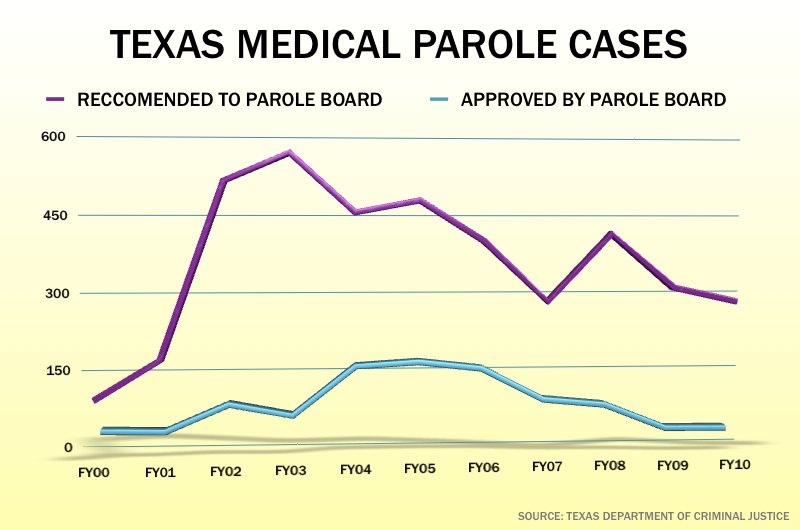
Prison doctors routinely offer up the oldest and sickest of these inmates for medical parole, a way to get those who are too incapacitated to be a public threat and have just months to live out of medical beds that Texas’ quickly aging prison population needs. They’ve recommended parole for 4,000 such inmates within the last decade. But the state parole board, which makes the final decision on “medically recommended intensive supervision,” has only agreed in a quarter of these cases, leaving the others to die in prison — and on the state’s dime.


Texas’ “geriatric” inmates, classified as those 55 and older, make up just 7.3 percent of Texas’ 160,000-offender prison population. But they account for nearly a third of the system’s hospital costs and make three times as many visits to prison medical departments as younger inmates. Elderly inmates have average annual hospitalization costs of $4,700, compared to $765 for inmates under 55. In total, providing inmate medical care costs the state correctional health care system — already facing hundreds of employee layoffs amid a budget shortfall — nearly half a billion dollars a year.


Parole board members say they’re faced with the difficult task of determining whether an inmate is still dangerous and must err on the side of public safety. “You can be sick, have an illness or a disease, and still be a threat,” said board chair Rissie Owens. “Our decisions aren’t based on numbers, on quotas. And we feel like we’re making good decisions.”


But criminal justice and prison funding experts say leaving elderly, terminally ill inmates to waste away behind bars is often unnecessary and exorbitantly expensive. Those costs would be shared with the federal government if the offenders weren’t in state custody.


“These are totally incapacitated inmates, terminally ill inmates, inmates on respirators, who are not paroled at a huge expense to the state and hardship to the inmate’s family because of the nature of a crime they may have committed 20 or 30 years ago,” said Sen. John Whitmire, D-Houston, who chairs the state Senate’s Criminal Justice Committee. “I think it’s largely for political reasons.”


The cost of care


While the total prison population in Texas isn’t growing, it’s quickly aging. The ranks of geriatric inmates are rising by about 6 percent every year, frightening the budget writers who have to figure out how to pay for them. Health care costs are rising too: The average daily medical bill for Texas inmates grows about 4 percent every year — which is low, compared to some states.


The sickest inmates can each cost the state up to $1 million a year in health care costs. If these same inmates were living in nursing homes or hospice facilities, the federal government — through Medicaid — would pay two-thirds of the cost and save Texas taxpayers up to $50 million a year, according to state projections. If the offenders are eligible for Medicare, the feds would pick up the full tab. “We could be transitioning them to some other facility where state taxpayers wouldn’t have to bear the full health care cost,” said Marc Levin, the director of the Texas Public Policy Foundation’s Center For Effective Justice Director, who suggested special nursing homes or hospice centers monitored by parole officers. “It’s a real opportunity to identify some savings without doing anything to endanger public safety.”


But despite the fact that the national one-year recidivism rate for older offenders is miniscule compared to that of younger offenders — 3.2 percent for inmates over 55, compared to 45 percent for inmates between 18 and 29 — an April report by the VERA Institute of Justice, a nonprofit criminal justice policy group, found that the 15 states that allow medical release rarely use it. What stands in the way? Political repercussions, complicated review processes and limited eligibility, the researchers found.


Getting Texas inmates released on medical parole is no easy task. To be eligible for it, an offender can’t be on death row or be serving life without parole, and must be either terminally ill (six months or less to live) or require intensive long-term care, said Dee Wilson, director of the Texas Correctional Office on Offenders with Medical or Mental Impairments. Sex offenders must effectively be in a vegetative state for consideration.


If inmates qualify, the office, in conjunction with the Correctional Managed Health Care Committee, recommends them for medical parole, then submits them to the seven-member Board of Pardons and Paroles for a decision. “It’s all about how long you have to live, and what your prognosis is,” Wilson said. “You can have a terminal illness but still be fully functioning.”


Dying behind bars


The parole board, in turn, relies on a pre-existing condition threshold of sorts. If an inmate with a particular illness commits a crime, Owens said, it’s unlikely he or she will get medical release for that same diagnosis. Some inmates with multiple amputated limbs may look incapacitated, Owens said, but managed to commit their crimes that way. Of the roughly 4,000 inmates prison health officials recommended for medical release in the last decade, the parole board turned down nearly 3,000.


In the last fiscal year alone, more than 440 Texas inmates died in prison. Thirty-one inmates who’d been recommended by medical staff for release died while awaiting the parole board to take up their case; another 26 died after the parole board rejected them for release. Twelve inmates were approved for medical parole but died before they could be sent home.


“There are documented cases where individuals had days or weeks left to live” and were rejected for medical parole, Whitmire said. “I saw no reason why they shouldn’t be paroled so the family could make plans for their funeral.”


Texas is not the only state struggling with skyrocketing prison health care costs and concerns around medical release. Between 1999 and 2007, the number of inmates 55 or older in state and federal prisons grew by more than 75 percent, to 76,000. To date, more than a dozen states have units set aside for elderly inmates; eight have dedicated hospice facilities. Estelle has an impressive medical facility, with a bustling emergency room, high-tech telemedicine equipment and a team of nephrologists that perform 1,800 dialysis treatments a month — sometimes on aggressive or unstable inmates.


“From a medical perspective, I’m comforted that [offenders are] getting a level of care they may not be getting on the street. On the other hand, we’re about to un-employ 363 people,” said Dr. Owen Murray, the chief physician for the University of Texas Medical Branch’s correctional managed care program, which oversees health care for the majority of Texas’ prisoners — and is facing layoffs this summer. “Are there other strategies to reduce our costs? And how do we prevent having to build more expensive units in the future?”


Charles Dill, a 71-year-old offender who started a 20-year sentence in 2000, has been hospitalized multiple times himself for costly heart problems, including getting stents for his carotid arteries. He’s befriended several elderly inmates in Estelle’s geriatric unit, only to watch them die on the ward.


“I’ve seen several of these guys drop over dead,” Dill said, gesturing across a prison dorm room of prosthetic limbs and wheelchairs, adult incontinence products and white-haired men in Coke-bottle glasses. “I guess they completed their sentence.”


Saturday, March 6, 2010

Scott Watch: Ridgeway & Casellla.

Here's an excellent article covering the Scott Sisters' history from the folks at Solitary Watch - I was hoping to see something on them from Jim soon...blessings to you both for getting this out when you did. 


If Jamie's going to be there even another week, perhaps Wexford should be the target of the next big PR campaign and public protest - they should be sitting down with Jamie and her family, looking at her chart, explaining her illness, prognosis, etc - why do I keep repeating that? if they still haven't been fully disclosing or made any attempt to really educate and empower Jamie around managing her kidney disease, then MDOC should be dropping that contract pronto because they're going to kill even more people that way. 

Epps - how can you possibly say that you're satisfied with the work Wexford's doing after all this?You wouldn't be if that was your daughter - would you? I think there's a different standard here.

-------------------------------
Weekend EditionMarch 5 - 7, 20

The Terrible Case of Jamie Scott

By JAMES RIDGEWAY and JEAN CASELLA

On February 25, a small crowd gathered outside the state capitol in Jackson, Mississippi, to push for the release of sisters Jamie and Gladys Scott, who are serving two consecutive life sentences apiece for a 1993 armed robbery in which no one was injured and the take, by most accounts, was about $11. Supporters of the Scott sisters have long tried to draw attention to their case, as an extreme example of the distorted justice and Draconian sentencing policies that have overloaded prisons, crippled state budgets, and torn families apart across the United States. But in recent months, their cause has taken on a new urgency, because for Jamie Scott, an unwarranted life sentence may soon become a death sentence.


Jamie Scott, 38, is suffering from kidney failure. At the Central Mississippi Correctional Facility (CMCF) in Pearl, where Jamie and Gladys are incarcerated, medical services are provided by a private contractor called Wexford, which has been the subject of lawsuits and legislative investigations in several states over inadequate treatment of the inmates in its care. According to Jamie Scott’s family, in the six weeks since her condition became life-threatening, she has endured faulty or missed dialysis sessions, infections, and other complications. She has received no indication that a kidney transplant is being considered as an option, though her sister is a willing donor.

Jamie Scott’s family and legal advisors believe the poor health care she is receiving in prison places her life at risk. They have sent pleas for clemency or compassionate release to Governor Haley Barbour, whose tough-on-crime posturing and dubious record on issuing pardons do not bode well for Jamie. The Mississippi Department of Corrections (MDOC) has a provision for what it calls “conditional medical release,” but Scott is not a candidate, department spokesperson Suzanne Garbo Singletary said in an email last week, because “MDOC policy provides that an inmate must have a condition that is ‘incapacitating, totally disabling and/or terminal in nature’ in order to qualify.” So Jamie Scott appears to be caught in a deadly Catch-22: In order to be released from prison, she must convince the MDOC that her illness is terminal or “totally disabling”; but the only sure way for her to prove this is to die in prison.

Cruel and Unusual Health Care

In telephone interviews earlier this week, the Scott sisters’ mother, Evelyn Rasco, described the treatment Jamie has received at Central Mississippi Correctional Facility (CMCF), based on her own observations and information provided by her two daughters. Jamie, who has diabetes and bouts of high blood pressure, said that medical staff at the prison first diagnosed possible kidney problems in 1997–but until recently, she received minimal treatment outside of her regular insulin. Jamie’s physical and mental health suffered last fall when she spent 23 days in solitary confinement (for being found in an “unauthorized area” in the prison gym) and was cut off from her routine of work, classes, church, and occasional visits with her sister. Then, in mid-January, Jamie became seriously ill when both her kidneys began shutting down. She was sent to the prison infirmary and, after a week’s delay, taken to the hospital. There, doctors inserted a shunt in Jamie’s neck to allow her to receive dialysis through a catheter, and she was promptly returned to prison.

Rather than letting Jamie Scott leave the prison regularly for dialysis, prison authorities chose to truck in dialysis machines. About three times a week, Jamie has received hemodialysis in a trailer on the prison grounds—if the machines are working properly, which she reports isn’t always the case. At one session, Jamie told her mother, the blood was flowing out of her through a catheter into the dialysis machine—but it wasn’t flowing back in, so the treatment had to be stopped. At the end of January, another inmate looked in on Jamie, who was locked up alone in her cell, and found her unconscious. She was rushed to the hospital, where doctors told her there were problems with the shunt inserted into her neck. They made adjustments, and she was again taken back to prison. 

Evelyn Rasco lives in Pensacola, Florida, where she cares for her daughters’ five children while they are behind bars. Since Jamie and Gladys went to prison, Rasco’s husband of 30 years died of a heart attack; another daughter died of congestive heart failure; and her oldest son was away for several years serving with the Army in Iraq. In a letter to supporters last year, Jamie Scott wrote: “When I think of the word ‘strongest,’ I think of my mother. She is 4 feet 9 inches tall and has the strength of Job in the Bible.”

Rasco lacks the time and financial resources to visit her daughters often, but in mid-February, she managed to make the trip to Mississippi. When she visited the prison on February 18, along with Jamie’s 18-year-old son, Jamie was feeling sick but was able to make it to the visiting room. When Rasco returned two days later, she found Jamie in a cell attached to the infirmary. “She was real weak,” Rasco said. “She couldn’t walk.” An infection appeared to have developed at the site of Jamie’s catheter, which had filled with blood and pus. Nurses reportedly told Rasco that Jamie should be in the hospital, but the paperwork hadn’t been done.

Rasco said that when she entered her daughter’s cell, Jamie was sitting on the edge of a hospital bed with dirty linens, near a toilet and wash bowl that had not been cleaned. Prison staff arrived with a plate of food—a hamburger swimming in grease, some side dishes, and a cookie–but Jamie said it looked so bad she couldn’t eat it. The doctors at the hospital had given her a list of foods she should eat, including meat, fish, and vegetables, but they were not available, and she did not have permission to purchase food at the prison commissary. (That permission has since been granted.) So Jamie sat on her grimy bed eating a Snickers bar. “She sat right there with me,” Rasco said, “and tried to give me a piece.” Knowing it was the only nourishment her daughter was likely to have, her mother declined. 

Since Evelyn Rasco’s visit, Jamie was back in the hospital for a day after experiencing chest pains following dialysis, and to a clinic where her dialysis shunt was again adjusted and she was tested for infections. To date, the family does not know the results.

Evelyn Rasco also said that when Gladys Scott, 34, learned of her sister’s kidney failure, she immediately offered to give Jamie a kidney. If Gladys were to prove a viable match, this would be by far the best medical option for Jamie: Studies show that patients in their thirties who receive successful transplants live considerably longer than those who remain on dialysis. Gladys says that CMCF staff told her that state prisoners don’t qualify as donors, and that a transplant would be too expensive, though there is no indication that their statements reflect official MDOC policy. Rasco said that she was hoping the prison would at least let Gladys to care for Jamie—feed her and bathe her—as inmates are sometime allowed to do for ailing relatives. When Rasco last spoke to her, Gladys had not received the necessary permission.

Chokwe Lumumba, a longtime activist and attorney who also serves on the Jackson City Council, is representing the family in the medical matter. In an interview last week, Lumumba said, “Our first idea is to get some medical attention into the jail. Asking for a private doctor to go in there and see her.” But what Jamie Scott really needs, he told me, is “to be in hospital until a kidney transplant.”

Suzanne Garbo Singletary, Director of the MDOC’s Division of Communications, replied to several email inquiries regarding Jamie Scott’s care. In one email, she wrote that “MDOC cannot comment on any specific medical condition or treatment for an inmate.” In another, she referred to patient privacy laws when asked whether a kidney transplant was being considered for Jamie Scott. Regarding transplants for state prisoners in general, Singltary said that “the state would pay for a needed and necessary transplant” and would do so “when evaluated the Dr. as needed [sic].” Singletary added in another message: “Dialysis units are fully operational with no malfunctions documented in the past several years.” She also restated the MDOC’s policy that “chronic, but stable, medical conditions are not eligible for conditional medical release consideration.” 

At the Central Mississippi Correctional Center, Jamie Scott’s care is in the hands of Wexford Health Sources, a Pittsburgh-based private company that provides prison medical services. According to information compiled by the Private Corrections Working Group, Wexford’s record includes lawsuits by prisoners and current or former employees in at least four states, as well as allegations involving racial discrimination and improper gifts to public officials. In 2006, the Santa Fe Reporter launched an investigation into Wexford, which supplied health care to New Mexico’s 6,000 prisoners. It discovered widespread complaints about Wexford’s care.

Those who have raised concerns about Wexford include the company’s former regional medical director, the former medical director of Lea County Correctional Facility (LCCF) in Hobbs and numerous former and current Wexford medical employees. Their allegations are all hauntingly similar:


Wexford refuses to fill critical medical positions. Wexford refuses to grant off-site visits for seriously ill inmates. Wexford refuses to renew critical prescription medicine for inmates. And, according to those who worked for the company, and some who still do, the company’s insistence on the bottom line over the care of its charges causes inmates to suffer, sometimes with lasting, even fatal, results.
The investigation prompted hearings on prison health care in the New Mexico state legislature, and in December 2006, after just two years with Wexford, Governor Bill Richardson ordered the New Mexico Corrections Department to find a new health care provider. 

Wexford’s reported resistance “to grant off-site visits for seriously ill inmates,” is particularly relevant to the case of Jamie Scott, and the potentially dangerous delays she has experienced before being sent to the hospital. The same issue surfaced in a 2002 case in Pennsylvania, where a 26-year-old prisoner named Erin Finley suffered a fatal asthma attack in prison while under Wexford’s care. According to the Wilkes Barre Times Herald, Finley’s family eventually received a $2.15 million settlement, after their lawyer presented evidence showing that “Finley desperately sought medical care for severe asthma she had had since she was a child, but she was repeatedly rejected based on a prison doctor’s belief that she was ‘faking’ her symptoms.”

On the day of her death, Finley was taken to the prison infirmary several hours after complaining that she was having trouble breathing. A physician’s assistant examined her and told the doctor she needed to go to a hospital, “but he refused to see her and left the prison at 2:40 p.m. Twenty minutes later, Finley lost consciousness and stopped breathing,” according to the Times Herald. Finally she was sent to the hospital—only to be pronounced dead. 

In Mississippi, where Wexford took over health care for the majority of the state’s prisoners in 2006 under a three-year, $95 million contract, the Jackson Clarion Ledger reported in November 2008 that “a search of the federal court system found more than a dozen open lawsuits filed by inmates against MDOC on medical issues.” At Central Mississippi Correctional Facility–the prison where the Scott sisters are housed—the sister of a dead inmate said she watched her brother waste away for months from inadequately treated Crohn’s Disease, an inflammation of the digestive tract. “He literally starved,” Charlotte Byrd said of her brother William Byrd, who died in November 2008. “We watched him turn into a skeleton.” Byrd told the Clarion Ledger that people might lack sympathy for prisoners like her brother, a convicted rapist, but “Even a dog needs medical attention.” She said she believes that “If they are doing him that way, they are going to let somebody else die, too.” 

In fact, Mississippi has one of the highest prisoner death rates in the nation, according to a review of prison statistics carried out by the Jackson Clarion Ledger’s Chris Joyner, and the death rate in 2007 was 34 percent higher than in 2006—the year Wexford took over the MDOC’s medical care. A December 2007 report conducted by the Mississippi Legislature’s Joint Committee on Performance Evaluation and Expenditure Review (PEER) concluded that inmates were not receiving timely and adequate medical treatment from Wexford. Among other things, the PEER report found that Wexford “did not meet medical care standards set forth under its contract with the state,” and that the company “did not adhere to its own standards in following up on inmates with chronic health problems.” When questioned about the report and the high prisoner death rates, the Clarion Ledger reported, Corrections Commissioner Chris Epps “said he is satisfied with the contractor’s performance.” The budget presented by Epps for the coming fiscal year, which begins on July 1, 2010, shows a request of $37.4 million to Wexford for medical services. 

In response to questions about care provided by Wexford, MDOC spokesperson Suzanne Garbo Singletary wrote: “Jamie Scott is receiving quality medical care for her condition. Wexford provides basic medical care for all inmates at MDOC prisons. Inmates are sent to hospitals if the need for hospital care arises.” Singletary stated that such decisions are made by the attending doctor at the prison, who is a Wexford employee. Wexford did not respond to requests for comment. 

Unpardonable Offenses

Nancy Lockhart, a legal investigator and analyst based in South Carolina, has been working with Evelyn Rasco for several years, organizing a grassroots campaign to secure decent treatment for the Scotts and either a review of their case or some provision for their early release. In interviews last week, Lockhart said that she had helped Rasco appeal to the Obama Justice Department, which informed her that the statute of limitations was up for civil rights claims. They plan to try again, offering proof of earlier letters to the DOJ. They have also organized letter writing and email campaigns to numerous state and MDOC officials, and set up a web site. The Scott sisters’ group of supporters is growing, but they have received no meaningful responses to their pleas.

During her recent visit to Mississippi, Evelyn Rasco had the opportunity to confront Corrections Commissioner Christopher Epps in person when she attended a meeting at the state capitol on prison budget cuts. She spotted the Epps, whom she recognized from his photograph, walked up to him, and told him about her daughter’s poor health and the problems with her medical treatment. According to Rasco, Epps said that he was getting a lot of messages about Jamie Scott, and that he would do what he could obtain a pardon or clemency for the Scott sisters. He told her that he was “giving his word on this,” although he had no power to actually make it happen himself.

The person who could make it happen is Governor Haley Barbour, whose past record on pardons does not bode well for Jamie and Gladys Scott. Barbour, who took office in 2004, was initially known for refusing to grant any pardons. In his second term he changed course–but only for a particular set of offenders. A 2008 investigation by the Jackson Free Press found that Barbour had pardoned or suspended the sentences of five murderers, four of whom had killed their former or current wives or girlfriends. All five men were part of a prison trusty program under which they did odd jobs at the governor’s mansion. Writing in Slate, Radley Balko summarized Haley Barbour’s policy on pardons as “show[ing] mercy only to murderers who work on his house.”

Jamie Scott’s health crisis has also coincided with a protracted struggle between the governor and state legislators over how to handle budget shortfalls. Throughout, the ambitious Barbour, who is talked about as a possible 2012 presidential candidate, has appeared determined to polish his reputation for being both fiscally conservative and tough on crime. With revenue down due to the recession, Barbour implemented a series of deep, across-the-board cuts to state spending in the current fiscal year. Last week the he vetoed a bill that would have restored some of that funding, primarily to education. At the same time, he asked the legislature to put $16 million back into the Department of Corrections budget. “We have the resources to restore funding to our priorities this year,” the governor said in a statement, “including law enforcement and corrections.”

Against opponents who argued that Mississippi already spends more on prisoners than it does on schoolchildren, Barbour held up the specter of what could happen if prison spending was cut: 3,000 to 4,000 inmates would have to be released early. “The threat of convicted criminals on the streets,” the Jackson Free Press wrote earlier this month, “has provided Barbour a rhetorical trump card in budget negotiations.”

Jamie and Gladys Scott

Even amidst this kind of rhetoric, it would be difficult to see the Scott sisters as dangerous or violent offenders, although the state of Mississippi went to great lengths to depict them as such. On Christmas Eve of 1993, Jamie and Gladys, then 22 and 19, were both young mothers with no criminal records. They were at the local mini-mart buying heating fuel when they ran into two young men they knew, who offered to give them a ride. Sometime later that evening, the two young men were robbed by a group of three boys, ages 14 to 18, who arrived in another car, armed with a shotgun. 

Jamie and Gladys say that they had already left the scene to walk home when the robbery took place, and had nothing to do with it. The state insisted they were an integral part of the crime, and in fact had set up the victims to be robbed. Wherever the truth lies, trial transcripts clearly reveal a the case based on the highly questionable testimony of two of the teenaged co-defendants–who had turned state’s evidence against the Scott sisters in return for eight-year sentences—and a prosecutor who appears determined to demonize the two young women.

Jamie and Gladys Scott were not initially arrested for the crime. But ten months later, the 14-year-old co-defendant–who had been in jail on remand during that time–signed a statement implicating them. When questioned by the Scotts’ attorney, the boy confirmed that he had been “told that before you would be allowed to plead guilty” to a lesser charge, “you would have to testify against Jamie Scott and Gladys Scott.”

The boy also testified that he had neither written nor read the statement before signing it. It had been written for him by someone at the county sheriff’s office, he said, and he “didn’t know what it was.” But he had been told that if he signed it “they would let me out of jail the next morning, and that if I didn’t participate with them, that they would send me to Parchman [state penitentiary] and make me out a female”—which he took to mean he would be raped. The 18-year-old co-defendant who testified against the Scott sisters also said he was testifying against the Scotts as a condition of his guilty plea to a lesser charge. 

But the prosecutor succeeded in depicting Jamie and Gladys Scott not only as participants in the crime robbery, but as its masterminds—two older women who had lured three impressionable boys into the robbing the victims at gunpoint. (This despite the fact that the oldest of the co-defendants was just a year younger than Gladys, and was driving around with a shotgun in his car.) In his summation, he told the jury:

They thought it up. They came up with the plan. They duped three young teenage boys into going along and doing something stupid that is going to cost them the next eight years of their lives in the penitentiary.


That probably makes me, at least, as mad about this case, simply at least as much, as the fact that two people got robbed. That three young boys were duped into doing the dirty work.
The prosecutor also reminded jurors that while Jamie and Gladys Scott admittedly did not have a weapon, the judge’s instructions “tell you that if they encourage someone else or counsel them or aid them in any way in committing this robbery they are equally guilty.” 

It took the jury just 36 minutes to convict the Scott sisters. And while there was a range of possible sentences for the crime of armed robbery, the state asked for—and received—two consecutive life sentences for the Scott sisters. In contrast, Edgar Ray Killen, the man convicted in 2005 of manslaughter in the 1964 deaths of civil rights workers Schwerner, Cheney, and Goodman, received a sentence of 60 years–meted out by the same judge who presided over the trial of Jamie and Gladys Scott. A direct appeal, carried out by the same lawyers who defended them at trial, failed to overturn the Scotts’ conviction. 

Because they were tried for a crime committed before October 1994, when even harsher sentencing rules were put in place in Mississippi, the Scott sisters will be eligible for parole in 2014, after they have served 20 years—though there is no guarantee they will receive it. In the meantime, Evelyn Rasco is praying for mercy, for a good lawyer—and for her daughter Jamie to live that long.

James Ridgeway and Jean Casella can be reached at Solitary Watch, where this article originally appeared.