Retiring Arizona Prison Watch...


This site was originally started in July 2009 as an independent endeavor to monitor conditions in Arizona's criminal justice system, as well as offer some critical analysis of the prison industrial complex from a prison abolitionist/anarchist's perspective. It was begun in the aftermath of the death of Marcia Powell, a 48 year old AZ state prisoner who was left in an outdoor cage in the desert sun for over four hours while on a 10-minute suicide watch. That was at ASPC-Perryville, in Goodyear, AZ, in May 2009.

Marcia, a seriously mentally ill woman with a meth habit sentenced to the minimum mandatory 27 months in prison for prostitution was already deemed by society as disposable. She was therefore easily ignored by numerous prison officers as she pleaded for water and relief from the sun for four hours. She was ultimately found collapsed in her own feces, with second degree burns on her body, her organs failing, and her body exceeding the 108 degrees the thermometer would record. 16 officers and staff were disciplined for her death, but no one was ever prosecuted for her homicide. Her story is here.

Marcia's death and this blog compelled me to work for the next 5 1/2 years to document and challenge the prison industrial complex in AZ, most specifically as manifested in the Arizona Department of Corrections. I corresponded with over 1,000 prisoners in that time, as well as many of their loved ones, offering all what resources I could find for fighting the AZ DOC themselves - most regarding their health or matters of personal safety.

I also began to work with the survivors of prison violence, as I often heard from the loved ones of the dead, and learned their stories. During that time I memorialized the Ghosts of Jan Brewer - state prisoners under her regime who were lost to neglect, suicide or violence - across the city's sidewalks in large chalk murals. Some of that art is here.

In November 2014 I left Phoenix abruptly to care for my family. By early 2015 I was no longer keeping up this blog site, save occasional posts about a young prisoner in solitary confinement in Arpaio's jail. I'm deeply grateful to the prisoners who educated, confided in, and encouraged me throughout the years I did this work. My life has been made all the more rich and meaningful by their engagement.

I've linked to some posts about advocating for state prisoner health and safety to the right, as well as other resources for families and friends.

until all are free -

MARGARET J PLEWS (June 1, 2015)
arizonaprisonwatch@gmail.com


INDIGENOUS ACTION MEDIA

INDIGENOUS ACTION MEDIA
ANTICOLONIAL zines, stickers, actions, power

Taala Hooghan Infoshop

Kinlani/Flagstaff Mutual AID

MASS LIBERATION AZ

MASS LIBERATION AZ
The group for direct action against the prison state!

Black Lives Matter PHOENIX METRO

Black Lives Matter PHOENIX METRO
(accept no substitutions)

BLACK PHX ORGANIZING COLLECTIVE

BLACK PEOPLE's JUSTICE FUND

PHOENIX: Trans Queer Pueblo

COVID Mutual AID PHOENIX

AZ Prison Watch BLOG POSTS:


Showing posts with label indigenous resistance. Show all posts

Friday, March 14, 2014

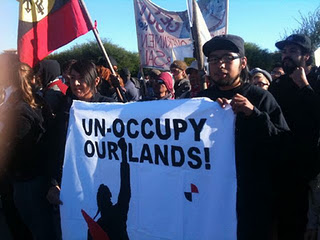
Arizona's Indigenous resistance to border militarization, CIR.

edited 03/17/14)


I was called out not long ago by a local Indigenous organizer I respect a lot. He was concerned about my uncritical support for the PUENTE hunger strikers, and my failure to really dig into how the larger "immigrant rights movement" had co-opted the actions of the hunger strikers and twisted it to fit their own agenda - which was to throw every criminalized immigrant under the bus while calling for "NOT1MORE Deportation!" (translated: No more "unnecessary deportations", that is, of the "good immigrants" only). The National Council of LaRaza, anyway, thinks it's still okay to deport every criminalized immigrant ICE finds - which includes the prisoners that PUENTE families have been trying to free from detention. 

Along those same lines, The NCLR as well as a lot of other immigrant organizations are clamoring for Comprehensive Immigration Reform (CIR) to be passed...this CIR. It's disastrous not only for immigrants, who are being tricked into thinking this "path to citizenship" will someday apply to most of them and their loved ones, but also to the Indigenous people most affected by border militarization - the Tohono O'odham, whose territory covers much of this part of the country. And despite how the current CIR plan on the table - S 722 - promises massive military buildup at the border and guarantees that they will pack more immigrants into private detention centers to enrich the evil people profiting from those places, I have indeed neglected the issues; my head has been kind of stuck in the AZ DOC and MCSO jails of late.

So, I'm taking a more thoughtful look around at the world again. I still support families and prisoners who take their fate into their own hands and launch direct actions instead of waiting for others to rescue them - it's not in their control what the rest of the movement does, if their efforts are exploited  or objectives distorted by others. That said, however, I do owe folks here a more thorough look at the issues involved in CIR, border militarization, and how the movement of people and goods across international borders interacts with the Prison Industrial Complex. Feel free to check me too, if I'm missing something.

For now, check out this interview with Alex Soto and Klee Benally, both committed activists and talented musicians. You can find Shining Soul's website here and their music here- it's pretty potent. Klee's music is here, and his organization is here. I know both men from their work in the community resisting the brutalization and militarization of their land, exploitation of their resources, harassment of their people, and the desecration of their sacred sites. 


---from Democracy Now with Amy Goodman---

Caught in the Crossfire: U.S.-Mexico Border Militarization Threatens Way of Life for Native Tribe

Democracy Now (March 14, 2014)
Transcript follows the video.


President Obama has deployed thousands of new U.S. Border Patrol agents to the southern border of Arizona, a state known for its controversial crackdown on immigrants. Caught in the middle of the border militarization are about 28,000 members of the Tohono O’odham Nation. Their federally recognized reservation is about the size of the state of Connecticut, and for a 76-mile stretch it spans both sides of the U.S.-Mexico border. Broadcasting from Flagstaff, we speak with both Klee Benally, a Diné (Navajo) activist, and Alex Soto, a member of the Tohono O’odham Nation and organizer with O’odham Solidarity Across Borders. He is also a member of the hip-hop duo, Shining Soul. "The Tohono O’odham people, which translates to desert people, are caught in the midst of colonial policies that are now militarizing our lands, from just the amount of Border Patrol agents, to checkpoints, to drones, to just the overall surveillance of our community," Soto says.

Transcript

This is a rush transcript. Copy may not be in its final form.

AMY GOODMAN: "Papers" by Shining Soul, a hip-hop duo that our next guest is a member of. Yes, this is Democracy Now!, democracynow.org, The War and Peace Report. I’m Amy Goodman. We’re on the road in Flagstaff, Arizona, a state known for its controversial crackdown on undocumented immigrants under Governor Jan Brewer, who announced this week she is not running for re-election. President Obama has also deployed thousands of new U.S. Border Patrol agents to Arizona’s southern border with Mexico.
Well, caught in the middle of this are about 28,000 members of the Tohono O’odham Nation. Their federally recognized reservation is about the size of the state of Connecticut. And for a 76-mile stretch, it spans both sides of the U.S.-Mexico border. Many O’odham must now pass through checkpoints when traveling through their land, and some members living in Mexico are almost completely cut off from their tribe.
Our next guest was part of a protest in 2010 where demonstrators opposed to border militarization and checkpoints occupied the U.S. Border Patrol offices at Tucson’s Davis-Monthan Air Force Base. Alex Soto is a member of the Tohono O’odham Nation and organizer with O’odham Solidarity Across Borders. He’s also a member of the hip-hop duo, Shining Soul.

Staying with us, Klee Benally, Diné, Navajo, activist.

Alex, welcome.

ALEX SOTO: Hello.

AMY GOODMAN: It’s great to have you here in Flagstaff, quite far, actually, from the border.

ALEX SOTO: Yeah.

AMY GOODMAN: Talk about the key issues right now.

ALEX SOTO: Well, currently, my community is in the middle of just the current push to militarize the border region. The Tohono O’odham people are—which translates to "desert people," are caught in the midst of colonial policies that are now militarizing our lands from just the amount of Border Patrol agents to checkpoints, to drones, to just the overall surveillance of our community. So, right now, you know, our way of life as O’odham are being affected, you know, from traditional practices to seeing family and friends, and just overall just being affected by the militarization.

AMY GOODMAN: Describe the wall to us.

ALEX SOTO: Well, on our reservation, keep in mind, the border region that you shared, 76 miles, is not necessarily a wall yet. All it is, is vehicle barriers. So, in my lifetime, at one point, you know, early childhood, there was no fence. There was nothing there. So, through my lifetime, I’ve seen the changes due to the current immigration policies that are acted out by the U.S. government. And now it’s to the point where we have vehicle barriers. But the current push for comprehensive immigration reform is now pushing towards a Berlin Wall-like scenario in my community right now.

AMY GOODMAN: Describe how you’ve seen the border militarized over the years of your growing up.
ALEX SOTO: You know, growing up—and I’m only 28 now—just being young, I was always raised to know that, as O’odham, you know, the land on both sides of the so-called U.S.-Mexico border is our land. And so, when I was young, there was no border there, other than chicken-wire fence for ranching or, you know, practices within the community. Only until—since the early '80s to the early ’90s, in particular with the passing of NAFTA, did we see the push to then regulate the border due to the level of migrant communities or indigenous people from Mexico now migrating here due to policy, economic policies by the U.S. So, you know, through the ’90s, it has escalated more and more just due to that, into 2001, with 9/11, where it pushed more policies towards militarization. So right now we're currently in that state, along—more or less because of immigration policy, as well. So, hand in hand, these issues are impacting us that are not necessarily O’odham issues, but the global context is now pushing that militarization on our land.

AMY GOODMAN: I mean, it’s so interesting that we’re talking about immigration issues when you’re the original people of this land.

ALEX SOTO: Yeah.

AMY GOODMAN: Talk about the Know Your Rights trainings that you’re involved in.

ALEX SOTO: I’m part of a grassroots effort in the community, along with many other young people, who are taking initiative to now know our rights in relation to Border Patrol, because in our community the Border Patrol operates as if—you know, with no accountability. I mean, they—keep in mind, our reservation is not in an urban setting; it’s in a rural area. So, agents, they pretty much act out, you know, whatever they want. And that being said, community members are in a position where they don’t know what their rights are. So, my friends, in particular, the collective that I’ve been involved with, solidarity work, they’ve been putting that out there as far as what are the dos and don’ts. And in particular, when it comes down to Border Patrol interactions, they really are only supposed to ask your citizenship. They’re not supposed to ask where you’re coming from or who’s your family or who is this person in the back that looks, you know, in their eyes, illegal and so forth, even though, as you mentioned, we are the first inhabitants of the land. And keep in mind, we’re all indigenous people, as was mentioned.

AMY GOODMAN: I mean, it’s interesting you’re here at Northern Arizona University, which has a large criminal justice department. Students move on from here, many go into Border Patrol. Isn’t Border Patrol the largest security force in the United States?

ALEX SOTO: From my understanding, they’re getting up there to that point, because in our community, we have nearby border towns, such as Ajo, such as Casa Grande, where Border Patrol agents are—you know, that the push have been—you know, the escalation of what’s going on. Small rural towns are becoming just havens for them to now live. You know, there’s thousands of residents, in particular in Ajo, who now have Border Patrol agents housing there. So, it’s pretty sad in that regard.

AMY GOODMAN: I wanted to end by asking both of you about your music as a part of your resistance and your political activism. Talk about Shining Soul.

ALEX SOTO: Shining Soul is myself and my other colleague, who’s from South Phoenix, who’s a Chicano, Franco Habre, aka The Bronze Candidate. My hip-hop project is called Shining Soul, so together we’re a duo. You know, we rap. We make our beats. And with our music, we’re able to express what’s happening in our communities, you know, in the spirit of Public Enemy, in the spirit of NWA, to let not just our communities know, but the outside world, that these issues are affecting us, but it’s not just an indigenous issue or a Chicano issue or, you know, any—it’s everybody’s issue. So, from music, you know, dope beats and dope rhymes, as they say, you know, as an emcee, in the spirit of hip-hop’s—you know, in its early starts, you know, I spread that message in that regard, including his own regard is through his music, as well.

AMY GOODMAN: Klee, talk about your music in Blackfire.

KLEE BENALLY: Well, music is a tool for social transformation and change. I mean, in an era where we see capitalism as the enemy of Mother Earth, and indigenous people are tokenized, and we are—continue to face the ongoing genocide of our people—because, I mean, you asked what is the impact of global warming on indigenous people. It is genocide. I mean, the resource extraction on our lands is the result that you see with the symptoms of global warming. And so, music, for me, is an opportunity, a powerful opportunity, to get that message out there and to let people know that we need hope, but we need action. We have to meet that, match that.

AMY GOODMAN: And, Klee, also talk about Outta Your Backpack Media collective.

KLEE BENALLY: Outta Your Backpack Media was started in 2004 as a response to the need for media justice in indigenous communities. So what we do is we offer free workshops and resource kits for indigenous youth and empower them to be able to tell their own stories, because we know, and as you know, corporate media is not going to do the job for us. We need to do it ourselves.

AMY GOODMAN: And who are you training?

KLEE BENALLY: I work with indigenous youth, primarily high school ages, and we’re a collective. We’re all volunteer. And what we do is we train youth to become mentors themselves, to participate and educate other youth. So, really, it’s a spreading, it’s a growing movement. It’s connected to the music that Alex is doing; it’s connected to my music. And really, there is a strong upsurgence and uprising of indigenous people, not just with Idle No More, because we’ve never been idle. We are still part of this struggle. We’re still here.

AMY GOODMAN: Idle No More being the indigenous movement in Canada.

KLEE BENALLY: Yeah, and we’ve never been idle. My elders never gave up. When the U.S. government forces were coming to take their land up in Big Mountain and Black Mesa, which I believe you’ve been there—

AMY GOODMAN: My first radio documentary in 1985 was called A Thumbprint on Mother Earth, and, yes, I came out here to Flagstaff, went to Big Mountain and looked at the plight of the Diné and Hopi people. Often it was cast as a battle between these two tribes. But, in fact, when you came here and looked, you saw Peabody Coal behind the whole thing.

KLEE BENALLY: And that’s the connection to global warming. I mean, as long as people are tied up in these unsustainable lifestyles and continue down this destructive path that fuels this war against our mother, the Earth, then we’re going to have this conflict. And that’s—the resistance is still going on today. People are still on the land. They are still staying strong, carrying on our ways of life.

AMY GOODMAN: We’ll link to that documentary, A Thumbprint on Mother Earth, and also to the work of our guests. Alex Soto, thanks so much for being with us, O’odham Solidarity Across Borders, and Klee Benally, Diné, Navajo, activist.

Friday, January 11, 2013

Idle No More Phoenix: Action, Solidarity, and Resurgence.

Over the course of the past week I've had the privilege to bear witness to several events in the Phoenix area with Indigenous activists involved in the Idle No More movement out of Canada, now sweeping the planet.

Join Idle No More - Phoenix at Steele Indian School Park (parking lot C) on Friday, January 11, 2013 at 5:30pm to support a Global Day of Action, Solidarity and Resurgence. 


Below: Idle No More at PUENTE with migrant justice and other anti-racist organizers, 
preparing for the Jan 11 action...


"Idle No More calls on all people to join in a revolution which honors and fulfills Indigenous sovereignty which protects the land and water. Colonization continues through attacks to Indigenous rights and damage to the land and water. We must repair these violations, live the spirit and intent of the treaty relationship, work towards justice in action, and protect Mother Earth."


Thursday, January 3, 2013

Federal Persecution of Indigenous Activists steps up.

 
I lifted the following posts from Indigenous Action Media to catch myself up to speed on the resistance in Arizona. I spent New Year's Eve with Klee Benally and a small gathering of friends in Flagstaff, and saw the sunrise from the San Francisco Peaks before leaving the gift below at the entrance to Snowbowl Road. I was deeply troubled by all I learned about the US Attorney's office's latest attacks on Klee and his comrades. 

As many readers of this blog know, Snowbowl is celebrating 75 years of desecration this year with a new feature: treated sewage effluent. Flagstaff's waste water has extended their season as well as the amount of recreational activities they offer now. Of course, it's not only a health and environmental concern, but the spewing of sewage all over the mountain is desecrating a sacred site, a continuation of the genocidal process the prison industrial complex is now playing its part in perpetrating - witness the persecution of Indigenous resisters to the violence against their people and culture, and join us in solidarity actions. 

You don't need a Facebook event page or a whole crew to make your own thoughts on the desecration known, by the way...this was done by my lonesome with simple food coloring and spray bottles, and I set up my tripod so my camera was watching my back. Always make sure someone is watching your back...


 Snowbowl Road Entrance, Flagstaff
New Year's Day 2013


Below are the last three posts from Indigenous Action Media. They do good work there. Please support them every way you can. Info from their site:


Indigenous Action Media (IAM) was founded on August 25th, 2001 to provide strategic media support and direct action to address issues impacting Indigenous communities.


IAM offers media strategy consultation and support in the face of environmental & social injustices. We do this through direct support, workshops, web and graphic design services, documentaries and youth empowerment projects.

We are a volunteer collective of experienced Indigenous media makers & activists that work together on a project by project basis for media justice from an anti-colonial & anti-capitalist framework.


-------------------------------

Peaks Activists Targeted with Federal Charges and Arrest Warrants as Forest Service Announces New Sacred Sites Policy

December 10, 2012
By
FOR IMMEDIATE RELEASE
Monday, December 10, 2012
CONTACT:
Klee Benally
indigenousaction@gmail.com

National Forest Service Announces New Sacred Sites Policy at the Same Time That Flagstaff Peaks Activists Are Targeted with Federal Charges and Arrest Warrants 
 
Peaks Activists Vow to Fight Charges and Plan to Turn themselves Over to U.S. Marshalls 
 
What: Peaks activist Klee Benally and others expected to be arrested
When: Tuesday, December 11, 2012 at 8:15 a.m
Where: US Marshall’s Office 123 N. San Francisco St, Flagstaff, AZ


FLAGSTAFF, AZ — On the same day that secretary Tom Vilsack of the US Department of Agriculture issued a final report on Sacred Sites and an inter-agency memorandum to work towards Sacred Sites protection, the Coconino Forest Service filed federal charges against four Sacred Sites advocates who were part of a protest at the Forest Service offices three months earlier.

On September 21, 2012 more than a dozen Flagstaff community members peacefully delivered letters to address the US Department of Agriculture’s policy on sacred places. While community members delivered the letters, a “quarantine” was also theatrically staged in the Coconino National Forest Service lobby to protest the agency’s role in approving of an Arizona Snowbowl ski area expansion and snowmaking with treated sewage effluent on the Holy San Francisco Peaks. Several members of the theatrical staging wore white suits and held caution tape with signs that said, “Quarantine Snowbowl,” “Forest Service Kills Native Culture, Stop Snowbowl,” and “Protect the Sacred.”

The four protestors are facing multiple counts (Section 261.3a) of a misdemeanor charge for allegedly interfering with a Forest officer. The statute reads, “Threatening, resisting, intimidating, or interfering with any forest officer engaged in or on account of the performance of his official duties in the protection, improvement, or administration of the National Forest System is prohibited.”

“Not only are these federal charges absurd, they are an attack on freedom of expression,” stated Klee Benally, a Dine’ (Navajo) activist who has been advocating for Indigenous religious freedom and protection of the holy Peaks for more than 14 years. “The fact that the USFS would bring these charges the same day they released their report on the protection of sacred sites demonstrates that they are not acting in good faith.”

Klee Benally delivered two letters to acting Forest Supervisor Earl Stewart calling for an immediate halt to ski area expansion and snowmaking with treated sewage effluent on the holy San Francisco Peaks. The letters were addressed to the Obama administration and included: US Department of Agriculture (USDA) Tom Vilsack, Senior Adviser for Tribal Affairs USDA Janie Hipp, Coconino National Forest Supervisor Earl Stewart, and Counselor to the Assistant Secretary of Indian Affairs Dion Killsback. The letters called for the termination of Snowbowl’s Special Use Permit and the protection of sacred places.

The letters also focused on public health concerns due to contaminants in the treated sewage effluent that Snowbowl ski resort intends on using for snowmaking on the Holy site and demanded a moratorium on the use of treated sewage effluent, commonly called reclaimed wastewater to avoid the “ick factor”, in public places.

“I entered the building with a group of people and requested to speak to Forest Supervisor Earl Stewart, we had a cordial conversation, he accepted letters regarding the sacred sites policy, we shook hands multiple times. We broke no laws. The Forest Service is the one who is violating the law of the creator.” stated Benally. “Myself and others will turn ourselves over to the U.S. Marshall tomorrow at 8:15 a.m. so we can move towards ending this act of repression and political retaliation against us by the US Forest Service.”

The U.S. Marshall’s office is located at 123 N. San Francisco St.. Benally and others are expected to be arrested and appear before a judge for arraignment at 10:00 a.m.

According to the Forest Service complaint, the fire department and a hazmat team were called to address a potentially hazardous spill of clear liquid that had flooded the Forest Service lobby floor after protesters exited. An unknown individual allegedly tipped over a 5 gallon bucket full of what the hazmat team determined to be treated sewage effluent.

“These charges are absurd! The irony is that the USFS has authorized Snowbowl to spill more than one million five hundred thousand gallons of treated sewage effluent per day onto a rare and pristine alpine habitat. Yet they feel its appropriate to call hazmat when a pail of wastewater is allegedly poured onto their polished tile floors? I hold the USFS liable for the environmental poisoning that is set to occur on the Peaks right now,” stated Flagstaff resident Evan Hawbaker.

On December 6, 2012, while addressing more than 500 Indigenous leaders at the “White House Tribal Nations Conference” Secretary Vilsack unveiled a sacred sites report stating, “This report represents a commitment by USDA and other agencies to be better partners and improve communications about Sacred Sites, better protecting those sites, access and provide government-wide training to ensure that there is a better understanding of the relationship those sites have to decisions we make.” Vilsack continued, “While we have made strides in improving services to Tribes, much is left to be done. One step we are taking today is the filing of our Sacred Sites report.”

“The President is insistent that these Sacred Sites be protected and preserved: treated with dignity and respect.  That is also my commitment as Secretary of USDA.  I know my fellow Secretaries share in this commitment.  We understand the importance of these sites and will do our best to make sure they are protected and respected.” Vilsack stated.

(http://blogs.usda.gov/2012/12/06/secretary-vilsack-addresses-white-house-tribal-nations-conference-unveils-sacred-sites-report/#more-43547)

Read the delivered letters here: http://protectthepeaks.org/protect-the-peaks-letter-to-usda-protect-the-holy-san-francisco-peaks-terminate-snowbowls-special-use-permit-for-higher-public-purpose/

Read the sacred sites report here: http://www.fs.fed.us/spf/tribalrelations/documents/sacredsites/SacredSitesFinalReportDec2012.pdf


News Release: Peaks Supporters Face Federal Charges in ‘Politically Motivated Attack’

December 12, 2012
By
Forest Service attempts to ‘Ban’ Peaks Activists from the Peaks to Prevent Further Protests
FOR IMMEDIATE RELEASE

December 12, 2012
Contact:
Klee Benally
indigenousaction@gmail.com


Peaks Supporters Face Federal Charges in ‘Politically Motivated Attack’
Forest Service attempts to ‘Ban’ them from the Peaks to Prevent Further Protests

Note to editors: Video of September 21, 2012 protest available upon request.

Klee Benally sings before being arrested.
FLAGSTAFF, AZ — On December 11, 2012 three Peaks activists peacefully turned themselves over to U.S. Marshalls in response to allegations of federal charges and “sealed” warrants resulting from a civil protest at a Forest Service building on September 21, 2012.

“It is obvious why these court documents were sealed, the Forest Service wanted to arrest and make an example out of us to deter further protests for protection of the Holy San Francisco Peaks.” stated Klee Benally a Dine’ (Navajo) activist. Benally has been advocating for Indigenous religious freedom and protection of the holy Peaks for more than 14 years, “This is a politically motivated attack that was clearly timed to send a message to anyone who cares about the Peaks from protesting Snowbowl snowmaking with treated sewage effluent.”

Benally declared to a crowd of supporters at the Marshall’s office, “The Forest Service lied in the Environmental Impact Statement, they lied in court, they are lying about these charges, and they are lying about their sacred sites policy. We are being arrested today because we are not afraid to stand up and speak the truth!”

Protect the Peaks supporters gather outside the Federal Courthouse.
The three Peaks activists were kept in shackles around their waists, hands and feet and caged for nearly 5 hours while waiting to appear before a judge. While in custody, plain clothed U.S. Forest Service agents attempted to individually interrogate the Peaks activists without lawyers present.

Forest Service law enforcement captain John Nelson was the only Forest Service representative in the courtroom. Nelson has a history of intimidating and harassing Peaks supporters and traditional practitioners engaged in prayer on the Peaks.

“It seems clear to me,” Benally stated, that the Forest Service is seeking to suppress any further possibility of us speaking the truth for religious freedom and protection of the holy San Francisco Peaks.”

The prosecutor repeatedly requested that the judge “ban” the activists from going on the San Francisco Peaks and to any Coconino Forest Service building as a condition of their release. During the arraignment, the federal prosecutor continually stated that he was concerned about the possibility of further protests.

Attorney Matthew Brown argued that Benally’s religious practice was directly connected to the San Francisco Peaks and restricting his access to the Holy Mountain would be akin to preventing him from going to church. The judge agreed not to ban Benally from the Peaks but cautioned him that if he broke any laws he would be immediately imprisoned until trial. Even a wrongful arrest on USFS lands would be grounds for imprisonment until trial.

The three Peaks supporters were released just after 2:30 p.m.. They re-joined the group of supporters and held a banner stating, “Protect Sacred Sites, Defend Human Rights.”

A status hearing for the Peaks activists will be held on December 27, 2012 at 10:00 a.m. at the Flagstaff Federal Courthouse. A date for a bench trial is expected to be set then.

The four protestors are facing multiple counts (Section 261.3a) of a misdemeanor charge for allegedly interfering with a Forest officer. The statute reads, “Threatening, resisting, intimidating, or interfering with any forest officer engaged in or on account of the performance of his official duties in the protection, improvement, or administration of the National Forest System is prohibited.”

“Not only are these federal charges absurd, they are an attack on freedom of expression,” stated Benally, “The fact that the USFS would bring these charges the same day they released their report on the protection of sacred sites demonstrates that they are not acting in good faith.”

“The final report on Sacred Sites repeatedly points directly at Coconino National Forest and Secretary Vilsack’s callous handling and subsequent approval of using treated sewage effluent to make snow at Arizona Snowbowl.” stated Rudy Preston, a citizen of Flagstaff. He continues his statement “it was the single most detrimental action to their ability to even be taken seriously while doing public outreach to create the report. I feel like the timing of these arrests had two goals in mind: the first was to ban effective activists from Snowbowl as the resort begins to make poop snow, and the second was to thumb their noses at the Sacred Sites report and say, ‘this is how we do it in the Coconino and we don’t care if you want to make good relations with Indigenous cultures.’ Even the Snowbowl Record of Decision clearly states ‘this project will likely have a disproportionately adverse effect on affected Native Americans (p.32)’ and additionally states that the no action alternative ‘is the environmentally preferable alternative because it would not have approved any of the physical, cultural or biological impacts that are anticipated under the implementation of Alternative 3 (snowmaking and expansion, p.33).’”

Peaks supporters have stated that they are undeterred from this attack on their freedom to express themselves and will continue their efforts to protect the holy San Francisco Peaks.

“The natural laws and the indigenous people were already here in a good relationship before the coming of the colonial society who draws law and boundaries.” stated Big Mountain resister Louise Benally who was outside the courthouse offering support, “However we Indigenous Peoples will always have ties with these lands, we will continue to live that way with nature and we will carry on. These man-made laws by the U.S. government will vanish soon.”

Previous News Release & Forest Service Report here: http://www.indigenousaction.org/peaks-activists-targeted-with-federal-charges-and-arrest-warrants-as-forest-service-announces-new-sacred-sites-policy/

More info: www.ProtectthePeaks.org

News Release: Arizona Snowbowl Starts Making Fake Snow from Treated Sewage… and it’s Yellow

December 24, 2012
By


FOR IMMEDIATE RELEASE
Monday, December 24, 2012
Contact: Rudy Preston
Email: info@truesnow.org
Phone: 480-382-5288
www.TrueSnow.org
Arizona Snowbowl Starts Making Fake Snow from Treated Sewage… and it’s Yellow
FLAGSTAFF, AZ (San Francisco Peaks) — After a decade of legal battles and opposition from environmental groups, concerned citizens, and Indigenous Nations, Arizona Snowbowl ski area has started making fake snow from Flagstaff’s treated sewage effluent.

Surprise… it’s yellow!

“My parents always told me not to eat yellow snow, this is absolutely disgusting,” said Katie Nelson, longtime resident of Northern Arizona. “ Will parents tell their kids it’s OK to play in it? I used to be a skier and snowboarder, but I am boycotting Snowbowl because they obviously don’t care about my health or the environment.” stated Nelson.

Snowbowl is set to be the only ski area in the world to make snow from 100% treated sewage effluent. This action has raised serious concerns from community and environmental groups due to potential risks to human health and the sensitive mountain ecosystem.

“Snowbowl is clearly disregarding public health by not fulfilling their requirement to have signs posted that the fake snow is made from treated sewage and that it must not be consumed. I checked the entire area where kids ski and learn to ski and I could not find any warning signs.” stated Rudy Preston, former board member of the Flagstaff Activist Network. “There were none posted on the childrens ski lifts either,” he continued.

Although Snowbowl manager JR Murray has stated that treated sewage would be “…cleaner than the snow falling out of the sky” the yellow colored snow clearly indicates that something is wrong.
State law mandates that it is illegal for anyone to consume snow made from treated sewage effluent. Ingestion pathways include the eyes, ears, nose, mouth, and skin. Additionally, any “direct reuse” cannot even have the “potential for ingestion.” While Snowmaking is considered legal, the “direct reuse” of this treated sewage effluent is in fact “skiing” and ADEQ is ignoring their own laws when it allowed Snowbowl to make snow (Arizona Administrative Code: R-18-9-704).

“Despite the obvious health risks, you would have thought that respect for our Indigenous brothers and sisters would have been enough to stop this project years ago, treated sewage for snowmaking is an absolute affront to Indigenous Nations that revere the Peaks as holy and I for one choose to respect their wishes and will no longer ski at Arizona Snowbowl.” stated Rudy Preston.

Multiple protests and prayer gatherings have been held since Snowbowl opened last Thursday.
On November, 14, 2012 the Hopi Tribe filed a new lawsuit and for injunctive relief due to threats reclaimed water poses to an endangered plant that is found nowhere else in the world but on the Peaks. The Hopi Tribe requested an injunction to be placed on snowmaking activities until consultation was completed with both the US Fish and Wildlife and Department of Agriculture. The court has yet to issue a response.

The wastewater, which is treated to Flagstaff’s highest standard, has been proven to contain endocrine disrupting chemicals (http://azdailysun.com/article_a53bda53-1369-5d4b-bf1f-cbce10164267.html) and now even anti-biotic resistant genes (http://www.rwlwater.com/antibiotic-resistant-bacteria-genes-found-in-flagstaff-water/). Since the Environmental Protection Agency has no regulations addressing these contaminants in treated sewage, the Forest Service, City of Flagstaff, AZ Department of Environmental Quality (ADEQ), and Snowbowl continue to call it “clean enough to drink” although it would be illegal to do so.

ADEQ regulations allow A+ treated sewer water to contain fecal matter in three out of seven daily samples (R18-11-303 2a). In addition, according to Northern Arizona University biologist Dr. Paul Torrence, the treated sewage effluent may also contain antibiotics such as triclosan and triclocarban, which break down into bio-accumulating cancerous dioxins when exposed to sunlight.

For nearly a decade every environmental concern brought to the courts by Sierra Club, the Center for Biological Diversity, and Flagstaff Activist Network have been swept under the rug on filing technicalities and no court has ruled on the issues raised about direct reuse and ingestion. In another lawsuit by the Hopi challenging the legality of the City’s contract with Snowbowl, Judge Joe Lodge ruled that the tribe waited too long for the court to make a ruling on clear ADEQ environmental law violations.

Download high resolution pictures here:

https://docs.google.com/open?id=0B9AUXPXEUmRJS1NtaWVMdHBPVEU

Photo credits: Katie Nelson and Rudy Preston

Friday, January 27, 2012

Beau Hodai: ALEC's persona non grata


The Indigenous call-out in Arizona to resist ALEC
(November 2011)

Inside ALEC: Naked Contempt for the Press and Public in Scottsdale

by: Beau Hodai, PRWatch | Report 
 
"Mr. Hodai had a history at the conference--not a very pleasant history. He was considered to be a persona non grata..."

-- Westin Kierland General Manager Bruce Lange to Olivia Ward of the Toronto Star.

Evicting the Press, Part 1: Meet Mr. Black

Scottsdale, Arizona--A suburb awash in money and golf courses, set against the backdrop of the jagged mountains surrounding Phoenix.

I was sitting in a sports bar of the Westin Kierland Resort and Spa, swapping journalism stories with Olivia Ward of the Toronto Star on one of the bar's overstuffed leather couches. Over the course of an hour, the bar filled with conventioneers from the American Legislative Exchange Council's 2011 States and Nation Policy Summit (SNPS). (A new story on Westin's connections to other ALEC corporations is available here.)

My assignment was to cover the 2011 SNPS, taking place at the resort from November 29 through December 2. ALEC had refused to grant me media credentials. Nevertheless, I was a paid guest at the resort.

Most of the ALEC members trickling into the bar were fresh from the ALEC "Holiday Gala." As drinks were consumed and new rounds were ordered by guys with ALEC badges, the place began to take on a distinct "Animal House" vibe.

Ward and I were just about to head to our rooms for the night when I saw Phil Black, director of Kierland's security team, approach two uniformed police officers just outside the entrance to the bar. The cops had arrived an hour earlier, glanced at Ward and me, then stationed themselves by the door.

Black entered the bar and headed straight towards me. "Would you mind coming with me, sir?"

Once outside the bar, we were joined by the cops and I was shuffled up the stairs.

"What's this all about?" I asked with Black facing me; a cop to either side, just behind me.

"We understand that you've attempted to enter ALEC events and been asked to leave numerous times," said Black.

This was not true. I had been on my best behavior. And, I had known, since my first meeting with Black the night before, that I was being watched.

Police with a Photo Array of Personas Non Grata

The previous night, I had passed by some cops. When I glanced back I caught one of the cops staring, a look of intense and painful concentration on his face, at a sheet of paper. The paper displayed an array of photos. As was later explained to me by a cop working the resort, it was a photo array of personas non grata provided to the cops via ALEC.

Moments later, after passing the cluster of cops, I was flagged down by a man who asked me who I was, why I was in Scottsdale, where I was from, what line of business I was in.
I gave vague answers and asked who he was.

"Oh, I'm with the hotel," said Black. "Have a nice stay."

Uniformed Police as Bouncers

The next night, I had wandered back into the ballroom where a swirling galaxy of well-dressed lawmakers and lobbyists were hobnobbing, some with neat single malts in hand. There was no indication posted anywhere that this party was limited to ALEC members. Nevertheless, I had been tailed through the ballroom by a cop. As I stepped outside for a smoke, I heard a voice behind me.

"Sir, are you part of the delegation?" It was a uniformed police officer later identified as Phoenix Police Department (PPD) Sergeant Lowe. I explained that I was not a member of ALEC, but that I was a guest at the resort. Lowe explained that the party was private and asked me to return to resort common areas.

Making my way to the door, Lowe in tow, I was approached by two women with resort security.

"Hi ... you're the one on the motorcycle, right? You're with ALEC? You're a guest at the resort? Just so you know, this is a private function, so we just ask that all our regular guests stay in the main area... Okay?"

No problem. I left.

"The ALEC People Don't Want You Here ..."

So, when Black accosted me at the bar the following night and claimed I had been asked to leave numerous ALEC events at the hotel, I explained that this was the extent of my one and only 'incident' and nodded to Sgt. Lowe over my left shoulder. "Ask him," I said.
"Nevertheless," said Black. "The ALEC people don't want you here ... and we understand that your reservations were made under false pretenses."

I asked Black why--given the fact that I had not been accused of any crime--I was surrounded by armed, uniformed cops. Were Phoenix police usually engaged in evicting hotel guests who were suspected of having made hotel reservations under supposedly "false pretenses?" Must be a slow night....

And, how could a person even make a hotel reservation under false pretenses, I asked. I had given the front desk my valid photo driver's license and my credit card for incidental expenses. I was planning to stay in the resort for two days and those two days had been paid for by the Center for Media and Democracy (CMD).... "False pretenses?"

Black would not elaborate further, limiting his conversation only to statements emphasizing the resort's urgent need for me to vacate the premises immediately.

Black said that he would--with the help of these nice police officers--escort me up to my room and help me pack.

I was, as Sgt. Lowe explained, being "trespassed"--which meant that I was being formally advised that I was not welcome on Kierland property. If I returned, or refused to leave following this advisory, I would be arrested and charged with criminal trespassing.

ALEC's Corporate Connections 

ALEC bills itself as being the nation's largest bipartisan legislative membership organization, dedicated to the advancement of "federalism" and "Jeffersonian ideals."

The simple reality of ALEC is that the organization serves as an intermediary, a conduit through which roughly 2,000 state legislators (the vast majority of which are Republicans) are connected with legions of lobbyists representing more than 300 global and national corporations.

Corporations pony up enough cash to help pay the travel, room, and dining expenses of hundreds of state lawmakers at luxury resorts through "scholarships" facilitated by ALEC. After closed-door meetings between lobbyists and politicians voting as equals on "model legislation," politicians often return to their home state to introduce those bills covering almost every area of law.

For ALEC’s winter meeting in sunny Arizona, corporate sponsors included dozens of global corporations, such as AT&T, Time Warner Cable, State Farm Insurance, Johnson and Johnson, the American Bail Coalition, Diageo, UPS, Exxon Mobil, American Petroleum Institute, Wal-Mart Stores, Inc. and AstraZeneca-- to name a few. ALEC’s operations are also underwritten by billionaires Charles and David Koch (who control Koch Industries, including "Koch Companies Public Sector").

ALEC has come under increased scrutiny in recent years in the media due to its tremendous influence over dramatic changes to the law being pushed in states across the country. Public awareness of ALEC jumped dramatically this past summer after the In These Times investigation of ALEC’s "Publicopoly" and the Center for Media and Democracy's detailed exposé of ALEC model bills, legislators, and lobbyists through ALECexposed.org, after a whistleblower came forward.

And, as a result of growing public malcontent with lawmaker malleability in the face of corporate greed, lawmakers attending ALEC events have been met ever more frequently by members of the public voicing their displeasure with the organization’s role in facilitating the cozy relationship between politicians and corporations.

The 2011 States and Nation Policy Summit was no exception to this trend.

Outside: Public Dissent Met with Pepper Spray


On November 30, the first full-fledged day of the conference, rows of police in full riot gear stood along along Kierland's eastern gate, providing a living buffer between the public and the guests at the posh hotel. Helicopters swarmed above the resort. Flanking both entrances were assembled a couple hundred protesters decrying undue corporate influence over elected lawmakers. These protesters were from several activist groups loosely united under the banner of "Occupy ALEC"--in most part an offshoot of "Occupy Phoenix" and a group known as "AZ-Resist."

Inside the resort ALEC conventioneers gathered for lunch and a speech by ALEC alum and Arizona Governor, Jan Brewer.

Brewer welcomed the conventioneers to Arizona, “the state too strong for any union sponsored boycotts to bring down! And their presence is so eloquently so in demonstrating.
They're out there ... they're out there," said Brewer scornfully. "Anyway, thank you all for coming today. And thank you to all you from the business community, I certainly thank you for your private sector sponsorship."

Recently retired Louisiana State Representative and outgoing ALEC national chairman, Noble Ellington, claimed the protests showed ALEC was doing something right:

"It is just so exiting and I hope you feel the same way that ALEC is on the move," drawled Ellington. "We've got things goin' our way and we're bound to be doing something right, or we wouldn't have the helicopters flying around and the demonstrators..."

Uproarious applause.

"Would you join with me in thanking Novartis for this luncheon today? They have been some really good friends to ALEC and we thank them so much..." said Ellington.

ALEC Director of Communications Kaitlyn Buss then sang the national anthem.

By the time Buss hit her high note, "For the land of the Freeeeeeeeee...," Phoenix police officers were treating protesters outside to the second round of pepper spray of the day.

Betsy Schuler, a former school teacher, was pepper sprayed as officers were moving barricades into the crowd. Schuler said an officer reached over the barricade and started pepper spraying the non-violent protesters. Schuler got a face full of the stuff. The officer, recalled Schuler, stood behind police barricades, smiling smugly.

Schuler was a part of a delegation of Unitarian Universalists who had joined the protests as peacekeepers.

According to Phoenix Police Department spokesman Sgt. Trent Crump, the first of a series of confrontations between the police and the protesters had occurred a few hours earlier that morning.

According to Bret "Buddha" Cary, a small business owner and an organizer with Occupy Phoenix, a group of anarchists had brought a large black canvas banner ("Shut Down ALEC") supported by a framework.

The anarchist moved toward the front of the protests and put the banner between the police and the protesters.

At first, police tried to push the banner back with their own barricade. Eventually, an officer reached over the police barricade and grabbed hold of the banner, tearing it apart. The cop then began throwing pieces of the banner back at the protesters.

A protester screamed, "No! No! No!" as pepper spray was sent out in bright orange streams to the crowd.

Cary and others tried to obtain the name of the officer who had reached over the barricade and grabbed the banner but the officer would not divulge his name and retreated to Westin grounds, smiling smugly at the protesters from a distance. Following the incident, Cary filed a complaint with PPD internal affairs. He has received no response to his complaint.


Inside: Public Dissent Met with Laughter

By the time Arizona House Majority Whip and ALEC Public Sector Chair, Rep. Debbie Lesko, kicked off her remarks on the Novartis stage, several protesters had been placed under arrest and loaded into paddy wagons.

"We have some critics--we saw a few of them outside--because a group recently wrote a large report criticizing ALEC," said Lesko ("ALEC in Arizona: The Voice of Corporate Special Interests in the Halls of Arizona’s Legislature," by Common Cause and People for the American Way). "And so, what better way is there to explain Arizona's involvement in ALEC by reading right from that very report?! So, here we go..."

"'Arizona has one of the highest concentrations of ALEC legislators of any state in the United States.'"

Uproarious applause.

"'At least 50 of the 90 legislators now serving in the legislature are ALEC members....'"

More uproarious applause.

"Yay Arizona," said Lesko. "Two-thirds of the Republican leadership in the Arizona House and Senate are ALEC members and the last three Arizona Senate presidents--including the current one--all served in ALEC roles."

Lesko did not mention that Senate President Russell Pearce had just been thrown out of office in a special recall election. Pearce had been criticized for pushing through the controversial SB 1070 immigration bill, for sitting on the ALEC Public Safety and Elections Task Force alongside Corrections Corporation of America (CCA), the nation's foremost operator of private immigrant detention and prison facilities, the scandal surrounding the Fiesta Bowl and his ties to special interest lobbyists, among other things.

"Way to go Arizona!" shouted Lesko.

Uproarious applause.

Earlier that morning, Ezra Kaplan, a college student and Arizona resident, was one of those arrested and charged with criminal trespass.

Kaplan was working as part of the media chain for the Occupy ALEC protest.

Arrested while Trying to Film, Taunted by Infiltrator

“There were several gentlemen sitting on the ground, kind of locking arms in peaceful protest. At one point, two officers decided to pick up a metal barricade and slant it down on top of [the seated protesters], pushing them to the ground, trying to get them to move," said Kaplan.

Kaplan entered the area between the banner and the police line and to capture this brutality on film.

Kaplan was taking pictures as police suddenly moved their barrier toward protester banners. Kaplan was caught between the two lines.

"I was basically standing there, with my hands above my head, peacefully and calmly talking to the officers, telling them 'I'm trying to get out,'" said Kaplan.

Kaplan says he was pushed to the ground by police "with a knee on my head and a knee on my neck," and cuffed by no less than three officers. As he was laying on the ground with officers on his back nonsensically shouting, "Stop resisting!" he looked up and saw a man in plain clothes. "Yeah, stop resisting, Ezra," the man taunted.

Kaplan was at a loss as to how this man knew his name. His name had not yet been taken by police, and he had not yet been booked for any alleged crime. (According to Kaplan, the police took his camera and continue to hold his camera as "evidence.")

Police spokesman Crump later said police action had been directly informed by real-time intelligence obtained from plainclothes PPD personnel interspersed through the crowd. 

Crump claims these plainclothes officers reported that protesters were engaging in “illegal activity” behind the banner:

"They were doing things like shaking paint cans, and they were using poles to stick them under the pedestrian walkway gate that we put up. And they were trying to do that hiding behind those banners. And so those banners were pulled down when they tried to [push police barriers]. And that is when pepper spray was deployed at those who were the ones engaging in aggressive behavior."

Protesters have uniformly stated that the crowd had no poles or sticks until after police reduced their banners to a mass of rubble (consisting mainly of poles and sticks).

According to Crump, the Phoenix Police Department has made over 100 arrests and expended nearly $250,000 in overtime pay to officers since the outset of Occupy Phoenix and related protests in mid October.

Native Americans and Others Protest ALEC State Co-Chair Salt River Project


 photo credit: Censored News


On December 2, an additional 12 protesters were arrested by Tempe police on trespassing charges during a related protest at Salt River Project (SRP) offices in Tempe, Arizona.

SRP Manager of State Government Relations Russell Smoldon serves on ALEC’s corporate board and is the ALEC Arizona private sector chair, tasked with extracting donations from lobbyists and their clients to pay for “scholarships” for ALEC legislators.

From the Novartis stage at the ALEC luncheon, Smoldon lobbied his fellow lobbyists:

"[Gov. Brewer is] the author of a new book. And every time I speak, I am required to put in this plug," said Smoldon. "Her new book is entitled, 'Scorpions for Breakfast.' If you go to JanPAC.com--J-A-N-P-A-C-dot-com--you can contribute to the governor's PAC, which will do great things for America. And, for a $100 contribution, you will get an autographed copy of the book from the governor."

Evicting the Press, Part 2: Rejoining Mr. Black's Inquisition

Hodai: "Surely you can see this is an odd time to be kicking someone out..."
Black: "That's one person's opinion. This is a 24-hour business."
Hodai: "That's a hell of a statement."

I was, by no means, the only reporter in attendance at the ALEC conference to face near arrest or harassment by police.

Almost Arresting a Reporter After He Interviewed Protesters?

Bob Ortega, of the Arizona Republic, stepped outside the Westin's eastern gate on the morning of November 30 to scope out the ALEC occupation. Ortega was one of the few reporters to be credentialed by ALEC for coverage of the conference.

Following the incident where the police tore down the protesters’ banner, Ortega attempted to return to the conference. He was stopped by police in riot gear, pepper spray in hand, at the Westin gate.

The cops told Ortega that he could not enter the grounds. Ortega showed them his ALEC-issued press credentials, identified himself and identified the paper he represented.
"I don't care who you are, turn around and leave or you're going to be arrested," retorted one of the officers.

Ortega persisted in arguing his point, explaining that he had permission from both ALEC and Kierland security to attend the conference-- at which point a cop grabbed him by the arm from behind.

"Okay, you've been warned," said the cop, who commenced to march Ortega off to a waiting paddy wagon.

Ortega narrowly escaped arrest by convincing one of the cops to check with hotel security before sending him off to Maricopa County Jail.

Renting a Real Cop?

This brings us to the interesting arrangement between PPD, Kierland and ALEC.

A few days before the conference, ALEC Senior Director of Membership and Meetings Chas Cirame sent out an advisory to conference attendees stating that, due to planned protests at the event, ALEC would be hiring additional security personnel to protect conference attendees. Cirame advised attendees to wear their ALEC identification badges at all times at the resort.

I had been on the lookout for additional security to see what firm of private spooks ALEC would employ. I had no idea ALEC had actually rented themselves real cops.

As was explained by Black during my eviction: all of these PPD officers on the Westin’s grounds--uniformed and armed--were actually off-duty and being paid, as one cop put it, "really well," to help ALEC and Westin keep undesirables out of the hair of conference attendees.

These were true 'rent-a-cops'-- the best money could buy.

Badgering a Reporter about a Talk over Drinks?

While Sgt. Lowe, another cop and Black supervised me packing in my room, two other officers harangued Ward outside the bar, wearing PPD uniforms but not disclosing that their services were rented for the night.

"Do you know this man? Do you know this man," a rented cop demanded of Ward, referring to me.

"Do you know this man? Do you know this man???" he continued.

Channeling the persona of her British mother, Ward let loose a fusillade of indignation:

"What do you mean? How dare you ask me such a question?! Are you putting me up on some sort of morality charge?! I am a Canadian citizen. Are you telling me that in the Westin hotel, I am not allowed to sit with a man to whom I am not married?!? I have continually attended meetings [at the conference] where I have been told that this is the land of the free and that Arizona is one of the free-est states in the union. So, what is going on here? Why are you asking me these questions?!"

"So, you know this man?" said the cop.

The officers eventually abandoned this cutting-edge line of interrogation and told Ward was told she was "free to go."

Claiming a Reporter "Presented a Threat?"

Ward later received somewhat more cogent answers to her questions from the resort’s General Manager Bruce Lange:

"Mr. Hodai was considered to be a persona non grata from the conference," Lange told Ward ("America's Secret Political Power," Toronto Star, December 17, 2011). "Not by the hotel, not by the police. ... He clearly presented a threat to the conference, based on his history."
Lange did not elaborate as to what "history" he was referring to.

Lange could not be reached for comment.

When asked why Ward had been interrogated by police under contract with the Westin during my eviction, Kierland Director of Communications Stephanie Dowling parried with this spin:

"Our main objective, our goal with anything--and we certainly understand everyone's concerns in this situation--is to protect our property and our guests, regardless of what organization they represent. That includes our friends from the media and everyone else. The safety and security of our guests is our number one priority--so, if there was any reason, or any situation that might have affected that--that would drive [hotel security's] reasoning behind asking someone to leave."

When asked what threat to the "safety and security" of conference attendees a reporter like me posed, Dowling declined to discuss the matter further, stating that the hotel would never compromise the privacy of a guest by discussing that guest's eviction with the press.

Hodai: "Well, I tell you what: I am that guest and I give you permission to speak to me, as a member of the press, about what happened."

Dowling: "Well, I do really appreciate you calling..."

It should be noted that Black later flatly denied he had ever said ALEC did not want me on the premises.

Evicting a Paying Hotel Guest Whom ALEC Did Not Want Nearby

According to Dowling, the argument that my reservation had been made under "false pretenses" stemmed from the fact that my reservation had initially been made under a different name. The Center for Media and Democracy had openly reserved a room at the Westin for its Executive Director, Lisa Graves, reserved with a CMD credit card. This reservation was later openly changed (by Westin personnel, at the request of CMD) to my name and pre-paid by CMD. There was nothing false or misleading about this process.
According to Dowling, the reservation was also problematic because it had been made as part of the "ALEC block."

CMD had clicked through to the hotel through an open reservation portal from the ALEC website. The portal did not require ALEC membership or ALEC approval and was open to anyone.

According to Dowling, during the conference ALEC personnel reviewed the hotel reservation roster and identified me as being "not part of the conference.” Dowling asserted that according to ALEC, CMD had falsely claimed to be a member of ALEC at the time the reservation made. CMD unequivocally denies this assertion and notes that it made no such statements to any Westin personnel.

A Mere "Miscommunication?"

"I don't know where the miscommunication came from. I do know that that was the information that we were given by ALEC," said Dowling.

When asked if it is standard Westin practice to throw paid guests out on the street in the middle of the night due to "miscommunications," Dowling asserted that Westin would never do such a thing without good cause and without alternative accommodations offered.
No such accommodations were offered in my case--unless those other accommodations were at the Maricopa County Jail.

And, just as the Westin has been unable to elaborate on what "safety" threat I posed to the ALEC conference, at least some of the cops involved in the eviction seemed to know that the situation was absurd. They knew I had committed no crime. These were just guys working on their off time, looking to take home a little more pay.

This was not true of Sgt. Lowe. He was committed to the notion I posed an imminent threat to the safety of the conference, not that I was being booted and threatened with arrest because I was a journalist who had caused some discomfort to the powers of the hour due to my past reporting on ALEC.

You've Been "Trespassed"

As I was being escorted from my room to the curb, Lowe asked for my ID--purportedly to file a report detailing how I had been "trespassed."

(Lowe never filed any such report with PPD. The only report detailing the activities of off-duty law enforcement in relation to this incident are maintained by Westin. Westin declined to disclose any portion of these reports.)

Lowe said it struck him as odd that I would carry an audio recorder. He said individuals in law enforcement carried recorders, "such as I am recording this entire conversation with you," showing me a little silver recorder tucked into his utility belt.

Lowe went on to assert that the only non-law enforcement people he knew of who carried audio recorders were those who were expecting trouble.

I explained that reporters routinely carry recorders--that this was not a violation of law.

"Do you, by any chance have journalistic credentials," asked Lowe.

ALEC had refused to credential me, despite my long-standing work as a reporter.

"Most folks who claim to be journalists, if they stumble on a story are actually able to say 'hey, I have media credentials,'" explained Lowe. "If they are carrying a recorder, they are carrying credentials at the same time. You see my dilemma?"

I did not see his dilemma.

"My dilemma is believing your story," Lowe retorted. "You understand that?!"

He was getting red.

Outside, I waited for Graves to pick me up at the curb, where she too would be threatened while attempting to take photos of the evicting officers. Waiting with me were Lowe, three other rented cops, along with Black and two members of his resort security team. Seven Westin Kierland security personnel in all--at least four of them with guns--all working at the behest of ALEC, all for one reporter. I was flattered.