Retiring Arizona Prison Watch...


This site was originally started in July 2009 as an independent endeavor to monitor conditions in Arizona's criminal justice system, as well as offer some critical analysis of the prison industrial complex from a prison abolitionist/anarchist's perspective. It was begun in the aftermath of the death of Marcia Powell, a 48 year old AZ state prisoner who was left in an outdoor cage in the desert sun for over four hours while on a 10-minute suicide watch. That was at ASPC-Perryville, in Goodyear, AZ, in May 2009.

Marcia, a seriously mentally ill woman with a meth habit sentenced to the minimum mandatory 27 months in prison for prostitution was already deemed by society as disposable. She was therefore easily ignored by numerous prison officers as she pleaded for water and relief from the sun for four hours. She was ultimately found collapsed in her own feces, with second degree burns on her body, her organs failing, and her body exceeding the 108 degrees the thermometer would record. 16 officers and staff were disciplined for her death, but no one was ever prosecuted for her homicide. Her story is here.

Marcia's death and this blog compelled me to work for the next 5 1/2 years to document and challenge the prison industrial complex in AZ, most specifically as manifested in the Arizona Department of Corrections. I corresponded with over 1,000 prisoners in that time, as well as many of their loved ones, offering all what resources I could find for fighting the AZ DOC themselves - most regarding their health or matters of personal safety.

I also began to work with the survivors of prison violence, as I often heard from the loved ones of the dead, and learned their stories. During that time I memorialized the Ghosts of Jan Brewer - state prisoners under her regime who were lost to neglect, suicide or violence - across the city's sidewalks in large chalk murals. Some of that art is here.

In November 2014 I left Phoenix abruptly to care for my family. By early 2015 I was no longer keeping up this blog site, save occasional posts about a young prisoner in solitary confinement in Arpaio's jail. I'm deeply grateful to the prisoners who educated, confided in, and encouraged me throughout the years I did this work. My life has been made all the more rich and meaningful by their engagement.

I've linked to some posts about advocating for state prisoner health and safety to the right, as well as other resources for families and friends.

until all are free -

MARGARET J PLEWS (June 1, 2015)
arizonaprisonwatch@gmail.com


INDIGENOUS ACTION MEDIA

INDIGENOUS ACTION MEDIA
ANTICOLONIAL zines, stickers, actions, power

Taala Hooghan Infoshop

Kinlani/Flagstaff Mutual AID

MASS LIBERATION AZ

MASS LIBERATION AZ
The group for direct action against the prison state!

Black Lives Matter PHOENIX METRO

Black Lives Matter PHOENIX METRO
(accept no substitutions)

BLACK PHX ORGANIZING COLLECTIVE

BLACK PEOPLE's JUSTICE FUND

PHOENIX: Trans Queer Pueblo

COVID Mutual AID PHOENIX

AZ Prison Watch BLOG POSTS:


Showing posts with label crime rates. Show all posts

Wednesday, October 12, 2011

Arizona crime rates released (2000-2010)

I find it interesting that the rates of violent crime in Arizona have been increasing so dramatically in the past two years. Since 2009, though, the rates of felons being sent to prison for violent crimes actually dropped.  Sounds to me like either the prosecutors and judiciary have gone soft on rapists and murderers, or - more likely - the cops are just too busy raiding worksites and chasing immigrants to pay attention to solving the crimes that really matter here...that might explain the MCSO's poor performance in recent years in this respect (their murders are down, but how's their clearance rate these days?).


-------------from the AZ Republic------------


Arizona eclipses U.S. in 10-year crime dip, analysis says

by Bob Ortega - Oct. 12, 2011 12:00 AM
The Arizona Republic

Despite recent increases in the rates of murder and rape, over the past 10 years, Arizona's reported crime rate has dropped by nearly a third, according to a new analysis of FBI crime data released Tuesday by the Arizona Criminal Justice Commission.

The 32.4 percent decrease in reported crime easily outpaced the 18.9 percent nationwide drop over the same time period. The biggest single driver of Arizona's decline was a 60 percent drop in the rate of motor-vehicle thefts from 2000 to 2010.

Although the rates of most reported crimes fell more sharply than the national average over the decade, Arizona's rate for each of the seven types of crime in the FBI index remains above the national median.

The crimes tracked include four categories of violent crime (murder, rape, robbery and aggravated assault) and three property crimes (burglary, larceny theft and motor-vehicle theft).

The analysis shows that, recently, Arizona's rates of murder, rape and aggravated assault have increased.

Arizona's rate of rape, after falling for four straight years, shot up 31.9 percent from 2008 to last year. That jump led the rate to climb by 10.4 percent over the decade, even as the national rate fell by 14.1 percent.

The justice-commission report does not attribute the rise to any particular cause. But that jump in reported rapes doesn't necessarily mean there has actually been an increase in rapes, said Dean Kilpatrick, director of the National Crime Victims Research and Treatment Center, in Charleston, S.C.

Because rape is so underreported - fewer than one in five victims contacts the police, he said - a successful program to encourage victims to step forward may increase the percentage of rapes that are reported, whether the actual number of rapes is rising, falling or flat.

"If you have good rape-crisis centers, if the police are seen as giving victims a fair shake, better counseling and advocacy, you may get an increase in reporting because victims feel they'll be treated well," he said.

The Phoenix Police Department can't say why the rate is up, said Sgt. Trent Crump, a spokesman. But, he said, in recent years, the department has worked hard to improve cooperation among police, prosecutors, rape counselors and victims advocates.

"We have a forensic-nursing program now to make the examinations less stressful for victims, and we're doing everything we can do to create an environment in which victims feel comfortable coming forward," he said.

Myra Ferell-Womochil, director of community-based services for the Northland Family Help Center in Flagstaff, said the Flagstaff police also have worked hard to educate officers on how to handle sexual-assault cases.

She said education programs run across the state by Arizona's Department of Health Services that teach about consent, healthy relationships and rape prevention may be helping. And, because alcohol use is often a factor, her center has worked with bar owners to educate staff on making bars safer.

The sex-assault statutes in Arizona and most other states don't track precisely with the FBI's definition of rape as "the carnal knowledge of a female forcibly and against her will," said Phil Stevenson, the director of the commission's Statistical Analysis Center.

The FBI includes attempted rape using force or the threat of force but doesn't include sex assaults on males, statutory rape or other sex offenses. The FBI is reviewing its definition of rape and will consider changes to it this fall, according to the bureau's Criminal Justice Information Service.

Crump said that in up to 75 percent of the sexual-assault cases in Phoenix, the victim and assailant know each other. "We don't want people to automatically assume these are stranger attacks," he said. "We don't currently have a serial rapist hitting an area."

Arizona's murder rate over the 10 years fell 12.7 percent. But from 2009 to 2010, the rate increased 18.5 percent. At 6.4 murders per 100,000 people last year, Arizona's rate remained one-third higher than the national rate of 4.8 per 100,000.

Crump noted that the 2009 murder rate of five per 100,000 residents was the lowest in more than 20 years. Even the 2010 rate is lower than any year from 2000 to 2007.

Maricopa County Sheriff Joe Arpaio said that, in his jurisdiction, murders and rapes are both down so far this year compared with this point last year, with eight murders in 2011 compared with 26 up to this point in 2010.

"We had a lot of our murders in the desert. One reason in our area we're not getting so many murders is the drop in illegal immigration," he said.

The rates of aggravated assaults and robberies both fell by roughly a quarter over the decade, giving Arizona an overall drop in the rate of violent crime of more than 23 percent.

From 2009 to 2010, the rate of aggravated assaults rose 4.5 percent. Property crimes fell more sharply - 33.3 percent - led by a 30.2 percent drop in larceny theft, which includes shoplifting, pickpocketing and the theft of bicycles, and the dramatic plunge in motor-vehicle theft.

The drop in vehicle crime can be credited to a decade-old change in how the state tackled that crime, said Brian Salata, executive director of the Arizona Automobile Theft Authority. Previously, few thieves were aggressively prosecuted.

"All we were doing was knocking off low-level players and not really solving the problem," Salata said.

In 2002, Arizona's vehicle-theft rate was nearly 2 1/2 times the national average. Counties agreed to assign specially trained prosecutors to deal with vehicle-theft cases, and they began pushing harder for thieves to roll over against others in their organizations to get plea bargains, Salata said.

That made it easier to cripple theft rings and criminal cartels, he said. By requiring anyone reporting a vehicle theft to sign a sworn affidavit, cities and counties slashed cases of insurance fraud. Improvements in vehicle security also helped.

While Arizona's vehicle-theft rate was still 40.9 percent higher than the national median last year, Salata said the rate is continuing to drop this year.

Saturday, March 26, 2011

Harm-Reduction = Crime-Reduction: Zimring on NYC.

Franklin Zimring is a great researcher, and has done some excellent work on juvenile justice and the death penalty. Note that NYC brought crime down through harm-reduction strategies, not mass incarceration, as Arizona prosecuting attorneys argue the solution is (the Fischer Report is nonsense)...We really need someone like this guy to check out the integrity of our own crime reporting stats more often.

--------------------------


‘Cheerful News’ on Crime Data and the Integrity Thereof

New York Times Blogs
February 3, 2011, 3:40 pm

The three panelists Police Commissioner Raymond W. Kelly tapped to evaluate the integrity of his department’s crime-recording system will be visited on Friday by a longtime academic, author and criminologist: Prof. Franklin E. Zimring of the University of California, Berkeley.

Why — some right-leaning law and order types might wonder — would a trio of Kelly appointees, former federal prosecutors all, seek out the wisdom of an academic from the West Coast? Simple: The professor has already carried out what one police official called “a pretty remarkable” analysis of the city’s historic crime decline. A draft of his findings (see also below) will be published in Scientific American in the fall, with a book to follow.

(The 38-page draft of the article was distributed by the New York Police Department’s public relations arm, which tickled the professor, who voted in 1972 for Senator George S. McGovern for president.)

The book — working title: “The City That Became Safe: What New York Can Teach America About Crime Control” (Oxford University Press) — has been years in the works. Professor Zimring relied on police statistics, and he had cooperation from the department’s hierarchy. He studied crime in three categories: homicides, robberies and automobile thefts. And he compared data from across the last two decades.

In a nutshell, his findings are that the crime drops depicted in the police statistics are, as Professor Zimring put it, “real.”

“The crime trends you get off the official data are trustworthy in the three cases where we could check them,” he said. “What that does not mean is that the number of thefts the New York City Police Department reports is the number of thefts that citizens have experienced in the city. There is not a ‘CompStat-effect’ that makes the problem much worse than 1994.”

He added: “The degree of underreporting, which I regard as a chronic condition in all police-generated data, is no greater now than it was 20 years ago, and probably, if you look at the robbery indicators, a little better now than it was then — and not measurably greater in this city than in other cities.”

Translation of Professor Zimring’s findings: Police data are always a bit loose, but no more so in New York than elsewhere or at other times; the department’s CompStat program, a computerized mapping system that tracks crime patterns, created tensions right from its inception, with police commanders ridiculing underlings at the twice-weekly sessions at the department’s 1 Police Plaza headquarters in Lower Manhattan. The overall news about crime being down is “not only big news,” Professor Zimring said, “but enormously cheerful news.”

The professor also concluded from his research that large numbers of criminals have stopped committing serious crimes. And he looked deeply at how the police in New York have successfully fought the war on drugs — essentially, by going into the “harm-reduction business,” where a principal aim was to make the streets safer and increase people’s confidence in using agencies.

So successful has the effort been, Professor Zimring said, that the narcotics squads in the city that were beefed up through the 1990s now have smaller staffs than in 1990.

As his paper says, one surprise from the city’s experience is that “the city made giant strides toward solving its crime problem without either winning its war on illicit drug use or massive increases in incarceration.”

“So,” it continues, “the great success in this city is a challenge to the two dominant assumptions of crime control policy in modern America.”

With regard to numbers, Professor Zimring truth-tested the police statistics with independent data. He compared the Police Department’s murder rates with municipal health records. He compared the department’s reporting of a “spectacular drop” in auto theft over the last two decades with theft loss reports from insurance-industry data bureaus.

“So the biggest decrease (auto theft) and the most important decrease (homicide) are both confirmed by independent sources,” Professor Zimring wrote. “And, there is confirmation as well for the big drop in robbery, because the number of killings from robberies dropped more than the 84 percent decline in non-fatal robberies.”

In an interview, Mr. Zimring expanded on his methodology of using independent sources — data the police could “not have fudged” — to confirm police crime statistics. “In all three cases, on the size of the decline and when it happened, I confirmed it,” he said. “I was a little bit surprised with that.”

He added: “That does not say there is no fudging; of course, there is fudging. There is fudging everywhere.” However, he added, the statistical measures of the declines in the three areas he studied seem clearly to survive an audit.

So, what does Professor Zimring plan to tell Mr. Kelly’s panel?

“First of all, I am going to tell them what I am not an expert on is the mechanics of the crime-reporting phenomenon,” he said. “I will then take them through what I did to assess trends and talk about what that does say and what it does not say.” And then, talk to them about what some of the dilemmas in crime reporting are.

That includes a discussion of what he called a “completely garbage category” — larceny — and “a second junk category,” assault.

“I think that police accountability is a very good thing,” Professor Zimring said. “And I don’t think the police should be in a ‘Love us or leave us’ position: ‘If anything we do works, then you have to approve of everything we do.’ That is not the way we run democracies and not the way we should run police departments. But what concerns me is, people should focus on the enormously important changes that have taken place.”...

Zimring Journal Article

Sunday, March 28, 2010

The New Jim Crow...

From the SF Bay View:
-------------

The new Jim Crow: How the war on drugs gave birth to a permanent American undercaste

Posted By mary On March 25, 2010 @ 4:26 pm In Prison Stories

Introduction by Andy Kroll
[2]
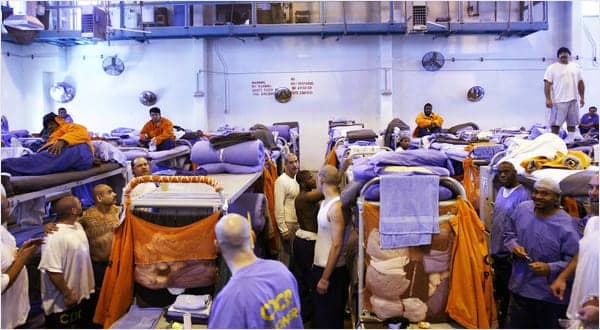
The California State Prison at Lancaster outside Los Angeles is at double capacity, with 150 triple-bunked here in the gym. Michelle Alexander says, “There are more African Americans under correctional control today – in prison or jail, on probation or parole – than were enslaved in 1850, a decade before the Civil War began” and that more Black men were disenfranchised in 2004 than “in 1870, when the 15th Amendment was ratified, prohibiting laws that explicitly deny the right to vote on the basis of race.” – Photo: by Ann Johansson, New York Times


California is, as the time-worn adage has it, our nation’s bellwether, and nowhere is that truer than in the Golden State’s prison crisis. California’s inmate population is among the highest in the nation. Its complex of prisons spills over with tens of thousands of inmates housed in every available inch of space and sleep-stacked three-high [3]. So overcrowded are California’s prisons that the state penal system has been successfully sued for violating the constitutional rights of inmates – essentially by subjecting them to a public health crisis. That its inmates consistently resort [4] to violence in prison should come as no surprise.

The dire state of California’s prisons can, in part, be traced to its draconian “three-strikes law [5],” which throws three-time felons behind bars for a mandatory 25 years. Overflowing prison populations have, in turn, contributed to that state’s bleak economic future, helping consign California to a perpetual budget deficit, annual financial crises, and repeated deep cuts in education and social funding. The state currently spends [6] a staggering 10 percent of its annual operating budget, or $10.8 billion, on its prison system and its nearly 170,000 prisoners – more than it spends on the University of California system, once the jewel in the crown of American public higher education.

And which Americans have borne the brunt of California’s prison boom? Mostly minorities, African Americans especially. In 2005, the state was incarcerating [7], on average, 5,125 for every 100,000 male adult Blacks in the population – nearly four and a half times more than for Latino men and six and a half times more than for white men. California’s prisons are also notorious for separating their prisoners by skin color, a form of segregation that was, one lawyer remarked [8], “not tolerated in any other aspect of American life and hasn’t been for 50 years. It’s the shame of California.”

As Michelle Alexander, legal expert and author of a startling just-published book, “The New Jim Crow: Mass Incarceration in the Age of Colorblindness [9],” points out in her first TomDispatch post, California’s racially infused prison quagmire is only a snapshot of a growing racial divide, one which includes the formation of a new undercaste in America that loses its normal rights at the prison gates and often never recovers them. To check out the latest TomCast, Timothy MacBain’s striking audio interview with Alexander in which she explains how she came to realize that this country was bringing Jim Crow into the Age of Obama, click here [10].

by Michelle Alexander

Ever since Barack Obama lifted his right hand and took his oath of office, pledging to serve the United States as its 44th president, ordinary people and their leaders around the globe have been celebrating our nation’s “triumph over race.” Obama’s election has been touted as the final nail in the coffin of Jim Crow, the bookend placed on the history of racial caste in America.

Obama’s mere presence in the Oval Office is offered as proof that “the land of the free” has finally made good on its promise of equality. There’s an implicit yet undeniable message embedded in his appearance on the world stage: This is what freedom looks like; this is what democracy can do for you. If you are poor, marginalized or relegated to an inferior caste, there is hope for you. Trust us. Trust our rules, laws, customs and wars. You, too, can get to the promised land.

Perhaps greater lies have been told in the past century, but they can be counted on one hand. Racial caste is alive and well in America.

[11]
Cover designed by Jamaal Bell

Most people don’t like it when I say this. It makes them angry. In the “era of colorblindness” there’s a nearly fanatical desire to cling to the myth that we as a nation have “moved beyond” race. Here are a few facts that run counter to that triumphant racial narrative:

*There are more African Americans under correctional control today – in prison or jail, on probation or parole – than were enslaved in 1850, a decade before the Civil War began.

*As of 2004, more African American men were disenfranchised (due to felon disenfranchisement laws) than in 1870, the year the Fifteenth Amendment was ratified, prohibiting laws that explicitly deny the right to vote on the basis of race.

* A Black child born today is less likely to be raised by both parents than a Black child born during slavery. The recent disintegration of the African American family is due in large part to the mass imprisonment of Black fathers.

*If you take into account prisoners, a large majority of African American men in some urban areas have been labeled felons for life. (In the Chicago area, the figure is nearly 80 percent.) These men are part of a growing undercaste – not class, caste – permanently relegated, by law, to a second-class status. They can be denied the right to vote, automatically excluded from juries, and legally discriminated against in employment, housing, access to education and public benefits, much as their grandparents and great-grandparents were during the Jim Crow era.

Excuses for the lockdown

There is, of course, a colorblind explanation for all this: crime rates. Our prison population has exploded from about 300,000 to more than 2 million in a few short decades, it is said, because of rampant crime. We’re told that the reason so many Black and Brown men find themselves behind bars and ushered into a permanent, second-class status is because they happen to be the bad guys.

The uncomfortable truth, however, is that crime rates do not explain the sudden and dramatic mass incarceration of African Americans during the past 30 years. Crime rates have fluctuated over the last few decades – they are currently at historical lows – but imprisonment rates have consistently soared. Quintupled, in fact. And the vast majority of that increase is due to the War on Drugs. Drug offenses alone account for about two-thirds of the increase in the federal inmate population and more than half of the increase in the state prison population.

The drug war has been brutal – complete with SWAT teams, tanks, bazookas, grenade launchers, and sweeps of entire neighborhoods – but those who live in white communities have little clue to the devastation wrought. This war has been waged almost exclusively in poor communities of color, even though studies consistently show that people of all colors use and sell illegal drugs at remarkably similar rates. In fact, some studies indicate that white youth are significantly more likely to engage in illegal drug dealing than Black youth. Any notion that drug use among African Americans is more severe or dangerous is belied by the data. White youth, for example, have about three times the number of drug-related visits to the emergency room as their African American counterparts.

That is not what you would guess, though, when entering our nation’s prisons and jails, overflowing as they are with Black and Brown drug offenders. In some states, African Americans comprise 80 percent to 90 percent of all drug offenders sent to prison.

This is the point at which I am typically interrupted and reminded that Black men have higher rates of violent crime. That’s why the drug war is waged in poor communities of color and not middle-class suburbs. Drug warriors are trying to get rid of those drug kingpins and violent offenders who make ghetto communities a living hell. It has nothing to do with race; it’s all about violent crime.

Again, not so. President Ronald Reagan officially declared the current drug war in 1982, when drug crime was declining, not rising. From the outset, the war had little to do with drug crime and nearly everything to do with racial politics. The drug war was part of a grand and highly successful Republican Party strategy of using racially coded political appeals on issues of crime and welfare to attract poor and working class white voters who were resentful of, and threatened by, desegregation, busing and affirmative action. In the words of H.R. Haldeman, President Richard Nixon’s White House chief of staff: “[T]he whole problem is really the Blacks. The key is to devise a system that recognizes this while not appearing to.”

A few years after the drug war was announced, crack cocaine hit the streets of inner-city communities. The Reagan administration seized on this development with glee, hiring staff who were to be responsible for publicizing inner-city crack babies, crack mothers, crack whores and drug-related violence. The goal was to make inner-city crack abuse and violence a media sensation, bolstering public support for the drug war which, it was hoped, would lead Congress to devote millions of dollars in additional funding to it.

The plan worked like a charm. For more than a decade, Black drug dealers and users would be regulars in newspaper stories and would saturate the evening TV news. Congress and state legislatures nationwide would devote billions of dollars to the drug war and pass harsh mandatory minimum sentences for drug crimes – sentences longer than murderers receive in many countries.

Democrats began competing with Republicans to prove that they could be even tougher on the dark-skinned pariahs. In President Bill Clinton’s boastful words, “I can be nicked a lot, but no one can say I’m soft on crime.” The facts bear him out. Clinton’s “tough on crime” policies resulted in the largest increase in federal and state prison inmates of any president in American history. But Clinton was not satisfied with exploding prison populations. He and the “New Democrats” championed legislation banning drug felons from public housing (no matter how minor the offense) and denying them basic public benefits, including food stamps, for life. Discrimination in virtually every aspect of political, economic and social life is now perfectly legal, if you’ve been labeled a felon.

Facing facts

But what about all those violent criminals and drug kingpins? Isn’t the drug war waged in ghetto communities because that’s where the violent offenders can be found? The answer is yes … in made-for-TV movies. In real life, the answer is no.

The drug war has never been focused on rooting out drug kingpins or violent offenders. Federal funding flows to those agencies that increase dramatically the volume of drug arrests, not the agencies most successful in bringing down the bosses. What gets rewarded in this war is sheer numbers of drug arrests. To make matters worse, federal drug forfeiture laws allow state and local law enforcement agencies to keep for their own use 80 percent of the cash, cars and homes seized from drug suspects, thus granting law enforcement a direct monetary interest in the profitability of the drug market.

The results have been predictable: People of color rounded up en masse for relatively minor, non-violent drug offenses. In 2005, four out of five drug arrests were for possession, only one out of five for sales. Most people in state prison have no history of violence or even of significant selling activity. In fact, during the 1990s – the period of the most dramatic expansion of the drug war – nearly 80 percent of the increase in drug arrests was for marijuana possession, a drug generally considered less harmful than alcohol or tobacco and at least as prevalent in middle-class white communities as in the inner city.

Federal drug forfeiture laws allow state and local law enforcement agencies to keep for their own use 80 percent of the cash, cars and homes seized from drug suspects, thus granting law enforcement a direct monetary interest in the profitability of the drug market.

In this way, a new racial undercaste has been created in an astonishingly short period of time – a new Jim Crow system. Millions of people of color are now saddled with criminal records and legally denied the very rights that their parents and grandparents fought for and, in some cases, died for.

Affirmative action, though, has put a happy face on this racial reality. Seeing Black people graduate from Harvard and Yale and become CEOs or corporate lawyers – not to mention president of the United States – causes us all to marvel at what a long way we’ve come.

Recent data shows, though, that much of Black progress is a myth. In many respects, African Americans are doing no better than they were when Martin Luther King Jr. was assassinated and uprisings swept inner cities across America. Nearly a quarter of African Americans live below the poverty line today, approximately the same percentage as in 1968. The Black child poverty rate is actually higher now than it was then. Unemployment rates in Black communities rival those in Third World countries. And that’s with affirmative action!
[12]
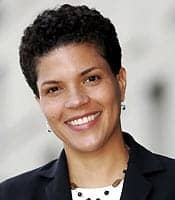
Michelle Alexander
When we pull back the curtain and take a look at what our “colorblind” society creates without affirmative action, we see a familiar social, political and economic structure – the structure of racial caste. The entrance into this new caste system can be found at the prison gate.

This is not Martin Luther King Jr.’s dream. This is not the promised land. The cyclical rebirth of caste in America is a recurring racial nightmare.

Michelle Alexander is the author of “The New Jim Crow: Mass Incarceration in the Age of Colorblindness [9]” (The New Press, 2010). The former director of the Racial Justice Project of the ACLU in Northern California, she also served as a law clerk to Justice Harry Blackmun on the U.S. Supreme Court. Currently, she holds a joint appointment with the Kirwan Institute for the Study of Race and Ethnicity and the Moritz College of Law at Ohio State University. To listen to a TomCast audio interview in which Alexander explains how she came to realize that this country was bringing Jim Crow into the Age of Obama, click here [10]. © Copyright 2010 Michelle Alexander. This story first appeared on TomDispatch [13] and, without the introduction, on the Huffington Post [14]. Andy Kroll, who wrote the introduction, is a writer based in San Francisco, an associate editor at TomDispatch and a staffer at Mother Jones magazine.

---------------------------

Article printed from San Francisco Bay View: http://www.sfbayview.com

URL to article: http://www.sfbayview.com/2010/the-new-jim-crow-how-the-war-on-drugs-gave-birth-to-a-permanent-american-undercaste/

URLs in this post:

[1] [Translate]: http://www.sfbayview.comjavascript:show_translate_popup(

[2] Image: http://www.sfbayview.com/wp-content/uploads/2010/03/Prison-overcrowding-Lancaster-4600-double-capacity-150-in-gym-0310-by-Ann-Johansson-NYT.jpg

[3] sleep-stacked three-high: http://articles.sfgate.com/2007-05-21/news/17245259_1_california-s-prison-budget-higher-education-incarcerating-inmates

[4] consistently resort: http://www.nytimes.com/2009/08/10/us/10prison.html

[5] three-strikes law: http://www.nytimes.com/2009/02/11/us/11prisons.html

[6] spends: http://cbs2.com/politics/California.prisons.spending.2.1140595.html

[7] incarcerating: http://www.ppic.org/content/pubs/jtf/JTF_PrisonsJTF.pdf

[8] remarked: http://www.pbs.org/newshour/bb/race_relations/jan-june06/prisons_3-15.html

[9] The New Jim Crow: Mass Incarceration in the Age of Colorblindness: http://www.amazon.com/New-Jim-Crow-Incarceration-Colorblindness/dp/1595581030

[10] here: http://tomdispatch.blogspot.com/2010/03/new-jim-crow.html

[11] Image: http://www.sfbayview.com/wp-content/uploads/2010/03/The-New-Jim-Crow-cover-designed-by-Jamaal-Bell.jpg

[12] Image: http://www.sfbayview.com/wp-content/uploads/2010/03/Michelle-Alexander.jpg

[13] TomDispatch: http://www.tomdispatch.com/blog/175215/tomgram:_michelle_alexander,_the_age_of_obama_as_a_racial_nightmare/

[14] Huffington Post: http://www.huffingtonpost.com/michelle-alexander/the-new-jim-crow-how-the_b_490386.html

[15] here: http://www.democracynow.org/2010/3/11/legal_scholar_michelle_alexander_on_the

[16] here: http://www.democracynow.org/blog/2010/3/11/part_ii_michelle_alexander_on_the_new_jim_crow_mass_incarceration_in_the_age_of_colorblindness

[17] Image: http://www.addtoany.com/share_save?linkurl=http%3A%2F%2Fwww.sfbayview.com%2F2010%2Fthe-new-jim-crow-how-the-war-on-drugs-gave-birth-to-a-permanent-american-undercaste%2F&linkname=The%20new%20Jim%20Crow%3A%20How%20the%20war%20on%20drugs%20gave%20birth%20to%20a%20permanent%20American%20undercaste

[18] America’s war in Central Africa: http://www.sfbayview.com/2009/america%e2%80%99s-war-in-central-africa/

[19] Black flight: http://www.sfbayview.com/2010/black-flight/

[20] The Census form: Send it back!: http://www.sfbayview.com/2010/the-census-form-send-it-back/

[21] Time for a U.S. revolution: 15 reasons: http://www.sfbayview.com/2010/time-for-a-u-s-revolution-15-reasons/

[22] Rwandan opposition parties condemn grenade attacks in Kigali: http://www.sfbayview.com/2010/rwandan-opposition-parties-condemn-grenade-attacks-in-kigali/


Monday, August 3, 2009

The Crime Wave that Wasn't

Oops! Former Guv Napolitano Wrongly Hyped "Impending Crime Wave" in 08


By Sarah Fenske

Phoenix New Times

Monday, Aug. 3 2009 @ 12:43PM

Janet, Janet, Janet ...

We found ourselves sadly shaking our head while reading the New York Times yesterday, wondering (yet again) how our former governor could have gotten things so wrong.

Governor Janet Napolitano, need we remind you, repeatedly insisted the state was not in a budget crisis -- suggesting as late as 2008 that we ought be giving free college tuition to any Arizona student who could muster a "B" average, even though in just a few short months things are bad enough to discuss selling the freakin' Capitol building. She also famously buried her head in the sand on Joe Arpaio, letting the sheriff get away with murder before realizing she'd helped to create a monster.

Now this.

Tucked near the end of a fascinating Times piece about the nation's plunging murder rate, we were reminded that Napolitano was part of a team of Dem governors who predicted that just the opposite was bound to happen, only a year and a half ago.

Napolitano, along with Governor Kathleen Sebelius of Kansas, Martin O'Malley of Maryland, and Phil Breseden of Tennessee, held a press conference in D.C. in February 2008 to detail an upcoming problem so great, it surely required suspending all sorts of civil liberties: A massive crime wave! Headed right toward your suburban neighborhood!

According to a press release from Third Way, the progressive group hosting the press conference, four new and "menacing" trends were converging all at once. We're talking about "a massive group of prisoners poised to reenter" your community! And "the lengthening shadow of illegal immigration!" And "the sprawling parentless neighborhood of the Internet"! And, finally, "the surging youth population"!

The exclamation points are ours. The overheated rhetoric, sadly, isn't.

Of course, as reporter Shaila Dewan points out in yesterday's Times' analysis, just the opposite is now happening all over the country. Crime rates, in fact, are plummeting.

As DeWan notes, regarding the governors' press conference:

Such appeals to Americans' fears, several criminologists said, is often linked to a political agenda fueled less by crime than by another variable that is famously unfazed by real-world predictors: public perception. Along with its report, The Third Way released a poll showing that by a 5-to-1 ratio, Americans believed crime was worse than it had been the year before. By year's end, though, the national crime data showed a decrease.

Indeed, the press release from Third Way shows that then-Governor Sebelius was using the supposed crime wave to call for "signficant federal support" for a "crime-fighting agenda." So now that it turns out the feds didn't increase their support for crime prevention, and the murder rate is way down, will we see Napolitano suggesting that we need fewer resources over at the Department of Homeland Security?

Right.