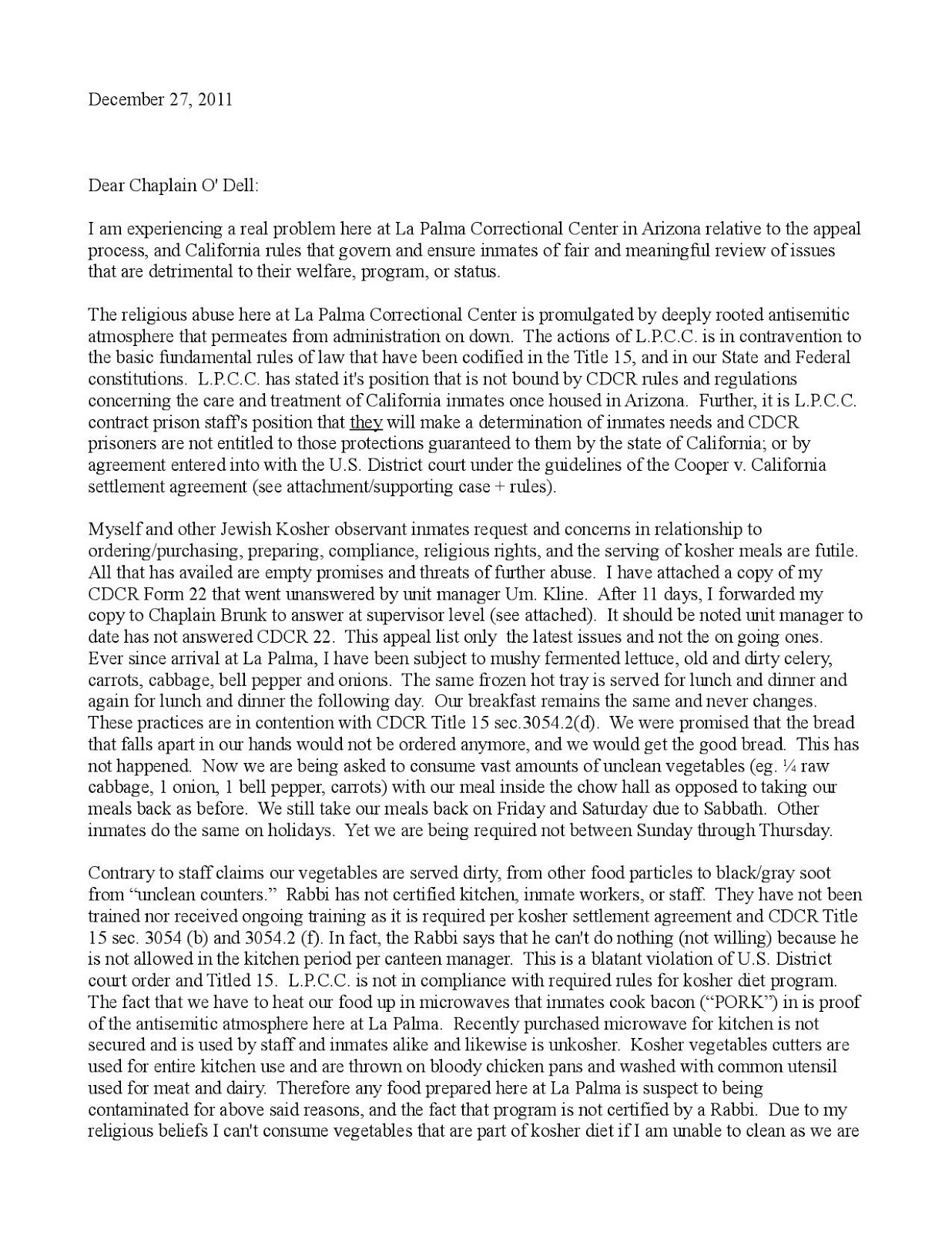
I've had some questions from AZ state prisoners and family members lately about religious rights and special diets in prison. Below is one good overview I found on pertinent law.
Also send them this intake form from the Arizona ACLU.
They may not be able to help individual prisoners, but it helps them to
document what's going on in the prisons in case they find there are
patterns of abuse.
This is the paperwork needed to file a Section 1983 Civil Rights complaint
in US District Court (AZ). Tell Prisoners: DO NOT TAKE THIS STEP
LIGHTLY. There are consequences if you do it without sufficient evidence
or following procedure.
Finally, here are the relevant AZ Department of Corrections policies to know:
Unfortunately, even if they face retaliation, prisoners
who want religious freedom will have to take this fight on from inside -
we can't file grievances or civil rights complaints for them out
here...
Whether it be religious diet, grooming, worship services, religious
jewelry or even access to a chaplain before execution, inmates
frequently challenge prison officials over what they allege are
violations of their freedom of religion.
Two Muslim inmates sued California prison officials, saying they were
forced to eat food forbidden by their religion. Christian inmates sued,
claiming that Mississippi prison officials violated their First
Amendment rights by refusing to allow inmate-led services and by
prohibiting inmates from preaching. A Jewish inmate in Ohio sued prison
officials after they cut his beard, which he says was necessary for his
faith. Kentucky prison officials recently prohibited inmates from
attending satanic services.
The Safley-O'Lone reasonableness standard
Often,
inmates will sue under the First Amendment free-exercise clause. This
clause generally prohibits the government from infringing on
individuals’ rights to practice their religion freely. But prisoners do
not have the same level of rights as normal citizens. Incarceration
drastically changes the constitutional equation.
Prison officials are normally granted a good deal of discretion,
particularly when they can show that their policies are necessary to
further a legitimate safety concern. When a prison regulation clashes
with an inmate’s religious freedom, the courts must strike a balance
between the two.
The U.S. Supreme Court established the current standard for inmate First Amendment cases under a pair of 1987 decisions, Turner v. Safley and O’Lone v. Estate of Shabazz. In Safley,
the Court examined restrictions on inmate correspondence and inmates’
right to marry. The Court established the following standard: “When a
prison regulation impinges on inmates’ constitutional rights, the
regulation is valid if it is reasonably related to legitimate
penological interests.”
The Court identified several factors relevant to determining the reasonableness of the prison officials’ actions:
- Whether there is a “valid, rational connection” between the prison
regulation and the legitimate government interest put forward to justify
it. The Court noted that the “governmental objective must be a
legitimate and neutral one.” It added: “Prison regulations restricting
inmates’ First Amendment rights [must be] operated in a neutral fashion,
without regard to the content of the expression.”
- Whether there are alternative means of exercising the right that remain open to prison inmates.
- Whether accommodating prisoners’ constitutional rights will
infringe on the rights of guards or other inmates and on the allocation
of prison resources generally.
- Whether there are alternative methods of accommodating
prisoners’ rights at minimal cost to valid penological interests. The
existence of easy alternatives can show that the regulation was an
“exaggerated response” to prison concerns.
The Safley standard has been used in most lower courts
examining prisoner First Amendment claims. One week after the U.S.
Supreme Court decided Safley, the high court applied the Safley standard to a free-exercise of religion claim in O’Lone v. Estate of Shabazz.
In O’Lone, a group of Muslim inmates challenged New Jersey
state prison policies that prohibited them from attending Jum’ah, a
weekly Muslim religious ceremony. Prison officials determined that
allowing inmates to leave outside work details to go inside the prison
for the religious service would imperil safety and institutional order.
They testified that inmates returning from outside work details created
too much congestion and delays at the main gate, which is a high-risk
area.
Applying the Safley standard, the high court majority ruled
that “while we in no way minimize the central importance of Jum’ah to
respondents, we are unwilling to hold that prison officials are required
by the Constitution to sacrifice legitimate penological objectives to
that end.”
The Supreme Court noted that the inmates could still “participate in
other Muslim religious ceremonies.” The Court wrote: “We think this
ability on the part of respondents to participate in other religious
observances of their faith supports the conclusion that the restrictions
at issue here were reasonable.”
Some prison-rights advocates say the Safley-O’Lone standard
excessively favors prison concerns. “It simply gives too much deference
to prison officials,” says Keith Defasio, director of Advocare, a
Virginia-based group that works for prisoners' rights. “There is a lot
of abuse of inmates’ freedom-of-religion rights.”
David Fahti, staff counsel for the American Civil Liberties Union National Prison Project, agrees that the Safley-O'Lone
standard is too deferential. “Oftentimes, in the lower courts prison
officials do not provide any evidence that their regulation serves a
legitimate prison interest but simply come up with a post-hoc,
speculative reason to justify the restrictive policy," he said.
"Prison
officials often dream up plausible — and sometimes not very plausible —
reasons for their actions.”
But the American Correctional Association contends that the Safley-O’Lone
standard is the proper one. Its Web site reads: “The legal standard for
establishing the validity of institutional rules on religious faith and
practice should be the reasonableness standard provided in Turner v.
Safley and O’Lone v. Shabazz.”
Marci Hamilton, a law professor who is challenging the
constitutionality of the Religious Land Use and Institutionalized
Persons Act, says that the Safley-O’Lone standard is sufficient to protect inmates’ First Amendment rights.
“It is very hard for prison officials to keep order in prisons,” says
Hamilton, a professor at Yeshiva University's Benjamin N. Cardozo
School of Law. “Inmates frequently rely upon religious defenses to any
type of prison regulation.”
Statutes that provide even greater protection
Congress has
passed two statutes that increase the protection of inmates’ First
Amendment rights. These are the Religious Freedom Restoration Act of
1993 — RFRA — and the Religious Land Use and Institutionalized Persons
Act of 2000 — RLUIPA.
Both statutes provide that government officials cannot impose a
substantial burden on inmates’ religious rights unless they show their
regulation serves a compelling government interest in the
least-restrictive way. The U.S. Supreme Court struck down RFRA as it
applied to the states in its 1997 decision City of Boerne v. Flores.
The Court determined that Congress did not have the authority to pass
RFRA based on its enforcement powers under the 14th Amendment. According
to the Court, Congress overstepped its authority in imposing such a law
upon the states.
Many states, meanwhile, also passed their own RFRA laws, and those
remain in effect. And while the Court said RFRA could not be applied to
the states, the law passed by Congress still applies to the federal
government, including federal prisons.
The Supreme Court's limiting of RFRA led Congress to pass another
federal law, called RLUIPA. Unlike RFRA, Congress justified RLUIPA on
both the spending and commerce clauses of the Constitution.
Many prison-rights and religious-freedom advocates applaud these
laws. For example, Charles Haynes, senior scholar at the First Amendment
Center, writes of RLUIPA: “It reaffirms and strengthens our national
commitment to do all that we can to protect the right of every citizen
to 'follow the dictates of conscience' in matters of faith.”
Fahti says that these laws are good because they make sure that
“prison officials give some thought before passing rules and policies
that burden inmates’ freedom of religion rights.”
Still, some believe that Congress went too far in passing both RFRA and RLUIPA. Professor Hamilton argues that the Safley-O'Lone
standard was sufficient. She also believes that Congress exceeded its
authority in passing RLUIPA as well as RFRA. She questions the viability
of the legislation under the commerce clause. “The key problem is that
the federal government is not regulating something that is part of the
economy,” she says. “The Supreme Court has said that government
regulation in and of itself is not economic for purposes of the Commerce
Clause.”
Others, like Fahti, believe that RLUIPA is constitutional. “It is much less vulnerable to challenge than RFRA,” he says.
Several appellate courts have considered the constitutionality of
RLUIPA. Most of these courts have upheld the statute. For example, a
three-judge panel of the 9th U.S. Circuit Court of Appeals ruled in Mayweathers v. Newland in 2002 that “RLIUPA merely accommodates and protects the free exercise of religion, which the Constitution allows.”
Similarly, three-judge panels in the 4th and 7th Circuits have joined
the 9th Circuit in upholding the constitutionality of RLUIPA. In Madison v. Ritter,
the 4th Circuit ruled that “RLUIPA has the effect of lifting burdens on
prisoners’ religious exercise, but does not impermissibly advance
religion.”
In Charles v. Verhagen, the 7th Circuit upheld RFRA from
constitutional challenges based on the establishment clause and the 10th
Amendment. The court also ruled that RLUIPA was a valid exercise of
Congress’ powers under the spending clause of the Constitution.
However, a three-judge panel of the the 6th Circuit ruled in Cutter v. Wilkinson that RLUIPA violated the establishment clause because it had “the primary effect of advancing religion.”
“One effect of RLUIPA is to induce prisoners to adopt or feign
religious belief in order to receive the statute’s benefits,” the panel
added.
The split in the federal appeals courts led the U.S. Supreme Court to take the Cutter case and address RLUIPA. In Cutter v. Wilkinson
(2005), the Supreme Court ruled that the part of RLUIPA dealing with
inmates “qualifies as a permissible legislative accommodation of
religion that is not barred by the Establishment Clause.”
Currently federal prisoners can sue under RFRA and RLUIPA, while state inmates can sue under RLUIPA and state RFRA laws.
An effect of this development is that prison officials have to be
more sensitive to inmate religious requests, or accommodate more
requests than they would under the general Safley-O'Lone standard.
Another complaint lodged against RLUIPA is that it will lead to more
and more spurious claims filed by inmates seeking favors based on
religious beliefs. However, both RFRA and RLUIPA require, as a threshold
matter, that the inmate’s request for accommodation be based on
legitimate religious belief. Legal commentator Heather Davis explains
that “this threshold inquiry is necessary to dispose of bogus claims
undeserving of First Amendment protections.”
For example, some inmates who espouse white supremacy have claimed
that, for religious reasons, they can share a cell only with a member of
their own race. A federal appeals court rejected the claims of an Iowa
inmate who claimed that his religious beliefs prohibited him from
sharing a cell with an African-American inmate. The inmate sued under
the First Amendment free-exercise clause and RFRA. The court rejected
both claims in Ochs v. Thalacker, writing that prison officials
had a compelling interest in not segregating inmates on a racial basis
because they believe that random cell assignments are the best way to
reduce gang activity and lessen racial tensions.
Should society care about inmates’ religious rights?
Whatever
legal standard is used to resolve inmate freedom-of-religion lawsuits,
some in society ask: “Who cares?” Many people believe that inmates
forfeited their rights when they committed their crimes.
But others believe society should try to encourage inmates to
practice their religious faith. “Let’s face it. Most inmates do get out
of prison at some point,” Fahti says. “And the single best predictor of
whether an inmate will do OK when they reenter society is whether they
maintain community ties when they are in prison.
“There are many reasons why we should recognize the religious rights
of inmates,” Fahti says.
“Our country was founded on principles of
religious freedom. Many people came to this country to flee religious
persecution in other countries. As long as a prisoner’s practice of
religion does not interfere with prison security, there is simply no
reason to deny an inmate’s religious rights.”
Added Advocare's Defasio, “Even though inmates are incarcerated for
crimes, they should still be entitled to their constitutional dignities.
Where are we as a democracy if we can give and take away constitutional
rights?”
Updated October 2008
Inmates contend Maine officials denied them the right to build sweat
lodge, seized religious items and temporarily confiscated ceremonial
bowl. 05.16.03
Three-judge panel finds that providing vegetarian meals instead is a
reasonable accommodation of prisoners' religious beliefs. 09.12.03
Law professor says Supreme Court may end up resolving split in appellate courts over constitutionality of RLUIPA. 11.10.03
ACLU of Southern California files federal lawsuit on behalf of Billy
Soza Warsoldier, who claims his religious beliefs would be violated if
he cut his hair. 04.03.04
California officials fail to persuade judges that mail containing Web
material might contain coded messages, which could pose safety issue.
04.21.04
Attorneys for state argue that serving Jewish fare would cost millions,
might violate establishment clause, could cause riots. 07.13.04
California prisons' hair policy forced inmate 'to choose between
following his religious beliefs and suffering continual punishment,'
court holds. 08.02.05
Alito sits out Beard v. Banks because he took part in 3rd Circuit case concerning denial of publications to help control unruly inmates. 03.27.06
Massachusetts high court says state constitution goes further than U.S.
Constitution to protect religious freedom of prisoners. 04.11.06
State justices find penitentiary rules on exchanging publications, displaying symbols are reasonable. 04.20.06
Calling decision 'somewhat of a close call,' federal judge says that
compelling state interest in safety trumps inmates' religious-freedom
rights. 06.08.06
Prisoner claimed wrongful punishment interfered with his free practice
of religion; Court says he missed grievance deadline. 06.23.06
Justices vote 6-2 in Beard v. Banks that state policy doesn't violate free speech of troublesome inmates.
Quick look at ruling 06.28.06
Muslim inmate ordered to handle pork can sue staff
3rd Circuit: Defendants had 'fair warning' from other courts that they
should 'respect, and accommodate when practicable' prisoner's religious
concerns. 07.26.06
Supermax inmate defeats prison rules on reading material
Mark Jordan brought suit after officials refused to deliver printout of
'Justice Denied' essays; court agrees restriction is too broad. 10.31.06
4th Circuit upholds RLUIPA in siding with Va. inmate
State had challenged federal law after Ira Madison complained in 2001
lawsuit that prison officials were violating the act by denying kosher
meals. 01.02.07
1st Circuit: R.I. inmate can sue over preaching ban
Unanimous three-judge panel rejects correction officials' argument that man's sermons presented security threat.
04.09.07
N.H. prison ordered to restore inmate's kosher diet
Federal magistrate sides with Orthodox Jewish prisoner, who argued
officials violated First Amendment by revoking religious diet after
catching him with non-kosher food. 05.06.07
Va. inmate can challenge denial of Thor's Hammer
By David L. Hudson Jr. Federal magistrate says Virginia prison
officials may have violated Forest Fisher's rights under First
Amendment, religious-freedom law. 06.05.07
R.I. inmate wins right to resume jailhouse preaching
Settling three-year legal battle, correction officials adopt policy
allowing Wesley Spratt to preach at religious services under chaplain's
supervision. 08.02.07
Vt. prisons to pay $25,000 to settle suit by Jewish inmate
Former prisoner said he was blocked from receiving kosher food from
charitable group, restricted in his use of a menorah for Hanukkah.
04.04.08
9th Circuit revives inmate's RLUIPA suit
By Josh Tatum Unanimous three-judge panel reinstates Darin
Greene's claim that California prison violated his rights by barring
group worship by maximum-security prisoners. 04.16.08
8th Circuit backs Ark. inmate's religious-freedom claim
Court finds judge erred in dismissing discrimination complaint by
prisoner punished for refusing to work on Sabbath. 10.03.08
N.J. inmate challenges ban on prison preaching
'The right to practice one's faith, or no faith at all, is fundamental
and applies inside and outside the prison gates,' says ACLU official.
12.07.08
9th Circuit revives Nev. inmate's lawsuit over kosher diet
Jewish convert says prison officials violated his rights by refusing to
serve kosher meals on grounds he couldn't show 'hereditary connection'
to or 'substantial philosophical understanding' of religion. 12.11.08
Prisoner's religious objection won't stop DNA sampling
D.C. Circuit: 'Government's extraction, analysis and storage of
(Russell) Kaemmerling's DNA information does not call for Kaemmerling to
modify his religious behavior in any way.' 12.31.08
Calif. inmate can pursue retaliation claim
By David L. Hudson Jr. Federal judge says prisoner's free speech can be chilled by withholding of food. 02.17.09
4th Circuit sides with prison officials in dispute over 'insolent' letter
By David L. Hudson Jr. Panel notes that inmates receive reduced
level of speech protection, deference to prison officials is paramount
consideration. 03.11.09
R.I. prisoner accuses guards of punishing him for speaking out
Lawsuit filed by ACLU claims officials retaliated against Jason Cook for
complaining publicly about prison reading-materials policy. 04.10.09
N.H. prison inmate loses challenge over kosher diet
Albert Kuperman's lawyers had argued that prison policy violated client's First Amendment right to practice religion. 11.27.09
N.J. prison officials agree to let inmate preach
Agreement, which settles lawsuit brought by ACLU, will allow convicted
murderer to deliver sermons and morning messages under supervision of
chaplain or approved volunteer. 12.01.09
Wis. inmate can't play Dungeons & Dragons behind bars
7th Circuit panel rejects Kevin T. Singer's claims that prison ban on
role-playing game, materials violated his free-speech, due-process
rights. 01.26.10
Ill. inmate can pursue religious-liberty lawsuit over pat-down
By David L. Hudson Jr. However, federal judge rejects Yaphet K. Jamal's sexual-harassment claim. 02.02.10
Prisoners' side struggles in reading-material case
By Tony Mauro Pennsylvania disciplinary policy that includes
withholding publications from unruly inmates seems undamaged in
arguments before Supreme Court justices. 03.28.06
'Lord Versatile' harnesses power of RLUIPA
By David L. Hudson Jr. Judge says Virginia inmate can use federal law to challenge prison's refusal to recognize his group as religion. 01.07.10
Religious liberty behind bars: How free should prisoners be?
By Charles C. Haynes Prisons can’t impose substantial burdens on
free-exercise rights of prisoners unless the regulation serves a
compelling state interest, such as prison safety. 07.25.04